Truth and Promise-Keeping
RamayanaTruth and Promise-Keeping is more than a personal virtue in the epic: it sustains moral life, supports a monarch’s authority, and is described as the foundation on which the world rests. Its force becomes concrete when Ráma refuses Bharat’s earnest appeal to return and rule. For Ráma, the question is not simply which choice would be most advantageous now, but whether a command and a solemn pledge can be set aside once their consequences have become painful.
Meaning and Scope
The rule connects truth in speech with fidelity in action. Truth is praised as the surest base of virtue and as a power surpassing other powers; neglecting it brings distress, while truth is blessed in the highest heaven. The principle therefore reaches beyond avoiding false statements. A person must also make conduct answer to what has been promised, even when keeping faith entails loss or hardship.
The rule has a public dimension as well. A monarch’s reign is upheld by truth, and the world itself is said to be sustained by it. Subjects take their princes as examples, so a ruler’s conduct can shape the conduct of those who look to him. The standard is consequently both inward and political: fidelity preserves the integrity of the individual, while truthful rule supplies a model on which collective life depends.
The Promise and Its Circumstances
Ráma invokes two connected obligations when Bharat urges him to accept the rule. He is bound by his father’s command, but he also recalls his own pledge to make the forest his home. That oath was made in Daśaratha’s presence, and Queen Kaikeyí heard it with joy. The remembered circumstances give the vow the weight of a public and relational commitment: it was not an unconsidered intention formed in isolation, but a declaration made before the people whose decisions shaped his exile.
The promise also governs the details of Ráma’s life in the forest. He resolves to remain there and sustain himself on prescribed food, including fruit and roots. His answer treats the vow not as a phrase that can be honored in name while its substance is abandoned, but as an undertaking that determines where he lives and how he lives. The discipline of the forest makes fidelity visible in daily practice.
The Dispute with Bharat
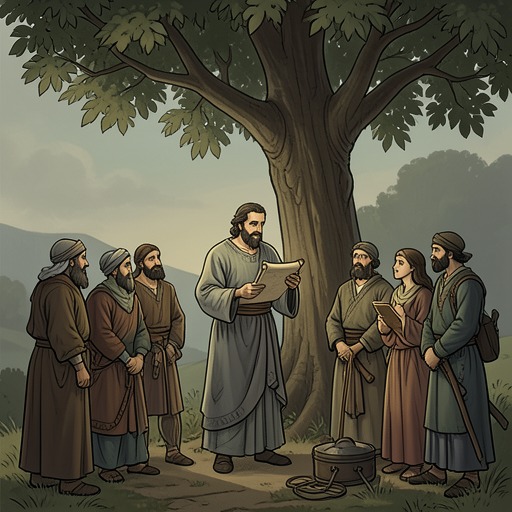
In the canto devoted to the praises of truth, Bharat’s appeal presses Ráma to take the rule that is rightfully his. The request presents a compelling alternative: Ráma could end his forest residence and assume the position Bharat urges him to claim. Yet Ráma rejects the proposed return because it would require him to disregard the command spoken by his father and break his own pledge.
His refusal is not represented as indifference to the suffering surrounding the decision. Elsewhere, the narrative registers Daśaratha’s anguish at Ráma’s fate, while Ráma is described as calm and unmoved by threatened woe. This contrast sharpens the cost of the rule: fidelity does not spare a family its grief, nor does grief itself cancel the obligation. The principle asks Ráma to bear the consequences rather than treat hardship as permission to withdraw his word.
Royal and Narrative Significance
The epic’s praise of truth makes Ráma’s decision exemplary without reducing it to a simple calculation of immediate benefit. Bharat’s appeal foregrounds the practical result of Ráma’s return; Ráma’s answer gives priority to the integrity of command and promise. In that choice, the ruler’s fitness is measured not only by possession of authority but by the truthfulness with which he accepts obligations, including those that frustrate his own interests.
The surrounding narrative also associates royal continuity with duty: a prophecy promises the monarch four sons who will uphold his royal line. Against that concern for the future of the kingdom, Ráma’s refusal places the keeping of one promise above an immediate restoration to rule. The episode thus makes truth both a personal discipline and a principle of political order. Its test is not whether a pledge sounds noble when made, but whether it continues to bind when keeping it divides a family, delays rule, and demands life in the forest.