Rapunzel’s Long Hair
RapunzelRapunzel’s Long Hair is the story’s changing instrument of access and separation. Its beauty makes it conspicuous, but its function is concrete: Rapunzel lowers it from a window in a tower without a door or stairs, allowing the Witch to climb in and, later, the Prince to reach her. The Witch’s cutting of the hair breaks that means of contact and accompanies Rapunzel’s exile; her use of the severed braids to deceive the Prince turns the same device into a trap. The ending shifts the story’s restorative force away from hair: Rapunzel’s tears clear the Prince’s blindness and reunite them.
Appearance and the Tower
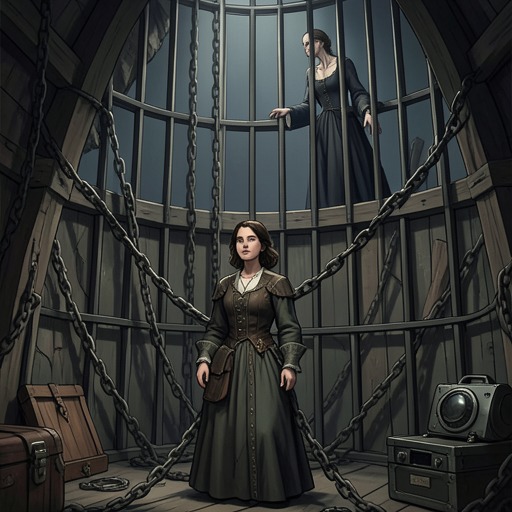
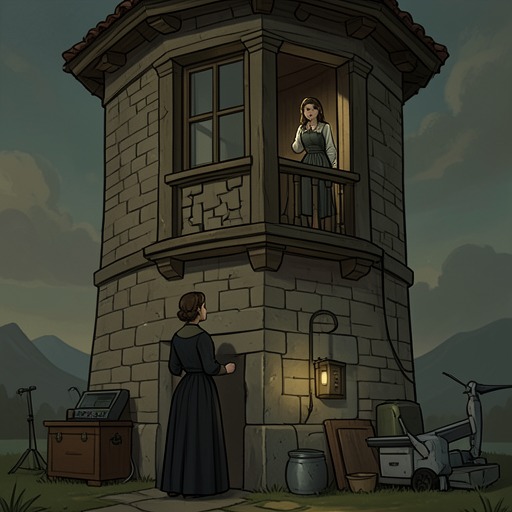
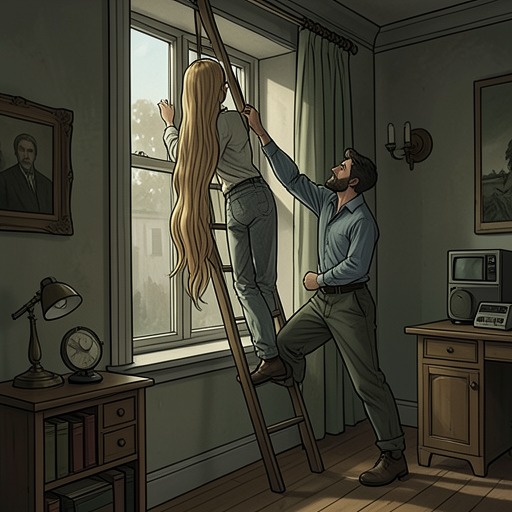
When Rapunzel is twelve, the Witch takes her into the forest and shuts her in a tower with no stairs and no door, only a tiny window high above the ground. Rapunzel’s hair is described as long, fine, and beautiful, like spun gold. The tale makes this striking feature into a working mechanism: when the Witch calls from the foot of the tower, Rapunzel uncoils her braids, ties them to the window latch, and lets them fall to the ground. The Witch climbs up by them.
The arrangement gives Rapunzel’s hair a double place in the tower’s design. It is the means by which the Witch enters, but it is also the only visible route from the enclosed room to the world below. Rapunzel does not control when the Witch visits, yet she physically supplies the ladder that makes each visit possible. The hair’s practical use therefore expresses the imbalance built into her confinement: the tower is inaccessible, and the Witch alone commands its established entrance.
The Prince’s Ascent and Escape Plan
Years later, the Prince hears Rapunzel singing as he rides through the forest. Her voice draws him repeatedly back to the tower, but he cannot find a door. Hidden behind a tree, he watches the Witch arrive and learns the call by which Rapunzel lowers her hair. The Prince then repeats it himself. Rapunzel’s braids fall, and he climbs through the window.
The hair has made a route that the tower’s architecture denies, but access does not immediately mean freedom. Rapunzel is frightened when a man appears at the window, having never seen one before. The Prince speaks gently, explains that her singing moved him, and asks her to marry him. She agrees and proposes a practical escape: he should bring a skein of silk on each visit so that she can weave a ladder, descend, and leave with him on his horse. The proposed ladder would replace dependence on her hair with a route the two of them could use to depart. Until it is finished, however, their meetings still rely on the braids that have already served the Witch.
Cutting, Exile, and Deception
The Prince visits every night, since the Witch is there during the day. Their secret comes to light when Rapunzel asks the Witch why it is harder to pull her up than it is to pull up the young Prince. The question reveals the visits, and the Witch understands that Rapunzel has not been isolated from the world as she intended.
In fury, the Witch wraps Rapunzel’s hair around her left hand and cuts the braids with scissors in her right. The gesture abruptly destroys the route that allowed the Prince to climb to the window and the pair to meet. The Witch takes Rapunzel to a desert, where she is forced to live miserably. Cutting the hair is thus not merely a change in Rapunzel’s appearance: it accompanies her removal from the tower and ends the couple’s established way of reaching one another.
On the same day, the Witch ties the severed braids to the window latch. When the Prince arrives and calls for Rapunzel to lower her hair, the Witch lets the cut locks fall. They still look and function, from below, like the familiar ladder. The Prince climbs, expecting to find Rapunzel, but encounters the Witch instead. She tells him that Rapunzel is gone and that he will never see her again. The hair’s return as a counterfeit entrance makes the deception possible: what had enabled the Prince’s access now carries him into the moment of loss.
Recognition and Restoration
After the Witch’s trick, the Prince leaps from the top of the tower. He survives, but a thorn bush scratches his eyes, leaving him blind. He wanders through the forest for many years, eating roots and berries and grieving for his wife. The story does not restore sight by returning the hair or reopening the tower route. Instead, the Prince eventually reaches the desert where Rapunzel is struggling to survive with their twins, a boy and a girl.
Hearing a familiar voice, the Prince follows it until Rapunzel recognizes him. She embraces him and weeps; two of her tears fall into his eyes, and he can see clearly again. Hair has served as ladder, invitation, and instrument of deception, but reunion and restored sight arrive through recognition and tears. Rapunzel and the Prince return to his kingdom, where they celebrate and live happily for many years. The contrast gives the hair motif its full arc: the physical means of entering the tower is lost, but the separation it helped produce does not have the final word.