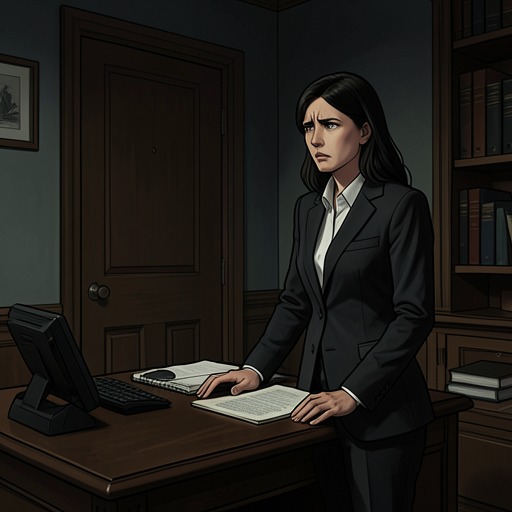
“I’ll always be close by. Watching. Waiting.”
Retribution“I’ll always be close by. Watching. Waiting.” is the threat that carries C.J. Townsend’s attacker beyond the night of her assault and into the years that follow. Spoken as reassurance, it makes continued surveillance sound inescapable; remembered later, it gives language to the fear that her attacker might still be near.
The threat in the hospital
The phrase first reaches the reader as C.J. Townsend lies in Jamaica Hospital after an assault. She has been told that her injuries required an emergency hysterectomy, and the memory of the attacker’s masked face returns alongside the knowledge that he knew personal details about her: her nickname, a favorite restaurant, and that she had missed the gym. His declaration that he would remain close, watching and waiting, converts those details into a threat that outlasts his immediate presence.
The words arrive amid the shock of learning what has happened to her. The reassurance is not comfort but menace: it suggests that the attacker’s attention has been directed at her before the assault and may continue afterward. The short, separated final words give the threat a lingering rhythm, making watchfulness feel less like a single act than a condition imposed on her.
Fear after immediate danger
For the first two days, a police guard remains outside C.J. Townsend’s hospital room. Then the guard is reassigned because she is no longer considered in imminent danger. Investigators continue to say they are pursuing leads, but their contact diminishes: a detective’s daily visits end, replaced by a daily phone call. The phrase’s promise of persistence therefore meets a changing institutional response. Although the police are still hunting the perpetrator, the protection and attention around C.J. begin to recede.
Her room fills with flowers, but she cannot bring herself to speak on the telephone or see most friends. She does not want visitors to see her bandages or ask about the assault, and she cannot return to the ordinary life she remembers. The words about watching and waiting acquire force in this isolation: the immediate attack is over, yet she cannot simply feel that the danger or its effects are over too.
A sentence carried through the years
Twelve years later, the phrase returns in C.J. Townsend’s recollection of the assault. Not knowing who her attacker was or where he might be had kept the possibility of his presence alive in ordinary places, from the subway and a diner to the bank or grocery store. She changed her name, took the Florida Bar, and moved to Miami; anonymity helped her sleep better, though it did not erase the fear. The old words persist as the verbal shape of that uncertainty.
When she recognizes the attacker’s face and has a name for him, the recollection becomes newly consequential. She considers whether to tell the State Attorney, contact the detectives who handled her old case, or inform the task force. In Miami, only her therapist knows about her past. The phrase now belongs not only to a memory but to a decision about whether and how to disclose that memory while prosecuting the case against William Rupert Bantling.
From private threat to public disclosure
C.J. Townsend’s review of old police and hospital records brings the earlier assault back with painful specificity. A former neighbor’s victim-blaming account renews guilt and shame she has struggled to overcome in therapy. The case materials do not simply identify past events; reading them forces her to face the attitudes and memories attached to them. Against that pressure, the remembered threat marks how the attacker’s control survives in her fear without establishing that he is physically near her.
The phrase’s private history eventually collides with the public courtroom. When Lourdes Rubio seeks C.J.’s removal from the prosecution, arguing that her judgment may be clouded, Bantling watches her as the challenge unfolds. Later, before the judge, C.J. discloses that she was raped years earlier as a law student in New York. Her statement makes the concealed history public, although she also tells the court that Bantling was not the man who attacked her. The phrase’s movement from bedside threat to recurring memory thus culminates in a struggle over who controls the story of her past: the attacker who once claimed continuing access, or C.J. as she chooses what to reveal.