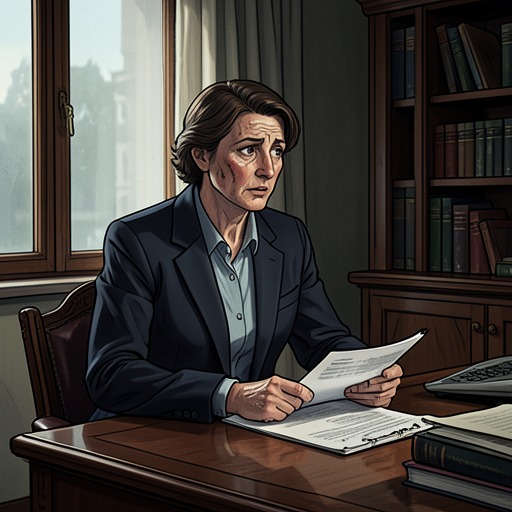
“Justice is blind… because she chooses not to look”
Retribution“Justice is blind… because she chooses not to look” is the closing admonition Lourdes Rubio gives C.J. Townsend after the Cupid murder trial. It revises the familiar ideal of justice as impartiality: blindness here is not an inability to distinguish facts, but a choice to avert one’s attention. The line gathers the novel’s conflicts over evidence, professional duty, and compromise into a pointed exchange between two lawyers who understand more than either says aloud.
The Phrase and Its Reversal
The expression turns on the difference between not seeing and choosing not to see. The first can suggest neutrality; the second implies knowledge and responsibility. Lourdes’s wording therefore makes blindness an action rather than a condition. It asks the reader to consider not only whether a legal outcome is correct, but also which facts its participants accept, suppress, or leave unexamined.
That distinction matters because the novel repeatedly places official assurances beside unresolved or contested facts. Early in C.J.’s history, Detective Harrison tells her that the assault was not her fault. Yet she later calls the detective daily for updates and receives the same assurance that the investigation is active, while recognizing that, without an identification, fingerprints, or other physical evidence, the case is likely to become cold. The gap between reassurance and result gives the expression a context beyond the courtroom: institutions may acknowledge a victim’s account while failing to bring the underlying case to resolution.
Victim-Blaming and the Limits of Recognition
The phrase also resonates with the old assault’s treatment in police records. When C.J. reads a former neighbor’s statement years later, his account blames her clothing and behavior for what happened. She understands intellectually that the accusation is unfounded, but reading it reawakens the self-blame she had worked through in therapy. The episode shows how a record can preserve not only information but also a damaging interpretation of the person seeking recognition. In that sense, the problem is not simply that facts remain unknown; it is that attention can be directed toward the victim’s conduct instead of the violence and its perpetrator.
C.J.’s experience of the legal system is correspondingly complicated. She becomes a prosecutor, but the old case remains unresolved, and the memory of it affects her present work. When William Rupert Bantling claims that he was her attacker, C.J. tells the court that he was not. She also discloses that she had been raped as a law student in New York, making public a history that had become relevant to the trial. Lourdes tells the judge that she has reviewed the police reports, spoken with C.J., and considers Bantling’s accusation without merit. The scene distinguishes a genuine conflict requiring scrutiny from an accusation that C.J. identifies as false; the line does not erase that distinction.
The Trial’s Uncomfortable Knowledge
Lourdes’s final remark follows a more specific concern about how the prosecution reached its closing stage. She questions the timing of Dominick Falconetti’s discovery of a house belonging to Bantling’s deceased great-aunt, which came at midnight just before closing arguments, despite months of investigation. She also points to the late rerun of Bantling’s criminal history and raises the possibility that an anonymous source prompted the discovery. Her account leaves the source uncertain rather than proving who supplied information or how it reached the agent.
C.J. meets Lourdes’s stare and recognizes that Lourdes has understood that C.J. knew. That recognition gives the closing phrase its immediate force. Lourdes is not merely condemning the abstract failings of a legal system; she is addressing a colleague who may have accepted, or chosen not to expose, a troubling means of advancing the case. Earlier, C.J. had challenged Victor Chavez’s account of a traffic stop by identifying a street layout that made his claimed view of the Jaguar impossible. Her demonstrated attention to contradictions sharpens the contrast: she can insist that an officer’s account be tested, yet the ending places her own conduct under suspicion.
Compromise, Responsibility, and the Ending
Before delivering the line, Lourdes acknowledges that parts of the case trouble her and that some responsibility may be her own. She wonders whether the ends justify the means, without settling the question. Her uncertainty prevents the phrase from functioning as a simple verdict on C.J. or on herself. Instead, the exchange sets the ideal of justice against the practical choices made in pursuit of a conviction, while refusing to declare those choices harmless merely because they may serve a desired outcome.
The empty courtroom intensifies that unresolved quality. Lourdes leaves after telling C.J. that justice may choose not to look; C.J. remains with the burden of what has been recognized between them. The admonition does not establish every detail of the suspected disclosure, nor does it settle the moral status of the prosecution’s conduct. Its significance lies in making avoidance legible: what the characters know, what they can prove, and what they are willing to say are not the same. Justice’s blindness becomes an ethical question about selective attention, especially when the people involved know that something important is being left out of view.