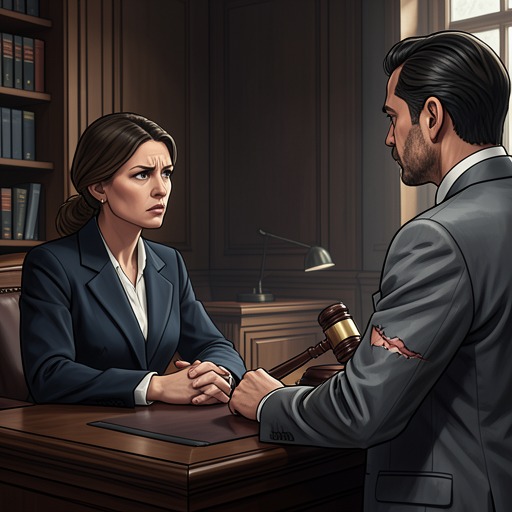
Bantling Found Guilty of First-Degree Murder
RetributionThe first-degree murder conviction of William Rupert Bantling is the decisive courtroom outcome in the trial over Anna Prado’s murder. On January 5, 2001, after a case that had appeared to be coming apart under the defense’s challenges, the jury returned a guilty verdict in less than an hour. The speed and unanimity of the decision brought the trial to a close, but not before the proceedings exposed how fragile the prosecution’s evidentiary position had become and how deeply the case implicated C.J. Townsend personally.
A Case Under Pressure
The verdict followed a week in which Lourdes Rubio’s defense tried to turn the prosecution’s evidence into reasonable doubt. Bantling’s Jaguar had been at Louie’s House of Tinting on Monday, January 18, and Tuesday, January 19, and was collected at about 7:15 that evening. The shop’s owner testified that the car had been left overnight in an unsecured lot, that more than ten employees could have accessed it, and that no one had checked its trunk after Bantling dropped it off. Those details supplied an alternative explanation for possible access to the vehicle and challenged the prosecution’s account of how the evidence had come to be there.
The defense also put Bantling’s work as a taxidermist at the center of its explanation for a number-five scalpel found in his shed. The head of the American Taxidermy Association testified that such a tool was used in taxidermy and that, in some work, an animal might be alive during the process to preserve a realistic appearance. That account offered a non-homicidal explanation for blood detected on the blade. A pathology expert further testified that the sample was too small for reliable DNA testing, that the red blood cells had nuclei and therefore were animal rather than human, and that the marks resembling Anna Prado’s blood appeared manufactured. The testimony recast what had seemed like corroborating forensic evidence as material with competing explanations.
C.J. Townsend watched the defense witnesses turn those possibilities into a sustained attack on the case. She believed that paid experts could challenge even apparently strong evidence, but recognized that her own cross-examinations were unprepared and increasingly strained. As jurors appeared to respond to the defense’s case, she felt their confidence in her diminish. The quick verdict therefore followed a trial that had not been steadily accumulating certainty: it came after the prosecution had endured an unusually direct assault on the reliability and interpretation of its evidence.
Deliberation and Verdict
Closing arguments ended on Friday afternoon. After the legal instructions, the two alternate jurors were dismissed, and the remaining twelve were sent to deliberate at 4:27 p.m. A little over fifty minutes later, at 5:19, a note from the jury reached the judge: the jury had reached a verdict. The return was unexpectedly rapid for a capital case. C.J. had left the courtroom to get coffee and was on her way back from the first-floor machine when Eddie Bowman hurried to tell her the jury had returned.
The courtroom was crowded with lawyers, reporters, spectators, and families. Judge Leopold Chaskel asked the foreman whether the decision was the jury’s verdict, then directed the defendant to rise as the clerk prepared to read the form. The foreman confirmed the verdict. The clerk announced that the jury found Bantling guilty of first-degree murder in Miami-Dade County, Florida, on January 5, 2001. A choked sob followed; C.J. thought it came from Mrs. Prado. At Lourdes Rubio’s request, the judge polled the jurors individually. Each of the twelve reaffirmed the finding of guilt.
The individual responses made clear that the verdict was unanimous, even as the jurors’ expressions varied. Some had red eyes, some seemed relieved, and others showed anger or disgust. When the final juror confirmed the decision, Anna Prado’s family began to cry out, relatives of other Cupid murder victims cheered, and reporters rushed into the hall to contact their news organizations. C.J. bowed her head in silent thanks. For her, the moment marked the end of a long and uncertain prosecution; for the victims’ families gathered in court, it was a public finding of responsibility after a series of killings that had brought them to the same courtroom.
The Prosecution’s Compromise
The guilty verdict cannot be separated from the prosecution’s earlier decision to continue despite the unlawful stop and search that led investigators to Bantling. C.J. had confronted Officer Chavez’s account and concluded that the anonymous tip supplied no adequate basis to stop the Jaguar: it gave no driver description, license plate, or explanation of how the caller knew about the supposed drugs. She also challenged whether Chavez could have maintained sight of the car along the route he described. Her questioning established that she understood the stop lacked probable cause.
C.J. nevertheless agreed to help preserve the case by allowing Chavez to repair his account. She told herself that compromising her professional integrity was a small sacrifice for the greater good: without the search, there would have been no body, and without the body, no case. The same search had led authorities toward evidence at Bantling’s home, including Haldol, blood, a suspected murder weapon, and videotapes. The decision to proceed thus made the prosecution’s objective and its legal vulnerability inseparable. The conviction resolved the jury’s determination of guilt at trial, but it did not erase the concealed bargain or the possibility that the case’s central evidence depended on an unlawful act.
Personal Revelation in the Aftermath
The verdict was followed by another confrontation in open court. Bantling began screaming, and the judge asked C.J. and Lourdes Rubio what the commotion concerned. C.J. then disclosed that she had been raped years earlier, while she was a law student in New York, and that the attacker had never been caught. She told the court that Bantling had learned of the old case through police reports and public records and was now claiming to have been the attacker. C.J. denied that claim and said she had already informed his attorney that he was not the man who had assaulted her.
Her disclosure gave the courtroom a new way to understand the prosecution: the attorney who had pursued Bantling was also a survivor whose history he had tried to use against her. It did not change the jury’s verdict, already returned and affirmed by all twelve jurors, but it brought her personal history into the public proceedings at the moment the case was supposedly over. The conviction closed one question of criminal responsibility while leaving the trial’s conflicts—over evidence, prosecutorial judgment, and C.J.’s private past—visible in its wake.