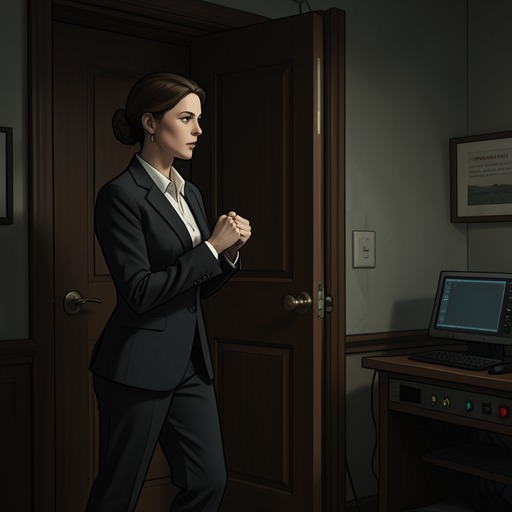
C.J. Fights Back Against Chambers and Escapes the Secret Room
RetributionC.J.’s fight against Gregory Chambers begins when he discovers that she has taken a scalpel and assumes he has already defeated her. Still weakened by Haldol, she has little strength and only a narrow opportunity to act. Her attempt to surprise him fails, but she keeps hold of another blade and waits until he comes close enough to strike. The struggle reverses the balance between captor and captive: Chambers is wounded, while C.J. gains a chance to get off the gurney and reach the locked door.
The First Reversal
Chambers notices the missing number-five scalpel as soon as he enters. He pries it from C.J.’s clenched hand, and the effort leaves her injured and apparently beaten. He treats her resistance as a failed move in a game he controls, but his confidence depends on having correctly judged how much the Haldol has weakened her. As its effects recede sooner than he expects, C.J. retains more capacity to act than he realizes.
C.J. has prepared another chance with a number-three scalpel held under her left hand. She waits until Chambers is close, then strikes him in the neck. The attack catches him by surprise; he staggers into the metal instrument cart, sending its contents across the floor. C.J. rolls off the gurney, hurt and still unable to rely on her legs, but no longer restrained there. Her escape has not yet been secured: Chambers remains alive, and the room’s locked door stands between her and help.
The Locked Room and Escape
C.J. Townsend’s first priority after leaving the gurney is to reach the door, but it will not open: Gregory Chambers has locked them both inside. She remembers the keys in his jacket on a nearby chair and drags herself across the room to retrieve them. Her legs remain too weak to support her, and the pain makes each movement harder. She finds the key ring and starts back toward the door, but Chambers catches her ankle and pulls her toward him, still holding a syringe filled with Mivacron, which would be fatal if injected directly into her bloodstream.
As C.J. struggles to get away, her hands find a pair of scissors on the floor. She uses them against Chambers, and his grip loosens; the syringe falls away. The immediate danger has passed, but escape is not yet certain. She has to reach the door, find the right key, and work the lock despite the wound in her palm and her diminishing strength. On the third try, a key turns; she opens the door and pulls herself into a dark hallway.
C.J. continues through the house, searching for a phone. She descends a staircase to a better-lit lower floor, where streetlights show through the blinds and a telephone sits on an antique desk beside photographs of Estelle and her family. The familiar Spanish-style house on Almeria reveals where Chambers has kept her: his own psychiatrist’s office. Unable to go farther, she lies on the cool tiled floor and waits for the police.
Immediate Aftermath
The first response to C.J.’s escape comes through care from the people around her. Manny Alvarez enters the room carrying flowers from the team, with even Bowman among those who contributed, and pastelitos of his own. He also passes along the doctor’s instruction that she avoid café con leche for a while and drink milk instead. The small, practical gifts mark a sharp change in the scene’s register: after the isolation of Chambers’s house, C.J. is once again within reach of colleagues who have come to support her.
Reversal and Narrative Significance
Chambers frames the confrontation as a chess game in which he can anticipate C.J.’s moves, but his confidence proves to be the decisive miscalculation: he notices one hidden scalpel and mistakes that discovery for control. The episode turns on that gap between apparent defeat and remaining capacity. C.J. cannot overpower him or simply walk out; she must preserve a final chance, use what is within reach, and keep moving despite her injuries and the locked room. Her escape reverses their positions without erasing its cost, ending not in triumphal freedom but with her reaching a phone and waiting for help. That she emerges into the house containing Chambers’s psychiatrist’s office makes the revelation personal as well as physical: the person she trusted in a therapeutic relationship has made that familiar setting part of her confinement.