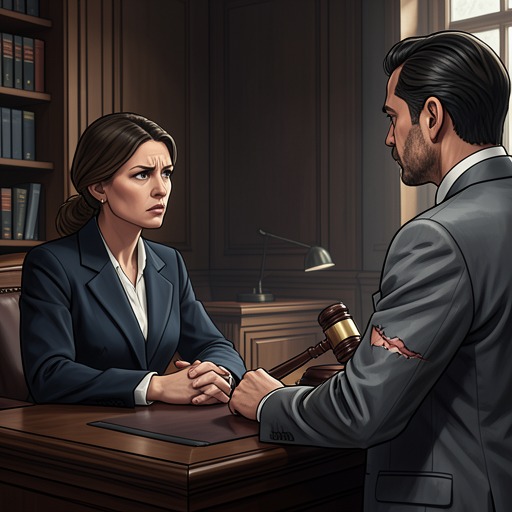
Compromise in the Name of the Greater Good
RetributionCompromise in the Name of the Greater Good is the moral logic C.J. Townsend uses when she knowingly helps preserve a prosecution built on an unlawful traffic stop, then steals evidence connected to her own history with William Rupert Bantling. The choices are presented as sacrifices made to prevent a dangerous man from going free, but they also damage the integrity of the case and C.J.’s professional identity. The phrase therefore names a genuine conflict, not a clean excuse: the threat Bantling poses is real, and so is the cost of meeting it by abandoning the rules she is charged with upholding.
The bargain over the stop
The decisive compromise follows C.J.’s recognition that Officer Chavez’s account of how he stopped Bantling’s Jaguar cannot be true. She confronts Chavez directly, and the road layout makes his story untenable: Sixth Street is one-way and does not continue through, while cement pilings prevent the turn he would need to have made. When the officers leave, C.J. understands that a pact has been made and that none of them can simply return to the previous position.
She knows the stop lacked probable cause and that the search was therefore unlawful. She also understands the practical chain of consequences: without the search there would have been no body, no discovery of Bantling, and no search of his home. The Haldol, blood, suspected murder weapon, and pornographic tapes found there could all be excluded. The legal defect was not peripheral; it threatened the entire prosecution.
C.J. accepts the repaired account because she believes that without it Bantling will walk. Her calculation extends beyond the Prado murder. She believes the American rapes are beyond prosecution because the time limits have expired, while crimes abroad are unlikely to be prosecuted. If released, Bantling would be free to hunt, rape, torture, and kill again. Her fear of that outcome gives the bargain its force, but does not make the stop lawful. The case’s central tension is that the hoped-for public protection depends on concealing a violation that could otherwise defeat it.
A principle that spreads
C.J. names her decision a small sacrifice of professional integrity for the greater good: putting away a monster, she tells herself, may require even good people to play dirty. Yet the sacrifice is not confined to accepting Chavez’s revised account. When Lourdes Rubio later files a motion to suppress the stop and seeks C.J.’s removal, C.J. is forced to face both the legal vulnerability and the personal conflict surrounding her continued role in the case.
The pressure is sharpened by C.J.’s past assault and the way it has already been handled. Detective Harrison reassures her that the rape was not her fault, but the investigation yields no identification, fingerprints, or other physical evidence, and the repeated assurances that it is active do not prevent it from receding toward the cold-case files. Years later, reading the old reports brings back guilt and shame, including the blame expressed by a former neighbor. This history makes the distinction between pursuing justice and protecting a prosecution intensely personal; it does not erase the ethical problem of keeping her own stake undisclosed.
The boundary is crossed again when C.J. finds the mask and pendant in the evidence. The pendant is the one-of-a-kind object that can connect her to Bantling. She places it and the mask in a black plastic bag, hides the bag in her purse, and reseals the evidence packaging before returning it to the box. She recognizes the act for what it is: theft, criminal conduct, and a step toward becoming one of the people she opposes. Calling it another sacrifice for the greater good does not restore the evidence to its proper status or remove her personal interest from the case.
Public disclosure and competing duties
The conflict becomes public in court when Bantling accuses C.J. of being his victim. She then tells the judge that she was raped as a law student in New York, but asserts that Bantling was not her attacker and says his accusation is an effort to discredit the proceedings. Lourdes, after speaking with C.J. and reviewing the police reports, tells the court that she does not support her client’s allegation. In light of the narrative’s revelation that Bantling did attack C.J., her denial is another consequential concealment, not a neutral clarification. The courtroom scene exposes how preserving the prosecution and telling the truth about a conflict have come into direct collision.
Gregory Chambers’s professional position supplies a related, more troubling contrast. He had served as a trusted psychiatrist and as an expert for prosecutors and police, while also treating Bantling. Chambers explains that patient status is confidential and privileged and that he would not disclose treatment without the patient’s consent. That duty helps explain why he did not reveal Bantling’s treatment, but it does not account for his larger conduct: he later admits that he treated Bantling and C.J. as specimens in an experiment about what a rape victim would do when she became a prosecutor, and how far she would go for retribution. His experiment turns the ethical dilemma into something he deliberately watches and manipulates, while C.J. believes she is acting to prevent further harm.
Meaning and consequence
The repeated language of a small sacrifice traces an escalation. First C.J. accepts a false account to keep a case alive; later she removes evidence that could establish her connection to the accused; then, in court, she denies the very connection Bantling exposes. Each step promises to protect a larger good, but each also narrows the space in which she can act openly and ethically. The phrase is powerful precisely because its scale is deceptive: the sacrifices are small in the language of justification, yet they affect evidence, prosecution, and C.J.’s own credibility.
Chambers’s experiment finally reveals the danger in treating justice as an outcome that excuses any means. He frames C.J.’s choices as a test of whether the persecuted will choose the ethical road or the just one, and whether Bantling’s life can repay his crimes. After Bantling is sentenced to death, Chambers is left with the result of an experiment he cannot share with his peers. C.J.’s compromises have served the immediate aim of keeping Bantling accountable, but the story does not make them morally costless or convert them into a dependable model of justice. The greater good remains a claim made under pressure—and one that can be exploited by a person who sees other lives as instruments.