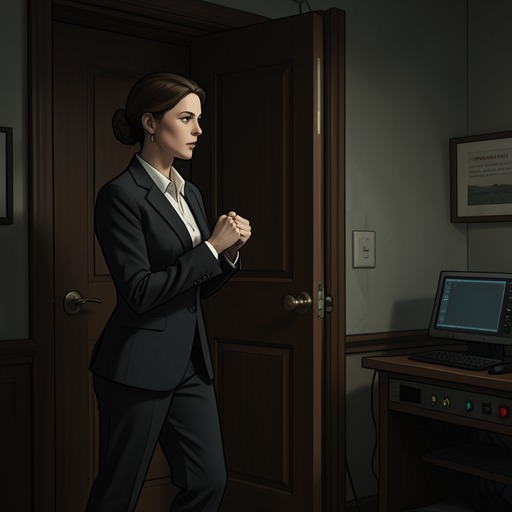
Power as an illusion
RetributionPower as an illusion is a hard-won, unsettling idea in C.J. Townsend’s understanding of her life after the assault. It names the gap between the control she once believed she had and the vulnerability she was forced to confront, while also explaining why she turns to prosecution as a possible form of agency.
The realization
After a nervous breakdown and two years of intense therapy, C.J. had to face what she had dreaded knowing: “Power is all an illusion.” The thought follows from the night when, in her view, she lost control of her life in an instant. Its force lies in the further implication she draws from that loss: she had never truly possessed the security or mastery she imagined she had.
The conclusion is not presented as a comforting lesson or a recovery completed. Years after the assault, C.J. still carries its emotional consequences and lives with a persistent fear. Her memory remains exact, and the possibility that her attacker might be nearby continues to intrude on ordinary settings. The idea of illusory power therefore describes not just a past loss, but the continuing difficulty of feeling safe in the present.
Chance and the limits of control
C.J.’s reflection places personal vulnerability within a world governed by chance. Life, she reasons, can turn on arbitrary outcomes: one person is struck by a bus on the way home from a funeral, while another wins the lottery twice. Her darkly practical conclusion is that avoiding a dark street may help one miss the bus. The advice offers a small precaution, not command over fate; it draws a sharp boundary between reducing exposure to danger and controlling what happens.
That distinction gives the idea its tension. C.J. cannot make the past safe by understanding it, and she cannot guarantee that danger will stay away. Even the change that helps her sleep better—changing her name and moving from New York to Miami—provides anonymity rather than certainty. The measures she takes matter, but they do not restore the comprehensive control she once thought possible.
Seeking agency through work
C.J.’s decision to become a prosecutor gives the concept a practical counterpoint. Unable to escape her fear in New York, she stops trying to do so, takes the Florida Bar, and moves to Miami. She hopes that a prosecutorial career might give her some control in a world she experiences as chaotic, and offer vindication to people who are powerless.
The hope does not erase her recognition that power is illusory. Instead, it shows her trying to act within that limit: she cannot master chance or undo the assault, but she can pursue cases on behalf of others. The contrast between the idea’s bleak origin and its professional consequence makes it more than a declaration of helplessness. C.J. seeks a bounded form of agency without mistaking it for complete control.