Antisemitism in Nazi Germany
ReunionAntisemitism in Nazi Germany is presented through a gradual collapse of ordinary security: first a distant political disturbance, then public propaganda and hostility at school, and finally the forced separation of Hans Schwarz from Germany and his parents’ deaths. The account’s central contrast is between the Schwarzes’ conviction that they belonged to their country and a political culture that increasingly treated Jewish identity as grounds for exclusion. The persecution appears not only in declarations and public signs but in everyday encounters that make a former sense of home impossible to sustain.
Everyday Belonging and Its Blind Spots
At first, antisemitism seems peripheral to Hans’s life. Political clashes between Nazis and Communists are reported from Berlin, while Stuttgart appears calm and reasonable. Minor incidents do occur: swastikas appear on walls, a Jewish citizen is molested, and Communists are beaten. Yet the city’s familiar pleasures continue, with restaurants, the Opera, and open-air cafés full, vineyards heavy with grapes, and families discussing summer holidays. Hans and Konradin von Hohenfels regard politics as an adult concern and devote themselves instead to questions about how to live and what purpose life might have. Their private confidence makes the political threat seem remote, even as signs of intimidation are already visible around them.
That confidence rests on Hans’s family understanding of identity. The Schwarzes have lived in Stuttgart for at least two hundred years, perhaps longer, and Hans thinks of the family first as Swabian, then German, and then Jewish. He regards Jewishness as an inherited fact rather than the defining feature of his life. His family’s religious observance is limited: his mother attends the synagogue on Yom Kippur, while his father avoids smoking and travel that day out of consideration for others, not from religious belief. The absence of reliable family records leaves the older origins uncertain, but this uncertainty does not weaken Hans’s attachment to Stuttgart. In his childhood understanding, home feels enduring and unquestioned.
His Father’s Patriotism and the Political Warning
Hans’s father rejects Zionism and insists that his life belongs in Germany, not in a country with which he feels no personal connection. He believes Hitler’s influence is a temporary illness that will pass when economic conditions improve. His confidence draws on a German cultural inheritance associated with Goethe, Schiller, Kant, and Beethoven, and on the memory of twelve thousand Jews who died for Germany in the First World War. He is not merely attached to the country in the abstract: he was wounded twice in that war and remains willing to fight for it again.
His public standing appears to confirm that belief. He is a popular doctor respected by Jews and Gentiles; a delegation of prominent citizens led by the mayor visits him on his forty-fifth birthday, his photograph appears in the Stuttgarter Zeitung, and Gentiles serenade him. Above his bed hangs the Iron Cross, First Class, with his officer’s sword nearby. To Hans’s father, these signs of respect and service function as assurances that a Jewish German can still count as fully German. The growing antisemitism will expose the weakness of that assurance: neither public esteem nor military sacrifice can compel a society to honor the belonging he considers settled.
Propaganda Enters the School
The political atmosphere becomes harder to ignore in the streets and at school. Huge blood-red posters denounce Versailles and Jews; swastikas and Communist symbols mark walls, while unemployed people march through the town. Inside the school, however, inherited lessons remain focused on older history, leaving current events largely outside the curriculum. This gap helps explain how the boys’ familiar routines can continue even as political language gathers force around them.
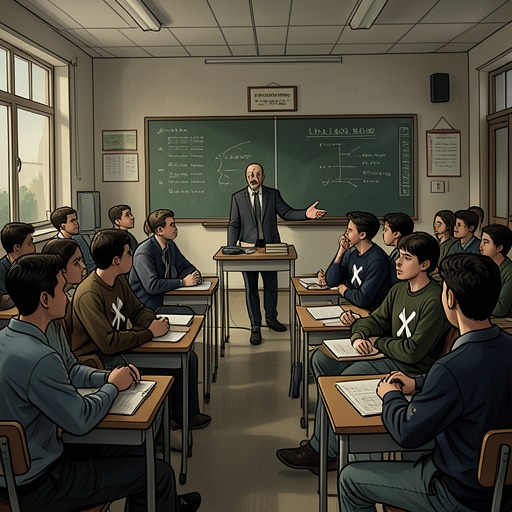
The new history master, Pompetzki, changes the classroom atmosphere by presenting history as a struggle against hidden powers undermining national heritage. He avoids naming the people he means, but the implication is clear to his pupils. Some reject his account by pointing to civilizations it ignores; others accept parts of it. Soon Hans hears a heated discussion about Jews through the closed classroom door. When he enters, the conversation stops. Bollacher and Schulz single him out, and their gestures and looks make plain that he is no longer being treated simply as a classmate. Hans considers confronting Schulz but decides that a fight would not remove the poison already spreading through the school.
Bollacher then rushes at Hans and tells him to return to Palestine, pressing a printed antisemitic slogan onto Hans’s bench. Hans asks him to remove it; Bollacher refuses and threatens him. When the matter reaches Pompetzki, the teacher treats the demand that Hans leave the country as friendly advice rather than an insult. His response turns antisemitic exclusion into something the classroom’s authority will tolerate. Hans waits after school, hoping Konradin might stay to help or console him, but finds the street empty. He begins avoiding his friend, believing that being seen together would embarrass Konradin. His isolation deepens: classmates and former teachers withdraw, and even the boy who once asked him to demonstrate his athletic ability stops approaching him.
Separation, Exclusion, and Retrospective Judgment
At the beginning of December, Hans’s father tells him that his parents have decided to send him to America until the political storm passes. Relatives in New York are to look after him and arrange for university. His parents intend to stay because they consider Germany their fatherland and home; his father is too attached to his established life to imagine starting over elsewhere. The decision is therefore both a response to the danger Hans faces and an expression of the family’s continuing belief that the danger will prove temporary. Hans leaves school at Christmas and departs for America on January 19, his birthday.
Konradin von Hohenfels’s letter reveals how far political conviction has entered their friendship. He regrets Hans’s departure but supports it as prudent, then declares his belief in Adolf Hitler as Germany’s hope. He imagines that Hans might return once the country has changed and assumes that the new leadership will distinguish among Jewish people, admitting some while excluding others. His assurance that Hans’s parents will remain safe makes the letter especially revealing: exclusion is acknowledged, but its consequences are minimized. The friendship that once seemed sheltered from politics now bears the mark of a political division Konradin has chosen to endorse.
Hans’s later recollection supplies the consequence that the earlier confidence could not foresee. A Nazi is stationed outside his father’s surgery with a notice warning Germans against contact with Jews. Hans’s father responds by putting on his officer’s uniform and decorations, including the Iron Cross, First Class, and standing beside the man. A crowd gathers; its hostility is directed at the Nazi, who leaves and is not replaced. The episode briefly makes the father’s civic standing seem effective, but it does not restore security. A few days later, while Hans’s mother is asleep, his father turns on the gas, and both parents die.
After their deaths, Hans avoids Germans as far as possible and does not open a German book, not even one by Hölderlin. He says he has tried to forget, yet the narrative preserves the precise symbols and encounters that make forgetting difficult: the school notice, the teacher’s dismissal, the father’s uniform, and the medal that had once embodied patriotic belonging. The account’s force lies in this reversal. The family’s assimilation and loyalty do not protect them from antisemitism; instead, the gap between their confidence in Germany and the exclusion imposed in its name becomes a measure of the loss.