Hans Schwarz’s loss of religious faith
ReunionHans Schwarz’s loss of religious faith is a decisive break in his childhood understanding of the world: after three children he knows die in a house fire, he rejects the existence of a benevolent God and begins asking how a life without divine purpose should be lived. The episode moves from intimate family memory to philosophical argument, then outward to the indifferent scale of the universe; its answer is not consolation, but a new and unresolved question about human responsibility and value.
Religious inheritance and uncertainty
Before the fire, Hans takes the existence of an all-powerful, benevolent creator for granted, but his family has given him no firm religious doctrine. His father, Dr. Schwarz, does not discuss religion with him. Hans overhears him describing Jesus as a historical Jewish moral teacher of wisdom and gentleness, while rejecting the idea that Jesus was the Son of God. To Dr. Schwarz, the notion of an omnipotent God who allows his son to suffer a prolonged death on the cross is repellent: such a divine father would show less concern for his child than an ordinary human father.
Dr. Schwarz’s position seems to Hans more agnostic than atheistic. His father would not have objected if Hans chose Christianity or Buddhism, though he would probably have opposed a life devoted to monastic contemplation, which he considered irrational and wasteful. Hans’s mother, meanwhile, moves freely among religious practices: she attends the synagogue on Christmas, sings a Christian carol, gives to Jewish aid for children in Poland and to Christian efforts to convert Jews, and teaches Hans simple prayers for his parents and their cat. Neither parent appears to need religion, and both leave their son to form his own ideas. He grows up among Jews and Christians, neither deeply believing nor seriously doubting that a benevolent intelligence watches over a world in which Jews and Gentiles are equally favored.
The fire and the problem of evil
The crisis comes through the fate of the neighbors’ three children, whom Hans has known by sight rather than closely. Their parents have two girls, aged four and seven, and a twelve-year-old boy. Hans remembers the family playing together in the garden, especially the father pushing a little girl higher on a swing. Her white dress and reddish hair had seemed, against the apple trees’ pale-green leaves, like a moving flame. The memory makes the later fire more than a report of disaster: it overturns an image of ordinary family happiness that Hans had witnessed himself.
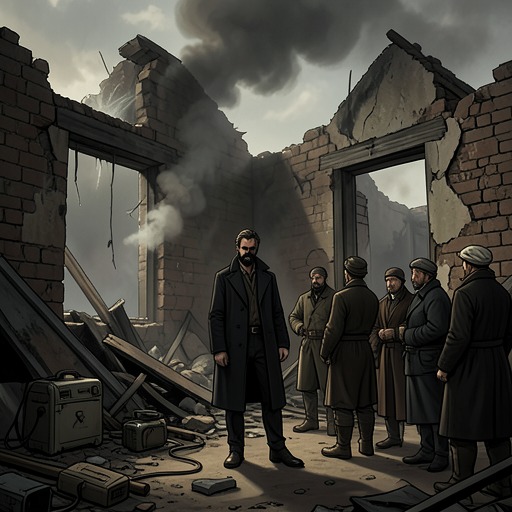
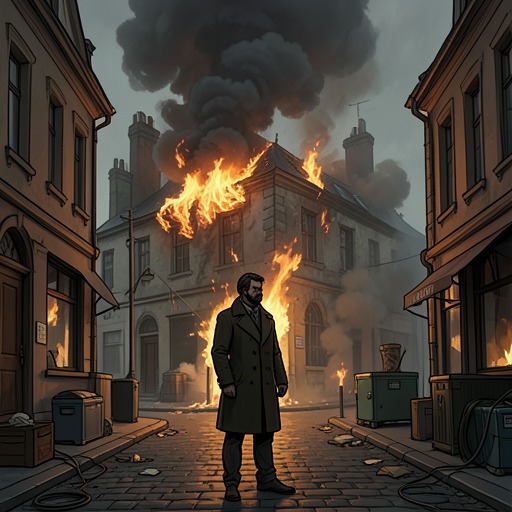
One night, while the parents are out and the maid has gone on an errand, the wooden house catches fire and burns so quickly that the children die before the fire engines arrive. Hans does not see the flames or hear the maid’s and mother’s screams. He learns what happened the next day and sees the blackened walls, burnt dolls, and the swing’s charred ropes hanging from the shriveled tree. That aftermath fixes the loss in physical objects and a familiar place. The disaster shakes him more than the enormous deaths he has previously encountered in books and history: millions drowned by the Yellow River or the Yangtze, and a million soldiers killed at Verdun. Those figures remain abstractions; the three children are people he has seen. The difference between a statistic and a known child makes suffering impossible for him to keep at a safe distance.
Hans asks what the children, their mother, or their father could have done to deserve such a fate. He concludes that either no God exists or a deity powerful enough to permit this suffering is monstrous, while a powerless deity is futile. He therefore abandons, once and for all, belief in a benevolent master mind. The conclusion is not abstract speculation detached from grief: it follows from the particular deaths of two little girls and a boy, deaths that no appeal to divine goodness can make acceptable to him.
Dispute with Konradin
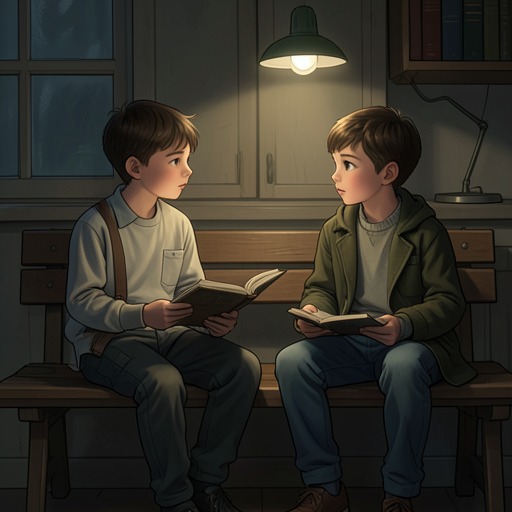
Hans’s despair becomes an argument with Konradin von Hohenfels, who has been raised in a strict Protestant faith. Konradin agrees that the fire is terrible and admits he cannot explain it, but refuses to accept Hans’s conclusion. He suggests that an answer may exist beyond the understanding of two schoolboys and that priests, bishops, saints, and other wiser people have considered the problem. Hans should, in Konradin’s view, submit humbly to their greater knowledge.
Hans rejects that appeal in anger. The explanations of religious authorities, he insists, cannot excuse the burning of the children. He challenges Konradin to picture their deaths and invokes the wider catalogue of malaria, cholera, famine, and war: what use is a God who is powerless or pitiless in the face of such suffering? Konradin cannot provide a rational explanation himself, but asks his pastor and returns reassured. The pastor has dismissed Hans’s argument as the immature outpouring of a schoolboy and, Konradin says, answered the questions satisfactorily. Yet Konradin cannot make the explanation clear to Hans. He speaks instead of evil as necessary for the appreciation of good, as ugliness is necessary for beauty. Hans remains unconvinced, and their discussions reach a deadlock. The exchange exposes a difference in how they respond to uncertainty: Hans treats the children’s suffering as a moral objection that no theory can override, while Konradin trusts that religious authority has an answer even when he cannot explain it himself.
Cosmic scale and the question of living
At the same time, Hans is reading about light-years, nebulae, and galaxies, and learning that stars may be thousands of times larger than the sun and that the universe contains millions or billions of stars. Earth becomes, in his imagination, a pebble among countless others; humanity, a particle of dust. This new sense of scale reinforces his disbelief: he cannot imagine how a God could attend to what happens across so many celestial bodies. The fire and the astronomical discoveries work together, one making suffering immediate, the other making human smallness vivid.
After a period of complete despair, the crisis changes direction. Hans’s central concern is no longer simply what life is, but what people should do with a life that seems valueless and yet remains uniquely valuable. He asks whether a person should live for personal good or for humanity, and how one might make the best of a bad situation. He and Konradin discuss these questions almost daily as they walk solemnly through Stuttgart, often looking toward Betelgeuse and Aldebaran. The stars seem distant and mocking, offering no answer to the boys below. The lasting consequence of Hans’s loss of faith is thus not a settled account of life’s purpose. It is the demand to decide what to do without relying on a benevolent cosmic guarantee.
Later resonance
In adult recollection, the death of Hans’s parents gives the earlier crisis a further, painful resonance, though the account does not present it as a recovery of faith or as a direct consequence of his childhood conclusion. A Nazi is posted outside Dr. Schwarz’s surgery with an antisemitic notice. Dr. Schwarz puts on his officer’s uniform and decorations, including the Iron Cross, First Class, and stands beside him. The gathering crowd turns its hostility on the Nazi, who leaves and is not replaced. A few days later, while Hans’s mother is asleep, Dr. Schwarz turns on the gas; both parents die. This later account again places a concrete human act of cruelty and a family’s death against any easy assurance of protection or justice. The childhood fire had already taught Hans to distrust explanations that preserve a benevolent God by asking the sufferer to accept what cannot be justified.