Nazi Germany
ReunionNazi Germany, as remembered by Hans Schwarz, is not only a political era but the force that gradually overturns a settled sense of belonging. At first, events seem distant from Stuttgart and from Hans’s friendship with Konradin von Hohenfels. Then political hostility reaches the school, compels Hans’s departure for America, and exposes the fatal gap between his parents’ trust in Germany and the persecution directed at Jews. Years later, a list of former classmates makes the era’s consequences impossible for Hans to keep at a distance.
A Threat That Seemed Distant
At the outset, reports of political unrest belong to a world beyond the boys’ private concerns. Clashes between Nazis and Communists are reported in Berlin, while Stuttgart appears calm. Swastikas on walls, harassment of a Jewish resident, and assaults on Communists are already signs of danger, but public life continues: cafés and the Opera remain busy, and people plan their summer holidays. Hans and Konradin treat politics as an adult matter, preoccupied instead with questions about how to live and what life means. Their sense of distance makes the next political shock all the more consequential.
Hans’s family has deep roots in Stuttgart, and he understands Jewish identity as secondary to being Swabian and German. His family has lived in the city for at least two hundred years, though the absence of records leaves its earlier origins uncertain. Religious observance is limited: his mother attends synagogue on Yom Kippur, while his father refrains from smoking and travel out of consideration for others rather than religious belief. Hans’s father rejects Zionism and regards Germany as his homeland. His confidence rests partly on his service in the First World War, in which he was wounded twice, and on the Iron Cross, First Class, displayed above his bed.
Confidence and Political Rupture
Hans’s father interprets the Nazi movement as a temporary sickness that will pass when economic conditions improve. His confidence in Germany’s cultural inheritance and in his own standing as a respected physician leads him to believe that the country will not embrace Nazi politics. He identifies himself as an assimilated German Jew, while also arguing that Jewish participation has enriched German culture. The memoir sets this faith beside the growing public hostility that it cannot explain away.
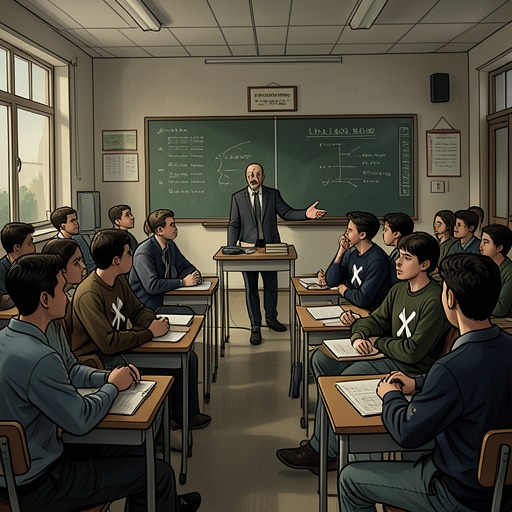
Political change becomes visible in the school and its surroundings. Posters denouncing the Treaty of Versailles and Jews appear across town, political symbols cover walls, and unemployed people march through the streets. The arrival of a new history teacher, Pompetzki, marks a further change: his lessons invoke hidden forces undermining national heritage without naming Jews, though Hans and his classmates understand the implication. Soon a classroom argument repeatedly turns to Jews. When Hans enters, the discussion stops; two classmates single him out, while most of the others withdraw. The political climate has shifted the terms of ordinary school life, making Hans’s identity a target where it had not previously been treated as one.
Exile and the Shattering of Heimat
After Hans’s conflict with Bollacher, he waits after school hoping Konradin will stay with him. The street is empty. Hans then avoids his friend, believing that being seen together would embarrass Konradin, and finds himself increasingly isolated. His father eventually tells him that his parents have decided to send him to America, where relatives in New York will care for him and help arrange university. The separation is presented as temporary: his parents intend to remain in Germany, which they continue to call their homeland. Hans leaves school at Christmas and departs on his birthday, January 19, nearly a year after Konradin entered his life.
Konradin’s farewell letter reveals that he has come to believe in Hitler. He presents the choice facing Germany as one between Hitler and Stalin, describes Hitler’s leadership as the country’s hope, and believes Hans may be able to return when the new Germany has a place for him. His assurance that Hans’s parents will live in peace and security stands in painful contrast to what happens. The letter makes the friendship’s political divide explicit: Konradin can still imagine German national renewal accommodating Hans, while Hans has already been forced to leave the country he considered home.
Years later, Hans recalls that his parents did not die in a concentration camp. When a Nazi is stationed outside his father’s surgery with an antisemitic notice, his father appears beside him in his officer’s uniform and military decorations, including the Iron Cross, First Class. A crowd gathers, and its hostility turns against the Nazi, who leaves and is not replaced. The episode briefly places the father’s German military identity in public defiance of the exclusion directed at Jews. A few days later, Hans’s parents die by suicide. Their deaths overturn the assurance that their standing and attachment to Germany could keep them safe.
Memory and the Era’s Afterlife
The consequences continue in Hans’s life in America. After his parents’ deaths, he avoids meeting Germans where possible, stops opening German books, and tries to forget. Even contact with Germans who resisted Hitler requires him to establish their past before he can trust them; he still finds speaking German difficult. The memoir presents exile, therefore, not as a completed journey to safety but as an ongoing estrangement from language, literature, and the country Hans once claimed as home.
That attempted forgetting is interrupted when Hans receives the school’s roll of the fallen. He reads through the names, skipping those beginning with H, and discovers that twenty-six of the forty-six boys in his class died for the regime. He sets the list down and waits, unable to treat it as a neutral record. In the memoir’s structure, the interval between the ordinary school years and this later encounter becomes a measure of Nazi Germany’s reach: political change first seemed remote, then altered the lives of individuals, and finally returned through the names of the dead to disturb the survivor’s carefully guarded past.