First World War
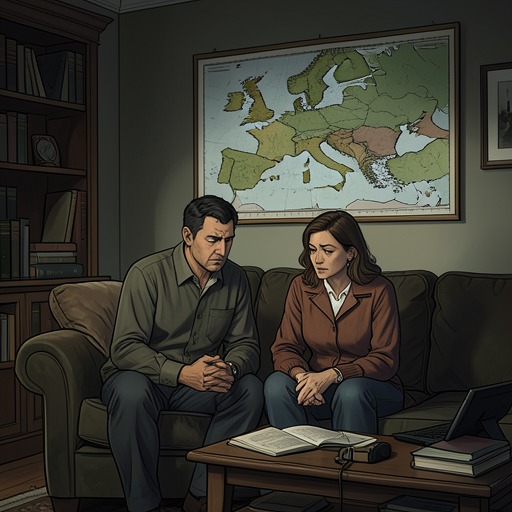
ReunionThe First World War appears in the memoir less as a narrated campaign than as an inherited measure of patriotism, loss, and historical memory. Dr. Schwarz’s wartime service and the Karl Alexander Gymnasium’s dead give the war a place in family and school life; the later collapse of the beliefs attached to that memory exposes the distance between patriotic belonging and the persecution that followed.
Family Service and National Belonging
Dr. Schwarz had been wounded twice in the First World War and remained ready, as his son recalls, to fight again for Germany. His service was part of how he understood himself: he opposed the idea that Jewish identity made him less German, and he regarded his attachment to Stuttgart and Germany as fundamental. The war therefore belonged not only to his past but to his confidence that he had earned a place in the country through service and sacrifice.
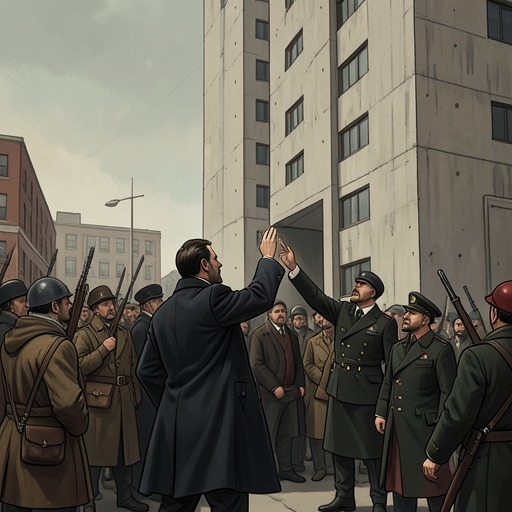
That confidence had visible emblems. The Iron Cross, First Class, hung above Dr. Schwarz’s bed, alongside his officer’s sword. Years later, when a Nazi stood outside his surgery displaying an antisemitic warning, Dr. Schwarz put on his officer’s uniform and decorations and stood beside him. The bystanders’ hostility turned against the Nazi, who left and was not replaced. The episode makes the medal’s meaning painfully unstable: a distinction earned in the First World War could testify to Dr. Schwarz’s German service, but it could not secure his family’s safety under Nazi rule. A few days later, Dr. Schwarz opened the gas while his wife slept, and both parents died.
The School’s Inherited Language of Sacrifice
At the Karl Alexander Gymnasium, the First World War was remembered through its dead. More than a hundred boys had been killed in the previous war, but the school’s account of that loss drew on the examples of ancient Greece and Rome. To die for one’s country was presented as following a time-honoured model; this made the deaths legible within a classical tradition of patriotic sacrifice.
That reverence existed beside a striking gap in the school’s teaching. Its history masters had not taught events later than 1870, while the curriculum already had to accommodate ancient civilizations, emperors and kings, Frederick the Great, the French Revolution, Napoleon, and Bismarck. The First World War could thus persist as remembered sacrifice without being part of a sustained study of recent political history. The school’s inherited framework honoured the dead, but did little to prepare its pupils to understand the political upheavals gathering around them.
A Changed Meaning of History
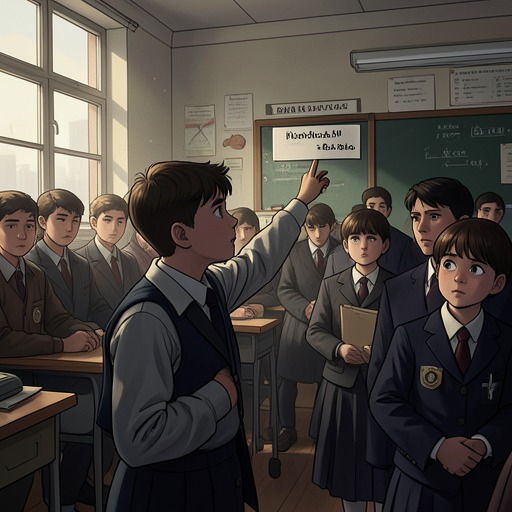
After the summer holidays, political conflict entered the school more forcefully. The town was covered with posters denouncing Versailles and Jews; swastikas and Communist symbols marked the walls, and unemployed people marched through the streets. Within the school, however, classical tradition still seemed to hold time in place. That separation weakened when a new history master began teaching a racialized account of history through insinuations about hidden powers. Soon after his arrival, Hans heard boys arguing about Jews; when he entered, the discussion stopped, and two classmates confronted him with contempt.
The First World War’s accepted language of national sacrifice stands in contrast to this new division of pupils by religion and ancestry. Hans’s classmates had inherited a school memory in which the country’s dead belonged to a shared patriotic past. The hostility directed at him showed how quickly the meaning of national belonging could be narrowed, while the school’s traditional habits offered little protection. At the end of the day, Hans waited in the hope that his friend would comfort him, but left to find the street empty. He then avoided his friend and described himself as alone.
Later War and the Return of the Dead
Much later, an appeal from the Karl Alexander Gymnasium asked Hans to contribute to a memorial for pupils killed in the Second World War. A small book listed four hundred boys killed or missing. Hans initially wanted to discard it, feeling that the school’s dead belonged to a past from which he had cut himself off. He read the names nonetheless, recognizing some only faintly and remembering others more clearly. He avoided the letter H, where he feared he might find the name that mattered most to him.
The list turned public commemoration into a personal reckoning. Hans eventually learned that twenty-six of the forty-six boys in his class had died for the Nazi regime. Among the names was his former friend, Konradin von Hohenfels, executed for involvement in the plot to kill Hitler. The First World War’s school memory of patriotic death thus returns beside a later generation’s catastrophic losses. The old language of sacrifice cannot reconcile the wars or restore Hans’s lost relationships; instead, the memorial appeal breaks through the forgetting he had tried to maintain.