Rise of Nazism
ReunionThe Rise of Nazism is portrayed through the changing texture of everyday life in Stuttgart: first as alarming news from elsewhere, then as propaganda and hostility entering the school, and ultimately as a force that breaks apart Hans Schwarz’s family and displaces him from Germany. The contrast between the city’s familiar routines and the growing pressure against Jews makes political change legible before its full consequences arrive.
A distant crisis in an apparently settled life
During the months when Hans and Konradin von Hohenfels’s friendship seems undisturbed, political violence appears to belong chiefly to Berlin, where clashes between the Nazi Party and Communists are reported. Stuttgart still seems quiet and reasonable. Minor incidents nevertheless mark the surface of daily life: swastikas appear on walls, a Jewish citizen is harassed, and Communists are beaten. The restaurants, Opera, and open-air cafés remain busy; people discuss summer holidays while the weather is warm and the vineyards and apple trees ripen. The persistence of ordinary pleasures makes the political danger seem remote, but it does not mean the city is untouched.
Hans and Konradin are absorbed in questions about how to live and what purpose life might have. They treat the political figures of the moment as insignificant beside those questions. That confidence belongs to their protected adolescence, and the narrative places it beside signs that the public world around them is already changing. The boys’ private circle can feel self-contained, but it cannot remain separate from history.
Belonging and the failure to recognize danger
Hans’s family understands itself as rooted in Stuttgart and Germany. The Schwarzes have lived in the city for at least two centuries, and Hans regards being Swabian and German as more fundamental to his identity than being Jewish. His parents’ limited religious observance reinforces the distance between Jewish ancestry and the family’s sense of daily belonging. His father’s patriotism is likewise grounded in personal and civic experience: he is a respected doctor, was wounded twice in the First World War, and keeps the Iron Cross, First Class, above his bed.
When a Zionist warns Hans’s father that Hitler’s rise should shake his confidence, the doctor dismisses the danger as a temporary illness that would pass when economic conditions improved. He invokes German cultural figures and the twelve thousand Jews who died for their country, insisting on their claim to Germany as a homeland. He believes that the country’s traditions and his own record of service will withstand the new politics. This confidence gives the approaching exclusion its particular force: the family does not experience itself as alien to Germany, and the father cannot imagine that its neighbors will accept antisemitic claims over the bonds of shared citizenship.
Propaganda enters the school
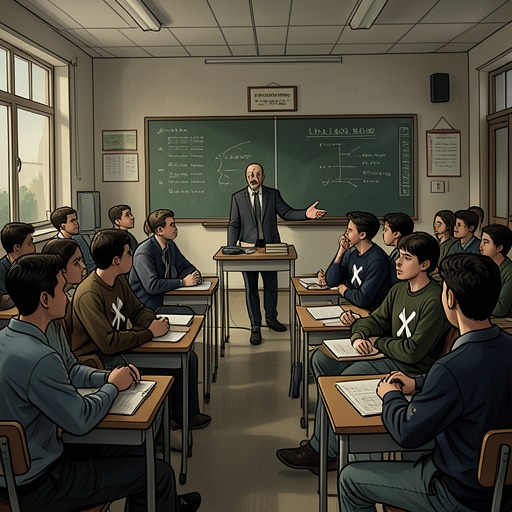
The political shift becomes harder to disregard as the school’s customary focus on older history meets the turmoil in the streets. Red posters denounce Versailles and Jews; swastikas and the hammer and sickle cover walls, and unemployed people march through town. Inside the school, however, historical tradition still seems to suspend the present. That separation is unsettled when Herr Pompetzki, a new history teacher from Prussia, arrives in mid-September and claims that a hidden force is undermining national morals and heritage. His lesson presents racialized accounts of Greek and Italian history as evidence of German superiority without naming the people he means to blame. The students understand the implication, and debate the claims after class.
Pompetzki’s arrival changes the atmosphere even among boys who reject his theory. Hans hears repeated references to Jews through a closed classroom door. When he enters, the discussion stops; Bollacher grins at him and Schulz provocatively holds his nose. The narrator connects this hostility to a poison already spreading through the school. At a later confrontation, Pompetzki treats Bollacher’s direction that Hans return to Palestine as friendly advice, then tells the boys to fight outside if they wish. Instead of challenging the antisemitism, the teacher normalizes it and returns to the lesson. Hans waits after school, hoping Konradin will offer help or consolation, but finds the street empty. He begins avoiding his friend, expecting that association with him would only cause embarrassment, and finds himself increasingly isolated.
Departure and the consequences at home
At the beginning of December, Hans’s father tells him that his parents have decided to send him to America, where relatives in New York can look after him and help him go to university. The decision responds to the hostility Hans has faced at school and the expectation that university will be still harder. His parents do not believe the separation will last: they expect Germans to come to their senses and intend to remain in what they still call their Fatherland and home. Hans leaves school at Christmas and departs on January 19, his birthday, almost exactly a year after Konradin entered his life.
The contrast between the parents’ decision and their faith in Germany becomes tragic in retrospect. In a later account, Hans recalls that his father publicly stood beside a Nazi Party member stationed outside the surgery with an antisemitic warning. Wearing his officer’s uniform and decorations, including the Iron Cross, First Class, the doctor’s presence drew a crowd; its hostility turned toward the Nazi Party member, who left and was not replaced. A few days later Hans’s father killed himself and his wife. Their deaths reveal the fatal limits of the father’s confidence that German patriotism and reputation could protect the family.
Retrospective meaning
The rise of Nazism is structured as an accumulation of reversals: the political crisis is first dismissed as distant, then appears in schoolroom insinuation, then changes whom Hans can safely approach, and finally makes leaving Germany necessary. Hans’s father continues to imagine the country as a home that can recover, even while his son’s departure and the parents’ deaths expose how completely that confidence has failed. The movement from summer routines to classroom hostility and family separation turns a national upheaval into a sequence of intimate losses.