“Merrily the feast I’ll make” rhyme
RumplestiltskinThe “Merrily the feast I’ll make” rhyme is the name-revealing song at the center of the Queen’s contest with Rumpelstiltskin: its final line gives her the knowledge that lets her keep her child. A messenger overhears it in the Forest, where the little man dances beside a hut, and carries the words back to the Queen on the third day of her search. The rhyme transforms a private performance into actionable intelligence, turning the bargain’s threatened ending toward the little man’s defeat.
Discovery in the Forest
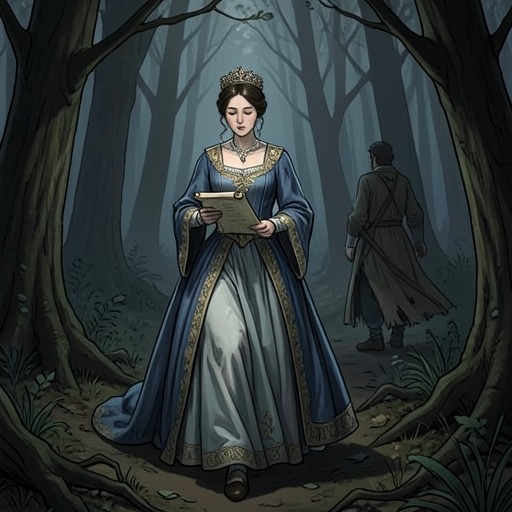
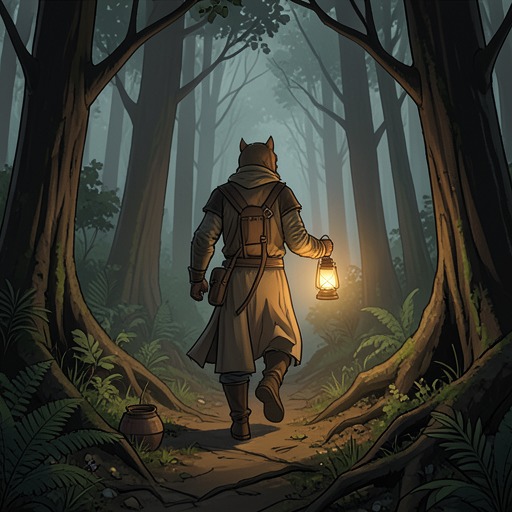
The rhyme enters the story through a report, not through the Queen’s direct observation. One of her messengers returns after traveling for two days without hearing any new names. The previous day, while climbing a high hill among the trees of the Forest, the messenger saw a little hut and a fire burning outside it. There, a funny dwarf danced on one leg and sang. This precise setting and gesture identify the source of the information: the secret is overheard during a private, self-amused performance, then carried from the woodland hut to the royal court.
The song’s opening projects a sequence of preparations and pleasures. The singer announces a feast, says that brewing will happen today and baking tomorrow, and anticipates dancing and singing. The rhyme thus gives the overheard scene a small calendar: today, tomorrow, and the next day. Its movement through those preparations leads to the promised arrival of a stranger, before the last line overturns the apparent generality of that prospect by naming Rumpelstiltskin himself.
Form and Revelation
Rhyming couplets make the lines easy to retain and repeat: “Merrily the feast I’ll make” is followed by “Today I’ll brew, tomorrow bake,” then by the dancer’s forecast of song and the coming stranger. The final couplet completes the pattern while supplying what the Queen needs. The name is not offered as a formal answer to her challenge; it emerges inside a song overheard at a distance, then is relayed by the messenger as evidence. The rhyme’s compact, orderly form therefore carries a secret that changes the action.
The messenger’s account also preserves the performance’s physical detail. The dwarf dances on one leg around the fire outside his hut among the trees, while he sings of his future feast and the stranger who will arrive the next day. Those circumstances connect the words to the little man’s own confidence about what is to come. The Queen’s discovery depends not on a random list of names, but on an overheard utterance that links the name to its speaker and to his expectation of taking her child.
From Private Song to Courtroom Tactic
The rhyme matters because it arrives at the end of a three-day reprieve. Rumpelstiltskin has agreed that the Queen may keep her child if she can tell him his name within that time. On the first day, she tests familiar names; on the second, she tries comic ones, and he rejects them all. When the messenger returns on the third day with the song, the name search acquires its decisive clue. The rhyme thus stands at the hinge between repeated failure and the Queen’s successful response.
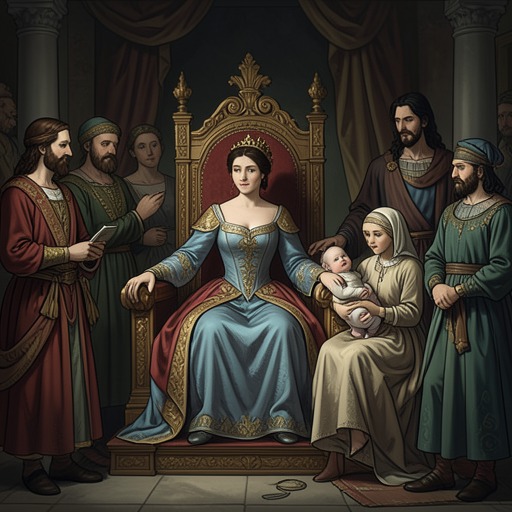
After hearing the report, the Queen jumps for joy. When Rumpelstiltskin comes to test her, she sits on her throne and gathers her court around her; the nurse stands beside her holding the baby, apparently ready for the child to be surrendered. She first offers other names, including John, Tom, and Jemmy, before slyly naming Rumpelstiltskin. The staged sequence echoes the song’s movement from expectation to fulfillment: the little man arrives expecting his claim to succeed, but the name that his own performance disclosed reverses the scene.
Relation to the Spinning Song and Resolution
The rhyme is set against the repeated “Round about, round about” song that accompanies Rumpelstiltskin’s spinning. During the Queen’s three straw-to-gold trials, he sings that refrain as the wheel turns and the straw becomes gold; the magical work is quickly completed, and he receives first the Queen’s necklace, then her ring, and finally her promise of her first child. That recurring song marks successful labor and the accumulating cost of the bargain. The feast rhyme has a different function: it does not transform material but discloses the identity on which the final contest turns.
The little man’s response confirms the rhyme’s consequence. When the Queen speaks his name, he protests that some witch must have told her, then drives his right foot so deeply into the floor in rage that he must use both hands to pull it free. He makes his way off; the nurse laughs, the baby crows, and the court jeers as he leaves. The rhyme therefore moves from an unguarded song in the Forest to the knowledge that breaks his hold over the child. Its final line is at once the close of a rhythmic performance and the key to the bargain’s resolution.