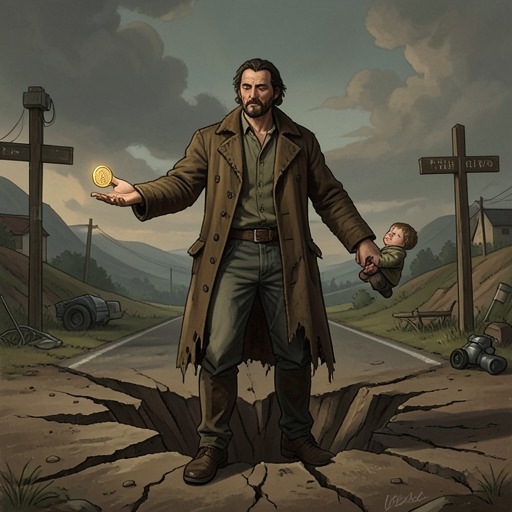
Spinning straw into gold
RumplestiltskinSpinning straw into gold is the impossible labor that drives the Miller’s Daughter from her father’s household toward the throne, while making the miraculous transformation the source of both royal wealth and a dangerous obligation. The King demands the work under threat of death; a strange little man accomplishes it in exchange first for jewelry and ultimately for the Queen’s first child.
The Boast and the Impossible Task
The Miller’s Daughter lives beside her father’s mill near a wood. The miller is proud of her beauty and cleverness, and boasts to the King that she can spin gold out of straw. His claim turns an extravagant assertion into a test imposed on his daughter: the King summons her and leads her to a chamber in his palace, where a great heap of straw and a spinning wheel await.
The demand is explicit and coercive. The King says that all the straw must become gold before morning if she values her life. The Miller’s Daughter explains that her father’s statement was only a silly boast and that she cannot perform the work, but the chamber door is locked and she is left alone. The story therefore establishes the transformation not as a skill she possesses, but as an impossible royal requirement from which she has no apparent escape.
A Marvel Priced in Jewelry
As the Miller’s Daughter weeps, a small, oddly appearing man enters and asks what troubles her. She tells him she must spin the straw into gold and does not know how. He offers to do it in return for a payment; she gives him her necklace. He sits at the spinning wheel, whistles and sings, and the wheel turns until the straw is gold. The work is completed quickly, and the first impossible demand is met before morning.
The King’s response makes the transformation economically consequential without relieving the coercion behind it. Astonished and pleased by the gold, he grows still greedier and shuts the Miller’s Daughter away again with a fresh task. In the next bargain, the helper receives the ring on her finger. He works at the wheel once more, and the second heap is finished long before morning. The repeated mechanism is simple—the wheel, the helper’s song, and straw changed into glittering treasure—but each success increases the King’s appetite and leaves the young woman with fewer possessions to offer.
From Treasure to a Child
After seeing the second result, the King still considers the gold insufficient. He takes the Miller’s Daughter to a yet larger heap and promises that if she spins it that night, she shall be his Queen. When the helper returns, she has nothing left to give him. He names a new price: the first little child she may have when she is Queen. She agrees because she knows no other way to complete the task, while thinking that the eventual birth may never occur.
The helper again spins the heap into gold. In the morning the King finds everything he wants and keeps his word: he marries the Miller’s Daughter, who becomes Queen. The sequence changes the scale of the bargain. The necklace and ring are present possessions; the final payment is a future child, promised under pressure to meet a demand that the Queen did not create. The gold thus brings her royal status while carrying forward a claim that will become immediate only after she has a child.
The Transformation’s Lasting Cost
At the birth of her first child, the Queen is delighted and forgets the helper and her promise. Later, while she sits in her room playing with the baby, he appears and reminds her of the agreement. She grieves and offers him all the wealth of the kingdom if he will release the child, but he refuses at first. Her tears eventually soften him, and he grants her three days to discover his name; if she succeeds, she may keep her child.
The name condition replaces the spinning wheel as the means by which the crisis can be resolved. The supernatural bargain had turned labor into gold and gold into a claim on kinship; now the Queen must find knowledge that can defeat the claim. The transformation’s decisive consequence is therefore not simply a store of treasure or a marriage, but the obligation that returns at the moment the Queen’s first child is born.