Forest
RumplestiltskinForest is the wooded setting around which the tale’s central changes of fortune unfold: the mill and the miller’s home stand beside it, the King comes there to hunt, and a messenger finds in its trees the clue that releases the queen from her bargain. At first it borders ordinary domestic life; later, its more remote depths become the setting for the secret knowledge that defeats the little man’s claim on the child.
Setting and the Mill
The story opens beside a wood in a distant country, with a fine stream running past a mill and the miller’s house close by. Forest is thus introduced not as an isolated wilderness but as the neighboring landscape of work and home. The miller’s daughter lives at its edge, in a household connected to the mill and within reach of the King’s attention.
The King regularly comes to hunt in the wood. That repeated activity links the rural setting to royal power: during one such visit, the miller boasts that his daughter can spin gold from straw, and the King’s greed turns the boast into a demand. Forest does not itself cause the ordeal, but the King’s access to the miller’s world through hunting helps set the plot in motion.
From the Wood to the Palace
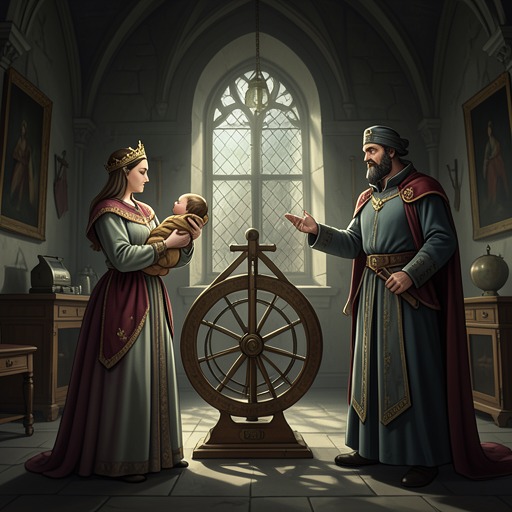
The King takes the daughter away from the miller’s house and confines her in a chamber at his palace, where a spinning wheel and a heap of straw await her. The contrast is sharp: the tale begins with a stream, a mill, and a household beside the wood, then shifts to a locked royal chamber where she must meet an impossible task under threat to her life. Forest remains the geographical point of departure, while the palace becomes the place where her position is controlled by the King.
The wood also frames the story’s transformation of status. The miller’s daughter is brought from her home near the mill into the King’s power; after repeated demands for gold, the King marries her and she becomes queen. The narrative does not describe a change to Forest itself, but the opening setting anchors the distance between her original household and the royal life in which the later claim on her child arises.
The Secret in the Trees
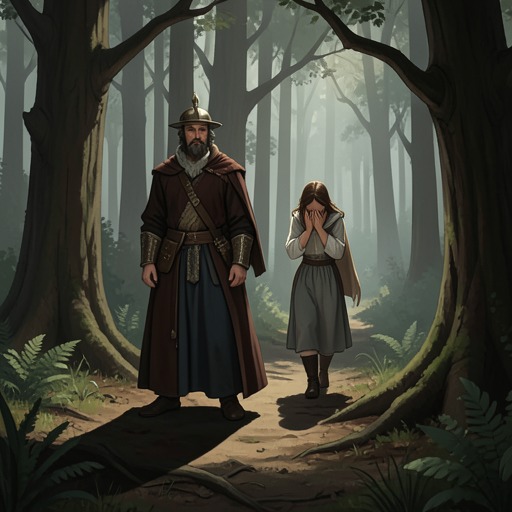
When the queen has three days to name the little man or lose her child, she sends messengers across the land to seek unfamiliar names. On the third day, one messenger reports that, while climbing a high hill among Forest’s trees, he saw a little hut with a fire burning outside. A dwarf danced around the fire on one leg and sang about making a feast, brewing that day, and baking the next; in the same rhyme, he named himself Rumpelstiltskin.
This discovery makes the wooded setting crucial to the resolution. The messenger’s journey carries him away from the court and its public guessing contest to a hut among the trees, where the little man reveals the name he has withheld. The queen can then use that knowledge when he comes to claim her child. Forest’s significance shifts from the familiar edge of the miller’s home to a remote place of hidden information.
Setting and Resolution
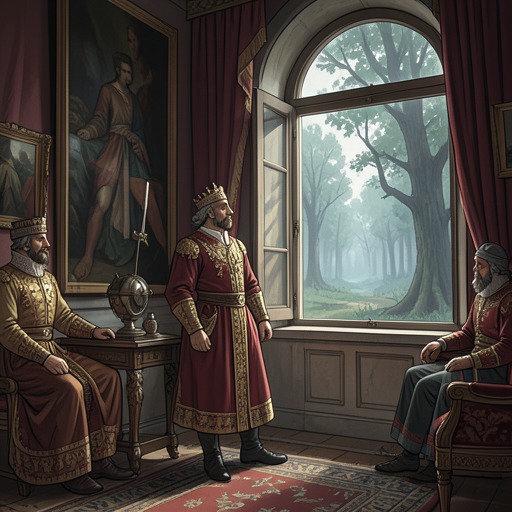
The queen stages the final encounter at court, seated on her throne with the court gathered around her and the nurse holding the baby. She tests ordinary names before speaking the one learned from the messenger’s report of the woods. The little man reacts in rage, stamps his right foot so deeply into the floor that he must pull it free with both hands, and then makes his way off. The nurse laughs, the baby crows, and the court jeers at him.
Forest is not the scene of the defeat, but it supplies the knowledge that makes the defeat possible. The movement from mill-side home, to palace chamber, to the distant hut, and back to the court gives the wood a structural role in the tale: it borders the heroine’s original life and later shelters the clue that breaks the supernatural bargain. The story leaves the wood itself unchanged; its importance lies in the information its depths yield to the queen’s messenger.