Jefferson
SanctuaryJefferson is the novel’s principal center of return: a town tied to family memory, legal identity, commerce, religion, and public violence. Horace Benbow was born there and practiced law there with his father, and his return places him inside a community whose courthouse, jail, streets, churches, businesses, and inherited reputations turn individual actions into public judgment. Jefferson is not merely a backdrop for the plot; it is the social mechanism that converts accusation into spectacle and spectacle into punishment.
Definition and Historical Setting
Jefferson appears as a Mississippi county seat shaped by the persistence of the past and the pressures of modern commerce. Its most charged nearby landmark is the Old Frenchman place, a plantation house built before the Civil War. The surrounding cotton fields, gardens, and lawns have long since reverted to jungle, while local people have dismantled the structure piecemeal for firewood or searched its grounds for the gold supposedly buried there during Grant’s Vicksburg campaign. The ruined plantation thus preserves both the material residue of slavery-era wealth and the community’s continuing appetite for a hidden inheritance.
The Old Frenchman place also connects Jefferson to the people who live beyond its formal civic boundaries. Lee Goodwin’s household occupies the ruin, and Horace Benbow’s account identifies Goodwin as a former cavalry sergeant who served in the Philippines, on the Border, and in France before transferring from cavalry to infantry and losing his rank. The house shelters an improvised and socially disreputable life: Goodwin and the woman are not married, the woman performs hard domestic labor despite having once possessed diamonds and automobiles, and an old blind man waits to be fed. Jefferson’s public morality reads this household as evidence of corruption, while the ruined plantation makes that condemnation appear to emerge from a landscape already marked by abandonment and historical violence.
Roads, Springs, and Return
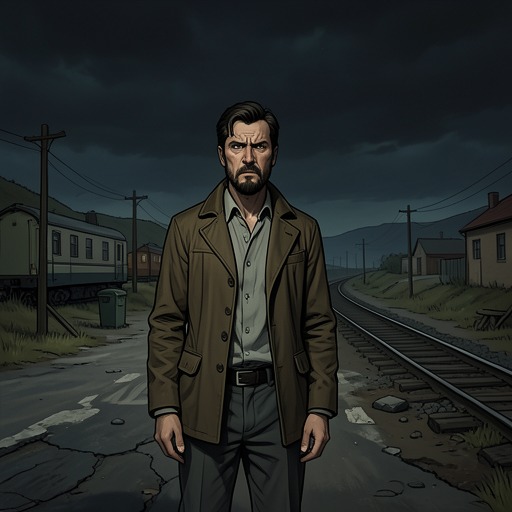
Jefferson is approached through spaces of uncertain protection rather than through a secure civic entrance. At a spring surrounded by cane, brier, cypress, and gum, Popeye watches a traveler drink and confronts him across the water. The traveler identifies himself as Horace Benbow, a lawyer in Kinston who formerly lived in Jefferson and is trying to reach the town. His declaration that he is harmless and wants only to get to Jefferson establishes the town as an expected destination while the spring scene exposes the danger waiting before he reaches it.
Benbow’s relationship to Jefferson is familial as well as professional. He and his sister were born there seven years apart in a house they still own. His sister, now a widow, had wanted to sell it after Benbow married the divorced wife of a man named Mitchell and moved to Kinston, but Benbow refused. He built a new bungalow in Kinston with borrowed money and continued paying interest, yet Jefferson remained the place of shared property, childhood memory, and unresolved family obligation.
The town also receives people and stories from the surrounding countryside. At Tull’s house, Mrs. Goodwin telephones the sheriff and directs him to the Old Frenchman place, giving Jefferson the information that initiates the official response to the death there. Later, Saturday crowds stream toward the square from the rural roads. Wagons fill the alleys, cars line the square two deep, and rural visitors move among stores in overalls, khaki, scarves, and parasols while radios and phonographs broadcast songs of bereavement, retribution, and repentance. Jefferson therefore functions as a gathering point where the county’s dispersed population becomes a single observing public.
Civic Space and Public Judgment
The courthouse is the visible center of Jefferson’s authority. From the surrounding streets, its cupola rises above oaks and locusts, while the square below fills with wagons, cars, merchants, professionals, and visitors. Benbow moves through this crowd as someone recognized from an earlier life: local merchants and professional men remember him as a boy, a youth, and a fellow lawyer, and he can still see the second-story windows where he and his father once practiced. His return is consequently a reentry into a network of recognition, not an arrival among strangers.
That communal familiarity becomes a form of surveillance. The people of Jefferson discuss Lee Goodwin not only as a suspected murderer but also as an adulterer and a threat to the county’s Protestant respectability. A Baptist minister uses Goodwin as a sermon subject, and the public rhetoric imagines burning Goodwin and the woman together as an example for their child. The child would then be taught that it was begotten in sin by parents who had suffered by fire. Such talk shows how Jefferson’s religious and civic institutions merge punishment, sexual regulation, racialized language, and moral instruction into one public narrative.
The same community has materially benefited from Goodwin’s illegal liquor business. His still is discovered and destroyed only after he surrenders, although the local customers had known what he was doing and had bought whiskey from him, sometimes drinking what he gave them freely. Jefferson’s condemnation therefore contains a sharp contradiction: the town’s moral guardians denounce the practices that its customers supported. The law appears less as a neutral standard than as a public instrument activated when the accused becomes vulnerable.
Trial, Jail, and Collective Violence
Jefferson’s courthouse converts the scattered evidence of the Old Frenchman place into a formal proceeding. When the trial opens, the District Attorney offers only sparse physical objects: the bullet from Tommy’s skull and a stoneware jug containing corn whiskey. Horace Benbow calls Mrs. Goodwin to the stand, helps her into the chair, and refuses to look back toward Goodwin even when Goodwin tries to interrupt. The courthouse thus stages a conflict between testimony, material evidence, and the emotional pressure of the accused man’s presence.
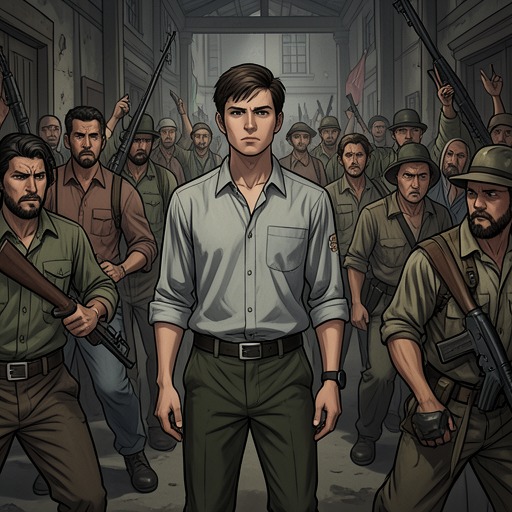
The jury deliberates for eight minutes. As Benbow leaves the courthouse at dusk, wagons are departing toward roads twelve and sixteen miles long, carrying the county away from the formal scene of judgment. Yet the town’s judgment does not end with the verdict. The jail remains in stark silhouette when a fire begins in a vacant lot beside it. Benbow runs toward the alley and sees figures moving through the flames, including a man carrying a five-gallon coal-oil can that explodes while he runs. At the center of the blaze, a mass of fire conceals the victim, while the crowd restrains Benbow and identifies him as the lawyer.
This scene makes Jefferson’s public space the site of an extralegal transformation. The courthouse’s measured procedure gives way to the crowd’s fire, and the jail becomes a symbol of a justice system unable either to contain communal fury or to protect the person under its authority. The vacant lot, ordinarily associated with tethered wagons on market days, becomes a place where commercial and civic routine is replaced by ritualized violence.
Social Contrasts and Narrative Significance
Jefferson’s streets hold several social worlds at once. Its square is crowded with rural visitors, stores, vehicles, and competing radios, while the courthouse and jail represent institutional power. The surrounding country contains the Old Frenchman place and the hidden still; the roads connect those spaces to town; and the town then sends the story outward through gossip, sermons, legal proceedings, and remembered reputations. The geography repeatedly moves characters from concealed domestic spaces into public scrutiny.
The town’s relation to modernity is equally divided. Its traffic includes cars, radios, phonographs, and commercial storefronts, yet its public life remains governed by inherited status, old family names, religious authority, racial hierarchy, and the memory of plantation society. The elderly former planter who meets trains at Kinston embodies the erosion of the old order, but Jefferson preserves the social habits that give that order a continuing afterlife. Its people appear to move outside ordinary time even as modern machines and communications pass through the town.
For Horace Benbow, Jefferson is therefore both home and trial. He returns as a lawyer with access to the courthouse and as a man bound to a family house, a sister, and the memory of his father’s practice. The town grants him recognition but also demands conformity to its public narratives. By placing the investigation, trial, verdict, and fire within Jefferson’s connected civic spaces, the novel presents regional society not as a passive setting but as an active force: it preserves history, organizes visibility, distributes shame, and finally makes violence communal.