Jefferson courthouse
SanctuaryJefferson courthouse is the institutional heart of Jefferson’s public life and the principal stage on which the Goodwin case is converted from a private catastrophe into a communal spectacle. Its courtroom gathers law, gossip, religion, class, race, and violence under one roof: formal procedure offers the appearance of order, while the crowd outside shows how quickly judgment can exceed the court’s authority.
Setting and Public World
The courthouse rises above Jefferson’s square, whose traffic makes the building a visible landmark in the town’s social geography. On a Saturday, the square is crowded with wagons and cars, while people in overalls, khaki, scarves, and parasols move slowly between the stores. The adjacent alleys are packed with tethered teams, and the courthouse cupola stands above the throng. The building therefore belongs not to an isolated legal sphere but to the daily circulation of the county: country visitors, merchants, professional men, automobiles, wagons, radios, and phonographs all converge around it. The courthouse also marks the meeting point between Jefferson’s rural past and its modern public life. The square contains both farm wagons and ranked cars, while the old county population observes the hurried movement of urban collars and shirts with deliberate calm. The courthouse, rising over this mixed traffic, becomes a fixed institution above a society undergoing uneven change. Its authority is presented as stable, but the social world surrounding it is full of competing customs and pressures.
The Trial Inside
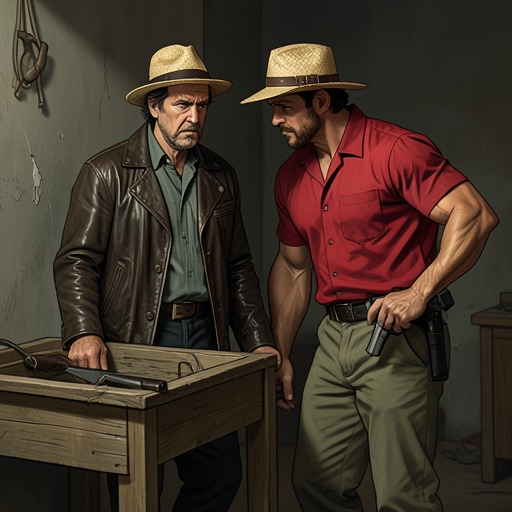
When the trial opens, the courtroom contains only a few material objects offered as evidence: the bullet from Tommy’s skull and a stoneware jug containing corn whiskey. Their sparseness gives them unusual force. One object represents the dead man’s bodily injury; the other connects the case to the illicit liquor economy surrounding Lee Goodwin. The court’s attempt to reduce a tangled history to such articles exposes both the power and the limitation of legal procedure. Horace Benbow uses the courthouse as the place where Mrs Goodwin’s account must be formally spoken. He calls her to the stand and helps her into the chair while refusing to look back at Lee Goodwin, although he can feel Goodwin’s eyes on him. Mrs Goodwin repeats the story she had previously told Horace, with the child lying on her lap; when Goodwin tries twice to interrupt, the Court silences him. The scene makes testimony a struggle over who may control the public version of events. Temple Drake’s appearance further complicates the courtroom’s authority. She wears a black hat, and the clerk must call her name twice before she moves to the stand. Once she does, Horace realizes that the Court is addressing him and answers that she is his witness. The courthouse thus becomes the setting in which a concealed and traumatic experience is forced into an official sequence of names, oaths, questions, and answers. The procedural form does not erase the violence behind the testimony; it gives that violence a public voice while also subjecting it to institutional control.
Spectators and Collective Judgment
The courthouse is surrounded by a crowd whose presence turns the trial into a civic event. When the bell rings, wagons, cars, overalls, khaki, sunbonnets, and flowered hats fill the square and move toward the building’s gothic entrance. Inside, heads of every age and social type settle into the seats, while the air carries tobacco, stale sweat, earth, and the musty odor associated with courtrooms. The sensory density makes the courthouse feel like a repository of accumulated appetites, quarrels, and resentments rather than a perfectly purified domain of justice. The public response to Lee Goodwin is shaped by more than the murder charge. His still has been discovered and destroyed after his surrender, although people who had bought his whiskey and accepted what he gave them freely had known what he was doing. The Baptist minister uses Goodwin as a sermon subject, condemning him as both murderer and adulterer and imagining an exemplary punishment for Goodwin, Mrs Goodwin, and their child. The courthouse therefore stands within a larger apparatus of communal condemnation in which religion, commerce, sexuality, and law reinforce one another.
Law and the Threat of Violence
After the jury has been out for eight minutes, Horace leaves the courthouse at dusk, visibly exhausted. The country wagons are departing, some facing journeys of twelve or sixteen miles, while Narcissa Sartoris waits for him in a car. His movement away from the building does not end the legal crisis. Instead, he walks back toward town and sees a crowd gathered before the Jefferson jail, whose barred window is empty. The sheriff insists that the people will probably do nothing, observing that a genuine mob would not spend so long talking where everyone could see it. The courthouse and the jail are thus linked as neighboring instruments of public order, but the distinction between lawful punishment and collective violence is fragile. Later, Horace sees a fire burning in the vacant lot beside the jail. He runs into the alley and witnesses figures around the flames, including a man carrying a five-gallon coal-oil can that explodes while he runs. The central fire is so intense that its victim becomes indistinguishable within the white-hot mass; when Horace reaches the crowd, people hold him back and identify him as the lawyer. The legal representative is transformed into a participant and symbol of the violence that the courtroom could not contain.
Narrative Significance
Jefferson courthouse concentrates the novel’s conflict between official knowledge and social spectacle. Inside, evidence is sparse, testimony is regulated, and the Court attempts to establish a rational account. Outside, crowds interpret the case through rumor, moral outrage, religious rhetoric, and the desire to witness punishment. The building’s cupola and gothic entrance give it an imposing civic visibility, yet its authority is repeatedly shadowed by the jail, the square, and the fire beside it. As a location, the courthouse also organizes Horace Benbow’s moral trajectory. He enters as a lawyer committed to representing the accused and leaves the building after the verdict with a drawn face and the stiff gait of an old man. His return toward the jail and the burning lot shows that legal advocacy has drawn him beyond professional procedure into direct confrontation with collective brutality. The courthouse remains standing as the formal center of Jefferson, but the events around it reveal that law operates within, and may be overtaken by, the passions and hierarchies of the society it claims to govern.