Kinston
SanctuaryKinston is Horace Benbow’s home city and the place to which his personal and professional life repeatedly returns. Although he has moved to Kinston, built a bungalow there, and remains tied to a wife and a marriage he has left in crisis, the city retains the older house he shares with his sister and the memories that draw him back toward Jefferson. Kinston therefore functions less as a neutral residence than as a test of whether Benbow can resume the identity he has tried to escape.
Definition and Setting
Kinston is presented as a town connected to the railroad, whose civic history has been reshaped by a sudden lumber boom. At the station, an old man meets incoming trains in a seven-passenger car. He was once a planter and landholder, descended from one of the first settlers, but lost his property through greed and gullibility; he then made a living carrying passengers between the trains and the town. His preserved waxed moustache and changing clothes mark the passage from the horse era to the automobile age without erasing the older social hierarchy. He still tells traveling salesmen how he once led Kinston society, even though he now drives them through it.
The driver’s transformation condenses Kinston’s uneasy modernization. His top hat has become a cap, and his worn Prince Albert coat has become a gray suit striped with red, yet the old performance of status survives in his speech and appearance. The town’s development is thus not a clean replacement of the past by progress. Former landholding authority, commercial expansion, and diminished gentility remain layered together, visible in the man who once possessed social prominence and now meets the trains for hire.
Horace Benbow’s Connection to the City
Benbow was born in Kinston, as was his sister, seven years later, and the siblings still own the house in which they grew up. His sister wanted to sell it after Benbow married the divorced wife of a man named Mitchell and moved to Kinston, but Benbow refused. At the same time, he built a new bungalow in Kinston with borrowed money and continued paying interest on it. The contrast between the retained family house and the indebted new home gives the city a double meaning: it is both the site of his adult obligations and the repository of an identity he has not surrendered.
When Benbow goes to his sister’s home four miles from Jefferson, he is already caught between these two positions. Miss Jenny urges him to return home, but he insists that he had not gone there merely to pursue Narcissa Sartoris and had not left one woman simply to run to another. Miss Jenny answers that he may eventually believe that explanation if he keeps repeating it. Benbow concedes that she is right and says that, if so, he will have to stay at home. Kinston is therefore implicated in his self-deception: the city is the place he claims to inhabit, while the older house and family circle expose how unfinished that claim remains.
Social and Regional Network
Kinston does not stand apart from the surrounding Yoknapatawpha County landscape. The road leading toward Jefferson passes through rural spaces such as the Old Frenchman place, a ruined plantation house built before the Civil War. That house’s overgrown cotton fields, gardens, and lawns, together with neighborhood efforts to pull it down for firewood or search for buried gold, preserve the material afterlife of the plantation order. The route between Kinston and Jefferson consequently links Benbow’s modern legal profession to a region still organized by inherited land, racial hierarchy, violence, and stories of buried wealth.
The same regional order appears in Benbow’s account of Lee Goodwin’s household. Goodwin had served as a cavalry sergeant in the Philippines and on the Border and in an infantry regiment in France, but his military past is uncertain. At the Old Frenchman place he is associated with a moonshine still, while the people who buy his whiskey later denounce him as both murderer and adulterer. Their condemnation reveals a community willing to consume the illegal liquor and accept his hospitality before turning public morality against him. Kinston is the civic setting in which that hypocrisy becomes communal judgment rather than private rumor.
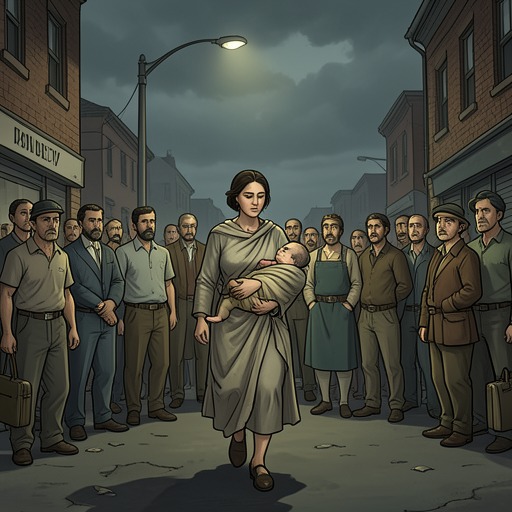
The town’s Saturday square makes the regional structure visible. Wagons fill the alleys, tethered teams gnaw corn ears over tailboards, and cars line the square two deep. Rural visitors in overalls, khaki, mail-order scarves, and parasols move slowly among stores, while radios and phonographs broadcast songs of bereavement, retribution, and repentance. Benbow is recognized by merchants and professional men as a local boy, a young man, and a brother lawyer. His movement through the crowd is therefore a return to social familiarity, but the scene also places him inside a collective culture whose calm, religious, and commercial surfaces coexist with punitive violence.
Return and Ending
After the case has drawn him away from ordinary domestic life, Benbow finally returns to Kinston by train. The station driver complains that he is one train late; Benbow gets out before the car reaches his destination, lifts his own suitcase, and receives no help. The suitcase is the one that had remained in the closet at his sister’s house for ten years and that he brought into town on the morning she asked him about the District Attorney. Its physical movement turns an old delay into a concrete act of departure: something long stored and withheld is finally carried back toward the life it was meant to serve.
Benbow’s Kinston house is new, set on a fairish lawn with poplars and maples he planted himself, still young. Before reaching it, he sees the rose-colored shade at his wife’s windows. He enters from the back and finds her reading in bed beside an open box of chocolates. He announces that he has come back, but the scene offers no reconciliation beyond the fact of his arrival. Kinston receives him into a domestic space that remains intact in its objects and arrangement, while his return carries the knowledge of everything that has happened beyond it.
The city’s significance lies in this unresolved return. Kinston is associated with trains, commercial change, professional recognition, family property, debt, marriage, and the moral consequences of events elsewhere. It promises continuity, but continuity is not restoration. Benbow can come back to the house, the wife, and the town that know him, yet the journey has altered the meaning of each. Kinston becomes the final spatial counterpoint to the Old Frenchman place: one is a new home awaiting a return, the other a ruined house where social violence has been exposed, and Benbow stands between them, unable simply to make either past or present disappear.