Old Frenchman place
SanctuaryOld Frenchman place is a gutted plantation house and surrounding tract of abandoned land whose decisive significance lies in the way it converts the buried history of the rural South into a present, functioning machinery of secrecy and violence. The ruin is not merely a backdrop for the encounters involving Popeye, Temple Drake, Lee Goodwin, and Ruby Lamar: its isolation permits concealment, its interior divisions organize captivity, and its roads and thresholds repeatedly determine who can escape, who can be watched, and who remains exposed.
Definition and Historical Setting
Old Frenchman place stands in a grove of unpruned cedar trees, its stark square bulk rising above the trees against the failing sky. Built before the Civil War, it was once a plantation house set amid cotton fields, gardens, and lawns. Those cultivated spaces have long since reverted to jungle. For fifty years, local people have dismantled the property piecemeal for firewood, while others have dug through it in sporadic hope of finding the gold the builder was said to have buried when Grant passed through the county during the Vicksburg campaign.
The house therefore carries several layers of abandonment at once. It is a former center of agricultural order reduced to a weathered landmark; a remnant of a vanished planter economy; and a material object onto which the neighborhood projects fantasies of concealed wealth. The search for buried gold and the removal of the house for fuel make its history economically active even in decay. Its past is not preserved as a stable monument but consumed, excavated, and misremembered by the people around it.
The surrounding terrain reinforces that historical pressure. The grounds contain a ruined lawn, an apple orchard, abandoned outbuildings, cane, brier, cedar, and other growth through which the breeze moves with a sad, murmurous sound. There is no plow, tool, or planted field anywhere in sight. The absence of husbandry makes the place legible as land stripped of its former social purpose, yet the property remains capable of sheltering people and hiding actions that the surrounding community cannot see directly.
Approaches, Visibility, and Entrapment
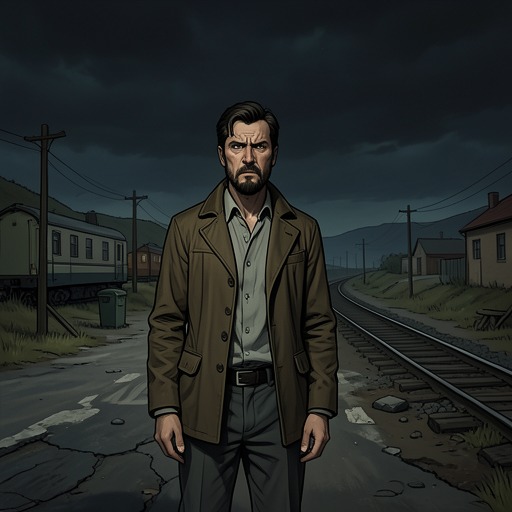
The route to Old Frenchman place is as important as the house itself. Popeye first watches a man approach a spring by a faint path from the road, then later leads Horace Benbow toward the stark ruin above the trees. The abandoned road descending from the house is an eroded scar, too deep to be a road and too straight to be a ditch, gutted by winter freshets and choked with fern, rotted leaves, and branches. The physical route has ceased to function as ordinary infrastructure, so movement through it requires following the faint track worn into the vegetation by feet.
This damaged approach creates a space of uncertain access. It is visible enough to guide those who know it, yet degraded enough to separate the property from ordinary travel and authority. Benbow and Tommy descend in single file, while the ruin behind them appears lightless, desolate, and profound. The house can be reached, but not casually; it is connected to the world by a scar rather than a maintained road. That condition helps explain how the place can remain near Jefferson while operating as a secluded enclave.
The road also becomes the site of violent interruption. When Gowan Stevens drives Temple Drake toward the house, Temple sees a tree blocking the way but accepts it as the disastrous logical end of the circumstances already surrounding her. Gowan drives into it at twenty miles an hour; the car strikes, rebounds, hits the tree again, and overturns. The wreck places Temple at the edge of the property before she has consented to enter it, while two men emerge from the cane and brier to observe her. The landscape does not simply conceal danger; it abruptly releases danger into the path of a trapped traveler.
Temple’s resistance to the house is immediate and spatially precise. When it comes into view beyond the black interstices of the cedar grove, she stops and says that she does not want to go there, asking Gowan to obtain another car while she waits. The request fails because the man at the property tells her that they have been ordered to come to the house. The threshold thus marks a loss of practical choice: the ruin is already exercising authority before its occupants need to use force openly.
The House as a Scene of Violence
Inside Old Frenchman place, the architecture combines exposure and enclosure. Three men sit at one end of the porch, while a faint light shows deep in the open hall, which runs straight through the house to the back porch and kitchen. The apparent openness of the hall does not produce safety. It makes the passage through the house observable, while rooms branching from it allow people to be intercepted, confined, or made to wait under the scrutiny of others.
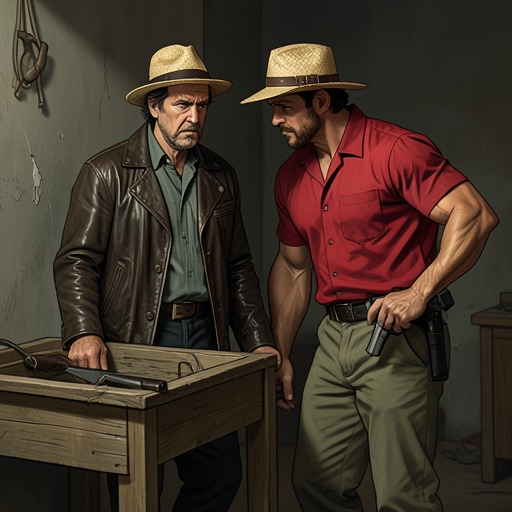
The kitchen scene establishes the property’s social disorder. A woman stands at the stove in a faded calico dress, wearing an unlaced pair of worn men’s brogans around her bare ankles while meat hisses in a pan. Popeye enters without stopping and announces that there is a bird out front. The woman answers that she does not serve Lee Goodwin’s customers. Her refusal identifies the house as a place with its own illicit economy and boundaries, while the casual exchange places ordinary domestic labor beside the threat carried by Popeye and the people arriving with him.
The house’s rooms then become instruments of concealment and bodily terror. Ruby Lamar helps Temple leave by night, both of them moving barefoot across the porch toward the barn. About fifty yards from the house, Ruby stops, pulls Temple close, curses her in a whisper filled with fury, and then continues toward a dark hallway. A door opens into a floored room that smells faintly of dusty grain; as Ruby closes it, something scurries nearby. Temple steps on something rolling beneath her foot and panics when Ruby identifies it as a rat. The grain room, the darkness, and the unseen movement reduce the world to touch, smell, and the threat beneath the feet, making the property’s agricultural remains part of its atmosphere of captivity.
The wider setting also contains a blind man and an old man, figures whose immobility intensifies the house’s moral and physical enclosure. Horace Benbow later describes the blind man as apparently removed from the world, while the old man sits waiting for someone to feed him. The house holds people who cannot easily see, move, or intervene, even as violence unfolds around them. Its social structure is therefore not a household in the protective sense but a damaged collection of dependents, exploiters, witnesses, and captives.
The House, the Spring, and the Road
The spring near Old Frenchman place provides the most important counter-space to the ruin. It wells from the root of a beech tree and flows over whorled sand, surrounded by cane, brier, cypress, and gum. Popeye watches a tall, thin man kneel to drink there, and the man discovers Popeye first as the shattered reflection of a straw hat in the water. The spring appears natural and open, but its reflections create another form of surveillance: the watcher is hidden beyond the bushes, while the watched man learns of his presence indirectly through the water.
After Ruby leaves the house carrying the sleeping child, she reaches the spring and sits beside it, drawing the hem of her skirt over the child’s face. Popeye emerges from the bushes and announces that he is going to town and clearing out, saying that he has had enough of the place. His departure does not resolve the danger. Ruby has forgotten the child’s bottle, and after about an hour she must return toward the house. The spring offers temporary distance but cannot sustain escape because the material needs of the child pull her back into the property’s orbit.
The road then turns separation into a spectacle of nonrecognition. As Ruby carries the child back, Popeye’s car passes with Temple inside. Temple looks directly at Ruby but shows no sign of recognition; her face appears to Ruby like a small, dead-colored mask drawn past on a string. The car continues toward the house, while Ruby proceeds in the opposite direction. The same road that once brought Temple into the ruin now carries her away under Popeye’s control, while Ruby remains bound to the house by the child and the forgotten bottle.
From Private Ruin to Public Judgment
Old Frenchman place becomes the point from which the hidden crime enters Jefferson’s official world. Ruby goes to Tull’s house, two miles away, to use the telephone. With Tull’s family still seated around Sunday dinner, she calls the sheriff and identifies the location of a dead man by directing him to pass Tull’s, turn off toward the Old Frenchman place, and find the house. The telephone carries the property’s secret into public communication, but the domestic setting of the call shows how abruptly private catastrophe is inserted into ordinary communal life.
The testimony surrounding Lee Goodwin reveals that the house had also been a site of illicit production and social hypocrisy. Horace reports that Goodwin had operated a still, which the sheriff’s men found and destroyed after Goodwin surrendered. The local customers who had bought whiskey from him and accepted free drink then joined in condemning him. A Baptist minister publicly treated Goodwin not only as a murderer and adulterer but as a pollutant of the county’s supposedly free Democratic-Protestant atmosphere. The ruin’s hidden economy thus becomes evidence used by the community to intensify moral punishment, even though the same community had benefited from it.
The house’s poverty and improvised domesticity also sharpen the contrast between public condemnation and private dependence. Goodwin has almost one hundred and sixty dollars buried in a can in the barn, and he tells Ruby that the money will keep her until the case is over, after which they intend to leave. Their plan to clear out has apparently existed for some time, but the property has held them in place. The barn, the hidden money, and the hoped-for departure show that escape was imagined materially and concretely, yet never achieved before the violence made the house impossible to inhabit.
The site’s influence extends beyond the immediate investigation. Horace later encounters news of the jail fire, where a mob attacks the prison and a man runs carrying a five-gallon coal-oil can that explodes into flames. Although the fire occurs away from Old Frenchman place, the sequence is connected to the house through the dead man, the prosecution, and the community’s desire to transform judgment into spectacle. The property’s secluded violence is transferred into public violence: what was concealed among cane, rooms, and ruined outbuildings reappears in the open lot before a crowd.
Old Frenchman place finally signifies a South whose formal structures have decayed without relinquishing their power. The plantation’s fields have become jungle, its house has been dismantled for firewood, and its road has been eroded into a scar, yet the location continues to organize labor, sex, property, surveillance, law, and punishment. Its movement from spring to house, from house to road, and from road to Jefferson shows that isolation is never complete. The ruin hides violence only temporarily; eventually the hidden act travels outward, first by a woman carrying a child, then by a telephone call, and finally through the public machinery of jail, court, and fire.