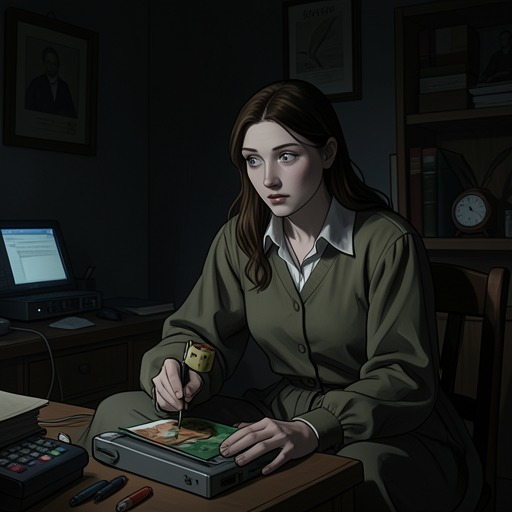
Miss Reba's house
SanctuaryMiss Reba's house is the Memphis brothel where Temple Drake is delivered after Popeye takes her from the Old Frenchman place. More than a backdrop for prostitution, it is a contested social space: a public business with private rooms, a refuge whose protection is conditional, and a place where women, clients, servants, police, and intermediaries negotiate power through doors, stairways, telephones, money, and surveillance. Temple's arrival and attempted escape make the house one of the novel's decisive thresholds between apparent safety and renewed coercion.
Setting and Physical Character
Miss Reba's house stands in a narrow, smoke-grimed Memphis street of frame houses, junk yards, garages, and grassless plots. Popeye turns into this degraded urban environment after reaching Memphis in midafternoon, and stops before a dingy three-storey house whose entrance is concealed by a lattice cubicle leaning awry. Two small woolly white dogs move sluggishly in the gasoline-like brightness of the yard, one marked by a pink ribbon and the other by a blue one. The setting's shabby visibility is important: the house is neither hidden countryside nor respectable lodging, but an exposed establishment whose entrance is screened without being truly concealed.
Inside, the house is organized around thresholds and circulation. Temple hears the dogs whimpering and scuffing outside her door, and sees them rush into the room when the Negro maid opens it, climbing onto Miss Reba's lap and sprawling across the bed. Voices and footsteps pass beyond the doors, in the hall, and on the stair. The house therefore offers no simple private sanctuary. Its rooms can shelter a frightened woman, but its corridors also carry the presence of clients, employees, and watchers, making movement through the building a continual negotiation of access.
Miss Reba's Authority and the House's Social World
Miss Reba Rivers governs the house through a mixture of commercial knowledge, personal reputation, maternal address, and physical frailty. She moves heavily up the stairs in worsted bedroom slippers, carrying a wooden rosary in one hand and a frosted metal tankard in the other, while speaking in a harsh, expiring voice and struggling with asthma. The dogs snarl at her as she curses and pushes them aside, turning the ascent into an image of laborious command: the house is hers, but maintaining control over it costs her breath and effort.
Her authority rests partly on an extensive network of recognition. She tells Temple that anyone in Memphis, including policemen, can identify Reba Rivers, and lists bankers, lawyers, doctors, police captains, and even the commissioner among the men who have spent money in her house. Her account presents the brothel as embedded in the city's respectable institutions rather than separate from them. Public morality may condemn the house, but the city's professional and law-enforcement elites have used it, protected its circulation, or become part of its lore.
Miss Reba also defines herself by a code of transactional loyalty. She insists that she has never double-crossed anyone, while her knowledge of clients' habits shows that she distinguishes between profitable customers, troublesome intruders, and people whose presence threatens the house. She regards one persistent male visitor as a cheap and vulgar nuisance because he came repeatedly, spent almost nothing, pinched the girls, brought only a half-pint of whiskey, and ordered four Coca-Colas. Her refusal to admit him demonstrates that the house's apparent openness is governed by economic judgment and internal rules.
Refuge, Surveillance, and Escape
Popeye chooses the house for Temple because Miss Reba has long wanted him to bring a girl there. His arrival converts the brothel into an enforced destination: Temple is not choosing a new life in Memphis but being transferred into a space selected by the man who controls her immediate circumstances. Miss Reba initially receives her as a vulnerable young woman, yet the house's protection never cancels the danger attached to Popeye's presence.
The house becomes a site of surveillance when Clarence Snopes approaches Horace Benbow at its gate. Snopes studies the building and the street, warns Horace that it is a place for farm boys and that it costs more than Monte Carlo, then waits outside while Horace goes in. Later, Minnie brings Horace a note from the same intrusive visitor. Miss Reba explains that the man had repeatedly asked about Temple and had been turned away, but had entered the house through Minnie and climbed upstairs to spy through a keyhole. Popeye found him kneeling there, held a match against the back of his neck, and drove him downstairs with his hands on his head. The story makes the house a space where privacy can be violated, but also where the women who control access can sometimes mobilize Popeye's violence against an intruder.
Temple's escape attempt reveals the limits of that protection. After dressing, recovering her bottles and jars, putting on her coat, and placing her platinum bag in its pocket, she drinks gin and moves silently down the hall. She expects to be stopped at the door and thinks with regret of the pistol she believes she would use without hesitation. The door opens, but the outside does not provide freedom: Popeye's car has already stopped opposite the house, its door swinging open without a word from him. The threshold that appears to release Temple therefore delivers her directly back into his control.
The House as a Public Spectacle
The brothel's social character extends beyond its daily business into collective ceremony and spectacle. When the coffin is placed beneath the orchestra platform, the tables are moved aside and covered in black cloth; flowers spread over the bier, platform, and piano, while a black pall covers the dice table. The house temporarily becomes a funeral hall, but its arrangement preserves the architecture of entertainment: the orchestra remains present, the gaming room remains nearby, and waiters circulate with ginger ale and bottles.
The resulting gathering exposes the unstable boundary between mourning and commercial pleasure. Men arrive in dark suits or spring colors, while younger women wear bright hats and scarves and older women appear in sober clothing and diamonds. A male quartet sings mother songs, including Sonny Boy, and older women cry while holding cups of punch. Then a drunken woman demands that the game begin and tries to remove the corpse from the gaming table. A fight follows; the bouncer drives the men into the bier, the coffin crashes open, and the corpse falls out with its face in a wreath. The house absorbs death into its machinery of music, gambling, alcohol, sexuality, and display, producing a macabre parody of respectable communal ritual.
Gender, Labor, and Narrative Significance
Miss Reba's house concentrates the novel's gendered labor. The women who work there are exposed to clients' demands, while Miss Reba manages the economic and physical conditions under which they survive. Her later recollection of a girl who bought an expensive Chinese robe, costly perfume, and rouge, only to have the possessions destroyed during violent quarrels, shows how luxury and confinement coexist inside the house's economy. The girl was beaten, prevented from leaving, and had the front of the house watched, so wealth offered no dependable protection from male control.
At the same time, the house gives women forms of knowledge and collective agency unavailable in more respectable spaces. Miss Reba and Minnie know who enters, who lies, who seeks Temple, and how Popeye disciplines an intruder. Their speech preserves histories that official institutions would flatten into accusations about prostitution, adultery, or morality. Yet their agency remains bounded by money, reputation, racial hierarchy, and the threat of physical force.
As a location, Miss Reba's house links the remote violence of the Old Frenchman place with the urban networks of Memphis. The novel repeatedly moves through controlled spaces—roads, doors, rooms, stairways, telephones, and guarded entrances—and the brothel is the most densely social of them. It receives Temple without making her safe, shelters her while exposing her to observation, and turns private suffering into public commerce and spectacle. Its significance lies precisely in that contradiction: the house is both a refuge from one form of violence and an institution through which other forms of power continue to operate.