September 11, 1959
SatanSeptember 11, 1959, becomes the hinge between an unresolved death in Touladi and the later disappearance of Roger Bolduc: a date that turns local rumor into apparent prophecy without settling what happened to La Grébiche. First experienced by Loïc as a child confined to the village by rubella, the fire returns to him in 2001, when Roger’s disappearance in the collapse of the World Trade Center complex makes the earlier date newly charged with meaning.
The Fire at Touladi
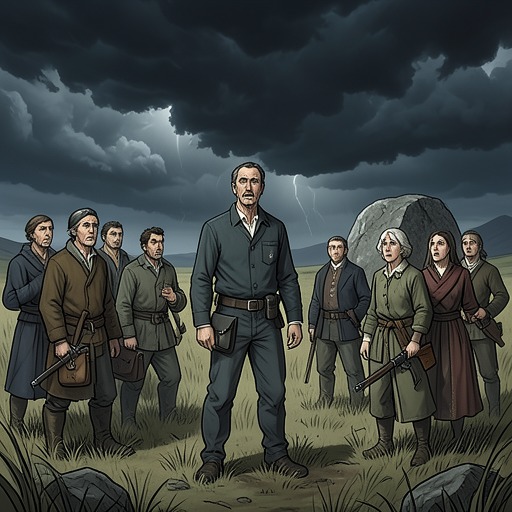
In September 1959, Loïc had not yet returned to school. Rubella kept him in Touladi until the middle of the month, so he learned there what happened before dawn on September 11. A sudden red blaze lit the dirt road along the rang de la Croix and the edge of the forest. Terrible cries alarmed dogs, whose barking spread through the village. Neighbors arrived with buckets, only to encounter cats with burning-looking eyes that yowled and fled as they approached. Chickens clucked and fluttered around what remained of La Grébiche’s home.
The fire had already consumed the small house and adjoining shed, where piles of papers and old belongings made the buildings a ready fuel source. The blaze was too intense for anyone to approach. A truck arrived with hoses and a pump; among its three men was Gilbert Rougeau, who acted as the municipality’s police officer. He ordered the onlookers back and marked out a boundary while the others fought the flames. At daylight, only blackened beams and a heap of charred debris remained. Rougeau and his companions searched the smoking wreckage as the crowd strained to see from behind the perimeter.
An Unresolved Disappearance
The authorities eventually treated the charred remains as La Grébiche’s, but they could not identify them. After the few remains had been buried, Rougeau ordered them exhumed in the name of the law and taken to Rivière-du-Loup for further examination. The account never establishes what became of the little that remained of the body. Thus the official identification did not resolve the more troubling question at the heart of the episode: whether La Grébiche had died in the fire at all, or what had happened to her.
The civil authorities closed the case in a terse report, kept in the archives and never made public. It recorded that Lucie Dubé, of the municipality of Saint-Michel de Touladi, had been found burned in her house beyond any possibility of identification. The fire was attributed, without further detail, to an apparent accident. The most reasonable explanation in the village was that she had knocked over the oil lamp she used because she had no electricity; the flames then reached the petroleum she stored in the shed, accounting for the fire’s violence. Loïc later considered another possibility: that La Grébiche might have set the fire herself. Neither explanation is confirmed.
The Curse and the Village Rumor
The attempt to bury the matter did not prevent stories from spreading through Touladi and the surrounding countryside. One version endured even as the villagers dispersed: La Grébiche had been murdered and burned to conceal the crime. Rumor supplied a possible culprit in Romuald Bolduc, Touladi’s richest and most powerful man, who had hated her for years.
The story attached that suspicion to a public quarrel. On September 7, Maurice Duplessis had died. Romuald, a fervent supporter whose fortune and local power had been secured by the government’s lucrative rural-electrification contracts, argued with La Grébiche in the village street two days before the fire. She told him Duplessis’s death marked the beginning of his end. Romuald nearly attacked her, showering her with insults and curses. The old accusations against La Grébiche resurfaced: her reputation as the village prostitute, her supposed connection to the Founder, and her pagan magic and witchcraft. In the villagers’ telling, she answered Romuald with a curse on him and his whole family, extending to the last of his descendants. His wife had given birth to his last son the day before the quarrel, and the villagers remembered the newborn as the curse’s immediate object. The story makes the fire’s timing ominous, but leaves the accusation of murder as rumor rather than established fact.
Loïc’s Retrospective Recognition
In autumn 2001, Loïc is preoccupied with Roger Bolduc’s mysterious disappearance when he realizes that his cousin had turned forty-two only days before the attacks in New York City. He then recalls the strange event that took place in Touladi only days after Roger’s birth: La Grébiche’s disappearance on September 11, 1959. The date’s recurrence does not prove a connection, but it changes how Loïc reads the old village story. The curse, once preserved as gossip around an unidentified death, now seems to echo forward into the disappearance of a Bolduc descendant amid the falling towers.
Loïc also imagines La Grébiche’s removal in biblical terms, comparing her to Elijah, whose name his father bore, and wondering whether she had been taken up to heaven in a chariot of fire. His response is not simply fear: he smiles at the thought because he has a weakness for this singular woman. The fire remains both an account of a likely accidental death and an opening through which the story entertains a supernatural interpretation.
The Dream Before the Fire
Loïc remembers, in fragments, a strange dream from the eve or night of La Grébiche’s death. Since childhood, he has experienced phenomena of this kind and understands significant events as sometimes announcing themselves beforehand. The dream’s procession is a mixture of religious pageantry and political menace: villagers in their Sunday clothes carry Sacred Heart banners, scapulars, papal standards, and crosses bearing the instruments of Christ’s Passion, which subtly become sickles and hammers. Black-clad Dames of Sainte-Anne pull white-dressed girls, bound together by an enormous rosary, like Joan of Arc on the pyre.
The dream also folds Loïc’s school anxiety into the vision. A classmate keeps asking whether he has finished his assignment, while their old rhetoric teacher, dressed as a formidable Cid, leads the procession and turns back with a severe look. Loïc is late with an essay on the spiritual mission of French Canadians in America. In retrospect, the dream’s religious symbols, political transformation, and image of bound children gather around the fire without explaining it. The narrative preserves the uncertainty of its timing—whether the dream came the night before or on the night of the death—and makes that uncertainty part of the date’s force: an event remembered first as a village catastrophe, then reassembled as a possible warning.