Bombay Municipal Corporation Department of Health
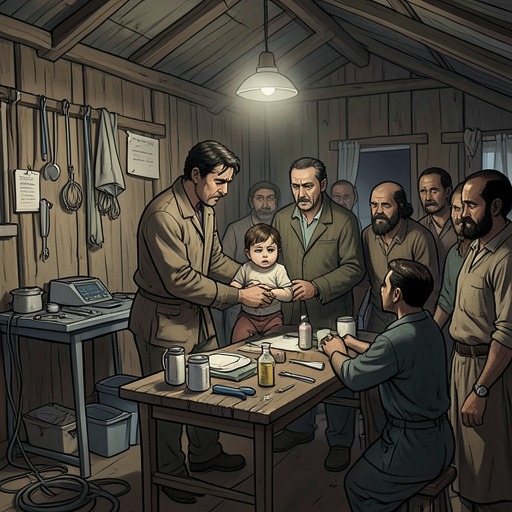
ShantaramThe Bombay Municipal Corporation Department of Health is the public authority responsible for responding to disease outbreaks in the city, but its appearance during the slum cholera crisis is defined by a gap between its formal responsibility and its limited capacity. Through official Sandeep Jyoti, the Department offers practical assistance without promising that it can remove the burden of care from the residents. Its response makes both the value and the limits of public health intervention visible: some patients can be transferred, supplies and volunteers can be arranged, but the community must contain most of the outbreak itself.
Public Health Under Strain
The Department enters the account after cholera spreads rapidly through the slum. Cases rise from ten serious illnesses and a dozen suspected cases by nightfall to sixty advanced cases and roughly a hundred people showing symptoms by the following day. Radha, a neighbour of Lin, dies before the Department’s official assesses the settlement. The outbreak is not presented as an isolated local emergency: Jyoti reports twelve other outbreaks between the slum and Kandivli, including a severe one in Thane with more than a hundred new cases each day. Local hospitals are already overcrowded, and the monsoon has produced conditions in which further outbreaks are expected.
That wider pattern explains the Department’s constrained response, but does not make the consequences less severe for the residents. Lin presses for hospital care for the slum’s sick, while Jyoti explains that only critical cases can be taken. He will arrange those transfers, but cannot admit everyone; other hutments are facing the same limits. Rather than conceal the shortfall, he tells the residents that they will have to fight the disease in place and get through it themselves. The Department’s official thus acts as both a link to scarce formal services and the bearer of an institutional refusal imposed by scarcity.
The Department’s Response
Jyoti does not leave the settlement without offering further support. After Doctor Hamid asks what help the authorities can provide, Jyoti undertakes to send trained volunteers as soon as the city can spare them and to give the request priority. He also commits to arranging a delivery of oral rehydration salts as soon as possible. These are specific, limited promises: assistance will reach the slum, but not immediately, and the supplies are being allocated in a city already stretched by multiple outbreaks.
The salts are especially important because the residents have begun organizing care before the Department can deliver its promised stock. Doctor Hamid has obtained supplies from lepers associated with Khader Khan, and Lin is administering them, while warning that some patients are too ill to keep the solution down. Jyoti asks where the salts came from and then pledges additional supplies. The exchange shows the Department building on an existing local effort rather than initiating the response itself; its role is to add support to an improvised system already operating under pressure.
Community Action and Institutional Limits
After the official departs, Qasim Ali Hussein takes charge of the local response and turns his home into a command centre. At a meeting attended by about twenty residents, the group plans to purify water in the holding tanks and in the pots and buckets used across the settlement’s seven thousand huts. Qasim Ali gives Johnny Cigar a large bundle of rupee notes to buy purification tablets and other medicines. Residents also arrange disinfectant-filled trenches in the lanes, safe waste-disposal bins, antiseptic soap for households, and soup kitchens serving boiled food in sterilised cups and bowls. Another team is assigned to carry the dead to the hospital. Lin’s task is to oversee the rehydration solution and prepare a homemade mixture when necessary.
The Department’s promise of outside help therefore sits alongside a much larger programme of local labour and coordination. Jyoti recognizes that the residents have already made a start and expresses confidence that they can manage more than they presently believe. His encouragement does not erase the distinction between state assistance and community responsibility: residents must organize essential prevention and care while waiting for the supplies and volunteers he has promised. The outbreak reveals how public health depends not only on official response but also on residents’ ability to carry out practical measures in their own homes and lanes.
Earlier Barriers to Care
The crisis also follows a longer-standing difficulty in accessing medical services. Lin, who has first-aid training but is not a licensed doctor, has been treating around fifty people a day in the slum. When he cannot identify an illness, he refers patients to St. George Hospital, yet many return without having been seen. Hospital staff have explained that they are overwhelmed, and that referrals from licensed practitioners could help patients move ahead in the queue. The residents, however, cannot afford the consultation needed to obtain such a referral. This earlier account is about access to care rather than a specific Department decision, but it clarifies the conditions in which its outbreak response takes place: poverty and overcrowded services already prevent residents from turning medical need into timely treatment.
Lin’s description of his clinic as serving his people marks a change in his relation to the settlement, while the Department’s appearance tests what that belonging can accomplish. Public authority can arrange transfers, volunteers, and medical supplies, but its capacity does not match the scale of need. The narrative places the official response beside the residents’ water purification, sanitation, food preparation, and treatment work, making the limits of institutional help concrete without treating that help as absent. The Department is neither a complete remedy nor a mere symbol of neglect; it is a strained service whose partial intervention leaves the community carrying most of the immediate work of survival.