Event 1
Lin’s prison escape
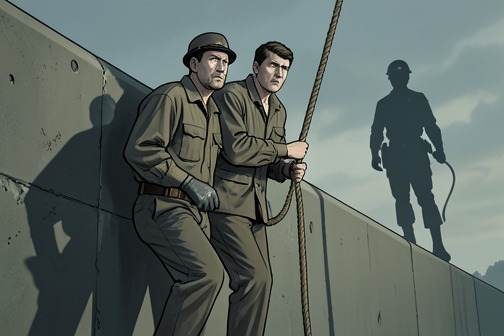
[Lin’s prison escape](entity:event-recall-event-lin-s-prison-escape-68c383b4e006) is the audacious break from a maximum-security prison that turns confinement into the beginning of his fugitive life. Planned with a fellow prisoner and carried out in broad daylight, it depends on using ordinary prison routines as cover: the two men are maintenance gardeners, the security building is being renovated, and guards accustomed to seeing them eventually look away. The escape is meticulous only up to the point where the plan meets the building’s thick roof; beyond that, improvisation, danger, and nerve determine whether the men can get out.
## Identity and Stakes
The escape is recounted by [Lin](entity:character-recall-character-lin-428ebd96b429) as a defining threshold in his life. He describes the attempt as taking place at one o’clock in the afternoon, over the prison’s front wall and between two gun-towers. Its stakes are immediate: if the plan fails, the guards in the punishment unit may kick the prisoners to death. The danger is not abstract, and neither is the freedom they are pursuing. Lin later frames his escape from prison as a condition that must be renewed day and night: reaching another country does not end the fugitive life, but begins another phase of it.
The escape also marks the first link in a much wider chain of consequences. After getting out, Lin becomes his country’s most wanted man. Nearly two years later, he reaches [Bombay](entity:location-recall-location-bombay-b9f73c3bdba6) using a false [New Zealand](entity:location-recall-location-new-zealand-a25d5a689a9c) passport, having crossed another border and entered a new country while still hunted. From there, his life will bring him into the [Bombay mafia](entity:organization-recall-organization-bombay-mafia-f8c586818a2e) and into work as a gunrunner, smuggler, and counterfeiter. The prison break does not make him secure or erase his past; it gives him a precarious freedom that has to be protected through continual movement.
## Planning and the Opening
Lin and his accomplice are alone in the attempt. The other prisoner is a big-hearted twenty-five-year-old serving a life sentence for murder. They approach eight tough prisoners, all serving long sentences for violent crimes, but each declines. Lin does not condemn them: he recognizes that a plan that looks heroic if successful could seem insane if it fails. The two who proceed are young first offenders without established reputations in the prison system, and their isolation makes the decision more exposed as well as more urgent.
Their opportunity comes from extensive renovations to a two-storey security-force office and interrogation block near the main entrance. The men work there as maintenance gardeners, so the guards on duty see them regularly. On the day of the escape, the guards watch them for a while, as they usually do, then turn away. The building is empty, and the renovation workers are at lunch. The men exploit a brief gap created not by defeating the guards’ surveillance but by becoming familiar enough to escape its attention.
They cut through the chain-link fence around the renovation site, force open a door, and climb through the deserted building. Its unfinished interior exposes uprights and load-bearing beams; dusty bare steps are strewn with brick and plaster fragments. At the top floor, a manhole opens into the roof-space. Lin climbs onto his friend’s shoulders, breaks through the wooden trapdoor, and gets into the ceiling. He has brought an extension cord concealed beneath his coveralls. He fixes it to a roof beam and lowers the other end so his friend can climb up after him.
## The Roof and the Race Against Discovery
The roof runs in zigzag waves. The pair crawl toward the narrowing space where it meets the prison’s front wall, choosing a trough whose neighboring peaks may conceal their opening from the gun-towers. In the dark roof-space, Lin uses a cigarette lighter for light. With a long screwdriver, a chisel, and tin snips, the men begin cutting through the hardwood beneath the outer sheet of tin. After fifteen minutes of hacking and scraping, they have made only a small hole, about the size of a man’s eye. The wood is too thick for their hand tools to produce an opening large enough to escape through quickly.
Time, rather than the guards’ immediate presence, becomes the trap. Lin estimates that they have about thirty minutes before a routine check. They still need to cut through the wood and tin, get onto the roof, recover the extension cord, and use it to descend the outer wall. Meanwhile, any guard might find the cut fence, broken door, or smashed manhole. His companion urges retreat, but Lin recognizes that returning would expose their damage and identify them as the only men permitted in the area. The escape has passed a point where simply abandoning it can restore safety.
The solution is the power saw resting near the building’s door, but retrieving it requires Lin to descend and enter the open gate area. He slides down the cord, creeps downstairs, ties the cord to the saw’s handle, and returns to the roof-space. Then he has to go out again to plug in the cord. Armed guards are talking less than twenty metres from the door. Lin waits until their attention is directed elsewhere, steps outside, connects the cord, and slips back in without being seen. His friend hauls up the saw. In the roof’s dark corner, Lin holds the lighter while the other man cuts. Four rapid cuts make a square opening in the hardwood and reveal the tin beneath it.
The saw’s noise brings a fresh moment of suspense: the men hear a telephone ring at the main gate and think they have been discovered. A guard answers and continues talking and laughing; the workers’ renovation noise gives the guards a reason to dismiss the sound. Lin punches through the tin with the screwdriver, widens the hole, and cuts a flap on three sides. Together, they push it outward. The opening leads into a trough of the roof, a blind spot where the men can lie beyond the tower guards’ view. The prison wall is close, but the route out is not complete.
## The Threshold and Its Consequences
The extension cord, still plugged in downstairs, is their only rope for climbing down the outside wall. One of them must return through the door in full view of the guards, unplug it, and climb back into the roof. Lin knows the task has fallen to him. At the door, he presses himself against the inside wall, breathing hard and feeling dizzy and nauseous; he tries to summon the strength to move into the open, but cannot make himself do it. The narration’s detailed account pauses at this hesitation, after the men have cut their way into the roof but before the cord has been recovered and the descent made.
The outcome is nevertheless established: Lin escapes over the front wall between the gun-towers. The tension between that completed fact and the scene’s pause at the threshold gives the escape its human scale. [Freedom](entity:concept-recall-concept-16bc935c6e52) is achieved neither by a flawless plan nor by fear disappearing, but through a sequence of exposed decisions made while fear remains. The later consequences are vast—an ongoing fugitive existence, flight across borders, and [Lin’s arrival in Bombay](entity:event-recall-event-88a3cc57edb1)—but the break itself turns on a small, immediate question of movement: whether he can step back into the guards’ sight to retrieve the rope that will carry him out.
Event 2
Lin’s arrival in Bombay
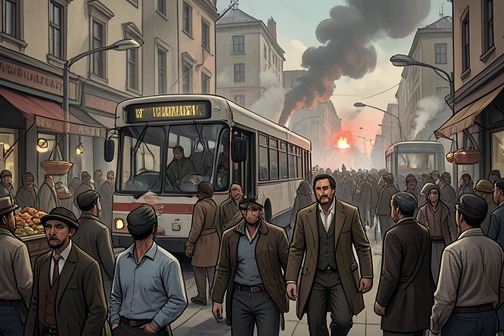
[Lin’s arrival in Bombay](entity:event-recall-event-88a3cc57edb1) is both a border crossing and the tentative beginning of a homecoming. He reaches [India](entity:location-recall-location-india-39df7eae59c1) as an escaped prisoner using a forged passport, with freedom still precarious and no settled destination beyond the city. The arrival’s decisive turn is modest but consequential: when asked whether he will stay or continue elsewhere, he chooses [Bombay](entity:location-recall-location-bombay-b9f73c3bdba6) for a while. The city becomes the place where a fugitive without a plan begins to imagine remaining.
## First Impressions of the City
[Lin](entity:character-recall-character-lin-428ebd96b429)’s recollection begins with the city’s smell, which he registers before seeing or hearing anything of India. In retrospect, he understands it as carrying the oppositions that will shape his account of Bombay: hope against hate, greed against love, and life amid both renewal and decay. Its associations range from the sea and machinery to the crowded activity of people and animals, and from restaurants and places of worship to bazaars devoted to perfumes, spices, incense, and flowers. The impression is not a single picturesque detail but a compressed portrait of a city containing competing forms of life. Lin later connects that first impression to belonging: the city’s familiar smell welcomes him when he returns.
Heat and people follow smell in the sequence of his attention. After leaving the climate-controlled plane, Lin waits in airport queues as the humidity makes the new climate immediately physical. He describes learning that Bombay’s wet heat persists through both day and night, presenting adjustment as a condition of staying: one learns to live with it, or leaves. The people he notices make another kind of first impression. He recalls the many regions, communities, religions, castes, and appearances represented in Bombay, seeing the city as a concentrated encounter with India’s variety. These observations establish that arrival is not simply entry into a new country; it is an encounter with a place whose scale and differences exceed his ability to take them in at once.
## Crossing the Border Under a False Identity
At the airport, Lin’s immediate concern is not to announce himself but to pass without attracting attention. He travels from [Auckland](entity:location-recall-location-auckland-96f279f578c2) on a [New Zealand](entity:location-recall-location-new-zealand-a25d5a689a9c) passport whose photograph he has replaced himself. The forgery is imperfect: he believes it can survive a routine inspection, but knows that further checking with the New Zealand High Commission could expose it. His freedom therefore depends on a document that offers passage without security.
Lin has prepared for the control by finding a small group of New Zealand students on the flight. They are making their second trip to the subcontinent, and he cultivates a slight acquaintance by inviting them to share their experience and travel advice. At the airport, Indian officials assume he belongs with the relaxed group and give him only a cursory check. He gets through not by persuading them of a detailed invented story, but by appearing to travel alongside people whose genuine documents and untroubled manner make his presence seem ordinary.
The retrospective narrator distinguishes this improvisation from the smuggling knowledge he will acquire later. At the time, Lin does not understand the broader tradecraft of smugglers and their use of unsuspecting fellow travellers. His sole contraband is himself: his vulnerable, hunted freedom. That distinction gives the border crossing its particular tension. The technique is improvised, but the risk is real, and passing control offers only temporary safety rather than a final escape.
## A Fugitive’s Continuing Escape
Outside the airport, Lin experiences the crossing as exhilaration, but the narration immediately qualifies that release. He had escaped from prison almost two years earlier; the fugitive’s life, he explains, requires another escape every day and night. Reaching Bombay does not erase the danger attached to his past. He is still not completely free, and the new passport and country bring hope alongside fear rather than resolving either one.
The moment at the airport therefore marks a change in location, not an end to flight. Lin stands beneath the Bombay sky with a sense of possibility, but that possibility remains inseparable from the need to run and hide. The contrast between the apparent simplicity of arrival and the ongoing labor of staying free becomes central to the event: a border can be crossed in minutes, while the fugitive condition continues beyond it.
## Choosing to Stay Without a Plan
When a fellow traveller asks whether he is checking into a room or passing through Bombay, Lin admits that he does not know whether he wants to stay or continue somewhere else. He has no plan, and at that moment he accepts the description of himself as a brave, hard man without one. He nevertheless says he thinks he will stay in Bombay for a while. His answer is provisional, not a declaration of a settled future.
The other traveller offers to share a room with him and a companion for the night before they catch the train the next day. Lin considers accepting because their genuine documents and easy manner might help conceal his false passport. Even after choosing to remain in Bombay, he assesses the offer through the practical caution of a man still protecting his assumed identity. The decision to stay and the instinct to hide coexist: the city offers a possible beginning, but Lin enters it still measuring safety one step at a time.
The event also establishes the retrospective shape of Lin’s story. He frames his life in Bombay as beginning with the city, a woman, and luck, and recalls that his first sight of [Karla Saaranen](entity:character-recall-character-karla-saaranen-a746f810c961)’s green eyes would become part of the hand he began to play there. The arrival thus points toward relationships and choices not yet developed in this scene, while its immediate outcome remains small and open-ended: Lin has made it through the airport and decided to stay, without knowing what that choice will lead to.
Event 3
Lin and Prabaker’s first meeting
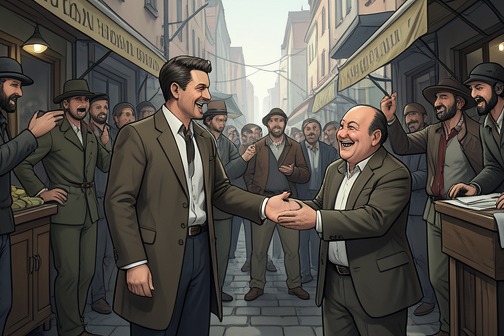
[Lin and Prabaker’s first meeting](entity:event-recall-event-d9c406e8183a) turns a crowded [Bombay](entity:location-recall-location-bombay-b9f73c3bdba6) arrival into the beginning of a lasting friendship. [Lin](entity:character-recall-character-lin-428ebd96b429) steps from the bus amid aggressive touts, gives a false name, and asks for a cheap hotel; [Prabaker](entity:character-recall-character-prabaker-f1cb57f00b87) answers with comic confidence and an offer to guide him. What starts as a practical bargain grows, over their first days together, into a relationship Lin identifies as friendship.
## The encounter at the bus
Lin reaches the foot of the bus’s steps only to find the pavement blocked by touts, street operators selling hotel rooms and other bargains to arriving passengers. They shout in broken English and jostle for attention. At the front of the crowd stands a small man with a nearly round head, dressed in a denim shirt and blue cotton trousers. He calls for silence from the others and greets the newcomers with a wide, radiant smile.
The first exchange is not simply a contest over who will secure a tourist. Lin is struck by the quality of Prabaker’s smile, which he remembers as mischievous and exuberant rather than merely happy. Their eye contact lasts only a moment, but Lin decides to trust him. Looking back, he calls that decision one of the best of his life: the narrative gives this ordinary arrival the shape of a threshold, before either man can know what the connection will become.
The surrounding disorder makes the meeting concrete. Other passengers beat and swat at the touts, while two young Canadian travellers move through the crowd without being harassed. Lin accepts their offer to share a room, and their company briefly makes his past as an escaped prisoner feel invisible. Prabaker then takes hold of Lin’s sleeve and leads him away from the fractious crowd. As the bus conductor throws luggage down from the roof, bags tumble onto the pavement and passengers rush to protect their belongings. Prabaker’s first act of guidance is thus literal: he steers Lin and his bags out of the crush to a quieter spot nearby.
## Names, work, and the first bargain
There, Prabaker introduces himself as a Bombay guide and asks Lin’s name. Lin gives the name Lindsay, taken from his false passport, rather than his own. The meeting therefore begins with an asymmetry: Prabaker openly offers his identity and occupation, while Lin presents the name that helps conceal his fugitive past. Lin’s invented name does not prevent him from accepting help; instead, the exchange establishes the guarded circumstances under which their acquaintance begins.
Prabaker advertises his knowledge of the city in extravagant terms, promising to show Lin everything and even more than everything. Lin’s immediate request is more limited: he wants a clean, cheap hotel room. Prabaker replies by distinguishing among several levels of cheapness, including a hotel so inexpensive that a sensible person would not stay there. The joke turns his sales pitch into a small display of personality, but the scene also keeps their arrangement practical. Lin has a concrete need, and Prabaker presents himself as the person able to meet it.
When Lin mock-seriously asks whether he needs Prabaker, Prabaker answers with theatrical alarm about the terrible things that might happen without his guidance. Lin then tells his travelling companions that he will pay the guide. They shrug and lift their packs, and Lin agrees to follow. Prabaker swiftly takes Lin’s pack and insists on carrying the luggage himself. The decision to hire him is Lin’s, but the exchange already gives the service a personal texture: Prabaker does not merely point the way; he physically takes on part of the burden.
## From paid guide to companion
The arrangement expands beyond finding accommodation. Lin offers to pay Prabaker for the whole week and asks him to show him Bombay and teach him something about the city. He adds that there will be a bonus at the end if the arrangement works out. Prabaker’s smile brightens, but his reply is notably sombre: he calls it a very good decision. The contrast between Lin’s provisional, businesslike terms and Prabaker’s serious response marks a shift in register. A hiring agreement is still being made, yet Prabaker treats its promise as weightier than a simple fee for services.
Their joking continues around money and the next outing. Prabaker proposes finishing the charras bought at the business price before buying more at a friendship price for both of them. The joke makes friendship sound like a pricing policy, but it also shows the two men turning an ordinary transaction into shared language. Lin laughs with him, puts an arm around his shoulder, and leads him into a busy restaurant. The physical gesture and the laughter give the emerging bond a reciprocal quality: Lin is no longer only being led around the city; he now takes Prabaker with him.
Later, Prabaker himself declares that he thinks he is Lin’s very good friend and calls them lucky fellows. Lin answers that perhaps they are. The exchange is playful rather than solemn, but its timing matters. The relationship has moved from a decision to hire a guide, through shared plans and joking over prices, to an explicit naming of friendship. Neither man offers a grand explanation; their mutual recognition is carried by the ease of the exchange.
## Significance of the meeting
That night, Lin lies awake beneath a revolving ceiling fan while images of Bombay turn through his mind. He is tired but unable to sleep, and feels hope and possibility. No one from the world he has left knows where he is, and no one in Bombay knows who he is; in the shadows, he feels almost safe. This reflection places the meeting inside the larger condition of his arrival: Bombay offers anonymity, but his first meaningful contact in the city is with someone he chooses to trust.
The scene’s decisive change is modest and human in scale. Lin does not cease to be a fugitive, and the false name remains part of his introduction. What changes is that he begins his new life not entirely alone: he accepts Prabaker’s guidance, commits to spending a week learning the city, and recognizes the possibility of friendship in the exchange. The encounter establishes a pattern in which practical help, humour, and personal loyalty grow together, making the first guide Lin hires one of the first people through whom Bombay becomes more than a place of concealment.
Event 4
Lin and Karla’s first meeting at the betel-nut stall
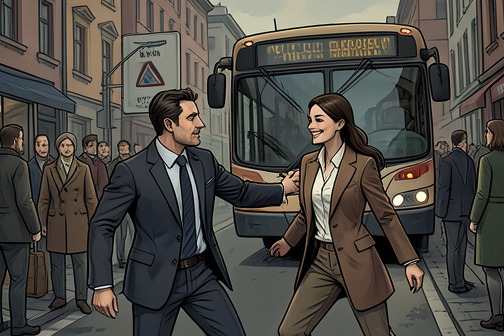
[Lin and Karla’s first meeting at the betel-nut stall](entity:event-recall-event-d197b05706e1) begins with a near accident in [Bombay](entity:location-recall-location-bombay-b9f73c3bdba6) and turns, within a few minutes, into an encounter that [Lin](entity:character-recall-character-lin-428ebd96b429) understands as fateful. [Karla](entity:character-recall-character-karla-3f7aa8a8ae5c) pulls him back from a passing bus, introduces herself through a teasing exchange, and invites him to [Leopold’s](entity:location-recall-location-leopold-s-1d82f936fa9e) Beer Bar. Lin’s later account gives the moment its weight: before either knows the other, he experiences an immediate attachment that he frames through legends of destined love, while the scene itself leaves the promise between them uncertain.
## The Stall and the Near Accident
The encounter takes place while [Prabaker](entity:character-recall-character-prabaker-f1cb57f00b87) and Lin stop at a crowded street stall. The vendor sells cigarettes and prepares paan from spear-shaped leaves, pastes, ground dates, coconut, and spices. Customers gather around the table, and Prabaker presses close to place his order. Lin tries to watch the vendor’s work through the crowd, moves toward the edge of the footpath, and steps down toward the road. The meeting is therefore set in motion by the ordinary bustle of the stall rather than by a planned introduction.
A double-decker bus passes as Lin steps into its path. Karla grasps his arm and pulls him back, preventing the bus from hitting him. Her first words acknowledge how close the danger was and how lucky he is. Lin answers that he is lucky, making the encounter’s first connection plain: before names, flirtation, or any account of their lives, Karla has intervened to keep him safe. The action gives the meeting an immediate life-or-death edge without turning it into a prolonged crisis; the danger passes, but the rescue becomes the circumstance Lin remembers as their beginning.
## An Introduction Marked by Distance
Lin’s first impression of Karla is shaped by her appearance and bearing. He notices her black, shoulder-length hair, pale skin, straight-backed posture, and clothes in different shades of green. Her smile seems ironic, and her manner conveys confidence. The description is not merely a list of features: Lin interprets her self-possession as something others might mistake for arrogance or impassivity, while he believes he sees a more complicated person. This is his first reading of her, not knowledge established by the brief meeting itself.
After she has pulled him back, Karla’s hand remains on his arm for a moment. Lin describes the contact as unexpectedly intimate and imagines a gesture he does not make: taking her hand and placing it against his chest. In his retrospective telling, he also speculates that she would have laughed and liked him had he done so. The scene thus distinguishes what happens from what he later imagines might have happened. They hold one another’s gaze for several seconds, but neither turns the pause into a declaration; their first exchange remains between strangers.
Lin asks whether Karla is always so helpful. She replies that she is not, and, when he asks how much of the devil is in her, treats the question as unusually personal. Her answer is playful but guarded: she does not explain herself, instead suggesting that he could find out if he came to Leopold’s. The invitation offers a possible continuation, while her teasing leaves its meaning open. Karla then shakes his hand with a firm grip that Lin cannot confidently read. He cannot tell whether she likes him or is simply pleased to say goodbye.
## Friends, Names, and an Invitation
A young man among Karla’s companions calls to her by name and urges her to come over. She turns, waves, and joins the group. Her friends are young Indians in fashionable Western clothes; they laugh and lean familiarly against one another, but Lin notices that no one touches Karla. He reads her as both attractive and difficult to approach. These observations place her among a social circle already at ease with one another, while Lin remains outside it, listening without understanding the language of their conversation.
Prabaker returns with the paan and identifies the woman Lin has been watching as Karla. His simple confirmation supplies the name that Lin has not yet learned directly from her. Lin had accepted the paan partly as a reason to stay near the stall longer, and he compares Karla’s apparent comfort in Bombay with his own sense of being an outsider. She seems to belong to the city and to draw warmth from the people around her. The contrast makes his attraction social as well as personal: he is drawn not only to Karla but also to the ease with which she inhabits a place he is still trying to understand.
## Retrospective Meaning
The encounter’s decisive shift is from accidental rescue to the possibility of renewed contact. Karla’s intervention establishes a brief bond, her name gives Lin a way to remember her, and her invitation to Leopold’s leaves open a next meeting. Yet the scene does not resolve what she feels. Her smile, handshake, teasing, and departure remain open to more than one interpretation, while Lin’s attention quickly settles on what he hopes they mean.
In retrospect, Lin sets that uncertainty beside the Sanskrit legends of karmic love: the idea that destined lovers recognize one another immediately, and the warning that such a bond may be possessed or felt by only one of them. His heart responds before he has evidence of mutual attachment, and the narration explicitly holds passion and caution together. The scene’s importance lies in that tension. Karla has saved him and offered a way to meet again; Lin, meanwhile, turns a fleeting encounter into the beginning of a love story whose reciprocity the moment itself cannot yet confirm.
Event 5
Prabaker names Lin Linbaba
[Prabaker names Lin Linbaba](entity:event-recall-event-e7dbc371d06e) in a small exchange that the narrator later recognizes as a turning point in his life. The name starts as a practical shortening of [Prabaker](entity:character-recall-character-prabaker-f1cb57f00b87)’s own short name, Prabu, but quickly acquires a public form and a larger meaning. [Lin](entity:character-recall-character-lin-428ebd96b429) accepts it almost casually; in retrospect, he sees that this act helped shape the person he became.
## From Prabu to Lin
The naming conversation begins as the two men are walking together. After declining, for the moment, an invitation to go somewhere, Lin asks what Prabaker’s friends call him for short. Prabaker answers that his short name is Prabu. Lin tries it aloud, then asks whether Prabaker knows Lin’s own short name. The exchange turns an ordinary question about familiarity into an offer of a new identity.
Prabaker proposes Lin, explaining that a short name would suit him and checking that Lin has no objection. Lin agrees. The choice is not presented as a formal renunciation of his earlier identity, but its context gives it weight: since escaping, he has assumed numerous other names in different places, and other people have given him names as well. Those names have been part of living under concealment and movement. Lin has also been sentenced under the secret name he was born with, a name bound to his former life and its twenty-year prison term.
## A name that feels ordained
Lin’s acceptance is immediate, but his later account distinguishes this name from the aliases that preceded it. He could not have invented Lin for himself; nevertheless, it sounds right to him. The name seems to carry an echo of something ordained, as though it belongs to him as surely as the lost name under which he was sentenced. His response combines practical acquiescence with a fatalistic sense of recognition: he accepts a name chosen by someone else because it feels as if it has already found him.
That contrast gives the scene its central reversal. Lin has repeatedly been compelled to take on new names, yet Prabaker’s suggestion does not register as merely another imposed disguise. At the moment, Lin cannot know the scale of the name’s eventual reach. Looking back, he describes the decision as an apparently insignificant yes-or-no choice that became pivotal. The smallness of the gesture is essential to its force: a life-shaping identity enters through a casual question between companions, not through a public ceremony or a deliberate plan.
## From private name to public address
Prabaker soon extends Lin into Linbaba. He introduces his companion to Mr. [Sanjay](entity:character-recall-character-sanjay-d03f09b872a7) Deshpande as Lin, then, when asked to repeat the name, identifies him as Linbaba. The repetition makes the naming social: it is no longer only a suggestion exchanged between the two men but an address Prabaker offers to another person.
Prabaker explains that baba is an honorific used to show respect, including toward a teacher, a holy person, or someone very old. Lin remains uncomfortable with the added form, despite understanding its respectful intent. Prabaker, by contrast, is delighted by the name and treats Mr. Deshpande’s response as evidence that it has landed well. He then calls out Linbaba to strangers passing on the street, turning a private naming into a small public announcement. Lin tugs at Prabaker’s sleeve and urges him to calm down and keep moving, an amused resistance that does not undo his acceptance of Lin.
## The identity Lin grows into
The narrator’s hindsight expands the scene far beyond its immediate participants. He says that thousands of people would come to know him by the name, from [Colaba](entity:location-recall-location-colaba-2bd495476f0e) to [Kandahar](entity:location-recall-location-kandahar-06ce6574e7a2) and from [Kinshasa](entity:location-recall-location-kinshasa-c91b9ddb95ed) to Berlin. Prabaker, whom Lin identifies retrospectively as a little [Bombay](entity:location-recall-location-bombay-b9f73c3bdba6) street guide, could not have known that reach when he made the suggestion. The narrative therefore holds together two scales: the ordinary intimacy of one person naming another, and the long movement through which that name becomes widely recognized.
Lin’s later judgment is stronger than the claim that the name simply became familiar. He says that the role he played under it, and the character he became as Linbaba, were more real and truer to his nature than anyone or anything he had been before. The name does not erase the past identities or the sentence attached to his birth name; instead, it comes to organize a more authentic version of the self that emerges after escape. In that sense, Prabaker’s casual suggestion acts as an accomplice to fate: the name is given without foreknowledge, accepted without ceremony, and understood only later as the beginning of a consequential identity.
Event 6
The Bombay passport-business war
[The Bombay passport-business war](entity:event-recall-event-c28ef68f75ae) was a struggle for control of the city’s passport-book trade, disclosed by [Didier](entity:character-recall-character-didier-381547eab195) as its victors entered [Leopold’s](entity:location-recall-location-leopold-s-1d82f936fa9e) Beer Bar. No battle is shown directly: its scale and cost emerge through a former operator’s displacement, the deaths of his men, and the arrival of the faction that now controls the business. Didier’s warning that the books would continue to be stamped in blood makes the trade’s transfer a change of power, not a settlement of the violence behind it.
## Causes and Background
The conflict concerned what Didier first calls a black market in books, then identifies as passports. [Rafiq](entity:character-recall-character-rafiq-75da08d4ef79), an Afghan whom Didier recognizes among two men at a nearby table, had once run that market and been its boss. The evidence establishes a contest over the passport business, but not its precise beginning, duration, or sequence of attacks. Didier summarizes its central reversal: Rafiq lost the book business, and his side lost men in the struggle.
The loss did not leave Rafiq without an income. He now moved brown sugar through [Pakistan](entity:location-recall-location-pakistan-041a2aec3e49), a more profitable trade than passports, according to Didier. But greater earnings had not erased his bitterness at losing the former business. That contrast makes the conflict about more than immediate revenue: the new trade may pay better, yet it does not replace Rafiq’s former position as the passport operation’s boss. The account does not explain why he could not reclaim that position or whether he continued to challenge the victors.
## The Rival Factions
Didier identifies the winners through a chain of authority. Bairam, an Iranian, is described as an enforcer working for [Abdul Ghani](entity:character-recall-character-abdul-ghani-d1a4aca9ef78), who in turn works for [Abdel Khader Khan](entity:character-recall-character-abdel-khader-khan-822d0cbbc88e), one of [Bombay](entity:location-recall-location-bombay-b9f73c3bdba6)’s great crime lords. Bairam and his men are therefore not presented as an isolated group of successful traders; their control of passport books sits within a larger criminal hierarchy. The exact roles of Ghani and Khader in the fighting are not specified, but Didier’s account locates the victors’ business within their organization.
The scene sets the two sides apart without showing a confrontation. Rafiq and his companion sit with a group of friends; later, Bairam enters with young men in western jeans and jackets. The differences in dress and manner mark the groups as distinct presences in the same public room, while Didier’s recognition connects that ordinary meeting place to the trade’s violent history. These details do not establish that the groups threaten one another in the bar. They do show how Didier reads the arrivals: Rafiq represents the displaced business, while Bairam’s party represents its new holders.
## The War Recalled at Leopold’s
Didier speaks quietly while watching the men. Rafiq and his companion turn to stare after a third man at their table points toward Didier and [Lin](entity:character-recall-character-lin-428ebd96b429); the account does not establish that they heard Didier’s remarks or explain what they made of the gesture. The look nevertheless places Lin within the scene of Didier’s disclosure: a private explanation of the trade’s past has become visible to people associated with its factions.
When Bairam’s group arrives, Didier identifies them as the victors and says they now control the passport-book business. The account offers no raid, negotiation, or decisive clash to explain how they won. Its emphasis is on the result: the former boss has been displaced, his men have been killed, and a different faction has assumed control. The war is thus narrated through the people and power relations left standing, rather than through a dramatized battle.
## Aftermath and Significance
Didier’s prediction is that control will remain bloody for a time. His image of passports stamped in blood links the practical business of the books to the deaths that made the transfer possible and to the violence he expects to continue. He admits that he would refuse to do business with the people involved if their business were not so good. His declared neutrality is therefore compromised by profit: he condemns the violence while acknowledging that its winners are useful partners.
The episode presents the passport trade as a market embedded in criminal power, where commercial advantage and organized force cannot be cleanly separated. Didier’s account makes clear who lost, who won, and through which hierarchy the victors operate, but leaves the individual acts of violence and the precise course of the war unstated. That gap gives his warning its force: the arrival of the victors confirms the outcome, while the business’s continued profitability offers no assurance that the struggle is over.
Event 7
Bombay opium-den closures
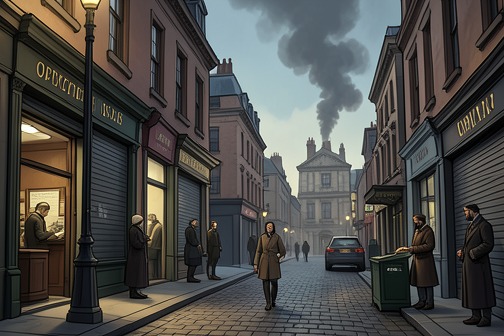
[Bombay](entity:location-recall-location-bombay-b9f73c3bdba6)’s opium-den closures were not simply a police crackdown: as [Didier Levy](entity:character-recall-character-didier-levy-bc900419ef54) explains them, they joined the Shiv Sena Party’s regional political ambitions to [Rafiq](entity:character-recall-character-rafiq-75da08d4ef79)’s commercial interests, turning the suppression of opium into an opening for heroin. The decisive consequence was a change in what poor smokers could obtain. The parlours were shut, but the trade did not disappear; it moved toward a more profitable drug, with costs that the novel later traces through addiction, overdose, and withdrawal.
## Political and Economic Background
[Didier](entity:character-recall-character-didier-381547eab195) introduces the closures while discussing a city in political transition. He points to Sainiks, workers for the Shiv Sena, sitting nearby, and describes the party’s politics as regional, language-based, ethnic, and organized around an us-against-them distinction. In his analysis, this was politics shaped by fear and by the pursuit of power rather than a neutral concern for public order.
His account connects that political movement to the distribution of influence in Bombay. He says the party had leverage over the police, whose lower ranks were largely Maharashtrian, as well as over many slums, unions, and parts of the press. He contrasts those sources of political control with the city’s industrial and illicit wealth, which he says was largely held by Parsees, Hindus from other Indian cities, and Muslims. The conflict over the opium dens therefore appears within a broader contest over who could control the city’s institutions, money, and trade.
Didier also situates the episode amid a change in the city’s name: Bombay had become Mumbai, though, as he observes, the maps had not yet changed. The closures belong to the same account of a city being altered incrementally, through political ambition and business arrangements as well as formal changes in naming. His remarks are an interpretation offered in conversation, not an impersonal account of government policy; the novel lets his anger and cynicism shape how the transaction is understood.
## The Closures and the Bargain
According to Didier, in the preceding months some Sainiks, not the most publicly prominent members, made a deal involving Rafiq, Afghans, and the police. In exchange for cash and concessions, the police closed all but a few of Bombay’s opium dens. Dozens of established smoking parlours were shut in one week, and Didier presents many as places that had served the community for generations. The speed and scale of the closures make the change feel less like a gradual decline in demand than a sudden rearrangement of access and power.
The transaction had a concealed economic logic. When [Lin](entity:character-recall-character-lin-428ebd96b429) asks what Rafiq gained from helping close the dens, Didier replies that the idea had been Rafiq’s. Brown-sugar heroin, known as garad, offered more money than opium. In Didier’s account, the former chandu smokers among the poor became garad smokers after the parlours closed. Rafiq did not control the entire supply: thousands of kilos came from [Afghanistan](entity:location-recall-location-afghanistan-ea09a8d619a6) through [Pakistan](entity:location-recall-location-pakistan-041a2aec3e49) into [India](entity:location-recall-location-india-39df7eae59c1), and no single person controlled all of it. But Didier says Rafiq controlled a substantial share of Bombay’s brown heroin. The crackdown therefore restricted one trade while making room for a more lucrative one.
## Wider Stakes and Human Consequences
Didier’s explanation extends beyond drugs. He says that guns, heavy weapons, and explosives also came into India from Afghanistan. He associates these weapons with Sikh groups in Punjab and Muslim separatists in Kashmir, and argues that influence over the drug trade could help create influence over the arms trade. In his reading, the Shiv Sena’s interest in the flow of weapons into [Maharashtra](entity:location-recall-location-maharashtra-f5ec1df7809d) joined money to political power. The closures were thus one part of a wider struggle over criminal commerce and the authority to control it.
The novel’s later episodes give the shift a human dimension without treating the closures as a complete account of any individual’s addiction. Lin has previously helped a man through an overdose, drawing on his own experience of repeatedly resuscitating drug users. Elsewhere, his own relapse is tied to heroin’s capacity to blunt grief, shame, and desire; he describes pausing with a prepared dose before using again. These episodes show the personal stakes of the market Didier describes, while remaining distinct events rather than direct consequences assigned to the den closures.
The account of withdrawal further emphasizes that drug dependence cannot be resolved by closing places where people gather to smoke. Lin explains that after stopping opiates, the body may take five to fourteen days to resume producing endorphins, leaving a period of severe anxiety, pain, and distress. That detail complicates the apparent simplicity of a police operation: the dens can be shut quickly, while dependence and its consequences persist in people’s lives.
## Narrative Significance
The closures expose the gap between the public appearance of a crackdown and its commercial result. The police action reduces the number of opium parlours, but, in Didier’s account, it redirects poor consumers toward heroin and benefits a criminal supplier. The apparent suppression of one vice therefore becomes an opportunity to reorganize the market around another.
The scene also establishes Didier’s role as an interpreter of Bombay’s changes. He regards the destruction of the old opium parlours as both a political maneuver and a loss of a long-standing social world, while Lin listens and responds to Didier’s formulation of the alliance between big politics and big business. The event’s significance lies in that double exposure: power operates through police closures and party influence, but its effects reach beyond institutions into the everyday vulnerability of people whose choices are reshaped by the altered supply of drugs.
Event 8
Bombay taxi crash and mob beating
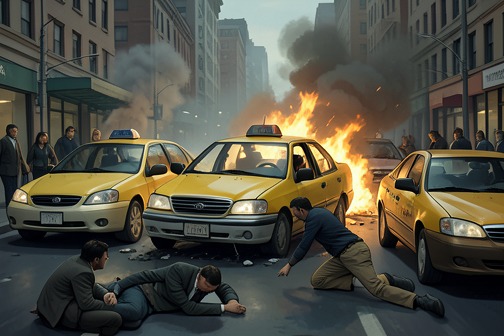
The [Bombay taxi crash and mob beating](entity:event-recall-event-8889d585e516) begins as a traffic accident and becomes [Lin](entity:character-recall-character-lin-428ebd96b429)’s first sharp encounter with the city’s capacity for collective violence. As the crowd turns on the taxi driver, Lin does not intervene; the experience unsettles his assumptions about [Bombay](entity:location-recall-location-bombay-b9f73c3bdba6) and leaves him convinced that remaining there will require more than detached observation.
## Causes and Setting
The crash follows a heated exchange between the taxi’s driver and his passengers, [Lin and Prabaker](entity:relation-recall-relation-lin-and-prabaker-c6d700ec59e3). With the vehicle travelling at speed, the driver turns toward them in anger instead of keeping his attention on the road. He brakes when he sees a car ahead, but there is too little room to stop. The taxi strikes the car, which has stopped to turn, and two more vehicles then collide with the taxi. The accident is sudden, involving four vehicles and leaving the passengers disoriented.
[Prabaker](entity:character-recall-character-prabaker-f1cb57f00b87) immediately urges Lin to get out. The taxi doors are jammed: one will not open, and another is blocked by a car pressed against it. Lin interprets Prabaker’s alarm as fear that the damaged taxi will catch fire. Once they are outside, Lin asks why Prabaker was so frightened. Prabaker explains that his fear was not of a fire in the vehicle but of the crowd gathering around them. That distinction changes the meaning of the scene: the danger Lin had imagined was mechanical, while Prabaker had anticipated the people around the wreck.
## The Crowd and the Assault
Around thirty people gather near the damaged cars, some helping those involved and others shouting and gesturing. The crowd grows as drivers delayed by the collision leave their own vehicles to join it. A man whose car was struck becomes its visible focus. He is angry and injured, and his conspicuous gestures draw attention away from the wreck itself. A woman is carried to the open space nearby and placed on cloth before being transferred to a wooden cart. She may be the man’s wife, but Lin cannot be sure. Her condition and removal intensify the crowd’s agitation.
The injured taxi driver is then dragged from his cab and attacked by the crowd. The assault unfolds so quickly that Lin experiences the moment as something he has no time to interrupt. He tells himself that he is dazed, that the scene is happening too fast, and that he is not in his own country. At the same time, he recognizes a less flattering impulse: he resents the reckless driver, whose actions had endangered both him and Prabaker, and feels that some part of the crowd’s revenge belongs to him. He wants to help but does not act. His account therefore distinguishes being caught by surprise from the spite and shame that make his inaction harder to excuse.
## Prabaker’s Response and Lin’s Inaction
Prabaker does not share Lin’s expectation that they should intervene. He considers the taxi driver beyond their help and urges Lin to leave. In his view, accidents are dangerous business in Bombay because the public has little patience for them; once the crowd has turned, it is already too late to change what will happen. His matter-of-fact response contrasts with Lin’s shock. What Lin experiences as a bewildering rupture, Prabaker treats as a familiar risk of travelling through the city.
The crowd eventually carries the taxi driver away, and traffic parts to let it pass. The account does not establish the driver’s ultimate fate. Lin and Prabaker leave the scene, but the violence stays with Lin. He has seen worse violence in prison, yet what shakes him here is not simply the assault. It is the collapse of his comfortable picture of Bombay as a place of temples, bazaars, restaurants, and new friends. The city’s convivial life and its capacity for sudden rage cannot be separated into different places or experiences.
## Aftermath and Significance
Prabaker resumes the practical business of the day almost at once. He takes Lin to a telephone and calls his cousin, who is working as a dishwasher at the Sunshine restaurant. The cousin wants a taxi-driving job for his brother, Suresh, and the now-vacant position offers an immediate opportunity. Prabaker makes the call and soon continues the tour in another taxi. He does not raise the beating again; when Lin later mentions it, Prabaker responds with a shrug or treats their escape without serious injury as good luck. The job call and the return to the tour make the event seem, to Prabaker, like one more commonplace disturbance in city life.
For Lin, however, the crash marks a change in how he understands his place in Bombay. Until then he has been able to experience the city as a newcomer and observer, attracted to it while remaining somewhat apart from its dangers. The sight of the taxi driver being borne away by the crowd makes that distance seem untenable. Lin concludes that staying will mean becoming involved and accepting that the city may draw him into both its exhilaration and its anger. The accident thus has two consequences: it reveals the ordinary peril that Prabaker already knows how to navigate, and it gives Lin a new, uneasy resolve to stop living as a spectator.
Event 9
Day of the Slaves
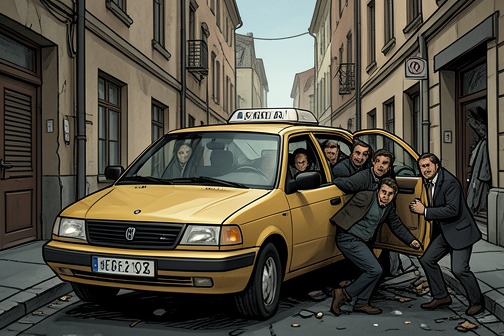
The [Day of the Slaves](entity:event-recall-event-e56b4d0ae711) is the visit [Lin](entity:character-recall-character-lin-428ebd96b429) makes with [Prabaker](entity:character-recall-character-prabaker-f1cb57f00b87) to a child-trafficking market in [Bombay](entity:location-recall-location-bombay-b9f73c3bdba6). The encounter turns Prabaker’s tour of the city’s hidden districts into a confrontation with organized exploitation and with the limits of Lin’s ability to act. Lin sees children who have been brought from places struck by disaster, and men who bargain over them. He leaves without stopping the trade, troubled by his helplessness and by the possibility that an intervention could make the children’s circumstances worse.
## The journey into the market
The visit follows a violent taxi incident that has already altered Lin’s understanding of what it means to remain in Bombay. Whereas Prabaker treats the city’s sudden violence as commonplace, Lin recognizes that he cannot stay an aloof observer: to belong in the city, he will eventually have to accept being drawn into its conflicts. With that realization still fresh, the tour continues toward a slave market near [Dongri](entity:location-recall-location-122b135e641c).
The route itself marks a departure from ordinary city space. Main roads narrow into streets and then lanes too tight for the taxi, so [Lin and Prabaker](entity:relation-recall-relation-lin-and-prabaker-c6d700ec59e3) continue on foot. As they enter the crowded inner passages, motor traffic falls away, and the surroundings seem increasingly removed from the time and pace of the modern city. Children recite verses from the Koran in a courtyard; women grind spices in doorways; hawkers call out their services. Bicycles give way to goods carried by people, and the buildings press close enough to reduce the visible sky to a narrow strip. This changing setting leads Lin from the city’s public thoroughfares into a concealed market embedded within its crowded blocks.
## The courtyard and the trade
After paying a policeman one hundred rupees to enter, Lin and Prabaker pass through a narrow corridor into a makeshift courtyard. Men sit or stand in small groups, including Arab visitors dressed in loose robes and kaffiyehs. An Indian boy serves tea. Beneath a ragged canvas awning, children sit together on a wooden bench, while the adults largely appear to attend to their own conversations. The space is not a purpose-built marketplace: patched coverings screen out much of the sky, windows are boarded, and the tiled ground has been assembled from salvaged flooring. Its improvised, enclosed character makes the market seem less like a formal institution than a hidden activity sustained within the surrounding congestion.
Prabaker explains quietly that the children are enslaved and that the apparently indifferent men are purchasers or agents. Bargaining is already taking place while the visitors watch, though its restrained manner makes the transactions easy to miss. The children have come from calamities in West Bengal, Orissa, Haryana, and Punjab: a cyclone, drought, cholera, and secessionist fighting. Recruiters find them amid these emergencies, and the children travel by train to Bombay, often alone and over hundreds of kilometres.
Prabaker also explains the chain that brings them there. Professional recruiters move from one disaster to another, while parents facing starvation may believe that selling one child gives that child a chance to survive. The account complicates any simple distinction between rescue and exploitation: the market takes children from catastrophe, but their survival is made conditional on being bought and assigned to work. That the adults’ negotiations proceed quietly, without a visible commotion, does not make the transactions any less consequential.
## The children’s futures and Lin’s response
The children’s expected destinations expose the different forms their exploitation may take. Boys are destined for work as camel jockeys in Saudi Arabia, Kuwait, and other Gulf States; some may be injured or die in races, and those who grow too tall to ride may be abandoned. Girls are to work in households across the Middle East, with some at risk of sexual exploitation. Prabaker calls the children who reach the market lucky in comparison with the many others who die of starvation before they can be brought there. The market is thus shown not as an isolated scandal but as one part of a wider landscape of disaster, recruitment, trafficking, and death.
Lin’s response is shaped by several constraints. He is a wanted criminal living on the run, so contacting the police or government authorities is not a practical option. He is also a foreigner who does not yet know the language or culture well enough, in his view, to presume that he understands how to intervene. Most importantly, he fears that using force to close this particular market would merely cause it to reappear elsewhere, perhaps in a more dangerous form. His restraint does not mean that he regards the trade as acceptable: he is appalled by what he sees, but cannot identify an intervention likely to protect the children rather than displace the harm.
The children’s presence also connects the scene to Lin’s earlier experience of prison. Much later, he understands that his ability to endure the sight without being emotionally overwhelmed was connected to men he had known in an Australian prison. Some had entered reform schools when they were as young as the children in the courtyard and had endured abuse and deprivation within institutions meant to administer justice. That history gives the scene a further consequence: Lin’s capacity to remain present is not presented simply as strength, but as a hardness shaped by prior exposure to institutional cruelty.
## The scene’s lasting significance
A ten-year-old girl stands and sings and dances to a popular Hindi film song. Lin remembers her voice and the moment when the purchasers and agents begin paying her renewed attention. Her performance is an individual episode within the market’s transactions, not an escape from them; it makes the children’s treatment more visible even as it draws adult interest. The incident remains with Lin, who recalls hearing the song many times in the years that follow and associates it with the girl.
The visit also deepens Lin’s bond with Prabaker as a guide to realities that Lin could not have read from the city’s surface. Prabaker explains what Lin sees, including the quiet negotiations and the children’s likely futures, while Lin must reckon with the distance between witnessing injustice and being able to stop it. The narration returns to the cost of knowing: understanding the scene does not produce an easy solution, and good intentions alone cannot ensure a good outcome. The Day of the Slaves therefore stands as both a revelation of child trafficking and a turning point in Lin’s developing responsibility to the city—not a moment of rescue, but a lasting encounter with the consequences of looking closely and being unable to make the harm disappear.
Event 10
Lin’s arrival in Sunder village
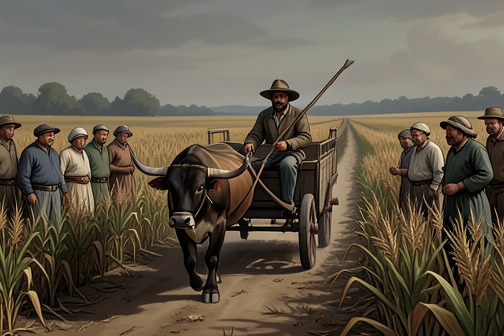
[Lin’s arrival in Sunder village](entity:event-recall-event-lin-sunder-a65ad1140213) is the moment a journey toward [Prabaker](entity:character-recall-character-prabaker-f1cb57f00b87)’s home becomes a public encounter with a whole community. Expected as an unfamiliar foreigner and watched by hundreds, [Lin](entity:character-recall-character-lin-428ebd96b429) first meets the crowd’s astonishment with a comic performance: a souvenir jester’s cap, bells, and a wag of the head turn wary silence into laughter and welcome.
## The journey to the village
Before reaching [Sunder](entity:location-recall-location-sunder-02955f6edb3e), [Lin and Prabaker](entity:relation-recall-relation-lin-and-prabaker-c6d700ec59e3) travel by ox-cart with Prabaker’s father, [Kishan Mango Kharre](entity:character-recall-character-kishan-mango-kharre-9ddc85b25c62). The slow cart moves along a track bordered by crops, while villagers peer through the maize, corn, and millet and hurry ahead to spread word of the visitors. [Kishan](entity:character-recall-character-kishan-93b761db3b7c) drives from the ox’s yoke, using a bamboo stick with a nail at its end; his frequent blows make the journey’s progress steady but punishingly slow. Lin tries to intercede on the animal’s behalf, but Kishan’s treatment grows more forceful afterward.
The road also gives the visitors an early glimpse of the practical hardship surrounding village life. Prabaker explains that well water usually comes for an hour at two in the afternoon, but sometimes flows for only half an hour or not at all. On those days, people scrape the green material from the surface of the water remaining in the well. The account places the welcome that follows against conditions in which even access to water is unreliable.
Kishan is introduced on the cart’s ox-bow yoke, smoking a beedie. He is a small, grey-haired farmer with a short moustache and a prominent paunch, dressed in a white cap, cotton kurtah, and dhoti. As the group nears the village, concern over the presents for Prabaker’s family briefly shapes the trip: the gifts are laid out beside the track and repacked into a bag intended for the family, then secured behind Kishan on the cart’s harness for the final leg.
## A village gathers
The last turn brings the cart into Sunder along a broad street of swept, pressed golden river sand. Round mud houses with curved doors, round windows, and small domes of thatched grass line the street, arranged so that no house faces another directly across it. Women’s and children’s excited voices announce the visitors before they come into view.
Sunder has about two hundred residents, but word of the foreigner’s arrival draws hundreds more from neighboring villages. The gathering numbers about six hundred. The crowd presses close around Lin and the luggage at his feet, fixing him with stares and whispers; for a moment, nobody speaks. Prabaker is pleased by the attention his guest brings him, yet even he is awed by the tightly packed crowd and the force of its curiosity.
Prabaker explains why Lin’s presence has drawn such notice: the last foreign visitor came from Belgium twenty-one years earlier. Everyone in the village younger than twenty-one has therefore never seen a foreigner in person. Prabaker remembers that earlier visitor as a good man and assures Lin that the people will love him too. His prediction is affectionate, but the crowd’s first stillness makes clear that welcome is not yet assured.
## The jester’s cap breaks the silence
At the center of the crowd, Lin reaches into his backpack for a souvenir: a black-and-white jester’s cap with three cloth horns and bells. An actor friend in [New Zealand](entity:location-recall-location-new-zealand-a25d5a689a9c) had made it as part of a costume and given it to Lin as a good-luck keepsake just before Lin’s flight to [India](entity:location-recall-location-india-39df7eae59c1). Lin puts it on, tightens it beneath his chin, and straightens the horns. The people at the front draw back with a gasp, so the gesture initially heightens the suspense rather than dispelling it.
Lin then smiles and waggles his head, making the bells ring. The sight releases the crowd’s tension. Women, children, and men laugh together; someone touches his shoulder, children reach for his hands, and those within reach pat and stroke him. The change is immediate and physical: the silent wall of staring faces becomes a crowd eager to make contact. Prabaker meets Lin’s eye with visible joy and pride, as though this unexpected welcome had taken on the force of a prayer.
The moment also echoes Lin’s earlier effort on the road to imitate the Indian head-waggle. There, the gesture had prompted people watching from the fields to smile, laugh, and run ahead to tell their neighbors. At the village entrance, the same playful willingness to meet an unfamiliar audience on its own terms finds its fullest response. Lin’s cap turns the foreign visitor from a spectacle to be inspected into a participant in a shared joke.
## Welcome and arrival
After allowing the crowd’s affectionate attention to continue for several minutes, Prabaker clears a path and leads Lin into Kishan’s dark, round house. As they enter, the crowd disperses, and the public welcome gives way to the intimate hospitality of the family. Prabaker tells Lin that his sisters have heated bathwater over the fire and are ready to prepare a bath after the long journey.
The scene’s decisive turn is not that Lin ceases to be a stranger, but that the crowd finds a way to receive him. The village’s exceptional curiosity has a specific history—two decades without a foreign visitor—and the celebration does not erase the material limits glimpsed on the road. Instead, a borrowed costume, a ringing set of bells, and a shared laugh make connection possible within those conditions. Arrival becomes more than reaching Prabaker’s home: it is Lin’s first welcome into the village community.
Event 11
Lin’s first-night awakening in Sunder village
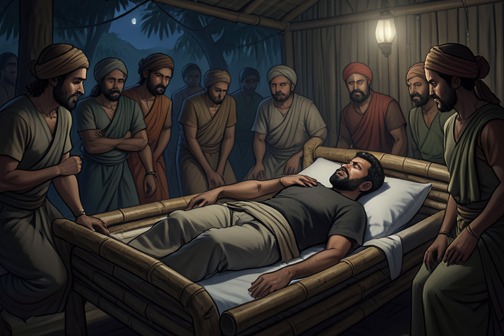
[Lin](entity:character-recall-character-lin-428ebd96b429)’s first night in [Sunder village](entity:location-recall-location-b19fdaedd032) transforms hospitality into a reckoning. Given a poor farmer’s bed and surrounded by people who stay awake to keep him company, Lin is moved by a simple touch on his shoulder to understand, at last, the pain and waste of his past. The communal vigil does not erase his exile or restore what he has lost; it gives him a moment in which he can finally feel those losses.
## Arrival and the gift of a bed
Before the night’s vigil, [Prabaker](entity:character-recall-character-prabaker-f1cb57f00b87) guides Lin through the ordinary intimacies of village life. Lin learns to bathe in a way that will not offend the neighbors, using a lungi to change beneath its cover, and shares dhal, rice, and homemade flatbreads with Prabaker’s family. The household and its neighbors spend hours asking about Lin, his home, and his family. He tries to answer truthfully, but withholds the crucial fact that, as a hunted exile, he does not expect to see his own home or family again. His account of himself is therefore already split between what he can say and the loss he has not yet managed to feel.
A bed is prepared for him outside [Kishan](entity:character-recall-character-kishan-93b761db3b7c)’s house. Made from coconut wood, with a mattress stretched on a web of coconut-fibre rope, it belongs to Kishan himself. Because a replacement cannot be made immediately to Kishan’s satisfaction, Kishan will sleep on the floor beside his son until then. Lin tries to refuse the sacrifice, but the family’s gentle insistence overcomes his protests. His first night in the village begins, as it had begun, with surrender: not to force, but to a kindness he cannot repay or deflect.
## The vigil and the touch
Prabaker explains that his family and neighbors worry Lin must be lonely in a strange place, far from his own family. They decide to sit with him in the dark until they are sure he is asleep. Their care begins in an act of imaginative reciprocity: Prabaker asks his companion to consider whether people in Lin’s country and village would do the same for him if he were far from home and missing his family. The vigil treats Lin not as a foreigner to be observed but as a person whose loneliness deserves company.
Prabaker, his parents, and the neighbors sit on the ground around Lin’s low bed, making a ring of protection. Their murmuring voices gradually lull him, but the decisive moment comes when Prabaker’s father reaches over and rests a hand on his shoulder. The gesture is simple and unannounced; its importance lies in how unexpectedly it reaches Lin. He had been drifting toward sleep. Instead, the touch brings him sharply awake and plunges him into thoughts of his daughter, parents, and brother, as well as the crimes he has committed and the loves he has betrayed and lost.
## A delayed understanding of guilt
The scene marks a delay between suffering punishment and understanding what punishment means. Lin had committed armed robberies while addicted to heroin, and remembers that an opiate fog covered his thinking and even his memories. During his trial and three years in prison, he was sober, but he remained occupied by the experience of being punished. That clarity did not, by itself, make him feel the consequences for his family or for the people he had robbed at gunpoint. Nor did escaping prison and living as a hunted man immediately give him a comprehensive grasp of the life he had made.
Only in Sunder village does that understanding arrive with emotional force. The rough, calloused hand of another man’s father connects Lin’s immediate experience of comfort to the family relationships he has damaged or lost. He recognizes not merely the facts of his past but its torment: pain, fear, waste, shame, and sorrow. The awakening is therefore not a discovery of previously unknown crimes. It is a change in his capacity to apprehend what those crimes have cost and what they have made of him. The kindness around him opens the way to a painful recognition that punishment and flight had left untouched.
## Silence, surrender, and consequence
Lin cannot answer the gesture outwardly. He understands his stillness as a consequence of what his culture has taught him, even as he distinguishes the soul from culture, nation, color, accent, and way of life. The language of universality does not make the moment easy or dissolve its contradictions: inwardly, his heart is breaking with shame and sorrow, while outwardly he gives no response. His awakening first appears as an experience he cannot communicate.
He clenches his teeth, closes his eyes, and surrenders to sleep. That ending echoes his earlier acceptance of the bed, but the second surrender carries a newly conscious burden. Lin now knows how lonely he is and how much crying remains within him. He also understands love as the only cure for loneliness, shame, and sorrow, while acknowledging that loneliness, shame, and sorrow can themselves uncover truths buried too deeply to reach otherwise. The night’s meaning lies in this double movement: the village offers care, and that care makes grief possible. The awakening does not repair Lin’s past; it changes his relation to it, turning emotional numbness into recognition and marking a decisive inward turn in his life.
Event 12
Lin is named “Shantaram”
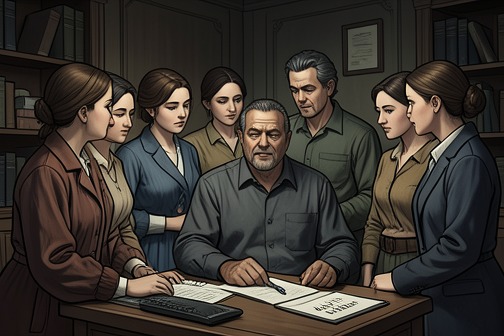
[Lin](entity:character-recall-character-lin-428ebd96b429)’s naming as Shantaram [Kishan](entity:character-recall-character-kishan-93b761db3b7c) Kharre is both a communal act of adoption and a turning point in his understanding of himself. The name reflects how the people of [Prabaker Kharre](entity:character-recall-character-prabaker-kharre-ca699443f286)’s village see him: not as the fighter his stern expression seems to announce, but as a peaceful man capable of laughter, play, and affection.
## A Name Chosen by the Village
Earlier on the day Lin stands alone in the rain, [Rukhmabai Kharre](entity:character-recall-character-rukhmabai-kharre-7017b6b9ee23) tells him that she has called a meeting of the village women to choose a new name for him. Their decision makes his place in Prabaker Kharre’s household part of the name itself. Because Lin lives in that home, he is to take the family name Kharre; because [Kishan Mango Kharre](entity:character-recall-character-kishan-mango-kharre-9ddc85b25c62) is [Prabaker](entity:character-recall-character-prabaker-f1cb57f00b87)’s father and Lin’s adoptive father, Kishan becomes his middle name.
The women choose Shantaram for his first name, judging his nature to be blessed with peaceful happiness. The name means a man of peace, or a man of God’s peace. The resulting full name, Shantaram Kishan Kharre, therefore records more than a personal label: it binds Lin to the family that has taken him in and expresses the character the village believes it recognizes in him.
## The Man Behind the Hostile Mask
Lin understands the contrast between that judgment and the persona he has cultivated. He has spent his life ready to fight for what he loves and against what he despises; over time, he has become so practiced at projecting menace that hostility seems to define his whole life. His face and movements have carried a warning to keep away, concealing what he regards as his real nature.
In the village, that warning fails. The people have no experience of foreigners to use as a point of reference, so they do not read Lin’s sternness as a threat. They laugh at his grim expressions and pat his back encouragingly. They see instead someone who works hard, jokes, plays the fool for children, sings and dances with them, and laughs openly. Their response reverses the force of his practiced body language: the mask does not determine how they know him.
## The River Within
The naming takes shape within Lin’s reflection on a river that is not geographical but runs through every person: the river of the heart and its desire, the essential truth of what a person is and may become. The question of where such a river stops becomes a way to consider where his own life might lead beyond the identity formed by conflict.
Lin sees the village as giving him a chance to reinvent himself and follow that inward current. The farmers’ flood-game stakes, nailed into the earth, become an image for the way the villagers have marked a place in his life: they have recognized, or perhaps helped create, the possibility of peace within him. He cannot decide whether they discovered that quality or planted it like a wishing tree. Either way, he locates the birth of the man he wants to be in these moments, standing in the rain with the new name taking root.
## Significance and Afterlife
Shantaram is not presented as a simple declaration that Lin has already become peaceful. He describes himself as only slowly, and much too late, beginning to become the better man the name implies. The distance between the name and the life still required to live up to it gives the moment its force: the village offers an identity as an invitation and possibility, not a completed transformation.
The event also changes the meaning of belonging. Lin’s adopted name joins him to Prabaker Kharre’s family through Kishan Mango Kharre and the Kharre surname, while Shantaram reflects the villagers’ experience of his conduct among them. The name thus holds together affiliation and aspiration: it tells where Lin has been welcomed, and points toward the person he hopes to become.
Event 13
Sword-Wielding Attack at the Standing Babas' Den
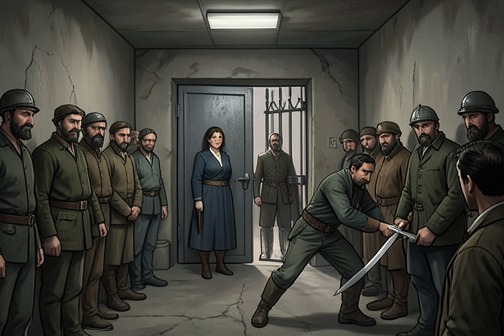
The [Sword-Wielding Attack at the Standing Babas' Den](entity:event-recall-event-standing-babas-fd21f6947f6d) is a sudden assault on [Lin and Karla](entity:relation-recall-relation-lin-and-karla-9a163b3f3796) during their visit to a crowded gathering of ascetics and hashish smokers. The danger is contained by a man in the crowd who disarms the attacker without escalating the confrontation; the encounter also brings [Lin](entity:character-recall-character-lin-428ebd96b429) face to face with Abdullah Taheri, whose intervention becomes the event’s defining consequence.
## Setting and participants
Lin stands with [Karla](entity:character-recall-character-karla-3f7aa8a8ae5c) and [Prabaker Kharre](entity:character-recall-character-prabaker-kharre-ca699443f286) at the back of a narrow den. Behind them is the sealed door through which the [Standing Babas](entity:character-recall-character-standing-babas-d0026063fa2f) entered; ahead, two lines of men extend along the walls toward an iron gate opening onto the street. The arrangement leaves Lin and his companions with little room to move, a fact that turns the den’s passage into a trap when violence begins.
The gathered men are socially varied: some wear suits or designer jeans, while workmen in faded lungis stand beside men dressed in traditional clothes from different regions of [India](entity:location-recall-location-india-39df7eae59c1). Young and old, rich and poor, they attend to the Standing Babas and the hashish. Some look openly at Lin and Karla, pale-skinned foreigners; some are visibly surprised to see a woman in the den. Yet nobody approaches them directly. Their presence marks them as conspicuous outsiders, but the crowd does not immediately treat them as targets.
The setting is also shaped by the Standing Babas’ chosen austerity. Their faces bear the visible signs of sustained physical hardship, while their devotion is accompanied by a constant use of Kashmiri hashish. Conversations, music, and devotional chanting mingle inside the compound. This combination of ascetic discipline, intoxication, and ordinary social bustle makes the attack a sharp rupture in a place where spiritual practice and communal routine occupy the same confined space.
## The threat in the passage
A scream draws everyone’s attention to the street entrance. A man in the dress of a northern tribesman stands near the iron gate, shouting. Before those present can understand his message or respond, he draws a long, thick-bladed sword and raises it. He then advances down the corridor, staring at Lin. Lin cannot understand the words, but reads the man’s intention as an attack directed at him.
The other men flatten themselves against the walls, and the Standing Babas rock out of the swordsman’s path. The door behind Lin and his companions is locked, they are unarmed, and the narrow passage offers no clear route of escape. Lin steps back and raises his fists in a karate stance. His seven years of martial-arts training return to him as a practical resource; he also recognizes in himself the familiar impulse of a tough, angry man who avoids a fight until it arrives and then takes pleasure in it. The scene thus places a trained response beside a potentially reckless appetite for confrontation, while making clear that Lin has few safe choices.
## A bystander intervenes
At the last possible moment, another man steps out from the wall, trips the swordsman, and sends him to the stone floor. The sword falls near Karla. Lin picks it up while the rescuer holds the attacker in place with a controlled restraint. The attacker’s anger or madness subsides, and he gives up. Men who know him escort him through the gate and out into the alley.
The intervention is forceful but measured: the rescuer stops the immediate danger, while the other men remove the attacker rather than allowing the encounter to become a wider brawl. A man returns and approaches Lin with his hands held out, palms upward, asking for the weapon without words. Lin hesitates, then gives it back. The man bows politely in apology and leaves. The sequence shifts the crowd from bystanders trying to make room for violence to a community that contains it and takes responsibility for its aftermath.
## Abdullah and the encounter’s significance
After the attacker has gone, Lin checks Karla. Her eyes are wide and her lips form a wondering smile, but she is not distressed. Reassured, Lin approaches the man who intervened to thank him. He is tall, athletic, and dressed in black silk clothes and leather sandals, with unusually long black hair tied in a high ponytail. When Lin gives his own name, the man introduces himself as Abdullah Taheri.
Lin acknowledges that the encounter came close to disaster and recognizes the skill and courage behind Abdullah’s apparently effortless movement. He also understands that instinct and timing mattered: Abdullah’s action was not simply a display of strength, but a rapid response in a narrow space where hesitation would have left Lin and Karla exposed. Abdullah offers a modest explanation for the attacker’s behavior, suggesting that he was drunk or not in his right mind.
The event’s importance lies both in the danger it resolves and in the relationship it begins. Lin is first prepared to defend himself alone; instead, a stranger in the crowd acts at the decisive moment, and Lin responds by returning the sword and expressing gratitude. The den’s many observers do not become a mob: one man intervenes, others escort the attacker away, and the weapon is reclaimed courteously. In that compressed passage between the locked door and the street gate, the episode introduces Abdullah through action, establishing him as a capable and composed presence in Lin’s life.
Event 14
Cuffe Parade slum fire
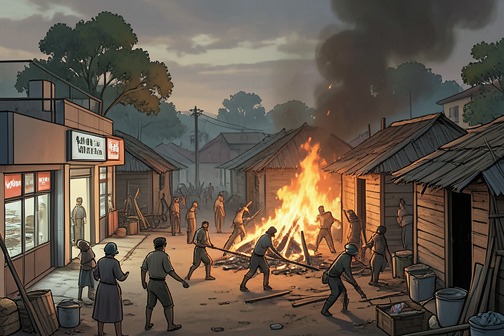
The [Cuffe Parade slum fire](entity:event-recall-event-cuffe-parade-1f48c514b4f0) is a defining early crisis in [Lin](entity:character-recall-character-lin-428ebd96b429)’s life in the settlement: confronted by a disaster moving through the homes of thousands, he abandons the attempt to save his own belongings and joins the residents fighting it. The fire exposes the precarious conditions in which the community lives, but its aftermath also reveals an organized local response, with [Qasim Ali Hussein](entity:character-recall-character-qasim-ali-hussein-e223a2b66e5b) directing the defense and neighbors sharing the work of rescue and care.
## Setting and Conditions
Lin arrives in [Cuffe Parade](entity:location-recall-location-27672e2a8588) beside the World Trade Centre, where two adjacent areas embody sharply unequal conditions. The modern commercial complex has shops and displays of luxury goods; the slum covers ten acres, with seven thousand small huts housing twenty-five thousand of the city’s poorest residents. There is no electricity, running water, or sanitation, and the settlement’s continued existence is uncertain because the authorities may clear it. That vulnerability matters when fire breaks out: closely packed homes and limited resources make a disaster a threat to the entire community, rather than to one household alone.
The blaze begins several hundred metres away as Lin is spending his first days in the slum. [Anand](entity:character-recall-character-anand-89b268e39901) spots it, and the residents turn toward the rising flames. The fire spreads with the sea breeze, advancing through the huts. When it reaches pressurized kerosene stoves, they explode; after weeks without rain, the dry settlement provides abundant fuel. The fire’s progress is therefore shaped by both the immediate conditions of the blaze and the settlement’s exposed, combustible housing. The narrative does not identify who or what first ignites it.
## From Flight to Participation
At first, Lin watches the fire’s advance and decides that his own situation is hopeless. He runs to his hut, gathers his pack and belongings, and reaches the doorway. There, a group of women and children sees him preparing to escape while the men are running toward the fire. Their unspoken judgment changes his course. Ashamed, he leaves his possessions with [Radha](entity:character-recall-character-radha-54371c819881), his neighbor, turns back, and runs toward the danger. The reversal establishes the event’s central personal shift: Lin moves from protecting himself to accepting responsibility among the people with whom he has just begun to live.
The lanes are narrow and twisting, and Lin loses his way as he joins the stream of men heading toward the blaze. Others move in the opposite direction, helping children and elderly residents away and carrying whatever possessions they can. Lin encounters a woman engulfed in flames. He uses his shirt to protect his hands and face and smother the fire on her, then continues toward the main front. The episode places immediate rescue alongside the larger effort, without suggesting that one act can halt the advancing fire.
At the center of the response is Qasim Ali Hussein, whom Lin recognizes as the slum’s head man. Tall and dressed in white, with a green scarf at his neck and a brass-tipped stick in his hand, Qasim directs the residents as if commanding a battle. His plan combines two tasks: teams beat back the flames to slow their progress, while demolition crews pull down endangered huts and remove their contents, depriving the fire of fuel. The strategy requires residents to surrender houses in the fire’s path in order to protect what remains. Lin joins a team with [Johnny Cigar](entity:character-recall-character-johnny-cigar-abaa784fef8e), striking at the flames with wet sacks and following Qasim’s directions. When smoke obscures Qasim, the sight of his green scarf raised above it helps rally the men to continue.
## Losses, Rescue, and Immediate Care
The fire is eventually contained, but the tally makes clear that the community has paid heavily. Twelve people are dead, including six elderly residents and four children; more than one hundred are injured, and about six hundred homes—roughly one-tenth of the settlement—are lost. Among the dead is Raju, who had invited Lin to live in the slum. Johnny translates the figures for Lin and cries when Raju’s death is reported. [Prabaker](entity:character-recall-character-prabaker-f1cb57f00b87), blackened with soot, calls this fire comparatively fortunate because a blaze the previous year destroyed more than two thousand houses and killed more than forty people. His comparison gives the survivors relief without diminishing their losses.
Search teams find a baby girl alive in the rubble after her parents die when adjoining huts collapse. Lin calls for the rescuers to bring her to his hut, where he has medicine and bandages. He opens his first-aid kit and applies local anaesthetic cream to her legs; she settles as it begins to work. The residents call him a doctor, though he does not consider himself trained for the role. As evening falls, Qasim calls for lamps, and Lin, Johnny, and Prabaker use the kit to treat residents in an improvised open-air clinic. Burns, cuts, deep gashes, and smoke inhalation are among the problems they address.
Qasim’s work continues beyond the immediate fight. He leaves the treatment area to oversee emergency shelters, distribute the remaining water, and organize food. Radha brings Lin tea, his first food or drink in the slum; later, she and others insist that he eat a meal. After midnight, her husband [Jeetendra](entity:character-recall-character-jeetendra-81b0506b001d) leads Lin to his hut, where a blanket has been laid out. These gestures make the response more than a firefighting operation: care moves in both directions, as Lin treats residents and residents take responsibility for feeding and sheltering him.
## From Emergency Aid to a Continuing Responsibility
The fire’s medical response anticipates the work of Lin’s later clinic, but it also exposes the limits of his ability to provide care alone. He tells [Doctor Hamid](entity:character-recall-character-doctor-hamid-3435ac57c6e5) that he refers illnesses he cannot identify to [St. George Hospital](entity:location-recall-location-st-george-hospital-c5c5fe31c0bb), yet many patients return without seeing a doctor or nurse. Hospital staff say they are overwhelmed, and although the settlement’s residents may obtain priority with referrals from licensed practitioners, they cannot afford to see a doctor to get one. Lin treats about fifty patients a day in his small clinic; the hospital sees six hundred, sometimes a thousand. The gap between need and access is part of the same precarious social landscape that the fire makes visible.
Later, a cholera outbreak brings that vulnerability into sharper focus. Health official Sandeep Jyoti reports other outbreaks in the region and overcrowded local hospitals. Qasim turns his home into a command center, and residents organize water purification, disinfectant trenches, waste disposal, safe food, and the removal of the dead. Lin is assigned to supervise oral rehydration solution. He feels shame that he had celebrated the clinic’s empty treatment queue only a week earlier, and that he had been occupied with hotel customers while Radha was ill. The outbreak is a distinct later crisis, not a consequence attributed to the fire; together, however, the episodes show the repeated demands placed on a community with limited services and the importance of collective organization.
## Significance
The fire marks Lin’s entrance into the settlement as a participant rather than a visitor. Its decisive turn is not that he single-handedly saves the slum, but that he changes direction when faced with the choice between flight and helping others. The event gives practical form to the community’s mutual dependence: residents sacrifice endangered homes to slow the blaze, follow Qasim’s coordinated commands, care for the wounded, and provide food and shelter after the immediate danger passes. Through the fire and its aftermath, the narrative connects Lin’s growing sense of belonging to concrete acts of work and care, while keeping the settlement’s insecurity and losses in view.
Event 15
Daylight Escape from Prison
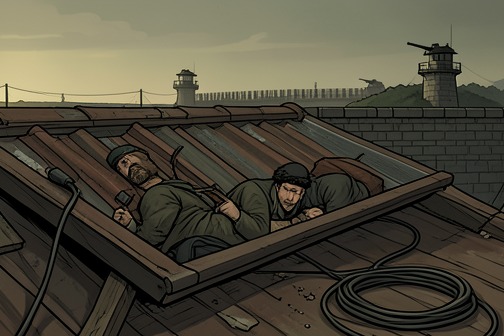
[Daylight Escape from Prison](entity:event-recall-event-daylight-escape-from-pr-a558d39a5b20) is the moment [Lin](entity:character-recall-character-lin-428ebd96b429) turns a carefully improvised breach into a passage out of maximum-security confinement. The escape depends less on speed than on concealment and restraint: Lin and his companion hide in a roof trough, improvise a rope from a power cord, and wait until the street is empty before crossing the prison’s front wall. [Freedom](entity:concept-recall-concept-16bc935c6e52) arrives, but the final image already carries its cost: Lin walks away toward a life shaped by pursuit and loss.
## Preparations and Constraints
The escape route begins in the roof, where Lin and his companion cut through the tin into one of its V-shaped troughs. The deep channel hides them from the gun towers, creating a narrow blind spot above the prison yard. Yet reaching the roof is only part of the problem. They still need the power cord, which runs from an outlet downstairs and outside the building, to serve as a rope down the exterior wall.
Getting the cord means crossing an exposed space. One of them would have to go downstairs, pass through a door visible from the adjacent gate area, unplug the cord, and return to the roof. Lin recognizes that he must take this risk, but at the door he cannot bring himself to step outside. His hesitation is not an abstract fear: the route demands that he expose himself to guards who may see him, and his body’s panic prevents the planned action.
Lin responds by changing the plan rather than forcing himself into the open. He cuts through the cord with a chisel where it enters beneath the door, accepting the possibility that severing the power might trigger an alarm or bring a guard to investigate. Nothing happens. The cord is free, and the escape can continue. The choice converts a visible, exposed errand into a quiet act inside the building, though it leaves the prisoners relying on the hope that the cut will not draw attention.
## The Roof and the Waiting
Back upstairs, Lin and his companion fasten the cord to a heavy wooden roof beam. The exit through their new opening is cramped enough to create another immediate obstacle: halfway through, the companion becomes stuck, unable to move either forward or back. In the dark roof space, Lin finds a lighter and sees that the thick leather tobacco pouch his friend made in a prison hobby group has caught on the opening. Lin uses the chisel to tear a flap in the pocket of his companion’s coveralls; when the pocket gives way, the pouch falls free and his friend can climb onto the roof.
They then crawl along the tin trough toward the castellated wall at the front of the prison. For a few seconds they are exposed as they look over it, but the guards in the towers are not watching them. The protection is partly architectural and partly psychological: the guards do not expect anyone to attempt a daylight escape over the front wall. Their assumption creates an opening, but not a safe one. Below, delivery vehicles are queued at the main gate, where each is searched, including beneath the vehicle with mirrors. The traffic makes the street a poor place to land unseen.
Lin refuses his companion’s impulse to go straight down through the waiting vehicles. Instead, they remain in the roof trough and wait. For twenty minutes, Lin repeatedly edges forward to check the street, accepting the risk of being seen each time. At last, he finds both directions clear and signals his companion to move. His friend crosses the wall and disappears into a narrow lane opposite the prison. Lin remains alone on the roof, still separated from the street by the wall and the dangling cord.
## The Descent and Escape
Before descending, Lin looks toward both gun towers. One guard is talking on a telephone and gesturing; the other, armed with a rifle, is speaking to a guard inside the gate area. Both appear occupied, and Lin experiences himself as unseen while standing on the front wall of a prison he regards as exceptionally secure. The moment reverses the ordinary relation between prisoner and watchers: the armed guards are present, but their attention has not settled on him.
Lin pushes away from the wall and begins climbing down with the cord. His hands slip, and he falls before catching the line again. He reaches the ground, gets to his feet, and crosses the road. His companion has already escaped, but the act is not complete for Lin until he makes the descent himself. The cord remains hanging over the wall, an exposed trace of the route they used, while the guards continue talking in their towers.
Lin looks back once. A car passes, its driver drumming along to a song, while the prison remains outwardly undisturbed. Lin turns away and walks through the lane. The ordinary movement of traffic and the guards’ continued conversation contrast with the magnitude of what has happened: a prisoner has crossed the boundary, yet nothing around him announces the change.
## Freedom and Its Aftermath
The escape changes Lin’s status from prisoner to fugitive, not from danger to security. In his later account, he connects this period of flight to the fear produced by his earlier armed robberies: the fear he had inflicted on others returns to him with multiplied force. The escape opens the way to life on the run, but the freedom it secures is shadowed by the expectation of pursuit and by the losses that accompany his fugitive existence.
That aftermath also changes the meaning of the escape’s repeated physical details. The gun towers and the cord dangling from the wall become images Lin carries into his later nights in [Bombay](entity:location-recall-location-bombay-b9f73c3bdba6). He walks through the sleeping city and forces himself not to look over his shoulder at a prison wall that is no longer there. The roof, cord, and wall therefore persist beyond the event as memories of fear: escape has removed Lin from the prison, but it has not immediately removed the prison’s hold on his attention.
## Narrative Significance
The scene is built around a series of practical reversals. The cord that cannot safely be retrieved in the planned way is cut free indoors; the tobacco pouch that blocks the escape is sacrificed with its pocket; the queue that makes an immediate descent too dangerous eventually clears. Each obstacle requires a decision, and Lin’s refusal to rush becomes as important as the physical route. Waiting, checking, and adapting make the escape possible where force alone would expose them.
The event also separates the companions at the threshold. Lin’s friend reaches the street first and vanishes into the lane, while Lin must still cross the wall and descend. The interval leaves Lin momentarily between confinement and freedom, with the guards nearby and the cord as his only route down. When he finally reaches the street, the achievement is real but incomplete as a release from fear: the prison is behind him, while a hunted life lies ahead.
Event 16
Lin meets Khader Khan on the sea wall

[Lin](entity:character-recall-character-lin-428ebd96b429) meets [Abdel Khader Khan](entity:character-recall-character-abdel-khader-khan-822d0cbbc88e) on the sea wall at [Marine Drive](entity:location-recall-location-marine-drive-943f298beb77) at a moment when belonging to the city has not freed him from shame. Abdullah’s intervention halts Lin’s movement toward suicide; Khan’s recognition and invitation then draw him from solitary despair into the orbit of a man whose influence reaches from the [Colaba](entity:location-recall-location-colaba-2bd495476f0e) hutments to [Bombay](entity:location-recall-location-bombay-b9f73c3bdba6)’s underworld. The encounter joins a personal crisis to the city’s hidden structures of power.
## Setting and state of mind
About three months after the fire, Lin is walking alone beside the sea wall at Marine Drive. The clean, broad footpath lies between the wall and a six-lane road; beyond it, an arc of expensive homes, apartments, consular offices, restaurants, and hotels faces the black sea. Few cars pass, the buildings behind him are mostly dark, and the wind brings salt air across an otherwise quiet stretch of city. The sea is louder than the streets.
That quiet contrasts with the densely inhabited life Lin has chosen elsewhere. He has stayed in the Colaba hutments even after earning enough money to leave, and has made a modest clinic there his work. He studies diagnostic medicine by lamplight and buys medicines, salves, and bandages with money earned through black-market deals with tourists. His work among the residents, and his ties to [Prabaker](entity:character-recall-character-prabaker-f1cb57f00b87), [Johnny Cigar](entity:character-recall-character-johnny-cigar-abaa784fef8e), and [Qasim Ali Hussein](entity:character-recall-character-qasim-ali-hussein-e223a2b66e5b), have given him a sense that the city can contain his unsettled life. His love for [Karla](entity:character-recall-character-karla-3f7aa8a8ae5c) remains another imagined source of rescue, though he tries not to dwell on it.
At the sea wall, that sense of connection fails to reach the shame beneath it. The waves striking the rocks three metres below seem to offer an easy end, and Lin imagines the fall and the cold of drowning. The suicidal impulse is not presented as the loudest thought in his mind, but as one arising from a deep conviction that he has disappointed everyone and does not deserve to live. The scene therefore turns on a stark division: Lin has built a life of service and attachment, yet experiences his shame as something he must face alone.
## Abdullah stops him
A hand settles on Lin’s shoulder before he can fall. Its grip is gentle but firm, holding him in place; when Lin turns, he finds a tall young man behind him. The action interrupts the immediate danger without making Lin’s inward crisis disappear. The contrast between the force of the sea below and the steadying human touch makes the encounter’s first change concrete: for the moment, Lin is no longer alone at the edge.
The stranger identifies himself as Abdullah and reminds Lin that they met at the [Standing Babas](entity:character-recall-character-standing-babas-d0026063fa2f)’ den. Lin recalls Abdullah’s help there and regrets that Abdullah disappeared before Lin could thank him properly. Abdullah brushes aside the debt, saying that Lin would have done the same for him in Abdullah’s country. The exchange establishes that their recognition is not wholly new, but also that Lin’s earlier encounter with Abdullah left him with an unfinished obligation of gratitude.
Abdullah then says that someone wants to meet Lin and gestures toward an Ambassador waiting at the kerb. The engine is running, but Lin has not heard the car draw up behind him. Abdullah opens the rear door, where a driver and a passenger are waiting. The movement from exposed sea wall to idling car is immediate: Lin has been stopped, recognized, and offered a destination, though he does not yet know who is waiting inside.
## Lin meets Abdel Khader Khan
The passenger is an older man with close-cropped white-grey hair and beard, a lean face, and amber eyes that Lin reads as combining amusement and compassion with possible ruthlessness—or love. He introduces himself as Abdel Khader Khan, addressing Lin as Mr. Lin and saying that he has heard good things about him. Khan’s deep, confident voice and courteous welcome are set against the ambiguity of his gaze; the scene offers warmth without concealing the power that surrounds him.
Lin already knows Khan’s public reputation. His name appears in the newspapers and circulates through bazaars, nightclubs, and slums. The rich admire and fear him; the poor respect and mythologize him. His discourses on theology and ethics at [Nabila Mosque](entity:location-recall-location-nabila-mosque-495a375e716a) in [Dongri](entity:location-recall-location-122b135e641c) draw scholars and students from different faiths, while his friendships extend to artists, businesspeople, and politicians. He is also one of Bombay’s mafia lords and a founder of the council system that divided the underworld into territories governed by separate councils. People credit that arrangement with bringing relative order and peace after a decade of bloody power struggles. The man who has stopped for Lin is therefore at once a public thinker, a reputed benefactor, and a dangerous criminal power.
Khan’s claim to the hutments makes that power immediate and personal. He tells Lin that he knows about his work as a doctor there, and that the land on which the huts stand belongs to him. Lin learns that the half-square-kilometre settlement, home to twenty-five thousand men, women, and children, is within Khan’s ownership. Although Khan’s name has been familiar in the neighborhood, no one had told Lin that he owned it. Lin’s surprise exposes the distance between living among the residents and knowing who controls the ground beneath their homes.
Khan says that Lin has pleased him by working there. Lin tries to correct the description, explaining that he is not a doctor. Khan answers that perhaps this is why Lin has succeeded in treating the sick: trained doctors will not willingly enter the hutments. He then reflects that men can be compelled not to do wrong, but cannot be compelled to do good. His praise is thus tied to Lin’s practical service, while his remark frames that service as a voluntary choice—one that matters precisely because it cannot be forced.
## An invitation at a turning point
Khan explains how the meeting came about: Abdullah recognized Lin as they passed, and Khan turned the car around to come back for him. This gives the encounter a deliberate sequence. Lin is not merely approached by a stranger on the road; Abdullah’s recognition prompts Khan to return, and the return brings together the man who has been helping in the settlement and the person who claims to own its land. Khan asks Lin to get into the car and says he will take him somewhere. Lin hesitates and begins to decline, leaving the invitation unresolved at the scene’s close.
The meeting’s force comes from the collision of two kinds of vulnerability. Lin is physically exposed on the wall and inwardly overwhelmed by shame; Khan arrives with a car, a driver, a recognized name, and ownership over the community where Lin has chosen to live. Yet Khan approaches with praise rather than a threat, and the hand that first holds Lin is Abdullah’s, not Khan’s. The scene does not erase the imbalance between them. Instead, it makes that imbalance part of the encounter’s promise and uncertainty.
For the narrative, the sea wall is both an edge and a threshold. Lin’s work in the hutments has given him a fragile sense of belonging, but the meeting reveals that the neighborhood is also embedded in a concealed system of authority. Abdullah’s return prevents the private crisis from ending in death; Khan’s recognition opens a path toward a new relationship with the city’s criminal power. The invitation supplies no answer yet, but it shifts the scene from Lin’s solitary wish to disappear toward a consequential choice about whether to follow someone who has just identified himself as both the owner of Lin’s world and one of Bombay’s most formidable men.
Event 17
Lin’s first visit to the leper camp
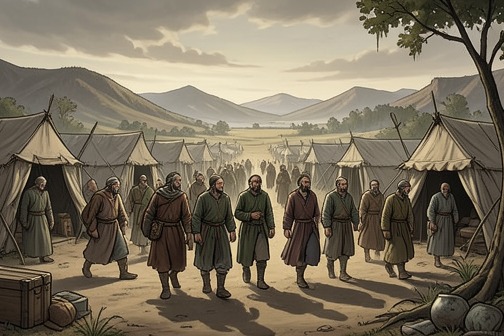
[Lin’s first visit to the leper camp](entity:event-recall-event-b7ee97abd9fd) near Khar transforms his improvised work as a neighborhood healer into a relationship with a community whose medical knowledge and underground trade are bound to its exclusion. Led by [Ranjitbhai](entity:character-recall-character-ranjitbhai-6a293620c477), the camp’s residents offer [Lin](entity:character-recall-character-lin-428ebd96b429) medicines for his patients and a place in their network. The encounter also reveals the stark logic behind that network: denied reliable access to treatment, the residents have become suppliers to people who need medicines but cannot safely obtain them through ordinary channels.
## Setting and encounter
Abdullah takes Lin to meet the residents after Lin has begun treating people in the [Colaba](entity:location-recall-location-colaba-2bd495476f0e) hutments. The journey leads to the outskirts of [Bombay](entity:location-recall-location-bombay-b9f73c3bdba6), where a few dozen people with leprosy live beyond the city’s treatment colonies. Those state- and privately funded colonies provide medical care, support, and clean surroundings, but their strict rules are difficult for some residents to accept. Some leave; others are made to leave. Outside the colonies, they face further rejection: neighborhood councils and street committees rarely tolerate their presence for long. The group therefore lives in temporary camps, moving to open ground where it can and leaving when necessary.
On the day of Lin’s visit, the residents have made their camp on rusty railway land beside Khar. Their shelters occupy a clear space between the tracks and are assembled from cardboard, plastic, branches, and string. Around thirty men, women, and children live there. The precariousness of their homes contrasts with the more established huts of the settlement where Lin lives, making visible how little security this group has even among people already accustomed to life on the margins.
The residents have seen Abdullah and Lin approaching. Ranjitbhai, the camp’s senior figure, comes out to greet them, supported by two children. Abdullah addresses him with respect and introduces Lin to the assembled group. Ranjitbhai is treated as the camp’s leader, and the meeting proceeds with the residents gathered around the visitors. Their welcome is not merely personal hospitality: it opens a conversation about the camp’s needs, its means of survival, and the medicines Lin requires for his patients.
## A leader and a supply arrangement
Ranjitbhai tells Lin that [Abdel Khader Khan](entity:character-recall-character-abdel-khader-khan-822d0cbbc88e) has informed him of the need for medicines. A boy named Sunil brings forward a canvas bundle containing labeled, apparently new ampoules and plastic bottles. The supplies include morphine hydrochloride, penicillin, and antibiotics used against staphylococcal and streptococcal infections. The display makes the residents’ practical capacity clear: they can obtain and organize medical stock, rather than merely receive whatever help outsiders choose to provide.
The camp agrees to help Abdel Khader Khan and offers medicines regularly. Ranjitbhai arranges for Sunil to deliver supplies to Lin’s hut as required. The arrangement links the camp’s underground resources to the daily work of Lin’s informal clinic. In time, the connection also matters during the cholera emergency: Khaderbhai’s lepers provide oral rehydration salts, which Lin and [Doctor Hamid](entity:character-recall-character-doctor-hamid-3435ac57c6e5) use in treating the sick. The visit thus establishes a concrete supply route whose importance becomes clear in a later crisis.
Ranjitbhai also directs the men, women, and children of the group to approach Lin and touch his feet. Lin finds the gesture mortifying and asks him not to require it, but Ranjitbhai insists. The residents approach one by one. The scene gives the meeting a ceremonial dimension, while also placing Lin in an unfamiliar position: he has come as a visitor who doubts his own qualifications, but the community receives him as someone whose work deserves recognition.
## The medicine trade and its history
Abdullah explains why the camp’s residents steal medicines and sell them on the black market. During the [British Raj](entity:time-recall-time-british-raj-ff5721ba16ff), lepers were placed last in the allocation of medicines, bandages, and treatment. Shortages caused by famine and floods could leave them without conventional supplies or traditional remedies. Stealing became a way to obtain what they could not otherwise get; as their skill and stock grew, the residents began selling medicines as well as using them to survive.
The trade also fills a particular gap in a country repeatedly marked by conflict. Medicines and medical supplies are monitored through chemists, hospital pharmacies, and wholesalers. Purchases substantially above the norm can attract attention, and records of antibiotics have helped authorities trace dacoits and revolutionaries. The residents’ market operates differently: they do not ask customers why they need the drugs, and they sell to anyone able to pay. Abdullah describes similar networks in [India](entity:location-recall-location-india-39df7eae59c1)’s major cities, serving terrorists, infiltrators, separatists, and outlaws, as well as other customers seeking to avoid scrutiny.
This account complicates the camp’s position in the story. Its residents are not simply recipients of charity, nor are they presented only as criminals. The trade arises from deprivation and exclusion, yet it makes them indispensable to people whose needs range from survival to armed resistance. Their marginality places them outside systems of care and regulation, but also gives them a role those systems cannot easily replace.
## Consequences for Lin’s work
Lin initially resists being called a doctor. He has first-aid training from a course taken as a teenager, and he has used CPR to revive people suffering overdoses, earning the nickname Doc. But he regards himself as unqualified for the wider demands of the slum clinic. He sends patients whose illnesses he cannot identify to the diagnostic service at [St. George Hospital](entity:location-recall-location-st-george-hospital-c5c5fe31c0bb), only to find that many return without having seen medical staff. His modesty is therefore grounded in a real limit: basic training cannot substitute for diagnosis, equipment, or reliable institutional care.
The camp’s supplies do not resolve that problem, but they give Lin practical resources and a continuing connection to people who can obtain them. His clinic grows through a mixture of limited skill, improvised care, and help from others. During the cholera outbreak, he acknowledges that he can do little beyond arranging for trained volunteers, while relying on the oral rehydration salts supplied through the same network established by Abdel Khader Khan’s lepers. Later, he also uses his first-aid knowledge to treat Ameer’s arm and to perform CPR during an overdose. These episodes extend the role first formed in the slum without making Lin a formally trained physician.
The encounter’s decisive change is relational as well as practical. Lin arrives with Abdullah as an outsider to the camp; he leaves with an agreement that the residents will help provide medicines to his patients. The visit binds a fugitive healer, a marginalized community, and Abdel Khader Khan’s network through a shared, if uneasy, reliance on care. It gives Lin’s work a source of support while exposing the conditions that make such support necessary: formal services fail many patients, and people excluded from them have developed their own means of obtaining and circulating medicine.
Event 18
Farouk and Raghuram’s religious dispute and reconciliation
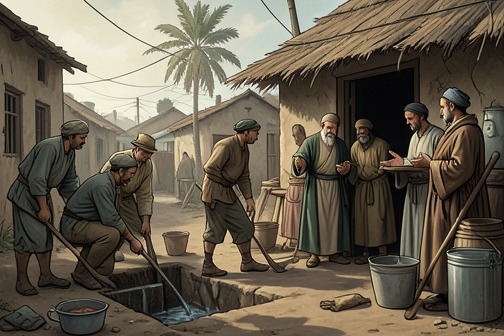
Faroukh and Raghuram’s religious dispute and reconciliation show how a quarrel between friends becomes a test of the whole slum’s solidarity. When the two young men fight over insults to their respective faiths, community head [Qasim Ali Hussein](entity:character-recall-character-qasim-ali-hussein-e223a2b66e5b) intervenes. Rather than allow religious allegiance to divide the neighborhood, he makes their punishment reaffirm their friendship and culminate in learning across faiths. The episode presents justice not only as discipline, but as an effort to restore the people and relationships that wrongdoing has damaged.
## Setting and Background
The incident takes place during preparations for the coming monsoon, when residents are working collectively to defend their homes. [Lin](entity:character-recall-character-lin-428ebd96b429) has joined a team clearing drains and gullies clogged by months of accumulated refuse. The work brings him into contact with people across the slum, where humble tasks essential to the community receive respect even when they are disparaged outside it. Against this background of shared labor and mutual reliance, the fight between two neighbors threatens more than their personal friendship.
Before the confrontation, a group gathers at Qasim Ali Hussein’s hut to hear Iqbal describe his six months as a contract laborer in Kuwait. Young men ask about jobs, employers, and ways of earning money between the Gulf States’ and [Bombay](entity:location-recall-location-bombay-b9f73c3bdba6)’s black markets. Iqbal’s informal afternoon lessons have drawn listeners into the hut and its forecourt. The shouts that interrupt this gathering abruptly redirect the crowd’s attention from useful shared knowledge to a conflict capable of setting neighbors against one another.
## The Fight and [Qasim Ali](entity:character-recall-character-qasim-ali-1195f20a5d70)’s Intervention
The crowd converges on the disturbance and finds Faroukh and Raghuram wrestling and punching. They belong to the team helping [Prabaker](entity:character-recall-character-prabaker-f1cb57f00b87) gather poles and lengths of wood. Iqbal and [Johnny Cigar](entity:character-recall-character-johnny-cigar-abaa784fef8e) separate them; then Qasim Ali steps between the young men. His arrival quiets the crowd, which has gathered noisily around a quarrel with a religious charge.
Asked to explain themselves, Faroukh says Raghuram insulted the Prophet, while Raghuram answers that Faroukh insulted Lord Ram. The people around them take sides with cries of condemnation. Qasim lets the uproar continue briefly, then raises his hands for silence. He stresses that the two men are friends and that fighting among friends and neighbors is especially damaging. Neither man’s appeal to religious insult persuades him that violence is justified.
Qasim broadens the dispute from the two combatants to the community they share. The residents are poor, he says, and have enough enemies outside the slum without turning on one another. Their survival depends on living together. He tells the young men that they have hurt people of every faith and shamed him. The crowd, now more than a hundred strong, passes his words outward from those nearest him to those at its edges. Faroukh and Raghuram lower their heads; Qasim’s emphasis on the harm done to their people, rather than merely to themselves, makes the collective consequence of their fight unmistakable.
## A Punishment That Makes Them Cooperate
Qasim announces that the two men will be punished, with their parents and him deciding the sentence that night. Until then, they must clean the area around the latrine. He then removes the long green scarf he wears around his neck and explains its purpose: it will bind the friends together as they work, reminding them of their bond while the unpleasant task reminds them of what their actions have done to one another.
He ties Faroukh’s right ankle to Raghuram’s left and sends them toward the latrine. At first they stumble; to make progress, they have to hold on to each other and move in step. Their forced cooperation gives the punishment a direct relation to the offense: the friends who acted against one another must coordinate their movements to complete the task. As they hobble away together, the crowd’s tension gives way to laughter. Qasim has already begun walking back to his hut, smiling as the people praise his judgment.
## The Community’s Sentence and Reconciliation
The latrine work is only the immediate consequence. Later, after Faroukh and Raghuram have washed and changed into clean clothes, they stand before an assembly of family, friends, and neighbors. A council made up of Hindu and Muslim friends and neighbors has decided the fuller punishment: each young man must learn one complete prayer from the other’s religious observances. The sentence answers the religious character of the quarrel not with a declaration that either faith has prevailed, but with an obligation to learn from the faith that the other observes.
Qasim explains that justice must be both fair and forgiving, and that a judgment is incomplete if it does not seek the satisfaction even of those who have offended and must be punished. In his account, punishment is also a way of trying to save the wrongdoer. The resolution thus extends the afternoon’s practical lesson in cooperation: the two friends must do more than stop fighting; they must attend to one another’s religious practice and return before their community on terms set collectively.
## Significance in the Slum’s Social Order
Lin later recalls this episode while reflecting on the community’s ability to govern itself in a city of twenty-five thousand people without policemen, judges, courts, or prisons. The case makes that local order tangible. Qasim has authority, but its exercise is restrained and public: he stops the immediate danger, assigns a proportionate shared task, and leaves the final punishment to a council of neighbors and families. The community both disciplines its members and takes responsibility for drawing them back into its life.
The episode also clarifies why Qasim’s leadership is widely respected. He does not treat religious difference as trivial, since the crowd’s response shows how dangerous such a conflict could become. Nor does he let difference become an excuse for retaliation. The green scarf, the synchronized walk, and the exchange of prayers each turn the abstract demand for coexistence into an action the young men must perform. Lin records Qasim’s understanding of justice in his black work journal; the remembered decision becomes a point of reference for the neighborhood’s broader practice of punishment joined to forgiveness and repair.
Event 19
Joseph’s community punishment
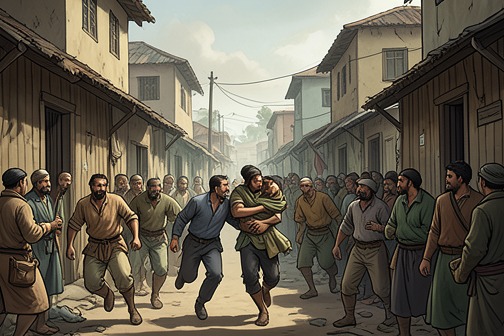
[Joseph’s community punishment](entity:event-recall-event-4f69d89da62f) begins when neighbors intervene after he beats his wife, Maria, and becomes an improvised local proceeding under [Qasim Ali](entity:character-recall-character-qasim-ali-1195f20a5d70)’s direction. Rather than call the police or remove [Joseph](entity:character-recall-character-joseph-a6dc2a0eb175) from the slum, Qasim organizes a public chastisement intended to make him answer for his violence, then sets out conditions for a possible reconciliation. The episode shows both the power and the danger of the settlement’s self-regulating order: it can respond where neighbors have hesitated, but its justice is personal, forceful, and dependent on Qasim’s restraint.
## Setting and Intervention
Qasim Ali’s authority in the settlement rests partly on an established communal role. He opens his main room several times a week as a forum where residents can bring grievances and requests; when disputes cannot be resolved there, he may have to act as an unofficial policeman and magistrate. Joseph’s case tests that order beyond the forum. One morning, while [Lin](entity:character-recall-character-lin-428ebd96b429) is drinking tea at Qasim’s house, [Jeetendra](entity:character-recall-character-jeetendra-81b0506b001d) reports that a man is beating his wife and may kill her. Qasim, Jeetendra, [Anand](entity:character-recall-character-anand-89b268e39901), [Prabaker](entity:character-recall-character-prabaker-f1cb57f00b87), and Lin hurry through the settlement’s narrow lanes toward huts on its edge, beside the mangrove swamp.
A crowd has gathered outside, but the violence has continued for hours. [Johnny Cigar](entity:character-recall-character-johnny-cigar-abaa784fef8e) reports that Joseph is drunk and has been beating Maria all morning. He also admits that this is not the first time, yet he and the other onlookers had not stopped it. The reluctance reflects the difficulty of intervening in what people commonly treat as a private marital dispute, even in a settlement where the close quarters make residents’ lives inseparable from one another’s. Qasim puts a hand on Johnny’s shoulder to calm him and orders that Joseph’s violence stop. When Maria comes out of the hut and collapses, her condition makes the need for intervention impossible to ignore.
Joseph then emerges still holding the bamboo stick he has used against her and moves as if to continue. The gathered residents rush forward. Prabaker, notably smaller than Joseph, is the first to grapple with him; the stick is taken away and Joseph is held down. Women cover Maria with a sari and carry her away. Shock and anger threaten to become mob violence, but Qasim immediately orders the crowd either to disperse or stand back, and tells the men restraining Joseph to keep him pinned. His first priority is therefore twofold: end the immediate danger to Maria and prevent the crowd’s outrage from turning into an uncontrolled attack.
## Public Chastisement
Instead of calling the police, Qasim asks what Joseph has been drinking and requests bottles of the rough local alcohol, daru. He also asks for charras and a chillum. Joseph is placed among a circle of young men, who give him alcohol and smoke while Qasim oversees what happens. The early phase of the punishment is deliberately public: residents see Joseph subdued and kept within the group rather than allowed to return to Maria or resume his assault. When he tries to leave, Qasim takes the bloodied stick and gives it to Johnny Cigar with an instruction to begin. Johnny uses it to strike Joseph, while the young men keep him within the circle.
The chastisement continues over several hours, but Qasim regulates its intensity. He calls for Joseph’s friends and relatives, along with members of Maria’s family, and they take turns confronting him and striking him with the same stick. The blows are painful but not intended to break the skin. Lin leaves and returns during the afternoon; throughout, Qasim remains seated nearby, watching the circle and directing the punishment with quiet words and gestures. This supervision distinguishes the proceeding, as Qasim conducts it, from revenge without limit. At the same time, the method is plainly coercive: Joseph is kept under the group’s control, and the community makes his conduct a matter of public accountability.
Joseph loses consciousness more than once. Eventually his resistance gives way, and he breaks down, repeating Maria’s name. The change in the scene is decisive: Qasim has waited for remorse before shifting from punishment to care. He signals for warm water, soap, and towels. The men who had been taking part in the chastisement cradle Joseph, wash him, give him water, and comb his hair. They offer kind words and tell him that genuine sorrow may be met with forgiveness and help. Joseph is made to touch the feet of people brought before him, including Lin, before being dressed in a clean shirt and supported by those around him.
## Conditions for Repair
Qasim tells Joseph that Maria is alive but badly injured. He then explains that the women of both families have decided the immediate terms: Joseph must not see her for two months while she recovers. During that period, he must work hard every day, save his earnings, and drink nothing but water. Qasim makes clear that these requirements are part of the punishment, not an optional promise. Joseph agrees, weeping and saying that he is sorry.
The settlement does not assume that Maria must take him back. Qasim tells Joseph that she may choose not to return and may seek a divorce; if she does, he will help her. Only if she decides to accept Joseph again after the two months is he to spend his saved money taking her to the cool mountains for a retreat. There, Qasim says, Joseph should confront what he has done and try to overcome the ugliness in himself. Reconciliation is thus made conditional on Maria’s choice and on Joseph’s conduct, rather than treated as an automatic result of his apology.
After Qasim ends the proceeding, Joseph’s friends help him back to his hut, which has been cleaned, with Maria’s clothes and personal belongings removed. He is given rice and dhal and left to rest while two friends fan him. Johnny suspends the bloodied stick from a post outside the hut, where it is to remain for the full two months of Joseph’s further punishment. The stick marks the continuing consequences of the assault even after the public chastisement has ended.
## Community Order and Significance
The episode presents community justice as more than punishment alone. The residents first fail to intervene in a repeated pattern of domestic violence; once Maria’s immediate danger is exposed, they act collectively, restrain Joseph, care for her, and bring both families into decisions about what follows. Qasim’s leadership is central at each turn: he prevents a possible lynching, controls the punishment, gives Maria’s family a role, and states plainly that Maria may refuse reconciliation. His authority is informal, but its reach includes immediate protection, public judgment, and a plan for what Joseph must do afterward.
The outcome is not shown as a completed reconciliation. Maria’s recovery takes priority, Joseph’s behavior is placed under continuing conditions, and the choice to resume the marriage remains hers. As the circle disperses, ordinary activity returns to the lanes: residents go back to their work, children play, and traders call out their wares. That return does not erase what happened. Instead, the episode sets private violence against the settlement’s shared life and asks whether that life can make a person answer for harm without surrendering the victim’s freedom to decide what repair means.
Event 20
Kano the bear’s hug and Abdullah’s letter

[Kano the bear’s hug and Abdullah’s letter](entity:event-recall-event-6372541dde5d) turn a noisy street spectacle into a message of affection from an absent friend. In the fifth month of [Lin](entity:character-recall-character-lin-428ebd96b429)’s life in the [Colaba](entity:location-recall-location-colaba-2bd495476f0e) slum, a huge bear reaches his hut under the control of two flamboyantly dressed handlers. They demand a hug before they will hand over the message they carry. Lin submits to the embrace, briefly feeling both helpless beneath [Kano](entity:character-recall-character-kano-72d93d20f33c)’s strength and strangely at peace; only afterward does he learn that the bear has come from Abdullah Taheri, who says he sent him to keep his brother company.
## An unexpected arrival
By the time Kano appears, Lin has been living in the slum for months. He has seen people from [Leopold’s](entity:location-recall-location-leopold-s-1d82f936fa9e) from time to time while working the streets with tourist clients, but he has not seen Abdullah during that fifth month. Instead, news of Abdullah reaches him through a succession of unusual messengers. The bear’s arrival continues that pattern, but on a scale that makes it impossible to mistake for an ordinary delivery.
Lin is writing alone at the small table in his hut when the [Dogs](entity:creature-recall-creature-dogs-e0736038fb3e) erupt in unusually furious barking. Their noise, joined by shouts and screams, approaches through the lane. He picks up the thick bamboo stick that is the only weapon in the house, then opens the plywood door. Half a metre away stands a bear so large that it fills the doorway, upright on its hind legs with its paws raised to the level of Lin’s shoulders. Lin drops the stick.
The bear’s presence sends the Dogs into a confused frenzy: unwilling to approach it, they turn on one another. Children scream and people scramble out of the way. Kano swings a massive paw at the dogs, scattering them, while young men use stones and sticks to drive them farther off. The commotion gathers around Lin’s hut, turning the lane into a crowded public scene before he understands why the animal has come.
## The handlers’ condition
Kano’s appearance is as striking as his size. A leather collar studded with short spikes circles his neck, with two chains trailing into the hands of his handlers. The men wear electric-blue vests, turbans, and trousers; blue paint covers their faces and chests and extends to the collar and chains. Silver bells and discs, red and yellow silk tassels, and thick dreadlocks tipped with coils of silver wire complete their unusual dress.
One handler addresses Lin by name, and people in the crowd confirm that he is Linbaba. The handlers say they are his friends and have brought an important message, but explain that he must first fulfill a promise. Because Lin does not know the Hindi word for promise, he initially cannot tell what they are asking of him. [Prabaker](entity:character-recall-character-prabaker-f1cb57f00b87) arrives and clarifies the condition: Lin has to hug the bear. The crowd, now numbering in the hundreds and filling the lanes, urges him on; children watch from the roofs of sturdier huts. With so many people gathered and the handlers withholding the message until he complies, Lin realizes that refusal is scarcely an option.
## The embrace
Lin takes two steps toward Kano and presses himself against the bear’s shaggy fur. Kano’s body feels unexpectedly soft, almost pudgy, but the forelegs that close around Lin at shoulder height are powerfully muscular. The embrace makes Lin feel utterly helpless: he knows the animal could break his back as easily as he could snap a pencil. At the same time, Kano’s low rumble vibrates against his ear, and the bear’s warmth and movement draw his attention away from the watching crowd.
The encounter is narrated through Lin’s bodily sensations rather than through conversation. He registers the softness of the fur, the bear’s strength, and its shifting weight; the crowd’s noise recedes as he clings to Kano and rocks with him. Lin describes the experience as a feeling of floating or falling from a place of peace and promise. The overwhelming animal power that first frightened him becomes, for the brief duration of the hug, a source of calm.
When Kano releases him, Lin has fallen to his knees. The bear is already lumbering down the lane with its handlers, the crowd, and the still-agitated dogs. Shaken and dizzy, Lin assures the people around him that he is fine. Prabaker asks whether Kano gave him a substantial squeeze and passes him the promised message. The physical encounter is over before Lin knows what it means; the letter supplies its explanation afterward.
## Abdullah’s message
Back in the hut, Lin opens a crumpled yellow envelope. Inside is a typed note on matching yellow paper, in English. Lin suspects it was prepared by one of the professional letter-writers on the Street of the Writers. The letter is signed by Abdullah and addresses Lin as his brother. Abdullah explains that he has heard Lin gives bear hugs to people and imagines this custom may leave him lonely in [Bombay](entity:location-recall-location-bombay-b9f73c3bdba6), where bears are in short supply. He therefore sent Kano so Lin could have someone to hug.
The note also provides concrete news that Lin has lacked during Abdullah’s absence: Abdullah says he is healthy, occupied with business, and intends to return to Bombay when that business is finished, God willing. Its affectionate joke does not erase the distance between them, but makes that distance the subject of a practical, improbable gesture. Prabaker reads the note aloud and responds with a joke that Abdullah is involved in the bad business he is supposedly not meant to discuss. That aside connects the tender message to Abdullah’s continuing, less innocent life beyond the slum.
The event brings together spectacle, fear, humor, and friendship without making the message grander than it is. The handlers’ secretive promise turns a letter into a small ordeal; Kano’s embrace gives Lin a wordless, bodily encounter before Abdullah’s explanation arrives. In a period when Lin has not seen his friend, the letter confirms that Abdullah is alive and thinking of him, while the bear makes that care momentarily tangible.
Event 21
Celebration feast in the village in the sky
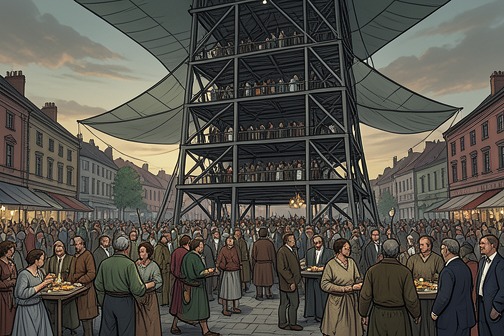
The celebration feast in the village in the sky turns an unfinished [Bombay](entity:location-recall-location-bombay-b9f73c3bdba6) skyscraper into a gathering place for residents of a settlement whose existence the authorities do not officially recognize. The occasion celebrates a hard-won temporary school and the birth of a long-awaited son; its setting, twenty-three floors above the slum, makes community achievement visible beside the uncertain future of the homes below.
## The school campaign and the reason to celebrate
The school campaign had answered a pressing need: roughly eight hundred school-age children lived in the settlement, while the schools for miles around were already full. Residents had organized teachers and found a suitable site themselves, but the authorities resisted. As [Lin](entity:character-recall-character-lin-428ebd96b429) explains to [Karla](entity:character-recall-character-karla-3f7aa8a8ae5c), the objection was bound up with the settlement’s unofficial status: recognizing a school might lend legitimacy to a place that was legally unrecognized. [Prabaker](entity:character-recall-character-prabaker-f1cb57f00b87) makes the erasure concrete through a joke that describes the residents as not-people in not-houses where they are not-living. The humor gives voice to a serious condition: the community lives there, but its presence can be denied in official terms.
The municipality eventually accepted a compromise, allowing a temporary school to operate nearby and promising that another would be organized soon. The concession was not secure permanence. The schools would have to be taken down when construction ended, and the slum itself was expected, at least in theory, to be cleared. Work on the towers had already continued for five years, with perhaps three more years to go, and no one knew what would happen afterward. The feast therefore marks a real victory without disguising its limits. The campaign had sometimes become violent; now the residents could celebrate the school, even as the future of the settlement remained unsettled.
A second reason for the gathering was the birth of a son to a man who had previously had five daughters. He was holding a special lunch before the larger school celebration that evening, and everyone had been invited. The joined occasions make the meal both a public recognition of collective effort and a family celebration. Prabaker calls the destination the village in the sky, and Lin points upward: the name refers to the unfinished towers themselves, not to a separate neighborhood.
## A feast inside the unfinished towers
The group travels by elevator rather than climbing to the twenty-third floor, where lunch is laid out on bare concrete. Steel rods and wires rise from the floor; evenly spaced columns divide the enormous space, and cables cross the ceiling. The building has no finished interior fittings. What will eventually be apartments is, for now, an open construction floor temporarily adapted for people, animals, and a communal meal.
The residents have arranged distinct uses around the pillars. A pen made from wicker and bamboo holds goats, chickens, cats, and dogs among bedding and discarded scraps. Blankets and mattresses are gathered by another pillar for people who sleep there; a third area, marked by small mats and toys, is set aside for children to play. These improvised domestic spaces make the floor more than a dramatic viewpoint over the slum: it functions, for the day, as a place where people and animals can gather and where ordinary needs have been accommodated within a structure still being built.
The meal itself is carefully prepared and abundant. Women serve saffron rice, alu palak, kheema, bhajee, and other dishes from kerosene stoves onto large banana leaves used as plates. Guests wash their hands at a drum of water and sit on reed mats. The women have their own banquet area about five metres away; Karla is the only woman among the twenty men in Lin’s group. [Johnny Cigar](entity:character-recall-character-johnny-cigar-abaa784fef8e) asks how she likes the party, and she praises both the food and the place. The scene presents a shared celebration while also recording the separate arrangement of the women’s meal and Karla’s unusual position within the men’s group.
## The hosts and the city around them
The new father, Dilip, is introduced to Karla by Johnny Cigar. He bows with his hands pressed together, then moves away, smiling shyly, to oversee tea being prepared at two large stoves. Dilip works as a rigger on the construction site. The site manager has given him the day off so he can organize the feast for family and friends. His hut stands on the legal side of the slum, close to Lin’s across a wire: a small detail that places the celebration near a boundary separating recognized from unrecognized habitation.
That boundary is overshadowed by the towers. By the time the group arrives, concrete reaches roughly three-quarters of their height, but windows, doors, and fittings have not yet been installed. Their unfinished openings expose the labor taking place on the floors within, while their sheer scale makes them a visible sign of the construction whose completion may mean the slum’s removal. Prabaker, who lives in the illegal settlement and has no connection to the project, boasts about the buildings as though they were his own. Lin corrects him that they are the tallest in Bombay, rather than in all [India](entity:location-recall-location-india-39df7eae59c1), and notes that lunch is being served on the twenty-third floor. The exchange folds local pride and playful correction into the scene without resolving the contrast between the residents’ lives and the development rising above them.
## Celebration beside an ominous sign
The feast also carries a brief warning. Beside the women’s banquet area, two men scrub at a word painted on the wall, but SAPNA remains legible in large English capitals. Lin says he has seen the name around the city and asks Johnny Cigar about it. Johnny identifies [Sapna](entity:character-recall-character-sapna-3597df1d97c4) as a thief and a goonda, and says that he has been breaking into houses, stealing, and killing. The mark interrupts the celebratory setting with evidence that violence is present beyond the school campaign’s earlier struggles. The feast does not become a confrontation, but the name left on the wall gives the scene a second register: communal success and hospitality coexist with anxiety about danger elsewhere in the city.
As an event, the gathering joins a temporary institutional gain to a domestic milestone, then places both within an uncertain urban landscape. The residents can fill an unfinished upper floor with food, animals, children’s play space, and company; they can also only celebrate a school the municipality has allowed them to establish provisionally. The village in the sky is therefore both an imaginative name for the party’s high perch and a reminder of how provisional the community’s foothold remains.
Event 22
Karla asks Lin to help Lisa escape
[Karla asks Lin to help Lisa escape](entity:event-recall-event-edb8952ef24f) from [Madame Zhou](entity:character-recall-character-madame-zhou-d453e8a13327), turning a private appeal into a plan to secure [Lisa](entity:character-recall-character-lisa-f8f8fe21b70f)’s freedom without exposing her to revenge. The encounter matters because [Karla](entity:character-recall-character-karla-3f7aa8a8ae5c) insists that rescue must mean more than getting Lisa out of the door: Madame Zhou must be persuaded to leave her alone permanently. [Lin](entity:character-recall-character-lin-428ebd96b429) is asked to make that possible by impersonating an American consular official, while the scene reveals the personal danger behind Lisa’s debt and the trust Karla places in him.
## The Request and Its Personal Stakes
Before Karla explains what she needs, Lin recalls a former girlfriend’s judgment that his curiosity about everything had also meant commitment to nothing. He does not tell Karla that the accusation still hurts, or that he believes it. The memory gives her ensuing request an intimate complication: Lin initially suspects that she has come not because she misses him, but because she wants something from him. Yet the fact that she has chosen to ask him, rather than someone else, offers him a measure of consolation. He also senses that asking for help is unusual for her and that much may depend on what she is about to request.
Karla’s tone changes as she asks whether Lin is interested in helping her with something. Once he agrees, she explains that her friend Lisa has become trapped at a place for foreign call girls. Lisa owes a large sum, and the woman who runs the establishment will not let her leave. Karla’s account establishes that this is not simply a debt dispute: Lisa’s employer has taken a personal interest in keeping her under control. Lin’s first proposal is to pay what Lisa owes, but Karla makes clear that money is not the obstacle. She has it already.
## Why a Simple Rescue Will Not Work
Karla describes Madame Zhou’s attachment to Lisa as a means of domination rather than ordinary business. In her view, the debt is an excuse: Madame Zhou wants to break Lisa gradually, until nothing of her remains. Karla attributes the hostility to Lisa’s beauty, brightness, and courage, qualities that make her a target in Madame Zhou’s eyes. The planned intervention therefore has to change Madame Zhou’s calculation, not merely remove Lisa from the premises for a night.
Lin asks whether Karla wants them to break Lisa out. Karla rejects that as insufficient. She has friends in [Bombay](entity:location-recall-location-bombay-b9f73c3bdba6) who could get Lisa out easily, and Lin considers approaching Abdullah Taheri and his associates, who are not afraid of a fight. But physical force would leave the central danger untouched: Madame Zhou’s heavies could find Lisa afterward and punish her. Karla warns that they use acid and that Lisa would not be the first woman to have acid thrown in her face for crossing Madame Zhou. The possibility of lasting injury makes a straightforward escape too dangerous. Karla’s stated requirement is that whatever they do must convince Madame Zhou to leave Lisa alone for good.
## Lisa’s Reasons for Staying
Lin asks why Lisa cannot simply run away and return to the [United States](entity:location-recall-location-united-states-2f533bc8d0b9). Karla explains that Lisa is American but will not leave Bombay. Her heroin addiction is one reason, but it is not the whole explanation: Lisa also has a past in the United States that she cannot face. Karla connects Lisa’s refusal to return with her own reluctance to revisit painful parts of her past. She does not explain those experiences, and Lin recognizes that she is not telling him everything about the situation. The partial disclosure preserves uncertainty while making clear that departure, though it may seem like an obvious solution from outside, is not available to Lisa in any simple sense.
That refusal shapes the rescue plan. Karla does not propose sending Lisa away; she wants her to remain in Bombay without being subject to Madame Zhou’s control. Lisa has already discussed the scheme with Karla and believes it may work. Her participation matters: she is not merely an object to be carried out, but someone who has considered the proposed approach despite her constrained choices.
## The Embassy Deception
Karla’s plan depends on Lin impersonating someone from the American embassy, presented as a consular officer assigned to remove Lisa and keep watch over her. Karla has already arranged the story: Lisa’s father will be described as a powerful American with government connections, and Lin will claim to have orders concerning her. Karla intends to prepare the details before Lin enters the establishment and says she will do most of the talking. The invented official identity is meant to supply a threat more consequential to Madame Zhou than the debt itself: the prospect of trouble with the embassy or government if she continues to harass Lisa.
Karla recognizes the plan’s uncertainty. It depends on Madame Zhou believing Lin’s identity, on the money being paid, and on the suggestion of government consequences being persuasive. Karla judges Madame Zhou more cunning than clever, but not stupid; the performance must therefore be exact rather than merely plausible at a glance. As she weighs the idea with Lin, she takes beedies from her pocket, lights two with a cigarette lighter, gives one to him, and draws on her own before explaining why she thinks the deception may succeed. The small, practical gesture sits beside the high stakes of the scheme: a shared cigarette, then the question of whether Lin can convincingly play an American official. He says that he was once an actor, though the remark locates that ability in a former life. The scene ends with the plan still conditional, but with Lin having agreed to take the role on which Karla believes Lisa’s lasting safety may depend.
Event 23
Slum housing demolition
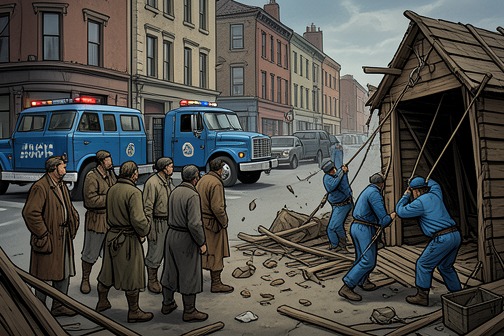
[Slum housing demolition](entity:event-recall-event-c4750a3a597a) is a recurring act of municipal control over the illegal settlement: police secure the area while council workers pull down homes, displacing residents and destroying their belongings. In one operation witnessed by [Lin and Karla](entity:relation-recall-relation-lin-and-karla-9a163b3f3796), roughly sixty houses are demolished in less than twenty minutes. The raid makes the unequal security of the city’s residents visible, while its aftermath becomes an intimate turning point for the two witnesses.
## The recurring operation
[Lin](entity:character-recall-character-lin-428ebd96b429) explains to [Karla](entity:character-recall-character-karla-3f7aa8a8ae5c) that the council carries out demolitions every month or so, ostensibly to keep the slum from spreading beyond its edge at the street. The operation begins when four, five, or six large blue police trucks arrive at an open area enclosed by the crescent of huts. An open truck follows, carrying council workers and their equipment; police officers then arrange their men in two rows as the demolition begins.
The workers are themselves mostly residents of other slums. Each uses a rope and grappling hook to catch a hut’s roof and pull the structure down. Residents have time to salvage only the bare essentials—babies, money, and papers. Stoves, pots, bedding, clothes, bags, and children’s toys are swept into the wreckage. Some people are stopped by police, and several young men are marched to the waiting trucks.
## Destruction and displacement
From the building where they are watching, Lin, Karla, and others see the operation from above. The distance separates them from the noise of the demolition, but not from its consequences. Workers stop construction at the site in sympathy, although their own homes in the legal slum remain safe. They understand that, once the building is finished, their homes are expected to be destroyed and replaced by a car park for limousines.
The raid clears a strip about one hundred metres long and ten metres wide at the illegal slum’s north-eastern corner. About sixty houses—homes to at least two hundred people—are obliterated in under twenty minutes. When the police and workers leave, people begin picking through the rubble. Canvas and plastic shelters are erected for elderly residents, babies, and small children.
Lin tells Karla that huts will probably be rebuilt by the next day, only to face another demolition later. Rebuilding does not undo the loss: residents must buy new bamboo and mats, and those arrested may not return for months. The repeated cycle makes the destruction more than a single clearance; each rebuilding leaves residents exposed to another round of loss and arrest.
## A wider insecurity
The demolition sits within a larger pattern of precarious living and limited access to public services. In a separate discussion with [Doctor Hamid](entity:character-recall-character-doctor-hamid-3435ac57c6e5), Lin describes sending patients from his small clinic to [St. George Hospital](entity:location-recall-location-st-george-hospital-c5c5fe31c0bb), where they often return without seeing a doctor. The hospital is overcrowded, while residents cannot afford the licensed practitioners whose referrals might help them move up its queue. These circumstances do not make the demolition a cause of illness, but they show how little protection or access the slum’s residents can rely on.
A later cholera outbreak makes the community’s response to crisis visible in a different way. Sandeep Jyoti reports other outbreaks across the region and overcrowded hospitals; [Qasim Ali Hussein](entity:character-recall-character-qasim-ali-hussein-e223a2b66e5b) turns his home into a command centre, and residents organize water purification, disinfectant trenches, safe food, and care for the sick. Lin takes responsibility for oral rehydration. The demolition scene and the epidemic response are distinct episodes, but together they contrast official force against residents’ vulnerability with the practical solidarity they build among themselves.
## Witnessing and intimacy
The demolition also changes the emotional relation between Lin and Karla. After the trucks depart and residents start to recover what they can, the two remain together at the window. Lin kisses Karla; the tenderness of the moment unsettles his prior sense of her as tough and emotionally guarded. He pulls away first and falters in apology. The kiss does not alter the residents’ losses, but the scene places a private moment of vulnerability beside the public spectacle of displacement, giving the demolition a personal consequence within their relationship.
Event 24
Lin and Karla’s kiss and love confession
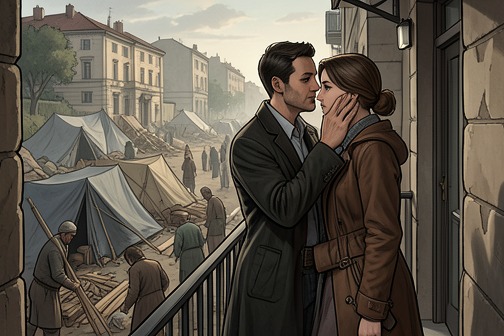
[Lin and Karla’s kiss and love confession](entity:event-recall-event-a8e194a3abc4) turns the devastation of the slum’s demolished homes into a moment of unexpected intimacy. The scene does not resolve their relationship: [Lin](entity:character-recall-character-lin-428ebd96b429) declares his love, while [Karla](entity:character-recall-character-karla-3f7aa8a8ae5c), startled and guarded, offers affection without claiming to share his certainty. Its decisive change is smaller and more precarious than a romantic commitment, but it makes their feelings speakable between them.
## In the aftermath of the demolitions
The conversation and kiss take place as people begin to pick through the rubble of their homes. From the window, [Lin and Karla](entity:relation-recall-relation-lin-and-karla-9a163b3f3796) see temporary shelters going up for elderly residents, babies, and the youngest children. The destruction is not treated as a single, finished disaster: homes may be rebuilt, only to be knocked down again, while residents must replace the bamboo and mats that made them habitable. Arrests add a more uncertain loss, since those taken away may not return for months.
Karla has just voiced her unease about the contrast between the force that crushes people and their capacity to endure it. The scene gives that contrast a visible form below the window: people are already searching through rubble and putting shelters together. Above them, Lin has his arm around Karla. Their closeness begins inside this aftermath, not apart from it; the sight of damage and the work of beginning again frame what passes between them.
## A kiss that unsettles Lin’s view of Karla
Although most people have moved away from the window, Lin and Karla remain close together, as they had been in the crowded press of people. Lin kisses her. He experiences the kiss as tender and vulnerable, a sharp revision of his picture of Karla as street-wise, tough, and nearly cold. Its tenderness surprises him enough that he is the first to pull away, then falters in an apology.
Karla answers by leaning away with her hands on his chest and reassuring him that the kiss is all right. Her response both accepts the moment and marks a limit: she does not simply turn it into a declaration of mutual love. She also makes a light remark about possibly making one of the pretty girls at the feast jealous. That shift in tone keeps the exchange from becoming a straightforward romantic culmination. Warmth, embarrassment, and caution remain together in the scene.
## Lin makes his feelings explicit
When Karla connects Lin’s decision to stay in the slum with [Didier](entity:character-recall-character-didier-381547eab195)’s theory that he must have a girlfriend there, Lin corrects the assumption directly. He says that he has no girlfriend and that he is in love with Karla. She immediately denies that he is, in an abrupt response that lands on him like a slap. The confession therefore does not produce instant agreement or reassurance; it exposes a difference between Lin’s certainty and Karla’s willingness to accept what he says.
Lin does not turn his declaration into a demand. He describes love as something that arrives without a person choosing it and stresses that Karla owes him no action or answer, nor does his confession obligate him to do anything beyond saying what he feels. This qualification matters to the scene’s balance: his words make a claim about his own feeling, while explicitly leaving her freedom intact.
## Affection without resolution
Karla says she does not know what she feels, but distinguishes loving Lin from liking him and says she is happy to like him a great deal. She even imagines being head over heels in like with him, if that is enough. The playful formulation gives her a way to acknowledge genuine affection without adopting Lin’s language of love or promising a future. Her eyes appear honest and brave to him, yet he senses that she is withholding something and remains afraid.
Lin relents and smiles; Karla laughs, and he laughs with her. Her final question about whether her affection is enough for now leaves the relationship at the point the scene has reached: more openly intimate, but not settled. Against the rebuilding below, the exchange offers no neat restoration or guarantee. It records a beginning made of unequal declarations, tenderness, hesitation, and a temporary agreement to let liking count.
Event 25
Lisa leaves Madame Zhou’s palace

[Lisa](entity:character-recall-character-lisa-f8f8fe21b70f)’s departure from [Madame Zhou](entity:character-recall-character-madame-zhou-d453e8a13327)’s palace is a negotiated escape, not an uncomplicated release. [Lin and Karla](entity:relation-recall-relation-lin-and-karla-9a163b3f3796) secure permission for her to leave, but Madame Zhou insists that Lisa remains hers if she comes back; the room’s hidden observer and the sealed envelope [Rajan](entity:character-recall-character-rajan-b88c52c5a766) gives [Lin](entity:character-recall-character-lin-428ebd96b429) leave the moment shadowed by control even as Lisa grabs her bags and walks out.
## The interview behind the grille
Madame Zhou receives Lin and Karla in a small, square room furnished only with a carpet, lace-curtained window, and two large cushions. They kneel before a metal grille in the wall, in a posture Lin associates with confession. Madame Zhou speaks from the darkness beyond the lattice; although her presence dominates the meeting, she remains unseen. The arrangement makes the conversation feel less like an ordinary request than an audience before a concealed authority.
The tension is personal from the outset. Madame Zhou tells [Karla](entity:character-recall-character-karla-3f7aa8a8ae5c) she is unhappy with her, while Karla answers angrily that happiness is a myth invented to make people buy things. Madame Zhou laughs, then turns her attention to Lin. The negotiation takes place in Hindi, a language Lin finds increasingly difficult to use under pressure. He has stumbled over two of the three questions Madame Zhou asked, and Karla, usually his guide in unfamiliar situations, is herself subdued after Madame Zhou tells her to be quiet. Lin drinks spiced iced lime juice while a shadow and whisper move in the darkness behind the grille; he wonders whether Rajan is there, but cannot make out the figure.
## Permission with a condition
Madame Zhou identifies Lin’s involvement as an act of love for Karla. She suspects that Karla persuaded him to undertake the job and warns him not to expect Karla to love him, keep her promises, or spare him sorrow. She presents the warning as a friendly gift, making her intervention at once a judgment of Karla and an attempt to influence Lin. The conversation about Lisa’s departure is therefore entangled with Madame Zhou’s claim to understand Karla’s character and Lin’s attachment to her.
Madame Zhou acknowledges that Lisa’s father is longing for his daughter and has influence he might use, but says it was Karla who talked Lin into the undertaking. She then states the terms directly: Lin may take Lisa away, but if Lisa chooses to return, Madame Zhou will not give her up. She also reserves the right to welcome Lin back as a guest and invites him to relax at the palace, suggesting that he might remember the invitation after Karla is finished with him. Lin agrees to the condition. His relief is enormous: he understands the immediate objective to have been won, while Madame Zhou’s terms make clear that the permission does not end her claim over Lisa.
## Lisa’s decision to leave
After the interview, Lin notices the marks Karla’s knees have left in the brocade cushion. Tired, angry, and confused, he follows Karla and Rajan through the palace corridors, growing more resentful as he goes. At the end of a corridor, Rajan leads them to a bedroom decorated with movie posters: Lauren Bacall in *To Have And Have Not*, Pier Angeli in *Somebody Up There Likes Me*, and Sean Young in *Blade Runner*. Lisa sits on the large bed with a suitcase and cosmetic case already packed at her feet. Her impatience makes plain that she has been waiting to get out; she complains that they are late and that she is going out of her mind.
Lisa first asks Karla whether Madame Zhou has really agreed. Both women look toward Rajan and then toward the mirror on the wall behind him, recognizing that Madame Zhou is watching and listening. Lin confirms that she can go, though he hopes she will not notice his imperfect American accent. Lisa demands reassurance that the permission is genuine. When Karla confirms it, Lisa rises quickly, grabs her bags, and urges them to leave before Madame Zhou changes her mind. Her movement converts the negotiated permission into an immediate act of departure.
## The threshold and its residue
At the street door, Rajan stops Lin and hands him a large sealed envelope. He stares at Lin with the same perplexing malice Lin has noticed before, then closes the door. The contents of the envelope are not disclosed in this scene, so the gesture adds an unresolved detail rather than an explanation. Lin catches up with Karla and turns her around to ask what the exchange was about. Karla answers that the plan worked: they got Lisa out.
The scene’s change is clear but limited. Lisa leaves the palace with her luggage, and Madame Zhou has allowed the departure; yet her warning that Lisa will remain hers if she returns keeps the release conditional. The hidden grille and the watching mirror reinforce the sense that permission is granted under surveillance, while Madame Zhou’s prediction about Karla leaves Lin’s love exposed as another point of vulnerability. Lisa’s swift departure is the practical success of the encounter, but the palace’s hold on the people who pass through it is not represented as wholly broken.
Event 26
Lin takes on the task of caring for and teaching Tariq
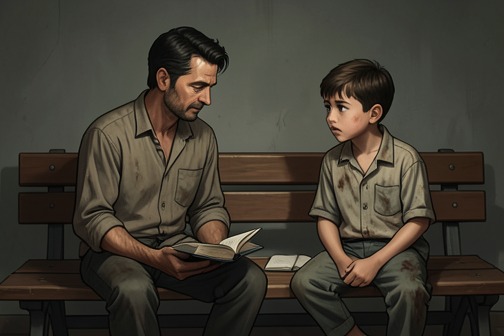
[Khader Khan](entity:character-recall-character-khader-khan-2bf2b74321b0) places [Tariq](entity:character-recall-character-tariq-6036f9dbabf7), his young nephew, in [Lin](entity:character-recall-character-lin-428ebd96b429)’s care with the stated aim of teaching him English through constant companionship rather than formal lessons alone. Lin is allowed only a two-day trial before deciding whether to continue, but the boy’s fear at being handed to a stranger makes the arrangement an immediate encounter with responsibility, not simply an invitation to teach.
## The request and its terms
Khader Khan returns to a favor he had mentioned the day before: Lin is to teach Tariq enough English to improve the boy’s command of the language and give him an advantage when he begins formal studies. Lin agrees to try, though he is bewildered by the request and unsure that he is the best person for the job. His uncertainty is practical as well as personal: he asks where the teaching is supposed to take place, imagining that he might come to Khader Khan’s home.
The proposal is far more encompassing. Tariq is to stay with Lin for ten or twelve weeks, living with him, eating and sleeping where he does, and accompanying him wherever he goes. Khader Khan wants the boy to learn not just English phrases but what he calls the English way—Lin’s way—through unbroken company. Lin objects that he is not English. Khader Khan answers that, as a foreigner, Lin is English enough for the purpose: the assignment depends on his difference from the people around Tariq, not on any claim that he is English by nationality.
## A trial and a network of care
Lin’s hesitation is not hidden from Khader Khan. He names both concerns Lin has not voiced aloud: that something may happen to Tariq, and that Lin will lose his freedom to go and do as he chooses. Lin feels relieved to be understood, and briefly expects that Khader Khan will withdraw the demand. Instead, Khader Khan offers a limited test. Lin is to take the boy for forty-eight hours; if he finds the situation impossible, he may bring Tariq back, and Khader Khan says he will ask no more of him.
The trial is not meant to leave Lin alone with the burden. Khader Khan says [Qasim Ali Hussein](entity:character-recall-character-qasim-ali-hussein-e223a2b66e5b), the head man in the slum and a friend of his, will help. Qasim is to arrange for several families, including his own, to share responsibility and provide places for Tariq to sleep as well as Lin’s home. Khader Khan’s plan is for the boy to experience the hardest life of the poorest people while also learning from an English teacher. He begins to explain why that last part matters to him, but pauses before completing the thought. The reason remains unstated in this encounter; the scene records its weight without supplying an explanation.
## The boy at the handover
When Khader Khan calls Tariq forward, the child is already standing beneath the cloister arches. Though eleven, he looks much younger to Lin, and his clean, pressed kurta-pyjama and leather sandals contrast with the tied calico bundle clutched in his arms. His expression is forlorn and distrustful. Rather than approach Lin directly, he circles widely around him and moves to the far side of his uncle’s chair. After Khader Khan speaks to him sternly in Urdu and points several times toward Lin, Tariq comes to Lin’s stool and extends his hand. His faltering greeting makes his reluctance audible; Lin’s hand nearly swallows the child’s, and the contact awakens a protective instinct that complicates his resistance to the assignment.
The parting makes clear that Tariq is not simply being delivered into a neutral arrangement. Khader Khan stares strength into the boy, then leaves without looking back at him. Lin and Tariq both watch him go feeling abandoned and betrayed. [Nazeer](entity:character-recall-character-nazeer-70724b855ba6) walks them to the door; as Lin changes into his street shoes, Nazeer presses Tariq to his chest with unexpected tenderness. The boy clings to Nazeer’s hair, and Nazeer has to be prised away from him with force. He then gives Lin a lingering, menacing look that makes the consequence of any harm unmistakable: Lin will answer to him.
## Reluctance, power, and responsibility
Outside, beside [Nabila Mosque](entity:location-recall-location-nabila-mosque-495a375e716a), Lin and Tariq hold tightly to each other’s hands, though their only shared understanding is their bewilderment at Khader Khan’s power to push them together against their wills. Tariq has obeyed; Lin recognizes that he has capitulated too readily. His affection for Khader Khan, which he experiences as a kind of love shaped by their unequal positions, sits uneasily beside his resentment at being ordered to take responsibility for a child. He turns that resentment into a moral objection: Khader Khan, he thinks, has disregarded Tariq’s rights and well-being and treated the child as if he were someone else’s plaything.
That judgment is entangled with Lin’s self-disgust. He condemns Khader Khan for surrendering a reluctant boy to a stranger, but also knows that he himself has failed to resist the demand. Angry at his own pliancy, he pulls Tariq along at a jogging trot through the crowded street. As they pass the mosque’s main entrance, the muezzin begins the call to prayer from the minarets. The handover therefore ends not with consent or reassurance, but with the two unwilling companions already moving together: Khader Khan’s authority has made the arrangement, while Tariq’s small hand in Lin’s makes its human obligation harder to dismiss.
Event 27
Kano and the bear handler are arrested and reunited in jail
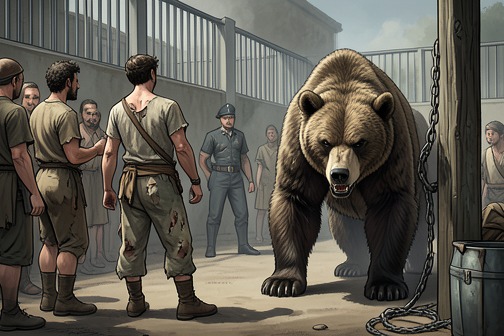
[Kano and the bear handler are arrested and reunited in jail](entity:event-recall-event-5880c485a248) after a dispute over an abused bear escalates into a fight. The handlers cannot be released, and [Kano](entity:character-recall-character-kano-72d93d20f33c) is confined in a cell, but [Lin and Prabaker](entity:relation-recall-relation-lin-and-prabaker-c6d700ec59e3) find another way to respond: they negotiate permission for the handlers to stay with him. The episode moves from a crowded prison audience’s outrage at animal cruelty to the quiet practical work of keeping a familiar animal from facing custody alone.
## The dispute and arrests
The events reach [Lin](entity:character-recall-character-lin-428ebd96b429) through two bear handlers who come to the prison gate seeking help. They explain that, near [Navy Nagar](entity:location-recall-location-74da319e0e60), they encountered other handlers whose bear was thin and being beaten with a whip. The animal cried out, and the men who came upon the scene challenged its handlers, insisting that a bear should not be treated that way. Their objection was followed by shouting and a fight. The account is relayed through [Prabaker](entity:character-recall-character-prabaker-f1cb57f00b87), who listens to the visitors and translates for Lin as the story unfolds.
At the gate, the story gathers an audience. Prisoners leave nearby rooms and crowd around to listen; the watchman, too, becomes absorbed in the account. The handlers’ description of a bear being beaten, and the revelation that the animal was female, draw angry and sympathetic reactions. In this telling, the dispute is not presented as a quarrel without cause: it begins with an attempt to intervene against cruelty, but the intervention itself turns into violence and attracts the attention of the police.
The handlers say the other side initially had the advantage, with additional men joining the fight. Kano then entered the fray to help his handlers. Prabaker’s account emphasizes the bear’s decisive intervention: Kano drove back the men and their companions before the police arrived. The sequence does not end in vindication for the handlers. They and Kano are taken into custody, and Prabaker confirms that the men have been arrested on a charge of disturbing the peace. Their effort to protect another animal has brought them into the same legal process as the fight it produced.
## Kano in the cell
After hearing what happened, Lin and Prabaker go downstairs to see Kano. A watchman opens a ground-floor cell, where the bear sits alone. He is muzzled and restrained by chains attached at his neck and paws and passed through a window grille. The account describes him as deeply distressed. The scene makes the cost of the arrests immediate: the bear who had intervened beside his handlers is now separated from them in confinement.
Prabaker reacts with tears and moves toward Kano, embracing and stroking him despite the watchman’s attempt to hold him back. His response is physical before it is explanatory: he treats the animal as a familiar companion in need of comfort, not simply as property or evidence in a police matter. Lin recognizes that he, too, had embraced Kano weeks earlier. The recollection links this prison visit to an earlier encounter and shows that Kano’s bond with the men around him has already made him part of their shared emotional world.
The handlers do not ask Lin to secure their release once they understand that this is not possible. What they want is permission to join Kano in the cell. They explain that he has never spent a night alone since he was a baby and fear that isolation in jail will frighten him and leave him distressed. Their concern is for his immediate welfare, including the comfort of familiar company. They also describe him as ordinarily well behaved, an appeal that contrasts his reputation as a fine citizen with his present status in custody.
## Negotiating a reunion
Lin and Prabaker first establish that they cannot bail out either the handlers or Kano. They then take the narrower request to the watchmen and guards: allow the men to stay with the bear. The negotiation works within, rather than abolishes, the prison’s rules. Prabaker argues and pleads energetically, while Lin provides the money required to obtain the guards’ agreement. The price is two hundred rupees, described in the narrative as about twelve American dollars.
Once the gate is unlocked, the group goes down the steel stairs to the cell. Hearing the handlers, Kano rises, but the chains pull him back down; he responds by moving his head and paws as they approach. The men greet him with affectionate attention and try to ease the strain of the restraints. Lin and Prabaker leave the handlers and Kano together inside the cell. Their reunion does not undo the arrests or change the bear’s confinement, but it answers the specific fear that brought the handlers to Lin: that Kano would have to face jail alone.
## Care, custody, and community justice
The episode sets official custody beside forms of care and judgment that operate through personal relationships. The police have arrested the handlers and bear after the fight, and Lin’s attempts to secure their release fail. Yet the guards can grant a limited concession without disregarding the rules altogether. The result is modest but consequential: the men are permitted to accompany the animal they had sought to protect.
This concern for repair and for people’s place in a community also appears in [Qasim Ali](entity:character-recall-character-qasim-ali-1195f20a5d70)’s handling of a religiously charged fight between Faroukh and Raghuram. He rejects their claims that insults to their respective faiths justified violence, orders them to work together cleaning the area around the latrine, and says that their parents will help choose a further punishment. In another community punishment, [Joseph](entity:character-recall-character-joseph-a6dc2a0eb175) is chastised for harming his wife; when he breaks down, the people who had disciplined him wash and comfort him, and Qasim Ali tells him that Maria is alive. These are distinct incidents, but they show a social order in which discipline may be followed by an effort to restore relationships. Lin and Prabaker’s negotiation for Kano is smaller in scale and takes place in a police compound, yet it similarly turns attention from punishment alone toward the needs of those caught in it.
The reunion gives the bear’s dependence on companionship the force of a claim. The handlers’ request is not that the jail declare them innocent or overlook the fight; it is that Kano should not be left without familiar company. Lin helps make that request possible, and Prabaker’s response gives it emotional weight. The event therefore ends not with release, but with a temporary, negotiated closeness inside confinement: a limited act of care amid the consequences of violence.
Event 28
Lin and Tariq are attacked by a pack of wild dogs
The attack on [Lin](entity:character-recall-character-lin-428ebd96b429) and [Tariq](entity:character-recall-character-tariq-6036f9dbabf7) turns a dangerous walk back to the slum into a fight for survival, and changes the meaning of Lin’s reluctant responsibility for the boy. Surrounded by a pack too large to outrun, Lin must protect Tariq with whatever is at hand. The crisis exposes courage in the child, brings Abdullah unexpectedly to their aid, and makes Lin recognize his love for Tariq as a father’s love.
## Background and approach
Before the dogs appear, Lin is already struggling with the responsibility of caring for Tariq. He remembers how frightening the slum’s edge had felt when he first arrived, but what once repelled him has become familiar: its smell signifies home and the collective shelter of the community. He understands that Tariq, a stranger to the place, is likely frightened and sickened. Yet Lin does not comfort him. Angry at himself for failing to tell Khaderbhai that he did not want the child in his care, Lin hopes Tariq will become so unhappy that he asks his uncle to take him away.
The tension ends when dogs begin barking in the open field. Lin cannot see them in the darkness, but hears the howling spread and realizes they are advancing. Their reputation makes the danger more than a threat in the moment: attacks on people are common, and Lin treats dog bites at his small clinic. The pack, estimated at twenty to forty animals, approaches in a wide crescent that blocks the way back to the slum. [Dogs](entity:creature-recall-creature-dogs-e0736038fb3e) that seem submissive by day become dangerous in packs at night, leaving Lin and Tariq with little room to escape.
## The fight on the path
With the dogs closing in, Lin judges that the slum is too far away to reach safely with Tariq. A nearby pile of timber and construction materials offers both a place to make a stand and potential weapons. Lin tells Tariq to run on command, then throws the plastic bag containing clothes [Karla](entity:character-recall-character-karla-3f7aa8a8ae5c) had lent him into the pack. While the dogs are distracted by the bundle, Lin sends Tariq toward the timber and follows, taking up a length of stout bamboo as the animals turn back toward them.
The stick gives the pair a moment’s resistance, not a way out. The dogs approach from several directions, make repeated rushes, and grow bolder when Lin’s blows fail to stop them for long. He tells Tariq to climb onto his back so he can defend the child while keeping him close. As the pack presses in, Lin stumbles and falls beside the timber. In that instant, he fears for Tariq and sees the boy slip from his grasp. Tariq gets to his feet, takes a piece of wood, and strikes the leading dog. His sudden courage helps hold the pack back briefly, but the animals regroup and attack again.
## Tariq and Abdullah turn the fight
Tariq’s action changes what Lin sees in him. The boy stands beside him and fights to protect them both, and Lin recognizes that his own response is no longer resentment or duty. He feels love for Tariq, explicitly understood as a father’s love, and recalls a line from Karla’s poem about dying for love. The recognition arrives not after the danger has passed, but while the two are still fighting to survive it.
They retreat against the timber pile, defending themselves together as the pack closes around them. Then Abdullah appears, leaping into the dogs’ midst from behind. Armed with a metal rod more than a metre long, he attacks instead of waiting for the pack to come at him. His decisive counterattack breaks the animals’ advance and sends them fleeing; two dogs are killed. The change in the fight is also a change in its balance: Lin and Tariq had been trying to hold the pack off, while Abdullah takes the initiative and forces it back. When the noise stops, he turns toward them with the rod raised over his shoulder.
## Aftermath and significance
Later, the three drink hot, sweet Suleimani chai in Lin’s hut. Abdullah explains that he had been waiting there, heard the dogs, and went to investigate because he sensed something was wrong. His arrival therefore comes from the nearby connection he already has with Lin, rather than from a planned rescue. After they talk through what happened, Lin makes three places on the bare earth floor and they lie down to rest.
Abdullah and Tariq fall asleep, but Lin remains awake, turning over the events of the preceding days. He feels caught among forces and personalities stronger or more mysterious than himself, and wonders whether the signs around him point toward leaving or staying. The attack thus ends in immediate safety without resolving the wider uncertainty of Lin’s direction. Its decisive personal consequence is clearer: the boy Lin had wished to send away has become someone he loves and is willing to defend, while Abdullah’s intervention confirms that Lin is not alone when danger reaches the edge of the slum.
Event 29
The Colaba Circle crash and mob attack
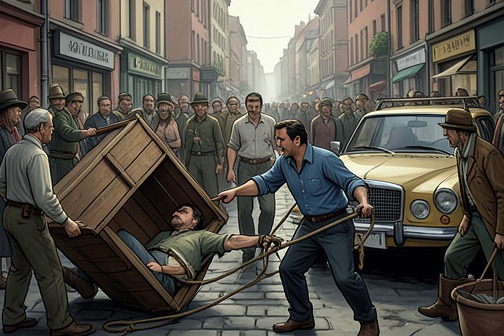
[The Colaba Circle crash and mob attack](entity:event-recall-event-bb5ec7d76079) turns an ordinary traffic accident into a test of whether [Lin](entity:character-recall-character-lin-428ebd96b429) Ford will again stand aside while a crowd assaults strangers. The collision injures a hand-cart puller; the crowd then targets the two African men in the Ambassador. Lin’s intervention grows from an earlier failure to act, and ends with him and one of the men escaping in the car.
## Collision and the Threat of Mob Violence
Lin has just parted from [Prabaker Kharre](entity:character-recall-character-prabaker-kharre-ca699443f286) and is walking through traffic when an Ambassador, attempting to overtake a slower car, crashes into a wooden hand-cart. The impact drives the heavy cart into a taxi only two metres from Lin. The accident leaves the cart puller seriously injured. His ropes and harness have caught him in the cart’s yoke, and Lin rushes in with others to free him. He cuts through the ropes, helps move the man to the footpath, and uses handkerchiefs donated by onlookers to make a sling for the injured arm. While Lin is examining the man’s leg, shouting breaks out near the damaged vehicles.
At least ten men are trying to seize the Ambassador’s driver, a large man braced inside the car. When the crowd fails to pull him out, it turns on the passenger instead. The men drag him from the back seat and begin beating him. The accident has thus given way to a separate, collective assault: the crowd’s attention shifts from the wreckage and injured cart puller to the two African occupants. Lin recognizes the passenger’s immediate danger, and the scene’s decisive conflict becomes whether he will intervene or watch another man be carried away by a mob.
## Lin's Intervention and Escape
The scene recalls an earlier encounter, nearly eighteen months before, during Lin’s first tour of the city’s darker streets with Prabaker Kharre. Then, Lin had watched a mob attack a man and had failed to intervene, telling himself that the city and its violence were not his responsibility. Now the distinction has collapsed: he considers the neighborhood his own, recognizes it as the area where he works, and knows some of the people in the crowd. That change in belonging turns memory into an obligation to act.
Lin runs into the crowd and pulls men away from the passenger, calling on them in Hindi to stop. He manages to create space and separate the man from the attackers, but the reprieve is brief. The passenger, bloodied and frightened but still prepared to defend himself, stands beside Lin as Lin faces the crowd with open hands and tries to calm it. Lin had imagined that courage and words might shame the attackers into dispersing; instead, the crowd closes in again, and the two men have to fight to get away. In retrospect, Lin allows that his appeal may have checked the crowd for an instant. The sight of a white foreigner pleading in Hindi for two Black men may also have unsettled its momentum, though neither possibility ends the danger.
Their escape depends on the driver, who gets the Ambassador running and slowly reverses through the crowd. Lin and the passenger move alongside it, fending off people who reach for them, until the driver opens the rear door and they climb inside. The crowd presses against the car and throws objects at it as it crawls along Causeway Road; only after it gathers speed do the men turn to check whether they are being followed. In the car, the passenger introduces himself as [Hassaan Obikwa](entity:character-recall-character-hassaan-obikwa-ceed6d51b8d2) and identifies the driver as [Raheem](entity:character-recall-character-raheem-52019dfa893a). The event ends not with the crowd persuaded, but with Lin’s refusal to repeat his earlier inaction—and with the three men escaping together.
## A Moment of Hesitation
Looking back, Lin interprets the crowd’s brief hesitation as more than a pause forced by physical resistance. He has encountered similar moments in other violent settings, including prison and war, when an appeal to shame seemed to interrupt a group’s momentum toward cruelty. He cannot explain the effect with certainty, but imagines that a crowd may possess a collective conscience that can be reached at a critical instant. In this encounter, the unusual sight of a white foreigner pleading in Hindi for two Black men may have helped unsettle the attackers. That possibility does not turn the intervention into a triumph of persuasion: the crowd soon presses in again, and escape remains necessary.
## The Encounter After the Escape
Safety does not erase the violence; it changes the terms of the encounter. Once inside the car, Lin and the passenger exchange names and a handshake: Hassaan Obikwa identifies himself, while Lin gives the name Lin Ford. Lin then notices the rings on Hassaan’s fingers, some set with diamonds, and the diamond-encrusted gold Rolex loose on his wrist. In the front seat, Raheem turns to grin over his shoulder and rolls his eyes in a survivor’s prayer before facing the road again. These small gestures give the escape an aftermath beyond flight: the men who had been strangers caught in the same attack become particular to one another, introduced by name and met in the immediate, unceremonious relief of having got away.
Event 30
Joseph and Maria celebrate their reconciliation
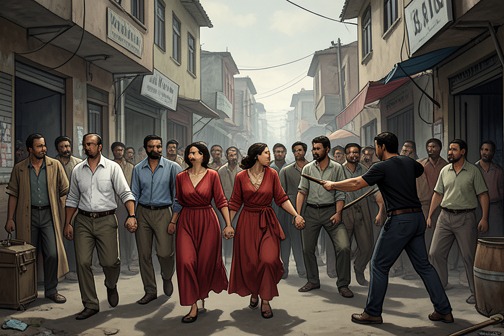
[Joseph and Maria celebrate their reconciliation](entity:event-recall-event-87e2d7fcb226) in a jubilant procession through the slum, transforming the aftermath of domestic violence into a public occasion of accountability, forgiveness, and renewed belonging. For [Lin](entity:character-recall-character-lin-428ebd96b429), the celebration resolves a lasting doubt about whether intervening in other people’s lives can truly help them: [Joseph](entity:character-recall-character-joseph-a6dc2a0eb175)’s nod suggests that the community’s action did not merely expose his shame, but helped make his recovery possible.
## The Community’s Judgment and Repair
The celebration follows a serious act of violence. As Joseph and Maria approach, [Prabaker](entity:character-recall-character-prabaker-f1cb57f00b87) explains that Joseph beat his wife. Lin recalls that Joseph was drunk and had beaten her terribly. Maria’s family and the wider community imposed a punishment, making the harm a matter not only between husband and wife but also of communal responsibility.
Prabaker had personally struck Joseph several times with a stick as part of that response. Yet the punishment was not presented as a single blow or a simple demand for retribution. Over the following months, Joseph stayed sober, worked hard, and completed jobs for the community. That labor was both part of his sentence and a way of earning his neighbors’ respect again. Maria forgave him a couple of months before the procession; together they worked and saved until they had enough to take a holiday.
The celebration therefore marks a sequence of changes rather than an instant absolution. Joseph’s violence is named plainly; his punishment is followed by sustained work and sobriety; Maria’s forgiveness comes within that longer process. The couple’s shared savings and planned holiday give the repair a practical consequence: they are able to make plans together again. The community does not erase what Joseph did, but recognizes the effort through which he has begun to return to it.
## A Procession Through the Slum
The crowd’s roar rises as Joseph and Maria draw near, surrounded by people and followed by family members carrying a blue shawl to catch the notes and coins thrown by well-wishers. Maria’s smile appears hopeful and brave. Joseph has lost weight and looks fit and healthy; in a blue shirt and new trousers, he walks close against her, matching her step for step. Their four hands are clenched together, an image of physical closeness that makes their reconciliation visible without making it effortless.
Prabaker cannot resist the dancing. He leaves the bench, teeters on his platform shoes, and joins the twisting bodies ahead of the couple, balancing with outstretched arms as though crossing a shallow river. [Didier](entity:character-recall-character-didier-381547eab195), initially surprised by the celebration, is drawn in as well; he glides into the moving crowd until only his hands remain visible above the dancers. Their participation makes the procession more than a formal display. Friends who know the story of Joseph’s punishment enter the celebration with the couple, sharing in the public recognition of what has changed.
Girls scatter petals from chrysanthemums over the converging crowd. The bright white flowers settle on those gathered as Joseph passes Lin. He looks directly at him, his face held between a smile and a frown; his eyes glisten beneath furrowed brows, and he nods twice before turning away. The gesture is brief, but the narration gives it the weight of an answer.
## Lin’s Doubt and Joseph’s Answer
The procession arrives against Lin’s unresolved worry about the consequences of helping others. Since seeing a tortured mouse, he has questioned whether even well-meant interference can produce dangers that would not otherwise have occurred. His concern reaches beyond Joseph: Lin is teaching slum children to speak, read, and write English, and some have already begun finding work with foreign tourists after three months. He wonders whether his intervention might expose them, especially [Tariq](entity:character-recall-character-tariq-6036f9dbabf7), to wounds or misfortunes they would not have faced without his friendship and teaching. [Karla](entity:character-recall-character-karla-3f7aa8a8ae5c) had previously warned him that people trying to change things can cause some of the worst wrongs.
Joseph cannot know that Lin has been carrying this doubt, but Lin reads the two nods as an answer. In Joseph’s expression, shame and exultation coexist. The narration treats neither as incidental: shame gives the joy of recovery its purpose, while joy gives shame a possible reward. Lin concludes that the community helped save Joseph not only by making him face what he had done, but also by joining in his happiness once he had worked toward repair. The scene does not establish that every intervention turns out well; instead, Joseph’s response gives Lin a particular instance in which action, accountability, and care have helped rather than merely harmed.
## Forgiveness and the Return to Daily Life
Lin’s interpretation broadens from Joseph’s recovery to forgiveness as a condition of human survival. He recalls Karla asking whether cruelty or the capacity to feel shame better characterizes humanity, then arrives at his own answer: forgiveness makes continued life together possible. Without it, he reflects, retaliation would consume human communities; love itself depends on the possibility of forgiving. The procession makes that argument concrete. Maria’s forgiveness, Joseph’s sustained effort, and the neighbors’ renewed welcome are distinct parts of the same return.
The celebration does not last indefinitely. The drums and dancers move toward the distant street, and their music dwindles until ordinary slum life resumes its hold on the lanes. The residents return to their routines, needs, and modest plans. For a little while, however, the hearts and smiles governing their shared world seem almost as clean as the flower petals left in their hair and clinging to their faces. The ending places the event’s hope beside its limits: one public celebration cannot abolish the daily pressures of slum life, but the community has briefly made room for a different kind of order, one shaped by accountability, affection, and forgiveness.
Event 31
The cholera epidemic in the Bombay slums
[The cholera epidemic in the Bombay slums](entity:event-recall-event-b37580e7f263) transforms [Lin](entity:character-recall-character-lin-428ebd96b429)’s informal clinic into a frontline of community care, while exposing how poverty and overloaded hospitals leave residents to face a lethal outbreak largely on their own. The crisis moves from one family’s illness to a community emergency within days. Its response is neither the work of a single doctor nor a solution supplied by the state: it depends on residents organizing together, with Lin’s limited medical knowledge placed at the service of a much larger effort.
## Outbreak and limited medical access
Lin’s role in the slum had grown out of his first-aid training, his experience treating overdoses, and the supplies in a first-aid kit given to him by friends in [New Zealand](entity:location-recall-location-new-zealand-a25d5a689a9c). Though residents came to know him as Doc, he resisted being called a doctor and understood the limits of his training. His clinic treated about fifty people a day, but he could not diagnose every illness. When he referred patients to [St. George Hospital](entity:location-recall-location-st-george-hospital-c5c5fe31c0bb), many returned without having been seen. The hospital was overcrowded and understaffed, and residents could not afford the consultation with a licensed practitioner that might secure a referral and help them get care sooner.
That gap between need and access shaped the epidemic’s response. When Lin met [Doctor Hamid](entity:character-recall-character-doctor-hamid-3435ac57c6e5) to discuss referrals, he explained that he was trying to help people whose illnesses he could not identify, but had no reliable way to get them examined. His concern was not that residents were exaggerating their symptoms: he considered them proud people who asked for help only when they needed it. The hospital, meanwhile, handled hundreds of patients daily, and sometimes as many as a thousand. The outbreak therefore struck a neighborhood where informal care already served as a substitute for medical attention many residents could not obtain.
## From individual illness to a public emergency
[Jeetendra](entity:character-recall-character-jeetendra-81b0506b001d) came to Lin in alarm because his wife, [Radha](entity:character-recall-character-radha-54371c819881), had a high fever, vomiting, and diarrhea. She had already been sick for two days. At her hut, Lin found that her condition was severe; her mother-in-law, Chandrika, was trying to care for her. The illness was not confined to one household. The community soon recognized cholera, and cases multiplied rapidly: by nightfall there were ten serious cases and twelve more possible; by the following dawn, sixty advanced cases and as many as a hundred people with symptoms. By noon, Radha had died, becoming the first victim.
A health official from the [Bombay Municipal Corporation Department of Health](entity:organization-recall-organization-bombay-municipal-b7bc55b01db2), Sandeep Jyoti, examined the slum with Doctor Hamid, [Qasim Ali Hussein](entity:character-recall-character-qasim-ali-hussein-e223a2b66e5b), [Prabaker](entity:character-recall-character-prabaker-f1cb57f00b87), and Lin. He reported other outbreaks between the neighborhood and Kandivli, as well as a severe one in Thane. Hospitals across the area were already overcrowded. Jyoti said that some of the most critical patients could be taken to hospital, but not everyone; residents in this and other settlements would have to get through the crisis locally. He offered to arrange trained volunteers and a delivery of oral rehydration salts, while making clear that the city’s resources were stretched.
## A community response
After the official’s visit, Qasim Ali Hussein took charge of organizing local efforts and made his home a command center. Around twenty men and women met there to plan. Their measures addressed the routes by which cholera could spread and the immediate needs of sick residents: they would purify the water in holding tanks and then in the pots and buckets used in the seven thousand huts. [Qasim Ali](entity:character-recall-character-qasim-ali-1195f20a5d70) gave [Johnny Cigar](entity:character-recall-character-johnny-cigar-abaa784fef8e) a substantial bundle of rupee notes to buy purification tablets and other medicines.
The plan extended beyond drinking water. Rainwater gathered in puddles and rivulets was also treated as a danger, so residents proposed shallow trenches filled with disinfectant at points along the lanes, requiring people to pass through the antiseptic water. They arranged designated bins for waste and antiseptic soap for households. Chai shops and restaurants were to provide boiled food and sterilized cups and bowls through soup kitchens. Another team would take the dead to hospital on a trundle-cart. Lin was assigned to supervise oral rehydration treatment and prepare a homemade mixture when needed. The work was demanding, but those at the meeting accepted their responsibilities without hesitation.
The plan became practical labor on a scale no small clinic could manage alone. Lin and the others visited sick residents and distributed packets of oral rehydration solution. By then, more than a hundred people had symptoms, and half were serious cases. Even brief visits to each patient took twenty hours. The caregivers sustained themselves with soup and sweet tea from sterile cups; after reaching their first full meal, they returned to the most serious cases. [Karla](entity:character-recall-character-karla-3f7aa8a8ae5c) worked alongside them, comforting families and helping children while maintaining her composure through long hours without sleep. Her participation made the response not only a medical effort but an intimate test of care, fear, and endurance.
## Loss and aftermath
The epidemic killed nine people, six of them young children. Jeetendra’s only son, Satish, survived, though two of his closest friends died; both had been students in Lin’s English class. Children followed the flower-garlanded biers in a procession of grief. [Parvati](entity:character-recall-character-parvati-4a5485bca332) also survived, and Prabaker cared for her for two weeks, sleeping outside her hut under a plastic covering at night. [Sita](entity:character-recall-character-sita-1913dd4978f6) took her sister’s place at their father’s chai shop. These individual consequences show how the outbreak reached beyond the sick themselves, altering family care and the daily life of the neighborhood.
Karla stayed through six of the worst days and returned several times in the following weeks. When the infection rate fell to zero and the most serious phase had passed, Lin went back to seeking work among tourists; he was nearly broke, and the monsoon flooding had damaged livelihoods across the city. The emergency did not end with the last case: it left grief in families, interrupted work, and made visible the fragility of life in a crowded settlement with limited access to care.
The epidemic also changes how Lin understands his place in the slum. A week before it began, he had celebrated the absence of patients at his clinic, taking it as though his work had cured the neighborhood. During the outbreak, he recalled that Radha had been ill for two days before he knew of it, while he had been working among tourists. He recognized that neither his clinic nor his absence had caused cholera, yet could not dismiss his shame or his feeling of responsibility. The episode sets the limits of his improvised medicine beside the strength of collective action: Lin cannot cure the slum, but he can accept a share of the work, and the community can organize care where institutions cannot reach everyone.
Event 32
The deaths of Ahmed and Christina
## Background and Relationships
Ahmed is remembered by [Karla](entity:character-recall-character-karla-3f7aa8a8ae5c) as a close friend, for a time her best friend and almost the brother she had never had. He came from [Afghanistan](entity:location-recall-location-afghanistan-ea09a8d619a6) after being wounded in the war and went to [Bombay](entity:location-recall-location-bombay-b9f73c3bdba6) to recover. His injuries left his health permanently diminished. Karla says that they nursed one another and grew close through conversations about books, philosophy, music, art, and food. Ahmed had graduated in science from [Kabul](entity:location-recall-location-fa0d480263ce) University and spoke excellent English; she remembers him as gentle.
The change in Ahmed’s life came when he met Christina, an Italian woman working for [Madame Zhou](entity:character-recall-character-madame-zhou-d453e8a13327). Karla had introduced them one evening at [Leopold’s](entity:location-recall-location-leopold-s-1d82f936fa9e) Beer Bar, where Christina arrived with [Ulla](entity:character-recall-character-ulla-87a1fc56dfd8); both women were then working at the Palace. Ahmed fell deeply in love with Christina. Her situation was not simply a matter of wanting to leave: the Palace was controlled by Madame Zhou, who had already resisted letting women go.
Ulla’s earlier departure had shown that escape could be achieved, but at a cost. [Maurizio](entity:character-recall-character-maurizio-9cd3f527287c) used his savings and a connection at the German Consulate to secure her release from the Palace, then put her to work to repay the resulting debt. Karla regards the arrangement as exploitative even while acknowledging that Ulla had been freed from Madame Zhou. Her departure encouraged Christina to seek a way out too. Madame Zhou, Karla explains, had been forced to let Ulla go but was determined not to part with Christina.
## The Attempt to Free Christina
Ahmed went to the Palace late one night to confront Madame Zhou and try to secure Christina’s release. Karla was supposed to go with him. She had done business with Madame Zhou, bringing businessmen there for her boss, and believed the relationship might make Madame Zhou listen to her. But Karla was called away to handle what she understood to be an important contact, a job she felt she could not refuse. Ahmed therefore went alone.
The next day, Ahmed and Christina were found dead in a car a few blocks from the Palace. The police said that they had both taken poison, describing the deaths as a joint suicide. That account is what the authorities said; Karla’s recollection gives reason to question whether the couple’s deaths can be understood as a voluntary act. The evidence does not establish exactly how they died or precisely what happened between Ahmed’s arrival at the Palace and the discovery of the bodies.
## Karla’s Belated Account
The deaths emerge in the narrative through Karla’s later conversation with [Lin](entity:character-recall-character-lin-428ebd96b429), after he asks her about Ahmed and Christina. Her response begins only after a long silence. She then recounts the history steadily, as if giving testimony, moving from Ahmed’s friendship and recovery to his love for Christina and the failed attempt to help her leave. That measured telling sets the tragedy against the emotional difficulty of disclosing it: the account is controlled, but not detached.
Karla’s sense of responsibility is inseparable from the night Ahmed went to the Palace. She had been expected to accompany him, had a connection to Madame Zhou through her business dealings, and thought she might be able to persuade her. Instead, work took her away, and Ahmed faced Madame Zhou alone. Karla does not say that her presence would certainly have changed the outcome; her account establishes the missed companionship and the choice that she continued to carry, not an alternative ending that can be known.
## Madame Zhou’s Role and the Aftermath
When Lin connects Karla’s distress to an earlier encounter with Madame Zhou, through the metal grille during the effort to get [Lisa Carter](entity:character-recall-character-lisa-carter-130e7270024c) out of the Palace, Karla confirms that the exchange concerned Ahmed and Christina. She says Madame Zhou had told her what she did to the couple before they died and how she played with them. This is Karla’s report of Madame Zhou’s account, not an independent description of the acts or a full explanation of the deaths. In combination with the couple’s discovery near the Palace, however, it casts the police’s suicide explanation in a disturbing light and points to Madame Zhou’s cruelty as part of the story.
The revelation also explains why Karla had been crying during that earlier encounter: Madame Zhou had brought the deaths back into the present by speaking of what preceded them. In the conversation with Lin, Karla’s account becomes an act of disclosure, though it does not resolve every uncertainty. After telling her story, she asks Lin to tell his. The transition does not undo her loss or absolve her of the guilt she associates with leaving Ahmed to go alone; it places her testimony within a moment of reciprocal vulnerability.
Event 33
Lin is arrested in Colaba
[Lin is arrested in Colaba](entity:event-recall-event-c59236dff1bf) after police intercept him on a deserted street and take him to the [Colaba Police Station](entity:location-recall-location-colaba-police-statio-2c3da2a917f7). The arrest is the abrupt threshold between his life outside and the prison system that will conceal him from the people who might search for him: no one witnesses his capture, and he is left without a way to explain where he has gone.
## Capture in the deserted streets
After leaving [Karla](entity:character-recall-character-karla-3f7aa8a8ae5c), [Lin](entity:character-recall-character-lin-428ebd96b429) runs through the empty market toward Arthur Bunder Road. The white canvas covering the stalls makes them look like shrouded bodies in a morgue, while his footsteps echo along streets emptied of the crowds that usually fill them. He turns onto Mereweather Road, then takes a side street to avoid the flooding. Ahead, a policeman rides a bicycle; another emerges from a dark driveway as Lin passes. A police jeep appears at one end of the street, another comes up behind him, and the cyclists converge. When the first jeep draws alongside, Lin stops. Five officers get out and surround him, holding the silence for several seconds before demanding that he get into the vehicle.
Lin tries to speak to the officers in Marathi, but the commander cuts him off. The police already know he speaks the language, and one officer threatens to beat him with lathis if he refuses to enter the jeep. Lin climbs into the covered back, where six men sit with their hands on him. They drive the two short blocks to the Colaba Police Station, opposite [Leopold’s](entity:location-recall-location-leopold-s-1d82f936fa9e). The street outside the bar is deserted; [Ulla](entity:character-recall-character-ulla-87a1fc56dfd8), who had said she would meet him there, is absent. Lin briefly suspects that she may have arranged his arrest, though he recognizes that the thought makes little sense. The cause of the arrest remains unclear to him, and that uncertainty turns the capture into the beginning of a disappearance as well as a detention.
## Torture in the police station
At the Colaba Police Station, the night duty officer orders ten policemen to beat Lin, telling them to hit him hard but, if possible, avoid breaking his bones before throwing him into the lock-up. Lin understands the instruction, though the officer gives no sign of knowing that. He bolts through the circle of policemen and reaches the compound yard, only to run into a round-up party at the gate and fall among men whose hands are tied. The attempted escape ends with the officers dragging him back, punching and kicking him as they go.
The police tie Lin’s hands behind his back with coarse hemp rope, bind his feet, and wind a thick coil around him from ankles to shoulders until he resembles a mummy. They carry him into another room and suspend him face down from a hook caught in the ropes. At the duty officer’s command, the policemen spin him faster and faster, then beat his body with cane lathis as it whirls. They strike his face, arms, legs, and feet; when his body is held still, they turn him in the opposite direction and begin again. Lin senses that he is bleeding, but clenches his jaw and refuses to let the men hear him scream. His silence becomes the one form of resistance still within his control.
When the beating is over, the policemen drag Lin up the metal steps to the lock-up. The familiar stairs recall an earlier visit with [Prabaker](entity:character-recall-character-prabaker-f1cb57f00b87), when Lin had tried to help [Kano](entity:character-recall-character-kano-72d93d20f33c)’s bear-handlers; now the same route carries him into custody as a prisoner. The duty officer has the other prisoners remove the ropes, kicks Lin to hurry them, and orders them to stand him before the open cell gate. Lin is too battered to strike back when the officer spits in his face. The prisoners hold him fast, but their hands are gentle as they guide him into the cell and lower him to the concrete floor.
## Disappearance, identity, and hatred
Once the other prisoners have eased Lin onto the cell floor, the arrest’s most frightening consequence becomes clear: nobody saw him taken, and nobody knows where he is. Ulla may never have reached Leopold’s; even if she did, she would not know he had been arrested. Karla, after their night together, could only think he had abandoned her. Lin imagines himself erased from the city as completely as if he had flown to Africa. In his metaphor, prisons are black holes for human bodies: neither light nor news escapes.
His uncertainty deepens into a practical fear about identity. Lin does not know why the police have arrested him, or whether they know who he really is. If the arrest concerns something else, identification procedures and fingerprint checks may still expose him; his prints are on file around the world through [Interpol](entity:organization-recall-organization-interpol-7a5532f04518). He needs to get word to someone powerful enough to help. He fixes on [Abdel Khader Khan](entity:character-recall-character-abdel-khader-khan-822d0cbbc88e), whose contacts, especially around [Colaba](entity:location-recall-location-colaba-2bd495476f0e), might eventually reveal that Lin has been detained. Until then, he has only a plan: hold on and find a way to send a message. As he is dragged up the metal stairs, he repeats that intention like a mantra, giving his thoughts a single direction amid the pain.
At the cell gate, the duty officer spits at Lin and delivers a threat that Lin understands as a declaration that his life is over. The other prisoners restrain him when he tries to strike back, but then handle him gently and lower him to the concrete. That contrast does not undo the violence; it marks the small, immediate care available inside it. The gate shuts, the lock turns, and the sight of the prisoners’ dead, frantic, resentful, and fearful eyes brings Lin to the taste of hatred—his own, the guards’, and the world’s. The arrest thus closes not only a cell around him but a circuit of hostility: the prison cages people with the very hatred that its punishments produce, and Lin recognizes that each turn of the key tightens that bond.
## The departure from Karla
The capture follows a quiet, unfinished exchange with Karla: Lin apologizes and runs a hand through her thick black hair, while she watches him closely and softly tells him to go. That parting gives his flight through the empty streets a personal cost beyond the danger of arrest. Lin has been sent away by Karla, yet the police disappearance that follows leaves her with no way to know what happened; from her perspective, his sudden absence can resemble a choice to leave her after their intimacy. The tenderness of the farewell and the silence imposed by his arrest therefore pull in opposite directions, turning a brief separation into a misunderstanding neither can immediately resolve.
Event 34
Lin arrives at Arthur Road Prison and is beaten in the baton gauntlet
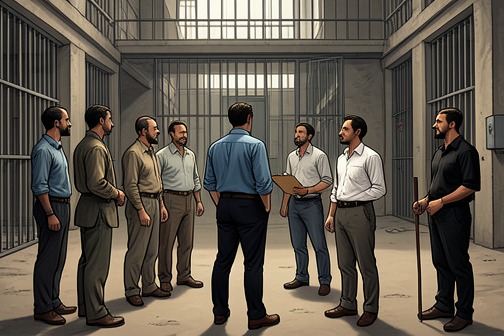
[Lin](entity:character-recall-character-lin-428ebd96b429) arrives at [Arthur Road Prison](entity:location-recall-location-arthur-road-prison-50f3a84a4e65) after three weeks in the [Colaba](entity:location-recall-location-colaba-2bd495476f0e) police lockup, where he and [Mahesh](entity:character-recall-character-mahesh-5584c4abfd61) have waited, smoked, prayed, fought, and sometimes comforted other prisoners. Their transfer begins with fingerprinting: the prisoners’ prints are pressed onto a page meant to identify them, then eighty men are crowded into an old blue prison truck built for far fewer. The truck speeds through [Bombay](entity:location-recall-location-bombay-b9f73c3bdba6) toward the jail, carrying Lin from one form of confinement into a much larger institution.
## Transfer and Intake
The prison gates do not mark a simple change of location. Guards pull the men from the truck and order them to squat while the staff process and register them one at a time. The intake lasts four hours. Lin is left until last, in part because the guards have been told that he understands Marathi. A watch commander tests this by repeatedly ordering him to stand and squat. Lin complies at first, then refuses to continue the performance. The commander’s amusement gives way to open hostility, and the moment of silence between them becomes a prelude to the punishment waiting inside.
The commander invokes the jail’s history to define Lin as an enemy: the British built the prison, he says, and now an Indian institution holds a British prisoner. Lin formally corrects him, identifying himself as a New Zealander. The correction changes nothing. The commander insists that Lin is British and points him toward an archway leading deeper into the prison. The episode makes the transfer political as well as procedural: Lin’s stated identity is overridden by the category his captors assign him, and the jail’s colonial past becomes a justification for present violence.
## The Baton Gauntlet
Beyond the archway, a sharp turn leads to a corridor lined on both sides by about twenty men carrying bamboo sticks. Lin recognizes the arrangement from a punishment unit in the Australian prison he escaped from, where guards had forced prisoners to run a gauntlet. The echo connects his earlier imprisonment to this new one, but the personnel and prison system here are different. The men awaiting him are convict overseers, not ordinary guards.
Arthur Road Prison’s daily routines and discipline have been delegated to prisoners serving long sentences. Long-term offenders could spend their first five years as common prisoners, their next five working in prison services or industries, and their final five in roles that carried a hat, belt, and stick. The overseers in the corridor are therefore both inmates and agents of prison authority. Their delegated power makes the assault part of the jail’s operating order rather than an isolated encounter with a guard.
Lin walks forward instead of running. The narrative does not turn that choice into uncomplicated heroism: looking back, Lin cannot settle on a single explanation for why he did not run. As he moves, he recalls the long path over the sea to [Haji Ali Shrine](entity:location-recall-location-4f2b84bb9652), one of his cherished images of Bombay. The remembered route toward the shrine’s white minarets interrupts the corridor’s immediate threat with an image of beauty associated with the city. The contrast does not remove the danger; it gives Lin something other than fear to hold in mind as he continues.
The overseers strike him as he passes. Lin flinches when the blows land, but keeps his hands at his sides, gripping the legs of his jeans rather than raising his arms. He does not claim to be untouched or fearless. The attack gradually diminishes and stops by the end of the corridor, where the men lower their sticks and eyes as he passes. Lin describes this as a limited victory: in prison, survival includes not only the body but also the will and spirit that can be damaged alongside it.
## Prison Order and Its First Consequences
After the gauntlet, guards and overseers take Lin through the prison to a dormitory. The room measures twenty-five paces by ten and has barred windows, steel gates at both ends, and three clean squat toilets. That night, 180 prisoners and twenty overseers are locked inside. The arrangement makes hierarchy visible in the room itself: the overseers claim a quarter of the floor, with clean blankets stacked into thick beds and open space around them, while the other prisoners sleep shoulder to shoulder in two lines on narrow blankets. Bright lights remain on through the night, and overseers patrol between the rows, carrying whistles to summon guards if a problem exceeds their control.
The overseers allow Lin five minutes to wash and use the toilet, then offer him a place in their part of the room. The offer may reflect their assumption that his white skin means access to money; the account also allows that his conduct in the corridor may have influenced them. Lin refuses to sleep among the men who have just beaten him and now exercise authority over the dormitory. He chooses a blanket beside Mahesh instead. The decision costs him the overseers’ favor: they sneer and laugh, angered by his refusal, and begin to act against him. Thus the gauntlet’s apparent end does not end the conflict. Lin’s refusal of their offer turns a moment of possible accommodation into a continuing struggle with the men who control daily life inside the prison.
## Significance
The arrival sequence links Lin’s Australian imprisonment, his disputed national identity, and the violence of Arthur Road Prison without treating them as identical experiences. The commander’s insistence that Lin is British collapses the distinction Lin tries to make, while the jail’s convict overseers embody a system in which incarcerated men are given authority over others. Lin’s steady walk through the corridor offers no escape from that system; its significance lies in his effort to retain choice within it. The event establishes survival as an inward as well as physical contest, then immediately tests that principle in the dormitory, where Lin declines a privilege offered by the same men who control his surroundings.
Event 35
Lin clashes with Big Raju and suffers a punitive beating
The clash between [Lin](entity:character-recall-character-lin-428ebd96b429) and [Big Rahul](entity:character-recall-character-big-rahul-a961fccfa964) begins when a rare moment of private concentration in prison is interrupted by the overseer’s violence. It becomes a test of how far Lin will resist and what the authorities are willing to do to reassert control: when the overseers turn their punishment on other prisoners, Lin gives himself up to spare them, only to face hours of beating and further restrictions.
## The writing interrupted
By this point, Lin’s frustration, dread, worry, and pain have accumulated over time. Big Rahul, an overseer who has focused his own hatred and misery on Lin, strikes him while Lin is sitting near the entrance to an empty dormitory. Lin is attempting to put on paper a short story he has composed in his mind over the preceding weeks, repeating its lines day after day so he can remember them. The writing is not simply an attempt to pass the time: the practice has served as one of his meditations and helped him remain sane.
That morning, Lin has managed to find a pencil stub and a small sheaf of discarded sugar-ration wrappers. The makeshift materials make the start of writing possible at last. He begins in a quiet moment after collecting [Sheppesh](entity:creature-recall-creature-sheppesh-fa2b175c27b1), only for Big Rahul to approach unseen and hit him. The interruption thus destroys more than a brief interval of calm. It falls on a fragile routine that Lin has built to preserve a part of his inner life within the prison’s constraints.
## Lin’s resistance
Lin rises and takes the stick from Big Rahul, then drives him backward into the empty room. He throws the stick through a barred window, removing the instrument of the first assault from the immediate confrontation. When Big Rahul reaches for his whistle, Lin kicks him and follows with a series of punches. The fight unfolds as a deliberate reversal: the overseer who has been using violence against Lin is forced to retreat, while Lin presses forward.
In the middle of the confrontation, Lin recalls the first rule of street fighting: stand one’s ground rather than retreat, except when preparing a counterattack. That remembered rule gives the exchange a practical frame, and the prison room becomes a place where knowledge acquired beyond its walls can still be used. But Lin’s resistance cannot determine the terms for long. The other overseers gather, hesitate, and confer in whispers. Their response shifts the conflict from a direct clash between two men to a coordinated exercise of authority.
## Prisoners used as leverage
Instead of immediately bringing guards, the overseers fetch ten prisoners from Lin’s room and order them to sit facing him. They beat the group, send those men away, and bring in another ten. The violence is now being used not just against Lin but as a means of making him watch what his continued resistance will cost others. The overseers repeat the procedure, turning the prisoners into leverage.
[Mahesh](entity:character-recall-character-mahesh-5584c4abfd61) is among the next group. Also facing Lin is one of the two men who had already been beaten and given an additional six-month sentence for trying to help him. The prisoners do not speak, but their looks plead with Lin. At that point, he lowers his hands and steps out of the corner. This is the decisive turn in the confrontation: Lin stops fighting not because the overseers have persuaded him that the punishment is just, but because they have made other prisoners bear its immediate cost.
The overseers seize him, drag him to a barred steel gate, and chain his outstretched wrists to it with two sets of handcuffs. They tie his ankles together with coconut-fibre rope. The restraint makes his submission permanent for the moment and gives the overseers control over what follows. His choice to spare the other men does not end the punishment; it leaves him alone to receive it.
## Punishment and its aftermath
The beating begins with Big Rahul and continues as other overseers take over. After a break for cigarettes, the assault resumes with fresh groups arriving from other rooms, followed by further relays of men. The account marks its duration precisely: it starts at ten thirty in the morning and continues until eight that night. The changing groups make the punishment seem organized and sustained, rather than a brief eruption of anger by one overseer.
Afterward, the authorities state the terms imposed on Lin: he is to wear chains on his legs, and his food ration is cut in half until further notice. They explicitly connect the punishment to his having hit the overseers, presenting it as a lesson intended to prevent another act of resistance. The result extends beyond the hours of beating: Lin is left with continuing physical restraint and less food, while the overseers assert that the encounter will carry consequences beyond the room.
The episode places Lin’s practiced self-command beside the limits of individual defiance in prison. Repeating a story, finding paper in discarded wrappers, and relying on remembered fighting rules are distinct ways he tries to retain agency. Yet the overseers answer his resistance by exploiting the vulnerability of the people around him. His decision to yield for their sake becomes both a moral choice and the opening through which the prison imposes its punishment. The scene’s central reversal is therefore not simply that Lin fights back, but that he must choose between continuing the fight and preventing the authorities from using other prisoners to force his hand.
Event 36
Operation Blue Star
[Operation Blue Star](entity:event-recall-event-operation-blue-star-8a60969c0c52) was the Indian Army’s assault on the [Golden Temple](entity:location-recall-location-golden-temple-016d5a7a77c1) complex in Amritsar, ordered by [Indira Gandhi](entity:character-recall-character-indira-gandhi-b654aedd7ba1) to remove a well-armed group of Sikh militants. The operation achieved that immediate objective, but the deaths it caused and the desecration associated with the assault made it a turning point in the novel’s account of political violence: the temple was cleared, while the struggle for Khalistan gained martyrs and a new force of vengeance. Its consequences surface again when news of Indira Gandhi’s assassination reaches [Lin](entity:character-recall-character-lin-428ebd96b429) and later details connect the killing to the bodyguards’ response to the assault.
## Background and decision
The narrative places the operation amid a prolonged conflict. Sikh militants had entered and fortified the Golden Temple, using the complex as a base for punitive attacks against Hindus and against Sikhs they considered recalcitrant. The militants understood themselves as freedom fighters and martyrs for the Sikh cause; their opponents faced a group armed and entrenched within a major holy site.
Indira Gandhi’s decision is presented as a response to both the militants’ presence and the political pressure surrounding her. With a fiercely contested general election approaching, she feared that failure to act would make her appear weak and indecisive. The novel describes the assault as what many regarded as the worst among her limited options. That qualification matters: the action is neither presented as politically effortless nor separated from the dangers of choosing military force at a sacred site. The army was sent against the militants, and the decision linked an immediate security objective to consequences that would outlast the operation itself.
## Assault and immediate result
The army operation to dislodge the militants from the Golden Temple was called Operation Bluestar in the narration, also rendered as Operation Blue Star. The militants met the army with what the account characterizes as reckless, desperate resistance. More than six hundred people died and many hundreds were injured. The army ultimately cleared the temple complex, fulfilling the operation’s stated objective, but the scale of loss made that result inseparable from its human cost.
The narrative does not describe the fighting in tactical detail. Instead, it emphasizes the stark contrast between the operation’s military outcome and its political aftermath. Indira Gandhi had sought to reassure Hindu voters that she would act decisively; by the novel’s account, that aim was achieved. But clearing the complex did not end the conflict. It changed the conditions under which the Sikh struggle continued, supplying it with new martyrs and giving the cause of a separate homeland, Khalistan, a renewed charge.
## Retaliation and consequences
The operation’s consequences recur in the account of Indira Gandhi’s death. When news of the assassination arrives, Lin first considers its dangers for his own life as a wanted man in [Bombay](entity:location-recall-location-bombay-b9f73c3bdba6). The narration then turns from his immediate fear to the history behind the killing: only months after the operation, Indira’s Sikh bodyguards murdered her. The novel presents her as a figure whose public meaning was divided—reviled by some as a despot, revered by many others as the mother of the country, and closely identified with the nation’s past and destiny.
A later account, attributed to information passed from Khader’s contacts in [Delhi](entity:location-recall-location-7242cbb9d528), supplies the circumstances surrounding the assassination. Indira had been advised not to keep Sikh members in her security detail after the Golden Temple assault, but insisted on retaining her Sikh bodyguards because she could not believe that loyal guards would turn against her. The account connects that insistence to a failure to grasp the hatred the army’s attack had produced. On the morning of the killing, she greeted the guards at the gate of her residence; one opened fire with a revolver, and the other fired a Sten gun. These details belong to the later report of the assassination, not to the military action itself, but they make the operation’s delayed political consequence explicit: an assault intended to demonstrate resolve had become part of the setting for retaliation against its author.
## Narrative significance
Operation Blue Star is recalled rather than dramatized as a battle scene. Lin’s account of it interrupts the immediate restaurant conversation surrounding the radio announcement of Indira Gandhi’s death, widening the frame from a breaking-news shock to the history that helped make the killing intelligible. The operation thus appears through consequence: first in the loss of life and the growth of the Khalistan struggle, then in the vengeance that followed.
That structure resists treating the clearing of the temple as a clean conclusion. The state achieved its immediate military aim, but the account follows the violence beyond the end of the assault, tracing how deaths, political calculation, religious attachment, and remembered injury remained active afterward. Operation Blue Star’s decisive significance in the novel lies in this gap between tactical success and enduring political damage. It closes the army’s campaign inside the complex while opening a longer chain of grievance and retaliation.
Event 37
The assassination of Indira Gandhi
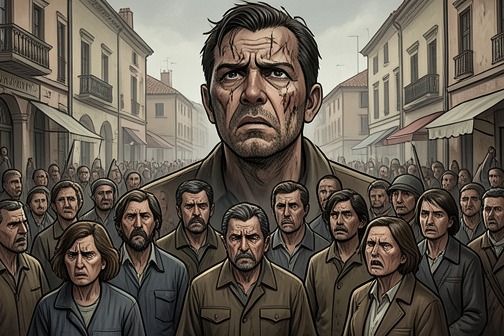
[The assassination of Indira Gandhi](entity:event-recall-event-8096534bf046) is both a national rupture and a turning point in [Lin](entity:character-recall-character-lin-428ebd96b429)’s life in [Bombay](entity:location-recall-location-bombay-b9f73c3bdba6): the news makes political violence immediate, while forcing him to choose between flight and the moral debts that bind him to the city. The event first reaches him as a radio announcement, then takes on a more specific cause and sequence through a secondhand account. Its consequences are anticipated before they fully unfold, giving the killing force not only as a death but as a warning of the danger spreading through the country.
## Announcement and Public Shock
The news arrives during a gathering with [Didier Levy](entity:character-recall-character-didier-levy-bc900419ef54) and [Vikram Patel](entity:character-recall-character-vikram-patel-70646435bc43). [Didier](entity:character-recall-character-didier-381547eab195) reports that [Indira Gandhi](entity:character-recall-character-indira-gandhi-b654aedd7ba1) is dead; at first, the reports are not confirmed, though he believes there is little doubt. When [Vikram](entity:character-recall-character-vikram-9e00afad97ee) asks whether the killing involved the KLF or a bomb, Didier says the attackers were her Sikh bodyguards. The revelation transforms a distant announcement into an intimate betrayal: those assigned to protect her were members of a community wounded by her government’s actions.
Vikram leaves the table to listen at the restaurant counter, although the broadcast is loud enough to hear from where he had been sitting. Fifteen or twenty men have pressed together around the radio, listening to an announcer deliver the details in Hindi. The crowd’s physical closeness offers a form of solidarity as the news is absorbed; the gathering is not simply an audience receiving information, but a group seeking contact with fellow countrymen at a moment of national shock. The scene makes public reaction part of the event’s meaning without claiming that the men share one response or political view.
## [Operation Blue Star](entity:event-recall-event-operation-blue-star-8a60969c0c52) and the Motive Reported
The account places the assassination in the aftermath of Operation Blue Star. After Indira Gandhi sent the army into the [Golden Temple](entity:location-recall-location-golden-temple-016d5a7a77c1) to dislodge Bhindranwale and the militants, the operation left more than six hundred people dead and many hundreds injured. The temple complex was cleared, and the operation strengthened Indira Gandhi’s image among voters she sought to reassure. At the same time, the Sikh struggle for Khalistan gained new martyrs, while Sikh anger over the assault on their holiest shrine intensified. In the narrative’s account, the operation’s political success and its deepening of grievance exist side by side.
Later, Lin hears a more detailed version from Didier, who says [Abdel Khader Khan](entity:character-recall-character-abdel-khader-khan-822d0cbbc88e)’s contacts in [Delhi](entity:location-recall-location-7242cbb9d528) have supplied the inside account. At nine in the morning, Indira Gandhi walked to a security gate at her residence and greeted two Sikh bodyguards she knew. They had been assigned there at her insistence. After Operation Blue Star, she had been advised not to include Sikhs in her security detail, but she did not believe her loyal guards would turn against her. Didier presents the killing as inseparable from the hatred generated by the attack on the Golden Temple. This explanation is reported through contacts rather than witnessed by Lin, and the narrative marks that distance even as it gives the event a clear political context.
The report describes the first bodyguard firing three times with his service revolver. The second then used a Sten gun, emptying its thirty-round magazine. The account emphasizes the close-range assault without making Lin an eyewitness: the reader receives the sequence as information relayed after the initial radio bulletin. That change in scale—from an unconfirmed announcement to a specific account of the guards, the greeting, and the weapons—makes the betrayal more concrete while preserving the scene’s reliance on reported news.
## Consequences and Lin’s Decision
The assassination immediately sharpens Lin’s sense of danger. He expects security forces across [India](entity:location-recall-location-india-39df7eae59c1) to go on special alert and anticipates riots, killings, looting, and arson directed against Sikh communities in revenge. The radio reports troop deployments in Delhi and Punjab intended to quell disturbances. Lin understands that the unrest could threaten him as a wanted man working for the mafia and living in India on an expired visa. The public crisis and his private vulnerability converge: he is not merely observing national events but calculating what they may mean for his survival.
For a moment, Lin considers fleeing Bombay. He then decides that he cannot leave. His choice is tied to Abdel Khader Khan, whose financial debt Lin has repaid but whose protection and rescue have created a deeper moral debt. After Lin came out of prison, Abdel Khader Khan promised to protect him for as long as he remained in Bombay. The assassination does not erase the danger or make the city safe; instead, it tests Lin’s resolve to remain within the obligations he believes he owes. The event therefore changes the immediate conditions around him while exposing the commitments that shape his response.
## Narrative Significance
The event enters the story through layers of transmission: first a radio bulletin whose details are not yet confirmed, then Didier’s summary, and finally his account of information from Delhi. This progression distinguishes the public fact of the death from the reported circumstances and motive. It also makes the act of listening central to the scene: the counter crowd gathers around the broadcast, while Lin listens and weighs the personal risks attached to the news.
Indira Gandhi is presented as a figure whose public meaning was sharply divided—reviled by some as a despot and loved by others as the mother of the country—yet closely identified with the nation’s past and destiny. Her death accordingly registers as more than a change in leadership. In the story, it exposes how state action against the Golden Temple can reverberate through private loyalties and public violence, and how a national emergency can force an individual choice. Lin’s decision to stay in Bombay closes the immediate crisis not with safety, but with a renewed commitment to the city and to the people whose protection he has accepted.
Event 38
Sabra and Shatila massacre
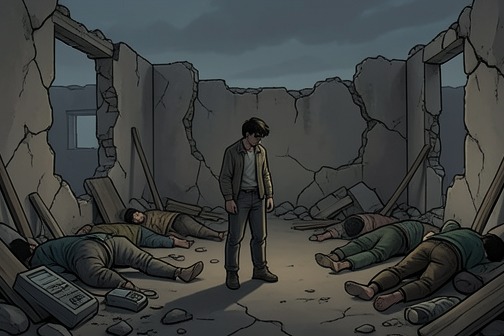
The [Sabra and Shatila massacre](entity:event-recall-event-e7519b888074) is recounted in the novel through [Khaled Ansari](entity:character-recall-character-khaled-ansari-579dc41e3899)’s testimony to [Lin](entity:character-recall-character-lin-428ebd96b429), as a catastrophe that annihilated his family and made private loss inseparable from political violence. The account turns on a broken truce: Palestinian fighters left the camps with their weapons, but the [Phalange](entity:organization-recall-organization-phalange-cf24fcbf02b4) entered after their departure and killed those who remained. Khaled’s family was among the dead. His inability to locate their bodies, and his refusal to let the event become merely past, shape both his life and his arguments with Lin.
## Background and displacement
Khaled’s account places the massacre within a history of exile and armed struggle. His parents were prominent scholars in the Palestinian struggle for an independent nation-state. Khaled trained with Palestinian guerrilla units in Tunisia, Libya, and Syria, and fought for nine years in operations across many conflict zones. By the time he reached Beirut, his family and many of his old neighbors were refugees with nowhere else to go. The camp was not simply a military position: it was also where the people closest to him had gathered after displacement.
Before the massacre, Khaled had lived and studied in [New York City](entity:location-recall-location-new-york-city-65df0a129d4c), where he fell in love with a Jewish student. Her parents supported [Israel](entity:location-recall-location-israel-ecf64b6f6a44) but opposed the occupation of the territories. Khaled later linked the night his father died in an Israeli prison with his return to the region and the October War, which he says he reached just in time. The narrative does not present this personal history as an explanation that cancels what followed. Instead, it shows how intimate attachments, political loyalties, and the escalating losses of war occupied the same life.
## The truce and killings in the camps
Khaled describes the Palestinian fighters’ departure as an evacuation under a truce. They left with their weapons so that their withdrawal would not appear to be a defeat, and marched out like soldiers while firing took place in the air. The departure had the outward form of an organized, even celebratory, procession, but it left families and other camp residents behind. The difference between the apparent order of the truce and the violence that followed gives the event its central reversal in his account.
After the fighters had gone, the promises were broken and the Phalange was sent into the camps. Khaled says that its forces killed the old men, women, and children who remained. His whole family was there, along with many neighbors from his earlier life; all were killed. He did not know where their bodies were. He believed they had been hidden because those responsible knew the killings constituted a war crime. This absence of a known burial place leaves the loss without the ordinary form of a final accounting: Khaled can testify to the deaths, but cannot say where his family lies.
## A loss that becomes a lasting wound
The massacre followed years of combat for Khaled, but the deaths of his mother and the rest of his family brought his fighting life to a breaking point. His [Fattah Group](entity:organization-recall-organization-fattah-group-23ada1e1217c) commander recognized signs of a mental breakdown and released him from duty. Although Khaled continued to speak of Palestinian statehood, the narrator understands that he had become absorbed by the suffering he had endured and the suffering he inflicted in return. In the aftermath, he drifted to [Bombay](entity:location-recall-location-bombay-b9f73c3bdba6) on the recommendation of a senior guerrilla fighter who knew [Abdel Khader Khan](entity:character-recall-character-abdel-khader-khan-822d0cbbc88e). Abdel Khader Khan took him in; Khaled’s education, languages, and intense commitment earned him successive promotions in the criminal organization, eventually giving him charge of its black-market currency operation and a seat on the council.
That new position did not mean the old loss had settled into the past. When Lin tells Khaled that he knows the story of Sabra and [Shatila](entity:location-recall-location-shatila-eb42e238020c) and had followed the news, Khaled challenges whether Lin can understand what it means to have lost his family there. He recalls the evacuation, the broken promises, and the people left behind, then asks whether he should simply let the event go. His account makes clear that public knowledge and personal knowledge are not interchangeable: Lin may have followed the reports, but Khaled carries the loss as the destruction of his own family and community.
## Memory, hatred, and the act of telling
The massacre is also the foundation of the one subject over which Khaled and Lin repeatedly disagree. Khaled’s grief has hardened into hatred of every Israeli and every Jew in the world. Lin, who grew up among Jewish friends in [Melbourne](entity:location-recall-location-melbourne-9115df2f60d3), admired and loved them; some had supported him when his life collapsed, and a Jewish friend had helped him escape [Australia](entity:location-recall-location-australia-443153725cd3). Lin therefore refuses to accept collective blame, comparing Khaled’s position to hating all Indians because some had tortured Lin in an Indian prison. The comparison identifies the ethical conflict without diminishing Khaled’s loss: the massacre explains the origin of his hatred, while Lin contests the generalization through which that hatred is sustained.
The story reaches the reader as remembered testimony rather than as a directly narrated scene of the killings. Lin had already followed the news, but it is Khaled’s account that gives the event its intimate scale: a family among the dead, a community of refugees, and a survivor unable to find their bodies. His telling links a public atrocity to its long aftermath in exile, political disillusionment, and damaged relationships. The massacre thus remains present not because the narrative reconstructs every detail, but because its consequences continue to determine what Khaled can forgive, what Lin challenges, and what the two men can understand about one another.
Event 39
Yom Kippur War
The [Yom Kippur War](entity:event-recall-event-a2b285135b7c), which [Khaled Ansari](entity:character-recall-character-khaled-ansari-579dc41e3899) also identifies as the October War, is recalled as the beginning of his sustained life as a fighter. In his account to [Lin](entity:character-recall-character-lin-428ebd96b429), returning home in time for the war leads from defeat and flight to training and years of combat; the memory also sits beside the later family losses that shape Khaled’s grief and his conflict with Lin over hatred and forgiveness.
## A return to war
Khaled places the war after his father’s death in an Israeli prison. At the time, Khaled was in New York with a Jewish student he loved; he later blamed himself for being with her on the night his father died. He returned home just in time for the conflict, describing his side as having been badly beaten. That personal sequence makes the war more than a historical marker in his account: it follows intimate loss and precedes the years of fighting that become central to his identity.
## From defeat to years of fighting
After the defeat, Khaled made his way to Tunis, where he received training, and began fighting. He continued through a succession of operations and conflict zones, eventually reaching Beirut. His history extended well beyond the Yom Kippur War: he trained with Palestinian guerrilla units in Tunisia, Libya, and Syria, and fought for nine years. The war is therefore recalled as an entry into a much longer course of armed struggle, rather than as a complete account of his military experience.
## [Shatila](entity:location-recall-location-shatila-eb42e238020c) and the war’s personal aftermath
Khaled’s account of the war leads into the later story of the Israeli invasion of [Lebanon](entity:location-recall-location-lebanon-77be8160c97f) and the stand at Shatila. His family and many former neighbours were among the refugees there. Under a truce, the fighters left the camps with their weapons; after their departure, the [Phalange](entity:organization-recall-organization-phalange-cf24fcbf02b4) entered and killed the people left behind. Khaled’s parents, sisters, extended family, and other loved ones were killed, and he did not know where their bodies had been taken. This later massacre is distinct from the Yom Kippur War, but it is essential to understanding the losses that deepen the significance of his recollection.
## What the memory reveals
Khaled’s story connects a personal bereavement, the return to fighting, and the destruction of his family across successive stages of conflict. By the time he tells it to Lin, he remains devoted in words to Palestinian statehood, while the suffering he has endured and the suffering he inflicts have displaced other causes in his life. Their disagreement over his hatred is rooted partly in this history: Lin urges him not to hold himself responsible for his father’s death or for what others did, while Khaled insists on the force of his own guilt. The remembered war thus helps explain both Khaled’s path into militancy and the emotional ground on which he and Lin argue.
Event 40
Lin escapes from an Australian prison
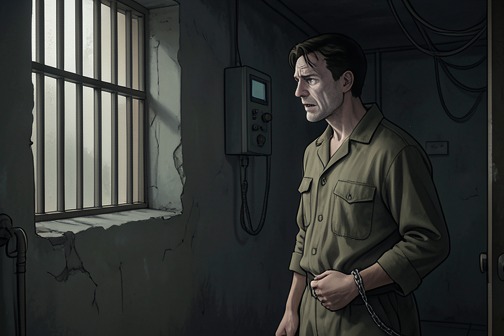
[Lin escapes from an Australian prison](entity:event-recall-event-5ec36569b1f6) after deciding that another stay in its punishment unit would likely cost him his life. Recounted later to [Abdel Khader Khan](entity:character-recall-character-abdel-khader-khan-822d0cbbc88e), the escape is not presented as a daring feat for its own sake: it follows a cycle of torture and resistance, and leads [Lin](entity:character-recall-character-lin-428ebd96b429) to abandon his fellow fugitive, reject armed robbery, and accept an uncertain life on the run.
## Causes and Decision
Lin explains the escape when Abdel Khader Khan asks why he fled, rather than how he managed it. That distinction shifts the account away from ingenuity and toward the conditions that made flight seem necessary. In the prison’s punishment unit, guards tortured prisoners nearly every night. Lin fought back, describing resistance as part of his nature, but he understood that it made the guards’ treatment of him worse. His long sentence meant he expected to be sent back to the unit sooner or later, whether the authorities found an excuse or he gave them one.
The decisive fear was a repetition with a fatal outcome: Lin believed that he would fight the guards again, and that they might kill him. The escape therefore answers a stark calculation rather than a sudden impulse. Remaining meant the prospect of renewed torture and a possible death inside the punishment unit; leaving meant risking recapture as a wanted man. In the later telling, that pressure is the reason for the escape, while its practical details explain how he made it possible.
## The Escape
After a severe beating, Lin allowed the guards to believe that they had broken his spirit. That appearance changed how they used him. They assigned him work that, in the prison’s own hierarchy, was given to beaten men: pushing a wheelbarrow and making repairs near the front wall. Lin waited until the moment was right and escaped from there. His account supplies no further mechanics; the significant turn is that apparent submission gave him access to work near the boundary he needed to cross.
The escape was not an immediate return to safety. Lin and another fugitive, a man serving time for murder whom Lin regarded as decent and compassionate, first went to stay with an outlaw motorcycle gang. Its leader had once owed Lin a favor because Lin had helped save the leader’s younger brother from a dangerous man in prison. The gang provided the two men with shelter, weapons, drugs, and money, protecting them for thirteen days and nights while police searched the city for them. Their refuge was real but temporary, and the assistance came with the danger of continuing to live armed and underground.
## The Choice to Separate
On the thirteenth night after the escape, while still hiding with the gang, Lin felt compelled to visit a former teacher: a respected Jewish intellectual who lectured in philosophy at a university in Lin’s city. Lin could not explain why he risked the journey to see him. In the later account, the meeting functions as a second turning point. The escape had removed Lin from the prison; the teacher’s counsel helped determine what kind of fugitive he would become.
The teacher urged Lin to give up his guns and not to commit armed robbery again. He warned that repeating that crime would bring capture or death, and advised Lin to separate from his companion, whom he believed would be caught. He also urged Lin to travel, tell people only what they needed to know, and ask them for help. Lin followed the advice: he returned to the gang, handed his guns to his friend, and left alone. His former companion was captured six months later after a gun battle with police. Lin remained free, but described that freedom as uncertain because he was still wanted and had nowhere to go.
## Retelling and Consequences
Lin relates the escape over a meal with Abdel Khader Khan, who listens without interrupting and responds sympathetically. He asks about the escapee who accompanied Lin and why the two did not remain together. Lin can give the sequence of events, but admits that he scarcely understands his own reasons for leaving his friend. That uncertainty matters: the separation is not reduced to a tidy strategic choice, even though the teacher’s prediction of the friend’s capture appears to have been borne out.
The conversation also clarifies why Lin will not seek safety by testifying against the prison guards. He believes the justice system would protect them, doubts that reporting their abuse would prevent it from continuing, and fears that returning to custody would place him back in their power. He refuses to inform on anyone, including torturers, treating that refusal as a principle rather than a calculation that promises an advantage. The escape thus opens onto a wider conflict between survival and complicity: Lin escapes the institution, but does not imagine that official justice will make him safe.
Later accounts of Lin’s imprisonment in [Bombay](entity:location-recall-location-bombay-b9f73c3bdba6) give this escape an additional resonance without describing the same prison or event. At the [Colaba](entity:location-recall-location-colaba-2bd495476f0e) police station lock-up, he is held for three weeks among 240 men in rooms and a corridor that could have accommodated about forty with reasonable discomfort. In [Arthur Road Prison](entity:location-recall-location-arthur-road-prison-50f3a84a4e65), he keeps silent when authorities abuse their power, having learned that speaking can worsen their retaliation. These later experiences establish the recurring cost of incarceration in Lin’s life; they should not be mistaken for the Australian prison conditions that precipitated this particular escape. The episode’s lasting significance lies in the decision it begins: Lin remains outside prison, but freedom means both separation from the man who fled with him and life under the continuing pressure of pursuit.
Event 41
Lin’s imprisonment and release from Arthur Road Prison
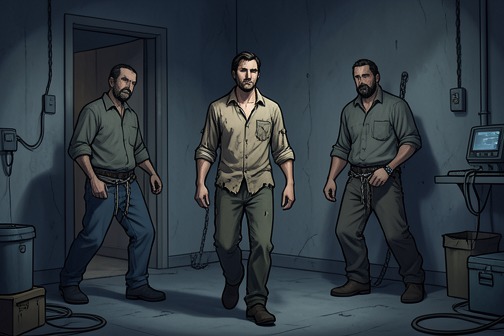
[Lin](entity:character-recall-character-lin-428ebd96b429)’s imprisonment in [Arthur Road Prison](entity:location-recall-location-arthur-road-prison-50f3a84a4e65) is a struggle to survive a system of punishment and neglect, and a test of whether survival can remain connected to concern for others. As hunger and illness weaken him, the prison’s violence turns a confrontation into the occasion for an unexpected washing; when release becomes possible, Lin uses it to seek freedom for other prisoners as well.
## Confinement and survival
Chains restrict Lin to short, shuffling steps. By observing two other chained men in his room, he learns how to walk, and recognizes that their careful movements give a measure of grace to a humiliating constraint. The discovery offers a small form of human agency inside the prison’s imposed degradation. Yet he understands the humiliation as more than physical: it strikes at the part of a person that wants to love the world, and makes violation feel like a source of shame.
Half rations steadily undermine Lin’s strength. He estimates that he loses as much as fifteen kilos in a month, living on a palm-sized piece of chapatti and a saucer of watery soup each day. Other prisoners risk beatings to smuggle him food. He eventually refuses their help, not because he no longer needs it, but because seeing them punished on his behalf adds guilt to his hunger. The beatings become less forceful after he meets a prison official, although [Big Rahul](entity:character-recall-character-big-rahul-a961fccfa964) and other overseers continue to strike him occasionally.
## The staged attack and its aftermath
While Lin lies weakened in the dormitory, a powerful prisoner suddenly attacks him, apparently mistaking him for his younger brother, Mukul. Lin draws on the reserve of strength he has kept back and fights the man off. The overseers then chain Lin at the gate and beat him for hours. During a pause, they reveal that they had arranged the attack: they expected the other prisoner to overwhelm or kill Lin, and are enraged that their plan has failed. The violence is therefore not simply an episode of prison disorder but a deliberate effort by the overseers to destroy him, followed by punishment for resisting it.
The assault leaves Lin in such a grave condition that the overseers fear the consequences of what they have done. Unable to report the episode without exposing their own role, they keep it quiet and order a subordinate to wash him. The man protests, but is pressured into carrying out the task. The washing is the first Lin receives in the prison, and, as his infected wounds and fever make clear, it has consequences beyond comfort: he believes the soap and warm water help save his life. The moment reverses the prison’s ordinary arrangement of power. A coerced act of care, performed by an unnamed subordinate after the overseers’ violence, gives Lin relief where the institution has otherwise denied him protection.
## Release and obligations
As Lin’s strength ebbs, his thoughts repeatedly turn to [Karla](entity:character-recall-character-karla-3f7aa8a8ae5c). In a fevered state, he imagines that she has saved him; soon afterward, guards remove his chains and bring him to the prison official’s office, where [Vikram Patel](entity:character-recall-character-vikram-patel-70646435bc43) is waiting with the official and a plain-clothes policeman. [Vikram](entity:character-recall-character-vikram-9e00afad97ee) says that a friend sent him and promises to get Lin out. The official demands ten thousand American dollars, explaining that enough people know about Lin’s condition to make silence costly. Vikram protests at the price, then agrees to obtain the money and asks that Lin be cleaned and prepared for release.
Lin makes his freedom conditional on helping others leave as well. He asks for two prisoners who had tried to bring him food and had received additional time for it, and for [Mahesh Malhotra](entity:character-recall-character-mahesh-malhotra-82abf2c81b85), who cannot afford bail of a few thousand rupees. The officials treat these requests as minor matters and agree to release the two men; Vikram is to pay [Mahesh](entity:character-recall-character-mahesh-5584c4abfd61)’s bail. Lin then asks for [Raheem](entity:character-recall-character-raheem-52019dfa893a), an African prisoner in a separate compound whose arms had been broken. The prison official refuses, describing Raheem’s case as a police matter and citing the inspector whose wife Raheem had been involved with. Lin’s intervention nonetheless brings Raheem into the release arrangements.
Afterward, Lin rides with Raheem in a taxi through [Bombay](entity:location-recall-location-bombay-b9f73c3bdba6). Raheem has received treatment and his arms are in plaster casts, but he remains thin and distressed; he speaks only to direct the driver to [Hassaan Obikwa](entity:character-recall-character-hassaan-obikwa-ceed6d51b8d2)’s restaurant in [Dongri](entity:location-recall-location-122b135e641c), where Lin leaves him. Lin then returns to Vikram’s home in separate taxis for himself, Raheem, and the other men, mindful of the body lice they carry from the prison. His first actions outside are not limited to his own escape: even in extreme weakness, he uses the opportunity to secure help for prisoners with less power and fewer resources.
## Aftermath and the decision to remain
On the journey back into Bombay, Lin asks the taxi driver for an Indian film song that prisoners had passed from group to group and sung in the dormitory. The driver finds it, turns up the volume, and joins Lin in singing through the city. The shared song briefly carries something of the prison community beyond its walls, transforming the journey from a solitary escape into an act of connection. Lin then goes to Vikram Patel’s home, where he washes and changes after the confinement.
Vikram tells Lin that Karla left Bombay two days earlier, and no one seems to know where she has gone. Lin’s thoughts return to her and to the possibility that she may believe he abandoned her. Rather than leave the city, he decides to stay and wait for her return. Release therefore ends his imprisonment without resolving the uncertainty that shaped his thoughts inside it: freedom brings Lin back to Bombay, but his next choice is organized around the hope of finding Karla.
Event 42
Lin and Karla reunite in Goa

[Lin and Karla reunite in Goa](entity:event-recall-event-6e8be076f7c0) after a search prompted by [Ulla](entity:character-recall-character-ulla-87a1fc56dfd8)’s letter, and the encounter turns an uncertain pursuit into a renewed intimacy. [Karla](entity:character-recall-character-karla-3f7aa8a8ae5c)’s confidence that [Lin](entity:character-recall-character-lin-428ebd96b429) would find her, his declaration of love, and their week traveling together make the reunion a decisive change in their relationship, though the episode does not settle what their future will be.
## The search leads from Ulla to [Goa](entity:location-recall-location-goa-4b350123a787)
The route to Karla begins with Ulla in trouble. She needs a thousand dollars and asks Lin to accompany her to the hotel where she left her clothes and belongings. He gives her the money, helps her collect her things, and pays the bill. Her predicament is connected to a failed business deal involving [Modena](entity:character-recall-character-modena-687f7ee2847c) and [Maurizio](entity:character-recall-character-maurizio-9cd3f527287c): people who lost money want repayment and may pursue Ulla. She does not tell Lin who they are or why they consider her a target, and he does not press her for an explanation.
That silence exposes the limits of Lin’s attention. He later recognizes that asking more about Ulla’s danger might have spared considerable trouble, perhaps even saved lives. At the time, however, his concern is directed toward Karla. Ulla first says Karla is in Goa, then clarifies that a letter sent from [Mapusa](entity:location-recall-location-mapusa-f8a84aae07dc) arrived only the day before and places her somewhere near the town. The letter gives Lin a location without providing a precise address; the search still depends on his determination to reach her.
## A reunion built on trust
When Lin finally encounters Karla on a beach, her presence overwhelms him. The narrative sets the force of that moment against the time since their previous meeting and their earlier intimacy: feeling arrives before he can conceal it, and he tries to restrain its effect on him. The reunion is therefore not simply the discovery of Karla’s whereabouts. It brings back an attachment Lin has been trying to manage, while making clear that the separation has not made her emotionally insignificant to him.
Karla explains that she trusted he would find her without a message from her. She says she knew he would come, although she cannot explain how she knew. Her confidence rests partly on what she has seen of Lin. She calls his behavior in the slum good and admires how he stayed present while she was worried and afraid, smiling for her and being there when she woke and when she went to sleep. Her account gives the reunion a history: the care Lin showed during their work together has remained meaningful to her, even though she had not told him so then.
She also connects his goodness with his unconventional, unpredictable quality. Lin is surprised by her judgment, but Karla presents that combination—a tough man capable of genuine goodness—as something she finds difficult to resist. Her explanation changes the scene from a one-sided pursuit into a meeting shaped by trust and admiration on both sides, even though the available exchange does not make every aspect of their feelings equally explicit.
## The declaration and renewed intimacy
Lin answers Karla’s remarks by trying to understand what she means by liking him. Her response returns their conversation to the question of love, a subject already complicated by his belief that she does not believe in it. The exchange does not resolve that disagreement through argument. Instead, it moves toward what each can acknowledge about their bond: Karla’s faith that he would come, and Lin’s open admission of how deeply he loves her.
Once they are alone, Lin tells her that his love reaches back to the first moment he saw her. He names what he loves about her—her voice, face, hands, actions, mind, and speech—while admitting that he cannot fully understand or explain the feeling. Most consequentially, he describes Karla as giving him a reason to live and to love the world. The declaration presents love not as an idea he can master, but as a force that restores meaning to his life.
Karla kisses him, and they make love on the sand, their hands clasped and arms outstretched. The episode’s imagery places their closeness beneath a praying moon and beside the sea, but the essential change is relational: the guarded pursuit gives way to mutual physical intimacy. The reunion does not erase the time apart or answer every question between them; it shows that their connection can again be acted upon rather than only remembered or desired.
## A week together in Goa
For the following week, [Lin and Karla](entity:relation-recall-relation-lin-and-karla-9a163b3f3796) travel as tourists. They visit beaches along the [Arabian Sea](entity:location-recall-location-arabian-sea-c6dbb6bf7a27) coast, from [Chapora](entity:location-recall-location-chapora-64d58243bce2) to Cape Rama, and spend two nights at [Colva Beach](entity:location-recall-location-colva-beach-66abcd0e78c7). They also visit the churches of Old Goa and join the crowds at the Festival of St. Francis Xavier. The sequence broadens the reunion beyond the private beach encounter: the pair share ordinary travel, public celebrations, and time in places neither meeting nor confession alone could provide.
The festival is described as a major annual gathering on the anniversary of St. Francis Xavier’s death. Pilgrims, including blind, lame, and afflicted people hoping for a miracle, move toward the [Basilica of Bom Jesus](entity:location-recall-location-basilica-of-bom-jesu-d94078e68f50), where the saint’s body is displayed once every ten years. Lin recounts its history of repeated burial and disinterment, its preservation, and the removal of parts of the body as relics. He and Karla offer extravagant bribes to the basilica’s caretakers, laughing as they do so, but the caretakers refuse them a viewing. This episode supplies a comic limit to their sightseeing and sets their irreverent playfulness beside the solemnity of the pilgrimage.
The week gives the reunion a temporary shared shape: beaches, churches, crowds, and unsuccessful attempts to see the relic become experiences they undertake together. Its significance lies less in a promise about permanence than in the contrast between the uncertain search that brought Lin to Goa and the companionship that follows. The account moves from Ulla’s incomplete clue, through Karla’s confidence in Lin, to an open declaration and a week of common life; it establishes renewed closeness without claiming that the couple’s future is thereby settled.
Event 43
Lin and Karla part ways in Goa

[Lin and Karla part ways in Goa](entity:event-recall-event-128cd4581348) when [Lin](entity:character-recall-character-lin-428ebd96b429) chooses to return to [Bombay](entity:location-recall-location-bombay-b9f73c3bdba6) despite [Karla](entity:character-recall-character-karla-3f7aa8a8ae5c)’s insistence that he stay. Their last morning turns a period of love into an irreconcilable choice: Karla will not give the explanation Lin demands, while Lin will not accept a decision imposed without one. The separation ends not with a negotiated compromise but with Karla’s declaration that she will leave and Lin’s departure from the beach alone.
## The last morning in [Goa](entity:location-recall-location-goa-4b350123a787)
The parting follows days and nights that Lin later remembers as almost impossibly happy. Looking back, he imagines the life the two might have built from the stars, the sea, and the sand. But his recollection is shadowed by the knowledge that he did not attend to what Karla was trying to tell him. He remembers being captivated by her eyes and voice while failing to read the signs in her expressions or hear the fear and anguish in how she spoke. The separation is therefore framed not only as a present-tense disagreement, but as the belated recognition of a failure to listen.
On the final morning, Lin wakes at dawn preparing to travel back to Bombay and finds Karla standing in the doorway, looking out at the sea. She asks him not to go. He initially laughs, treating the request as something that can be answered by bringing her with him: he proposes that she return to Bombay alongside him so they can remain together. His easy confidence in a shared future makes the difference between their positions sharper. He thinks in terms of continuing the relationship elsewhere; Karla is asking him not to make the journey at all.
## [Freedom](entity:concept-recall-concept-16bc935c6e52) and the ultimatum
Karla says that she has reasons for wanting him to stay but will not tell him what they are. She insists that the fact she has reasons should be enough if he loves her. Lin is surprised by the force of her position, but answers with his own account of what love and choice require: he will not be ordered to act without understanding what is happening and why. For him, a decision made with no explanation is not a genuine choice. His response makes the conflict more than a question of where the two will live; it is also a contest over whether trust can substitute for knowledge.
The disagreement is bound to Lin’s idea of freedom. When he offers to get Karla a passport, she rejects the offer. She wants to learn how to make and alter passports herself, including how to repair and forge them, because she believes that learning the work will make her free. Lin’s offer of documents would provide her with a means of travel; Karla wants the knowledge and capacity to manage that means independently. Her repeated insistence on freedom gives the argument a concrete stake, while her question about why Lin should be different challenges the expectation that he can choose his own course without consequence for their relationship.
Karla eventually states the consequence in absolute terms: if Lin returns to Bombay, she will not go with him or wait for him, and their relationship will be finished. She also says she cannot explain herself, then adds that she will not. The distinction leaves no path to the reassurance Lin seeks. He can stay with her in Goa or leave alone, but he cannot make the choice with the reasons disclosed. Lin calls her position an ultimatum and insists that she cannot simply tell him what to do. Karla, in turn, treats the ending as a fact that will follow from his decision rather than as a threat she can withdraw.
## The departure from the beach
After Karla leaves the hut, Lin packs his bag, straps it to the bike, and goes down to the sea. The physical preparation makes his decision tangible: he has not merely argued that he must return to Bombay but has arranged to leave. At the shore, Karla rises from the waves and walks toward him through the sand. Lin embraces and kisses her, tells her he loves her, and promises that things will be all right and that he will be back soon. The promise imagines a temporary separation and a future reunion, even after Karla has told him that she will not wait.
Karla answers that it will not be all right, that it is over, and that she will not be there after that day. Her stillness contrasts with Lin’s attempt to make the parting temporary through affection and reassurance. He looks into her eyes, feels pride harden and hollow him, and lets his hands fall from her shoulders. Rather than return to her or continue the argument, he turns and walks back to the bike. The decisive gesture is not another declaration but the ending of the embrace and his physical departure.
At the final cliff overlooking the beach, Lin stops and looks back. Karla is gone. What remains in his view is the breaking surf and empty, unmarked sand. The landscape that had belonged to their imagined life together now offers no visible trace of her. His departure is thus followed by an absence that makes the ending immediate: the beach is still there, but the shared future Lin had pictured cannot be found in it.
## Retrospective significance
Lin’s later account gives the separation a double movement. In the scene itself, he is bewildered, angry, and in love; in retrospect, he recognizes that he had missed clues and failed to hear fear and anguish in Karla’s voice. That hindsight does not supply the reason she withheld. Instead, it emphasizes the gap between loving the way someone speaks and attending to what that person is saying. The event’s central loss is bound to that gap: Lin wants an explanation before he acts, while Karla refuses one, and neither changes course before he leaves.
The scene also refuses the reunion Lin’s promise appears to anticipate. He says he will return soon, but Karla explicitly tells him she will not be there after that day; his later recollection already knows that the parting was not the temporary absence he hoped to make it. The ending turns the Goa days from a picture of a life that might have lasted into a memory of what Lin failed to understand while it was happening. [Love](entity:concept-recall-concept-179ad7ce19f0) remains present in the embrace and in his repeated declaration, but it does not resolve their incompatible demands: Karla wants him to stay without explanation, and Lin chooses to go rather than accept that condition.
Event 44
Murder of Madjid
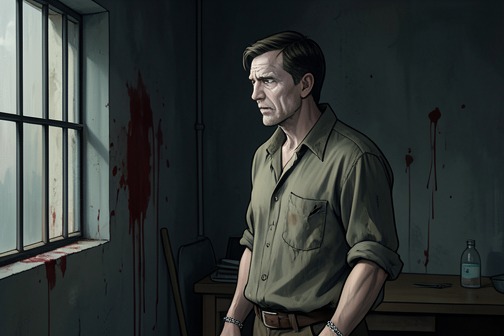
Madjid’s murder is an offstage killing whose disclosure exposes both the violence surrounding [Sapna](entity:character-recall-character-sapna-3597df1d97c4) and the grief [Abdel Khader Khan](entity:character-recall-character-abdel-khader-khan-822d0cbbc88e) cannot readily voice. [Lin](entity:character-recall-character-lin-428ebd96b429) learns that Madjid was slaughtered in his own home, with the name Sapna written on the walls in his blood; afterward, the subject settles into a long silence between Lin and Khader.
## The News and Its Circumstances
Khader tells Lin about the murder during a conversation that had turned to business. Lin is taken aback by the news. Khader, though visibly crying, keeps his voice composed and apologizes for his tears, explaining that the killing has taken its toll on him. His grief establishes the personal weight of the news before Lin knows its details.
Madjid was murdered in his own house. His body was found in different rooms, and the name Sapna had been daubed on the walls with his blood. The police blamed fanatics who followed Sapna. The account gives Lin and the reader a violent act, a conspicuous mark pointing toward Sapna, and an official attribution, but it does not establish who carried out the killing or whether that attribution is correct.
## Grief and Silence
Lin later remembers that he asked Khader about Madjid only once, soon after the murder. Khader looked stricken with grief, and Lin let the subject drop. As days became weeks and weeks drifted into silent months, Lin found it increasingly difficult to raise Madjid’s name again. The murder remains present in his thoughts, but he does not admit those thoughts to Khader.
Instead, their conversations turn to business or philosophy. That contrast makes the silence consequential: the men continue to speak and share intellectual ground, while the loss that most visibly pains Khader remains outside their conversations. Lin understands the unasked question as a secret he, too, is keeping.
## Narrative Significance
The murder reaches the narrative through its aftermath rather than through a depicted attack. Its defining image—the name Sapna marked on the walls—connects the death to the violence attributed to Sapna’s followers, while the scene of disclosure centers Khader’s grief and Lin’s response to it. The later recollection shows how a killing can persist not only as a criminal mystery, but as a subject that changes the terms of a relationship by becoming difficult to speak aloud.
Event 45
Rasheed’s kidney-extraction scam
[Rasheed’s kidney-extraction scam](entity:event-recall-event-rasheed-c7c823e92cbb) is a chain of deception that begins with a plan to raise money for a small shop and ends with two sisters dead and [Anand Rao](entity:character-recall-character-anand-rao-57f28ed0738c) charged with murder. [Lin](entity:character-recall-character-lin-428ebd96b429) recounts the scheme to [Kavita](entity:character-recall-character-kavita-993549a96176): [Rasheed](entity:character-recall-character-rasheed-eed8024ea304) persuades his wife and her younger sister to undergo operations, takes the money, and disappears. [Anand](entity:character-recall-character-anand-89b268e39901), unable to accept the sisters’ deaths or his own failure to stop Rasheed, tracks him down and kills him. The account links the exploitation of two vulnerable women to a second act of violence, without treating Anand’s response as undoing what came before.
## Background and the First Operation
Before the scheme unfolded, Anand Rao had met Rasheed’s wife and her sister and had come to like them. They were shy but friendly, and Anand may also have become fond of the younger sister. Rasheed and Anand knew each other well: they had shared a hut for two years. That familiarity gives Anand grounds to distrust Rasheed, but it does not prevent the fraud from taking hold.
Rasheed presented the prospect of selling a kidney as the only way for him and his wife to establish the small shop they wanted. His wife objected, but he persuaded her to proceed at a private hospital he knew. After the operation, he reported that the hospital wanted a woman’s kidney rather than a man’s. His wife was understandably reluctant, yet Rasheed persuaded her to go ahead. The first operation thus became more than a single sale: it supplied the premise for pressing the younger sister as well.
## The Scheme Expands
When the wife returned from the hospital, Anand challenged Rasheed. He knew him as a con man and was angry about what had happened, but Rasheed denied wrongdoing and responded by spilling kerosene on himself, daring Anand to act if he believed him guilty. Anand did not take the bait. He warned Rasheed to look after the women and left. The confrontation exposes Anand’s suspicion and concern, while also showing how little leverage he had over a man who could turn an accusation into a challenge.
Six months after the first operation, Rasheed told his wife that he had repeatedly tried to sell one of his own kidneys but that the hospital would not accept it. He also said the money from her operation was only half of what they needed for the shop, and that the hospital still wanted women’s kidneys. His wife opposed involving her sister, but Rasheed worked on the younger woman with the argument that refusing would make the wife’s operation and sacrifice pointless. The women eventually agreed. Rasheed sent the younger sister to the hospital, and she returned having undergone the operation and lost a kidney. What had been represented as a shared route to a livelihood had become a repeated extraction from the women, with Rasheed controlling the decisions and the money.
## The Sisters’ Deaths and Anand’s Response
Rasheed took the money and ran. The sisters were devastated, their health worsened, and both ended up in hospital. They fell into comas and were pronounced dead within minutes of one another. Anand was at the hospital with others from the slum and remained long enough to see the sheets placed over their faces. Their deaths changed his response from warning Rasheed to pursuing him; Lin recounts that Anand left the hospital overwhelmed by anger and guilt.
Anand knew the drinking places Rasheed frequented and searched them until he found him asleep in a rubbish pit after a binge. Rasheed had paid children to keep rats away from him. Anand sent the children off, sat beside Rasheed, and waited while he slept. He then killed him and remained there until the killing was over. Lin’s account does not present this as a rescue or a restoration of justice: the sisters were already dead, and Anand’s action added another death rather than reversing their loss.
## Confession and Narrative Frame
Anand gave himself up and made a full confession. By the time Lin tells the story, he has been charged with murder; the account supplies no later legal outcome. His confession distinguishes his response from Rasheed’s evasion: Rasheed fled with the money, while Anand accepted exposure to the law after killing him. It does not, however, erase the difference between confessing to a crime and repairing the harm that preceded it.
The episode reaches the reader through Lin’s account to Kavita, who is taking notes and using a cassette recorder. Her questions prompt Lin to clarify where the operation occurred, when it happened, and what followed. This layered telling makes the chronology of the fraud legible while keeping Anand’s inner state at a distance: Lin offers anger and guilt as his own reading of Anand’s conduct, not as a direct confession of motive from Anand himself. Elsewhere, Lin describes his own position in the slum as an improvised healer, trained in first aid but unwilling to claim the title of doctor. That context frames him as a witness relaying a story of bodily risk and inadequate power to intervene, rather than as an authority who can settle the sisters’ medical history or Anand’s guilt.
Event 46
The Blue Sisters’ revival
[The Blue Sisters’ revival](entity:event-recall-event-aedf3e0d9806) transforms a presumed double death into a public miracle, but its consequences reach back into violence: believing the sisters had died, [Anand Rao](entity:character-recall-character-anand-rao-57f28ed0738c) killed [Rasheed](entity:character-recall-character-rasheed-eed8024ea304) and surrendered to the police. The women’s return to life brings pilgrims, new prosperity, and a charity for abandoned wives to the slum, while their story spreads across the country through [Kavita Singh](entity:character-recall-character-kavita-singh-7d8cb9489230)’s reporting.
## The deaths that preceded the revival
Rasheed took the money entrusted to him and disappeared, leaving the two sisters devastated. Their health deteriorated until both were hospitalized and fell into comas. They were pronounced dead within minutes of one another. Anand Rao stayed long enough to see the sheets drawn over their faces, then left in anger and what [Lin](entity:character-recall-character-lin-428ebd96b429) later describes as guilt.
Anand Rao sought Rasheed at the drinking places he knew. He found him asleep in a rubbish pit after a binge, with children paid to keep rats away. Anand Rao chased the children off, sat beside Rasheed, and waited while he slept. He then killed him and remained there until the blood stopped flowing. He gave himself up and confessed; when Lin explained the case to Kavita Singh, Anand Rao had been charged with murder.
## The reversal and its consequences
Half an hour after the sisters were pronounced dead, Rasheed’s wife stirred beneath the sheet. A few minutes later, her sister moved and groaned. Both survived and were well. Their revival overturned the understanding on which Anand Rao’s act had rested: he had killed Rasheed believing the sisters were gone, but they had not died.
The reversal also changed the sisters’ standing in the slum. Their hut became a kind of shrine, drawing visitors from around the city who came to see the women said to have returned from the dead. The pilgrimage brought business to the neighborhood, and the sisters received enough small donations to become wealthier than they had expected. They established a charity for abandoned wives, giving their public renown a practical consequence beyond the visitors and trade it attracted.
## The [Blue Sisters](entity:character-recall-character-blue-sisters-fa4fc587a80f) in public view
Kavita Singh’s account carried the story beyond the slum. Her syndicated article appeared in newspapers across the country, recounting the sisters’ history and including visitors’ claims of miraculous cures. One woman attributed her recovery from tuberculosis to them; another said her hearing had returned; an elderly man said his lungs had become strong after he touched the hem of their blue garments. These are claims reported in the article, not independently established outcomes.
The sisters did not choose the name by which the public came to know them. They wore blue consistently because, after waking from their comas, they shared a dream of floating in the sky. Their devotees settled on the name Blue Sisters. [Kavita](entity:character-recall-character-kavita-993549a96176)’s article ended with her own account of meeting them and her conviction that they were exceptional, perhaps supernatural. Lin later read the article on page three and marked it before taking it to [Arthur Road Prison](entity:location-recall-location-arthur-road-prison-50f3a84a4e65), where he went to visit Anand Rao.
## A story of grief, belief, and return
The revival’s force lies in the distance between what the characters believe and what happens. The sisters’ apparent deaths trigger Anand Rao’s grief and violence; their return gives the same neighborhood a story of wonder, public attention, and renewed livelihood. The event does not erase the killing or Anand Rao’s confession. Instead, the sisters’ survival makes the tragedy’s mistaken certainty visible, while their charitable work turns the aftermath toward care for other abandoned women.
Event 47
Anand Rao kills Rasheed
[Anand Rao kills Rasheed](entity:event-recall-event-anand-rao-rasheed-bbff281d069c) in the first murder committed by one resident against another in the [Cuffe Parade Slum](entity:location-recall-location-28c2712491c5). The killing follows the deaths of two sisters whom [Rasheed](entity:character-recall-character-rasheed-eed8024ea304) had defrauded, and it shatters a community norm among roughly twenty-five thousand people accustomed to frequent disputes but not lethal violence. [Anand](entity:character-recall-character-anand-89b268e39901)’s confession makes the act both a personal response to loss and a turning point in the slum’s history.
## Background and the sisters’ deaths
Rasheed took money from the two sisters and fled. Their health deteriorated rapidly, and they were admitted to hospital; each fell into a coma, and they died within minutes of one another. Anand was present long enough to see them covered, then left in a state of intense anger and guilt. Their deaths provide the immediate context for his pursuit of Rasheed, though they do not undo the consequences of the fraud or make the killing an act of justice.
## The killing
Anand knew Rasheed’s drinking places and eventually found him asleep in a rubbish pit after a binge. Some children had been paid to keep rats away from him. Anand sent them away, sat beside Rasheed, and listened to him snore before killing him. He remained there until Rasheed had died. The account emphasizes the sequence leading to the act—the sisters’ deaths, Anand’s search, and his pause beside Rasheed—without presenting the murder as an impulsive encounter.
## Consequences in the slum
The news reached [Lin](entity:character-recall-character-lin-428ebd96b429) as a rupture in the Cuffe Parade Slum’s shared life. Across its twenty-five thousand residents, people had fought, argued, and bickered, yet none had killed another; Anand’s act was the first slum-dweller-on-slum-dweller murder. Its significance therefore exceeds the private conflict between Anand and Rasheed: violence has crossed a boundary the community had maintained despite its everyday discord.
For Lin, the announcement also brings other deaths back into view. He recalls Madjid, whose murder he had pushed from his waking thoughts, and the killing of an old gold smuggler and mafia don that Ghani had described as a slaughter. These separate deaths become entangled in Lin’s response to the news, placing Anand’s crime within a widening field of loss rather than isolating it as a single event.
## Confession and significance
Anand gave himself up and made a full confession; he was charged with murder. The surrender distinguishes the aftermath from an attempt to conceal or evade responsibility, but it does not restore the lives lost or the slum’s former sense that its residents, for all their quarrels, would not kill one another. The event joins grief to culpability: Anand’s anger follows the sisters’ deaths, while his choice to kill Rasheed creates a new death and a new public consequence.
Event 48
Vikram proposes to Letitia
[Vikram](entity:character-recall-character-vikram-9e00afad97ee) proposes to [Lettie](entity:character-recall-character-lettie-f339e1d1927e) in a staged surprise aboard a moving train, turning a risky rooftop reveal into a public declaration that joins private love to the shared, exuberant life of [Lin](entity:character-recall-character-lin-428ebd96b429)’s [Bombay](entity:location-recall-location-bombay-b9f73c3bdba6). Lin helps carry out the plan: Lettie trusts him enough to follow his strange instructions, and when the banners appear, her surprise gives way to delight. Her acceptance sets off a joyful reunion, followed by a week-long absence and an affectionate welcome back among their friends.
## The Surprise Takes Shape
The scene begins with Lettie unaware of the plan. She has been told only that Vikram arranged for her to meet Lin and [Didier](entity:character-recall-character-didier-381547eab195). As a train approaches from Churchgate Station, Vikram signals Lin with an exaggerated widening of his eyes and a shake of his head. Lin turns Lettie so that her back faces the tracks, then asks whether she trusts him. Her smile supplies the answer without spoiling the surprise.
Lin tells her that the group has prepared something about love and asks her to put on a blindfold and promise not to look until they say so. Lettie examines the request, considers it, and agrees with a laugh. Vikram ties the blindfold, checks whether it is too tight, guides her toward the train, and asks her to raise her arms. Her joking warning that she will punish him if he tickles her makes the moment sound playful, even as the concealed plan is about to become startlingly physical.
## The Rooftop Reveal
Several men who have been lying on the carriage roof reach down and lift Lettie by her raised arms onto the train. She shrieks, but her cry is swallowed by the train guard’s whistle as the train starts moving. Vikram climbs up the outside of the carriage to join her, while Lin follows. The scene’s comedy and danger are intertwined: Lettie is being held so she will not fall or stand into an overhead wire, and Vikram later explains that the men are keeping her safe until she understands what is happening.
Vikram removes the blindfold. From the roof of the fast-moving train, Lettie takes in the view and breaks into a broad smile. He points along the carriages to a huge banner stretched high between the supports for the electric wires. As the train draws nearer, its message becomes legible: “LETITIA I LOVE YOU”. Musicians then strike up a popular love song, their voices rising above the tablas and flutes. The train stops at one station and pulls away again; between stations, a second banner comes into view, asking, “WILL YOU MARRY ME?” The proposal unfolds in motion, with the train carrying Lettie beneath the words before the moment can settle into a conventional private exchange.
## Acceptance and Celebration
Lettie cries, and Vikram cries with her. He throws himself forward to embrace her, and they kiss. Lin watches briefly, then turns toward the musicians, who grin and laugh as they play; he answers with a small victory dance on the rocking roof. The group’s performance is not merely background to the proposal: the helpers, music, moving train, and enormous signs make the lovers’ decision a communal spectacle, while the couple’s gaze and embrace keep its emotional center between them.
The scene’s narration enlarges that personal happiness into an image of the city. Lin reflects that dreams are continually born, die, and are born again around him; on the rusting red-brown roof, he sees a new dream of love taking shape. His thoughts turn both to his family and to [Karla](entity:character-recall-character-karla-3f7aa8a8ae5c) as he dances above the train moving through the humid air beside the sea. The reflection gives the proposal a place in a larger pattern of hope, without making the lovers’ future certain.
## Aftermath and Significance
Lettie accepts, and she and Vikram disappear for a week. When Vikram finally returns, the [Leopold’s](entity:location-recall-location-leopold-s-1d82f936fa9e) crowd greets him with affection, and the optimism associated with the engagement seems to circulate among its regulars. Lin and Abdullah have just finished training and tease Vikram for his exhausted, delirious joy. At the table, Vikram blubbers about love while the others eat in hungry silence; Didier, jubilant at the success of his romantic scheme, celebrates his own part in it by asking acquaintances for stiff drinks as modest tributes.
The proposal therefore continues beyond the rooftop: its effects are visible in the couple’s temporary withdrawal and in the warmth with which their friends receive them afterward. Its elaborate public form also contrasts with the everyday fellowship of the Leopold’s table, where extravagant romance becomes a shared joke and source of pleasure. The narrative abruptly turns from that happiness when a street boy summons Lin away and warns him that three powerful African men are looking for him. The threat does not undo Lettie’s acceptance, but its arrival places the celebration within the more dangerous world surrounding Lin.
Event 49
The Nigerian assassins’ attack on Lin
[The Nigerian assassins’ attack on Lin](entity:event-recall-event-lin-7d8a5da61931) transforms a warning of imminent violence into the discovery of a larger deception: three hired men have come to [Bombay](entity:location-recall-location-bombay-b9f73c3bdba6) believing [Lin](entity:character-recall-character-lin-428ebd96b429) is responsible for a lost drug deal, when the man who named him is [Maurizio](entity:character-recall-character-maurizio-9cd3f527287c) Belcane. The episode brings together the city’s street-level information networks, Lin’s obligation to allies who have helped him, and the dangerous momentum of his own response. What begins as a threat to his life ends with a clear target for retaliation—and a gun in his pocket as he sets out to find him.
## Warning and investigation
The threat reaches Lin during a rare moment of public ease at [Leopold’s](entity:location-recall-location-leopold-s-1d82f936fa9e). [Vikram Patel](entity:character-recall-character-vikram-patel-70646435bc43) has returned after a week away with [Lettie](entity:character-recall-character-lettie-f339e1d1927e), whose acceptance of his proposal has put the bar’s regulars in an unusually buoyant mood. Lin, Abdullah Taheri, and [Vikram](entity:character-recall-character-vikram-9e00afad97ee) have just finished training and are teasing Vikram when a street boy who works around black marketeers draws Lin aside. The boy warns that three large African men are looking for him and intend to kill him, urging him to leave Bombay. The interruption abruptly cuts across the celebration: the danger is immediate, but its cause is still unknown.
[Didier Levy](entity:character-recall-character-didier-levy-bc900419ef54) treats the warning as a problem requiring action rather than flight. He insists that the men cannot remain in Bombay, and, as the group prepares to leave the bar, discreetly passes Lin a pistol concealed in a napkin. The concealed weapon establishes how seriously the threat is taken, even before anyone knows who sent the attackers. Lin’s search then occupies the rest of the day and most of the night. [Hassaan Obikwa](entity:character-recall-character-hassaan-obikwa-ceed6d51b8d2) supplies the decisive clue: the three men are newcomers to the city, and although Hassaan does not know their motive, his contacts have confirmed that they mean Lin harm.
[Raheem](entity:character-recall-character-raheem-52019dfa893a), Hassaan’s driver, locates the men at a small hotel in the [Fort](entity:location-recall-location-fort-05df02ababa2) area. Still recovering from injuries sustained in [Arthur Road Prison](entity:location-recall-location-arthur-road-prison-50f3a84a4e65), he offers to kill them slowly as repayment for Lin having bought him out of prison. Lin refuses the offer. He wants to learn what the attack is about and stop its cause, rather than simply have the men killed. Raheem accepts the refusal and guides the group to the hotel, where he waits outside with two cars. [Salman Mustaan](entity:character-recall-character-salman-mustaan-435568cafd2f) and [Sanjay](entity:character-recall-character-sanjay-d03f09b872a7) stay with him, ready to delay the police if they arrive and give the others time to leave.
## The ambush in the hotel
An ally of Abdullah smuggles Lin, Vikram, and Abdullah into the room next to the one occupied by the three Nigerians. Through the connecting wall, they hear ordinary conversation before one detail fixes their attention: one attacker wants Lin’s gold medal, and another covets his boots. The men then discuss their plan. They intend to follow Lin from Leopold’s to the quiet car park beneath his apartment, beat him to death, and take his belongings. The practical greed of the plan makes the threat no less serious; its intended victim is being discussed as both a body to be killed and a source of valuables.
Lin and Abdullah listen on opposite sides of the partition, close enough for their eyes to meet through the narrow space between them. When the group moves, Vikram joins them at the hotel-room door. They use a passkey, count down, and find the door unlocked from within; Lin kicks it open. The attackers are caught off guard in a cramped room, and the three visitors close the door behind them. The confrontation is brief and disorderly. Lin grapples with the largest man, while Vikram and Abdullah engage the other two; the limited space leaves no easy way for anyone to avoid the fight. Abdullah and Vikram bring their opponents down, and Vikram intervenes when the largest man gains the upper hand against Lin. The violence leaves all three attackers subdued, but alive to be questioned.
## The motive and the name
After the fight, Lin’s group spends half an hour pressing the men for information. Raheem helps communicate with them in English and their Nigerian dialect. Their passports identify them as Nigerian citizens travelling on tourist visas, and details in their wallets and luggage connect them to [Lagos](entity:location-recall-location-e2f187e444f5). The account that emerges is that they are hired muscle, sent by a gangster in Lagos to punish Lin for a heroin and Mandrax deal worth about sixty thousand dollars. The money had been lost in a Bombay hustle, and someone had named Lin as the mastermind responsible for taking it.
The attackers initially refuse to identify the person who pointed them toward Lin. They say they will not betray him without permission from their Nigerian boss, making the name the final piece they are reluctant to surrender. Eventually, they disclose it: Maurizio Belcane. The revelation reverses the apparent shape of the episode. The men who arrived as Lin’s intended killers are not acting on verified knowledge of his part in the lost money; they have been directed toward him by someone else. The name supplies Lin with the explanation he sought and redirects his anger toward the person who has falsely implicated him.
## Aftermath and narrative significance
Lin orders that the men be taken to the airport and sent back to Lagos the following morning, with their own money used to buy the tickets. He tells them that he had no part in the deal, places responsibility for the false accusation on Maurizio, and warns them not to return to Bombay. Vikram reinforces the expulsion with his own angry warning. The outcome is not reconciliation or trust: Lin lets the attackers leave, but makes clear that the city is closed to them if they come back.
The episode’s immediate suspense—who wants Lin dead, and why—gives way to a more personal and consequential question of what he will do with the answer. Lin leaves the attackers and takes a cab to [Ulla](entity:character-recall-character-ulla-87a1fc56dfd8)’s new apartment, reasoning that she may know where Maurizio is. His throat aches after the struggle, and the pistol [Didier](entity:character-recall-character-didier-381547eab195) gave him occupies his thoughts. He imagines using its eight rounds against Maurizio, then hears an inner warning to get rid of the gun before meeting him. The attack therefore does more than expose a frame-up: it places Lin at the threshold between investigating a wrong and answering it with lethal force. The discovery of Maurizio’s name closes the mystery of the hired men’s immediate motive while opening the next conflict.
Event 50
Maurizio tortures Sebastian Modena and Ulla flees
[Maurizio tortures Sebastian Modena and Ulla flees](entity:event-recall-event-maurizio-sebastian-mode-12ceea3f89e7) is a remembered episode in which a struggle over stolen money becomes a test of loyalty, fear, and responsibility. [Modena](entity:character-recall-character-modena-687f7ee2847c)’s silence protects [Ulla](entity:character-recall-character-ulla-87a1fc56dfd8)’s hiding place, but when she finds him after [Maurizio](entity:character-recall-character-maurizio-9cd3f527287c) has left, she cannot bring herself to free him. Her account later leads Abdullah and [Lin](entity:character-recall-character-lin-428ebd96b429) to search for Modena, while the uncertain outcome leaves Lin haunted by the scene he did not witness.
## Background and Pursuit
Modena had first met a Nigerian businessman who wanted to buy sixty thousand dollars’ worth of heroin. He introduced the businessman to Maurizio Belcane, who took the money and intended to move on. Modena instead used the opportunity to free Ulla from Maurizio and escape with the money. His disappearance prompted the businessman to send a hit squad to [Bombay](entity:location-recall-location-bombay-b9f73c3bdba6). Maurizio diverted the danger by telling the Nigerians that Lin had taken their money, making Lin a target for a theft he had not committed.
Maurizio did not leave the city, despite fearing that the Nigerians might return. He remained attached both to his anger at Modena and to the money he and Modena had stolen. For weeks he watched Ulla and followed her, expecting that Modena would eventually contact her. When that happened, Ulla went to Modena without realizing that Maurizio was tracking her. Her visit brought Maurizio to the hotel where Modena was hiding.
## The Hotel and Ulla’s Flight
Maurizio arrived at the inexpensive hotel in Dadar to find Modena alone. Ulla had moved into an adjoining room, where she was hiding with all the money. Modena was ill; Ulla thought he might have malaria. Maurizio restrained him and tried to make him disclose where Ulla was. Modena did not reveal that she was only a few steps away, or that she had the money. His silence kept Maurizio from finding her, even as it left Modena isolated with his attacker.
Ulla later recalled waiting after Maurizio left the room. She eventually went in and saw Modena still restrained and unable to leave the bed. Afraid, she did not release him. She ran away instead, leaving both Modena and the money behind in the adjoining room. Her account presents the escape not as a planned rescue but as a moment in which fear overcame her ability to act. Modena’s refusal to expose her and her inability to help him form the episode’s central contrast: he shields her while she retreats from the danger surrounding him.
## The Account and Search
Ulla told the story later while staying with [Lisa](entity:character-recall-character-lisa-f8f8fe21b70f), Lin, and Abdullah. Nervous and afraid, she recounted events out of sequence, sometimes leaving out important details; the others had to ask questions to establish what had happened. Lisa gave her vodka and lime juice and stayed beside her as she spoke. The fragmented telling reflects Ulla’s difficulty in returning to the episode, while gradually supplying the practical details needed to look for Modena.
At first, Ulla could identify the hotel only by its position near a market and a rubbish area. She then remembered its name: Kabir’s. Abdullah said he had a friend in Dadar and arranged for someone to check. After hearing Ulla’s account, he followed up through that contact. Hotel staff had found Modena and taken him to hospital, but he had checked himself out. Abdullah’s contact reported that Modena had left in a taxi and that the doctor who treated him doubted he would survive the night. The search confirmed that Modena had been found, but did not establish where he had gone or whether he would live.
## Aftermath and Significance
The episode did not end with a confirmed rescue or a settled account of Modena’s fate. Lin remembered seeing him many times at [Leopold’s](entity:location-recall-location-leopold-s-1d82f936fa9e), yet could no longer summon the sound of his voice. Abdullah said that he had liked Modena and believed he would have made a good soldier. Lin had taken Modena for meek and weak; Abdullah’s judgment led him to reconsider strength as the capacity to endure, rather than the capacity to inflict harm.
After the immediate loose ends were addressed, Ulla left Bombay for Germany and Lisa moved to another apartment. Lin continued working, including passport flights to [Delhi](entity:location-recall-location-7242cbb9d528) and a turnaround journey to [Kinshasa](entity:location-recall-location-kinshasa-c91b9ddb95ed), but his mind repeatedly returned to Modena tied to the bed and looking toward Ulla as she left. He wondered what Modena had expected when she entered, and what he understood when she turned away. Those questions remain Lin’s conjecture, not facts established by Ulla’s testimony. The episode’s lasting force lies in that gap: Modena’s silence is known, Ulla’s fear and flight are known, but his final thoughts and ultimate fate are not.
Event 51
Night of the Wild Dogs
[Night of the Wild Dogs](entity:event-recall-event-night-of-the-wild-dogs-41518e205655) is the fight in which [Lin](entity:character-recall-character-lin-428ebd96b429) and [Tariq](entity:character-recall-character-tariq-6036f9dbabf7) faced a vicious pack in [Prabaker’s slum](entity:location-recall-location-prabaker-s-slum-46a1d59447a4) at [Cuffe Parade](entity:location-recall-location-27672e2a8588). The event is preserved through Lin’s later return to the place and his memory of the boy’s bravery: the physical traces of the fight remain, while its meaning has deepened in the years since.
## Setting and Retrospective Return
Long after [Prabaker](entity:character-recall-character-prabaker-f1cb57f00b87) has driven away to his bachelor party, Lin walks along the Causeway and continues past his apartment to Prabaker’s slum. He finds the spot where he and Tariq fought the dogs. A small pile of scrap timber and stones is still there, marking the place within a landscape of huts and dusty paths. Lin sits nearby, watching residents return to the settlement, and the ordinary movement of the neighborhood brings the earlier danger back into view.
## The Fight and Tariq’s Courage
The surviving account identifies the attackers as a vicious pack and presents the fight through Lin’s recollection rather than a blow-by-blow retelling. Its clearest emphasis is on Tariq: as Lin stands at the site, he remembers the boy’s bravery. The episode thus preserves both the threat of the pack and the striking fact that a child stood his ground in the struggle alongside Lin.
## Aftermath and Significance
The place draws Lin back into memories of the dogs and the fight, but also into a wider judgment of courage and smallness. He recalls that heroin sickness had once made him feel diminished and had led him to use a gun to rob people, many of them women. Against that admission, his memory of Tariq’s bravery carries particular force: the boy’s courage remains a vivid measure of strength, while Lin’s reflection refuses to mistake survival or stubbornness for nobility. Nearby, Prabaker’s party fills the slum with music and happy voices. Lin stays close enough to hear the celebration but too far away to share it, then walks back toward the city as the sound fades.
Event 52
The cholera epidemic in the Cuffe Parade slum
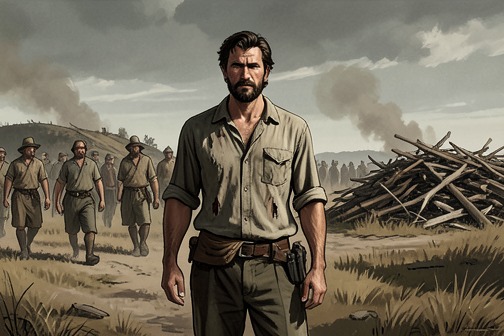
[The cholera epidemic in the Cuffe Parade slum](entity:event-recall-event-cuffe-parade-0ffc2fd936d6) turns an ongoing crisis of poverty and limited medical access into a rapidly escalating emergency. Its course is marked both by the growing number of cases and by the community’s efforts to respond, while the later grief of residents shows that the epidemic’s consequences endured beyond its first wave.
## Setting and Conditions
[Cuffe Parade](entity:location-recall-location-27672e2a8588)’s slum stood beside the World Trade Centre, but the neighboring plots offered sharply unequal conditions. The Trade Centre had electric light, shops, and fountains; the slum covered ten acres and held seven thousand huts housing about twenty-five thousand people, without electricity, running water, or toilets. Its residents also lacked security that the authorities would allow the settlement to remain. These conditions form the setting for the outbreak, though the narrative does not reduce its causes to any single feature of the slum.
Access to treatment was already difficult before the epidemic’s scale became clear. [Lin](entity:character-recall-character-lin-428ebd96b429)’s small clinic saw about fifty patients a day, while [St. George Hospital](entity:location-recall-location-st-george-hospital-c5c5fe31c0bb) handled six hundred and sometimes as many as a thousand. Lin sent people with illnesses he could not identify to its diagnostic clinic, but many returned without seeing a doctor or nurse. Hospital staff told him they were overwhelmed and suggested referrals from licensed practitioners so that patients could move ahead in the queue; residents were too poor to pay for the doctor’s visit needed to obtain those referrals.
## The Outbreak and Its Escalation
The outbreak worsened within days. By nightfall there were ten serious cases and another dozen possible cases. By the following dawn, sixty people had advanced cholera and as many as a hundred showed symptoms. At noon, the first victim died: [Radha](entity:character-recall-character-radha-54371c819881), Lin’s next-door neighbour. The compressed progression from initial cases to death gives the epidemic its immediate urgency.
A [Bombay Municipal Corporation Department of Health](entity:organization-recall-organization-bombay-municipal-b7bc55b01db2) official, Sandeep Jyoti, examined the slum alongside [Doctor Hamid](entity:character-recall-character-doctor-hamid-3435ac57c6e5), [Qasim Ali Hussein](entity:character-recall-character-qasim-ali-hussein-e223a2b66e5b), [Prabaker](entity:character-recall-character-prabaker-f1cb57f00b87), and Lin. His assistant collected blood, sputum, and stool samples in a metal case for analysis. Jyoti reported twelve other cholera outbreaks between the slum and Kandivli, and described a more severe outbreak in Thane, where more than a hundred new cases were appearing each day. Local hospitals were overcrowded, and the official characterized the pattern as a difficult but not unusual monsoon situation, with authorities hoping to keep the number of infection sites to fifteen or twenty.
## Response and Medical Limits
After hearing the official’s account, Lin broke the silence among the men and insisted that residents had to be taken to hospital. The account establishes the urgency of that demand, but does not report whether the proposed transfers succeeded. The outbreak response thus unfolds under two related constraints: the speed with which cases multiplied and the limited capacity of hospitals already serving a much wider population.
The clinic’s role had been shaped by the same shortage of accessible care. Lin could recognize that patients were genuinely ill, but he had to refer cases he could not diagnose, and those referrals did not guarantee treatment. The epidemic made that gap harder to ignore: the community’s immediate need for hospital care collided with crowded institutions and the cost of obtaining the formal referrals that might improve access.
## Death and Aftermath
The epidemic’s losses remained part of ordinary community life after the acute crisis. Months later, Lin saw [Jeetendra](entity:character-recall-character-jeetendra-81b0506b001d) supervising construction of a wedding stage. Jeetendra had begun to recover from the grief that followed his wife’s death in the cholera epidemic, but his son Satish still carried a visible sense of loss. Lin discreetly gave Satish a hundred-rupee note; as the boy returned to cutting coconut-fibre rope for the stage, his expression became numb, a response Lin recognized from his own experience of grief.
Later, at a gathering with Qasim Ali Hussein, Jeetendra, [Anand Rao](entity:character-recall-character-anand-rao-57f28ed0738c), and other neighbours, the conversation moved among communal conflict, the construction of the twin towers, and the upcoming weddings of Prabaker and [Johnny Cigar](entity:character-recall-character-johnny-cigar-abaa784fef8e). The meeting was genial, but the memory of the epidemic persisted in the people who had lost family members. The contrast between wedding preparations and Satish’s continuing sorrow presents recovery not as the erasure of loss, but as communal life continuing alongside it.
Event 53
Vikram and Lettie’s wedding

[Vikram and Lettie’s wedding](entity:event-recall-event-vikram-and-lettie-s-wed-de6ad3db602d) is a deliberately small registry-office ceremony that sets the couple’s choice against the elaborate Hindu wedding [Vikram](entity:character-recall-character-vikram-9e00afad97ee)’s family had planned. The ceremony lasts only minutes, but its aftermath gives Vikram an occasion to speak frankly to [Lin](entity:character-recall-character-lin-428ebd96b429) about commitment, trust, and his concern for Lin’s future with [Karla](entity:character-recall-character-karla-3f7aa8a8ae5c).
## A choice against family expectations
Vikram marries [Lettie](entity:character-recall-character-lettie-f339e1d1927e) despite passionate, at times violent, opposition from his family. Rather than accept the traditional wedding they had planned, he insists on a registry-office ceremony, explaining his decision with the phrase, “This is the modern [India](entity:location-recall-location-india-39df7eae59c1), yaar.” The choice makes the wedding a public rejection of his family’s expectations, not simply a smaller version of the celebration they wanted.
Only Vikram’s mother and sister can bring themselves to attend from his family. They join Lettie’s friends as the couple promise to love and honour one another for the rest of their lives. The ceremony has no music, colour, or dancing. Lettie wears a burnt-gold suit and a broad gold straw hat decorated with organdie roses; Vikram wears a three-quarter-length black coat, a black-and-white brocade vest, black gaucho pants with silver piping, and his beloved hat. When the ceremony ends, Lin and Vikram half-carry Vikram’s grief-stricken mother to her waiting car. The smallness of the event does not lessen its cost to her: the family’s anguish remains present even as the newlyweds make their own choice.
## Departure and the conversation with Lin
The day after the wedding, Lin drives Vikram and Lettie to the airport. The couple intend to repeat the ceremony in London with Lettie’s family. As Lettie calls her mother to confirm their arrival time, Vikram uses the opportunity to thank Lin for helping with his passport and obtaining a favourable exchange rate for their dollars. The exchange connects the intimate wedding to the practical assistance Lin has given his friend, while Vikram promises to return the favour when they come back.
Vikram then turns from thanks to warning. He tells Lin that he should settle down and says he fears Lin is heading for a serious fall. Lin laughs, but Vikram maintains his serious expression: he believes a man should find a good woman, win her love, earn her respect, and cherish her trust throughout their lives. He applies that conviction directly to [Lin and Karla](entity:relation-recall-relation-lin-and-karla-9a163b3f3796). Vikram says Karla respects Lin for his work during the cholera crisis in the slum, but argues that Lin has not trusted her because he does not trust himself. His advice makes the wedding more than a contrast in ceremony: Vikram treats his own marriage as a point from which to urge Lin toward the commitment he believes Lin is avoiding.
## Significance
The episode places two kinds of consequence beside one another. Vikram’s decision grants him and Lettie the wedding they choose, while leaving his mother visibly distressed by the rejection of the family’s plans. In the airport conversation, Vikram presents lasting love not as a single declaration but as continuing work: earning respect and keeping trust over a lifetime. His warning about Karla gives that ideal a personal edge, identifying Lin’s mistrust of himself as an obstacle to the relationship. The wedding therefore frames a difference between choosing a shared life and merely recognizing that love is possible.
Event 54
Abdullah Taheri’s killing
[Abdullah Taheri’s killing](entity:event-recall-event-abdullah-taheri-s-killi-be26e7e6ba47) is a fatal police ambush near [Crawford Market](entity:location-recall-location-989f9f906516), set in motion by the authorities’ belief that he is the criminal known as [Sapna](entity:character-recall-character-sapna-3597df1d97c4). The account reaches [Lin](entity:character-recall-character-lin-428ebd96b429) through [Didier Levy](entity:character-recall-character-didier-levy-bc900419ef54), who has heard police describe the encounter; its chain of transmission leaves the officers’ version distinct from directly witnessed fact. The crowd’s refusal to let the police remove Abdullah’s body turns the killing into a wider public confrontation, and the loss of a trusted ally gives the event particular force in Lin’s story.
## Background and identification
Abdullah is already established as a consequential figure in [Bombay](entity:location-recall-location-bombay-b9f73c3bdba6)’s criminal world, not simply as Lin’s companion. [Abdel Khader Khan](entity:character-recall-character-abdel-khader-khan-822d0cbbc88e) is one of the founders of the mafia council system, which divides the city into territories governed by separate dons and has brought relative order after years of bloody power struggles. Abdullah is entrusted with enforcing Khader’s control. His team includes Indian enforcers and Iranian veterans, and the network’s disciplinary role is backed by Khader’s promise of swift violence against those who rob his men or withhold money. That position places Abdullah inside an organized structure whose authority depends on both coordination and force.
His connection to Khader also reaches beyond enforcement. When Lin visits [Doctor Hamid](entity:character-recall-character-doctor-hamid-3435ac57c6e5), Abdullah explains that Khader once financed the education of gifted children from Bombay’s slums. Hamid was among those selected more than twenty years earlier, and Khader is now drawing on the network of professionals that grew from that support to help Lin’s clinic. Abdullah presents Khader as someone who plans for the future and makes those plans real. The episode helps establish Abdullah as a close interpreter of Khader’s methods and ambitions, as well as a figure through whom Lin encounters the organization’s influence on civic life.
The immediate cause of the killing is a mistaken identification. [Kavita](entity:character-recall-character-kavita-993549a96176) warns Lin that police believe Abdullah is Sapna and have placed him on a hit list. According to the information she has obtained from a crime reporter at the Times, officers are supposed to take him alive if possible, but are ordered not to take chances: if he hesitates during an attempted arrest, they are to shoot. The distinction between arrest and lethal force is therefore already fragile before Lin learns where the police have found him.
## The ambush
Lin and [Lisa](entity:character-recall-character-lisa-f8f8fe21b70f) go to [Leopold’s](entity:location-recall-location-leopold-s-1d82f936fa9e), reasoning that Abdullah might be there or might have left a message. Instead, they find [Didier](entity:character-recall-character-didier-381547eab195) drinking. He tells them that Abdullah has been shot dead almost an hour earlier, and that mosques in [Dongri](entity:location-recall-location-122b135e641c) are calling prayers for the dead. Lin demands to know how Didier learned this and where the encounter happened. Didier first speaks through grief and shock, then becomes lucid enough to explain that police officers had been at the bar and were boasting about the operation to Mehmet, one of its owners.
As Didier recounts the officers’ version, Abdullah was surrounded in a small street near Crawford Market and called on to surrender. The police said he stood still, then drew two guns from his jacket and fired; the officers returned fire, killing him. These details are presented as what the officers told Mehmet, not as an encounter Lin witnessed. The account therefore carries an unresolved distance: the reader learns what the police claimed, while the prior warning that they were prepared to shoot Abdullah makes their description of the confrontation consequential without independently confirming it.
## The crowd and the body
The police account did not end with Abdullah’s death. Didier says that a large, angry crowd gathered. When officers tried to take the body to a hospital in a police van, people attacked the vehicle and forced it off the road. The police then took the body to the Crawford Market police station, with the crowd following and shouting abuse. The effort to transfer Abdullah into police custody thus becomes a public struggle over who controls the aftermath of the killing. The crowd’s actions do not reverse the death, but they prevent the police from managing it quietly or immediately removing the body from view.
The immediate news also lands in a small, intimate scene of grief. Lisa begins to cry and sits beside Didier; he puts an arm around her and rocks, absorbed in shock. Lin, meanwhile, grabs Didier by the shirt and presses him for details. His urgency is directed at reconstructing what happened, while Didier’s response shows how the news has overwhelmed him. The contrast makes the killing’s consequences visible in the reactions of those who knew Abdullah, rather than only in the police operation or the crowd’s resistance.
## Consequences and narrative significance
The event confirms that the police have acted on the belief that Abdullah is Sapna, but the supplied account does not establish that identification as true. That uncertainty matters: Abdullah is killed under orders shaped by suspicion, and the story’s description of his final encounter is filtered through officers who, Didier says, were boasting about it. The narrative gives the reader a report with specific details but also makes its source and limitations plain.
Abdullah’s death also changes the human scale of the city’s criminal order. Earlier, he had acted as a guide between Lin and Khader’s world, helping Lin understand how power could be organized and how Khader’s influence could be used to support people such as Hamid. Now the police hit list and the fatal encounter expose the vulnerability beneath that influence. The crowd’s attempt to keep the body from being taken away extends the loss into the streets, while Lin and Lisa’s visit to Leopold’s brings it directly into their circle. The episode is therefore both a death and a rupture in the network of loyalty, information, and protection that had connected Abdullah to Lin and to Bombay’s underworld.
Event 55
Crawford Market riot
The [Crawford Market riot](entity:event-recall-event-crawford-market-riot-2f27e5df6c6f) turns the search for Abdullah’s body into a confrontation between grieving crowds, the police, and the neglected poor. [Lin](entity:character-recall-character-lin-428ebd96b429) reaches the market area expecting to find Abdullah at the police station, but encounters a crowd whose anger has spread well beyond mourning. He is drawn into the disorder, and [Khaled Ansari](entity:character-recall-character-khaled-ansari-579dc41e3899) gets him out. At the station, they learn that the crowd has taken the body and freed the prisoners; its whereabouts remain unknown.
## Background and escalation
The riot follows the police’s attempt to take Abdullah’s body to a hospital in a van. The crowd attacks the vehicle and forces it off the road, after which the police take the body to the [Crawford Market](entity:location-recall-location-989f9f906516) police station. People follow, shouting at the police. By the time [Didier](entity:character-recall-character-didier-381547eab195) tells Lin what has happened, the crowd is still gathered there, and Lin decides he must go to the station and see Abdullah for himself. His hope that Abdullah might still be alive persists despite the report that the body has been taken there.
The gathering is not simply a funeral crowd. As Lin makes his way toward the station, he recognizes that many of those present are Muslim, but the slogans and chants he can make out point to a broader outpouring of discontent. Abdullah’s death has become a focus for grievances among poor people in the market area. Different men shout for different causes, and prayers sound from several places. The scene gives the riot a wider social dimension without suggesting that the crowd acts as a single, coordinated body: its complaints are diverse, and Lin experiences its movement as confused and difficult to navigate.
## Lin enters the crowd
Lin abandons his bike near the market police station because the road is blocked by people. On foot, he is swept into the crowd, where progress toward the building requires pushing through waves of people moving in different directions. The police form a barrier across the station, standing several rows deep in helmets and carrying shields. The crush makes Lin vulnerable to being pushed or knocked down, and he has to keep struggling forward to remain on his feet.
A man grabs Lin’s shirt and attacks him. Lin cannot tell why the man has chosen him, and the attack becomes part of the surrounding disorder rather than a personal dispute he can understand. Lin fights back and draws the attention of others; more men join in, and he is surrounded. His own account makes clear that he is not acting from a plan to confront the police or lead the crowd. He is trying to reach the station, then caught in a street fight whose momentum threatens to overwhelm him. The crowd’s attention to the clash briefly holds others back, but Lin knows he cannot keep fighting indefinitely.
## Khaled’s intervention
A group of eight or ten men breaks through the surrounding crowd, and Lin finds himself face to face with Khaled Ansari. Running on instinct, Lin nearly strikes him before recognizing him. Khaled signals him to stop, and his men force a path back through the crowd. When Lin turns toward the attackers again, Khaled and two companions restrain him and pull him away from the confrontation.
Khaled’s intervention changes the immediate stakes: Lin is no longer isolated in the crowd, but he has still not found Abdullah. At the bike, Khaled tells him that Abdullah’s body is not at the station. He explains that the crowd had stormed the building before they arrived. After the police drove the crowd out, people went to the cell where the body had been placed, found it empty, released the prisoners, and took Abdullah’s body with them. The riot therefore ends Lin’s immediate hope of seeing Abdullah there without resolving what has happened to the body.
## Aftermath and significance
Lin has been struck during the struggle, but he registers little of that in the moment. His attention remains fixed on Abdullah and on the pain of believing him dead. Khaled wipes Lin’s face and offers a calm assurance that they will make inquiries and find both Abdullah and his body. The reassurance provides a next step, not a resolution: the crowd has removed the body, and its destination is unknown.
The riot links personal bereavement with public unrest. The attempted transfer of a body, the crowd’s confrontation with police, and the release of prisoners become part of one fast-moving sequence, while the shouted complaints reveal grievances extending beyond Abdullah’s death. Lin’s experience also gives the episode its narrow, urgent viewpoint: the wider disorder is visible, but the central question for him remains whether he can reach Abdullah. Instead, he is pulled out of the crowd and left with an absence that neither the police nor Khaled can immediately explain.
Event 56
Prabaker’s fatal taxi accident
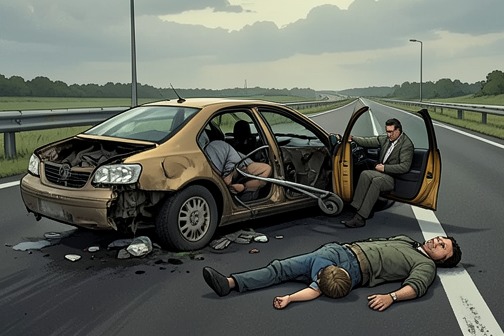
[Prabaker’s fatal taxi accident](entity:event-recall-event-prabaker-s-fatal-taxi-a-b7ffcb5d7647) is the sudden catastrophe that ends his life and transforms [Lin](entity:character-recall-character-lin-428ebd96b429)’s informal work as a caregiver into an encounter with the limits of care. A late-night fare brings [Prabaker’s taxi](entity:object-recall-object-prabaker-37994629f037) into the path of a runaway handcart carrying steel; he survives the collision but is not expected to recover. The account moves from the ordinary choice to keep working to the prolonged vigil at his bedside, where Lin’s love for his friend becomes inseparable from the painful recognition that he cannot save him.
## Causes and Circumstances
The accident occurs after [Prabaker](entity:character-recall-character-prabaker-f1cb57f00b87) accepts what is described as the last fare of the night, despite having earned well the previous day. At about three in the morning, he is driving a man and his daughter toward the airport. On the highway, a handcart loaded with steel loses control on a hill and rolls backward into the taxi. The cart’s operators have taken a forbidden shortcut to avoid pushing their heavy load farther. Their attempt to save time places the cart in the path of Prabaker’s car, turning a familiar nighttime journey into a fatal collision.
The passengers are killed, while Prabaker is left critically injured. He remains trapped in the taxi for two hours before being taken to [St. George Hospital](entity:location-recall-location-st-george-hospital-c5c5fe31c0bb). The contrast between the mundane circumstances of the trip and its irreversible consequences gives the accident its particular force: Prabaker has not set out on an exceptional or dangerous undertaking, but on one more piece of work in the routine of earning a living. [Johnny Cigar](entity:character-recall-character-johnny-cigar-abaa784fef8e)’s account also emphasizes that the fare was not necessary to Prabaker’s immediate livelihood; he had made enough the day before. That detail makes the decision painfully contingent without suggesting that the accident could have been foreseen.
## The News and the Hospital Vigil
Lin learns what has happened from Johnny Cigar, who has come to find him after leaving the hospital. Johnny has waited nearly an hour, believing Lin already knows. The confusion between them delays the revelation by only moments, but those moments make the news arrive as a rupture: Lin initially cannot understand what Johnny means by the accident, and only the mention of St. George Hospital establishes its gravity. Johnny, who has already seen Prabaker, struggles to speak and breaks down as he explains that the doctors expect his friend to die.
At the hospital, Lin finds Prabaker unconscious, with his parents, [Kishan](entity:character-recall-character-kishan-93b761db3b7c) and [Rukhmabai](entity:character-recall-character-rukhmabai-7dbf6fc39897), beside him. [Parvati](entity:character-recall-character-parvati-4a5485bca332), [Sita](entity:character-recall-character-sita-1913dd4978f6), [Jeetendra](entity:character-recall-character-jeetendra-81b0506b001d), and [Qasim Ali](entity:character-recall-character-qasim-ali-1195f20a5d70) stand nearby. The group’s presence makes the bedside a shared vigil rather than a private farewell: family and friends remain together while the machines monitor Prabaker’s condition. Lin seeks the doctor responsible for his care and offers a bundle of American hundred-dollar bills, asking that further expenses be sent to him. The doctor refuses the money because there is no hope of recovery. Lin gives it instead to Parvati, along with everything he has earned on his latest courier run. Money cannot change the prognosis, but he can still direct what he has toward the family.
## Care and Its Limits
The tragedy is sharpened by Lin’s earlier role in the slum. He has first-aid training from a course taken as a teenager, and his later use of CPR to revive people overdosing on drugs earned him the nickname Doc. Friends in [New Zealand](entity:location-recall-location-new-zealand-a25d5a689a9c) gave him a first-aid kit before he left; in the slum, residents come to know him as an unofficial healer. He understands these strands of his life as connected to the work that brought him there, even though he cannot explain their purpose.
That history does not make him a doctor capable of controlling what happens at the hospital. When introduced to [Doctor Hamid](entity:character-recall-character-doctor-hamid-3435ac57c6e5) as the doctor in the [Colaba](entity:location-recall-location-colaba-2bd495476f0e) hutments, Lin protests that he is not a doctor and has only been drawn into helping. He describes himself as unable to diagnose many of the illnesses brought to him and explains that patients sent to St. George Hospital often return without having received care. During the cholera emergency, Doctor Hamid can offer trained volunteers but acknowledges the community’s existing efforts and encourages them to continue. These earlier encounters establish a pattern of practical, limited care: Lin acts because someone must, while recognizing that his skills and the available institutions cannot meet every need. At Prabaker’s bedside, the limit becomes absolute. Lin can offer money and stay with his friend, but neither his training nor his willingness can prevent the death.
## Death and Aftermath
Lin and the others remain at the hospital for four days and nights as Prabaker suffers. The period of waiting extends the event beyond the collision itself. The initial expectation of death becomes an accepted fact, but acceptance does not make watching easier. Lin eventually finds himself hoping that Prabaker will die, not from a withdrawal of love but because he cannot bear to see his friend continue to suffer. In a cleaner’s room, he kneels beside a concrete trough and prays for that end; afterward, Prabaker dies. The wish and the death occupy the same painful sequence, leaving Lin to confront how love can demand the release of the person it wants to keep.
Afterward, Rukhmabai sits apart in the doorway of the hut she once shared with Prabaker and cuts off her long hair. Her act gives the loss a visible consequence in the domestic space, while the gathered friends’ vigil has already shown how widely Prabaker’s life was joined to others. Lin’s grief continues beyond the immediate aftermath. He remembers Prabaker not only as the friend he lost but as someone whose love remains present and painful after death. The accident therefore ends with no recovery or reversal: its consequence is a lasting absence, and Lin’s caregiving role cannot protect him from becoming one of the bereaved.
Event 57
Lin’s heroin relapse
[Lin’s heroin relapse](entity:event-recall-event-lin-s-heroin-relapse-acd485703773) follows a moment in which loss seems to have made any future feel unreachable. Faced with a woman who intends to stay and build a life on her own terms, he leaves rather than accept the possibility of a life together. His return to heroin is both an act of retreat and an attempt to silence grief that has accumulated through prison, bereavement, and the disappearance of the people who had given his life meaning.
## The choice to withdraw
The decision comes after [Lin](entity:character-recall-character-lin-428ebd96b429) remembers the stormy night when he and [Karla](entity:character-recall-character-karla-3f7aa8a8ae5c) were together, then measures that memory against everything lost since. Prison and torture, Karla and [Ulla](entity:character-recall-character-ulla-87a1fc56dfd8)’s departures, the disappearance of [Abdel Khader Khan](entity:character-recall-character-abdel-khader-khan-822d0cbbc88e) and his council, and the deaths of [Anand](entity:character-recall-character-anand-89b268e39901), [Maurizio](entity:character-recall-character-maurizio-9cd3f527287c), [Rasheed](entity:character-recall-character-rasheed-eed8024ea304), Abdullah, and [Prabaker](entity:character-recall-character-prabaker-f1cb57f00b87) crowd into the same reckoning. Lin feels alive in outward appearance but dead inside. The contrast is central to the relapse: his return to heroin does not follow a single loss, but a sense that the whole world of relationships and purpose has collapsed.
The woman asks what he will do if she stays. Lin holds her, kisses her, and briefly imagines the life they might have shared, extending from love and growing old to death. When the kiss ends, that possible future recedes. He recognizes that he might have loved her, perhaps already does to some degree, but remains in love with Karla. Instead of committing himself to the life the kiss evokes, he says he will get stoned. The decision turns an intimate encounter into a parting: tenderness is present, but it cannot displace his attachment to Karla or his impulse to escape feeling.
## Preparation and return to the den
Lin leaves without looking back. His actions are deliberate rather than impulsive in every respect: he pays three months’ rent on his apartment, gives substantial baksheesh to the two watchmen, keeps one forged passport with him, and entrusts his spare passports, cash, and Enfield Bullet bike to [Didier](entity:character-recall-character-didier-381547eab195). These arrangements preserve practical options even as he chooses a course that abandons his immediate life. He then takes a cab to Gupta-ji’s opium den on Shoklaji Street and enters one of its private rooms.
The room is close to the roof and furnished simply, with a cot, a small cabinet, a lamp, water, and reed-mat walls. Its enclosed, makeshift character recalls a prison cell to Lin. There, alone, he cries for Abdullah and Prabaker. Earlier grief had surfaced at several points in [Bombay](entity:location-recall-location-bombay-b9f73c3bdba6), including after he met the lepers, after a stranger washed his tortured body in [Arthur Road Prison](entity:location-recall-location-arthur-road-prison-50f3a84a4e65), and beside Prabaker’s father at the hospital. Each time, however, he had contained it. In the room above the den, mourning is no longer interrupted by other people, and the sorrow he had kept back comes through.
## The dose and its immediate effect
Gupta-ji brings the requested heroin and supplies, along with cigarettes, and introduces Shilpa, a young woman assigned to serve Lin. Lin sends them both away. The prepared dose remains unused for almost an hour. Five times he brings the needle to a vein and puts it down again. The delay makes the relapse a conscious threshold: he knows the drug has been bound up with criminal acts, imprisonment, the loss of his family, and the loss of loved ones, yet he also desires the emotional blankness it can provide.
At last Lin injects the dose. He describes its immediate effect as the silencing of thought and the dulling of ordinary discomfort. The relief is not a repair of what has happened; it is an interval in which he feels nothing. The drug’s appeal lies precisely in that vacancy, even as Lin understands that it has taken much from him and offers no lasting answer. His hesitation therefore does not resolve the conflict between knowledge and desire. It makes the choice visible before he crosses it.
## Grief returns as guilt and uncertainty
Lin cannot later say whether a week or a month has passed since that first dose. In the period that follows, he returns to the image of the rafters above his room, reading them as a sign that his life, Karla’s, Abdullah’s, and Abdel Khader Khan’s had intersected in a profound way. The image offers a possible pattern in the connections surrounding Abdullah’s death, but Lin closes his eyes rather than pursue what it might mean. The episode leaves the question open instead of turning his suffering into a solved mystery.
His thoughts then fix on Prabaker. Lin remembers that Prabaker was working late on the night he died because the taxi Lin had bought for him allowed him to work for himself. Lin blames himself, imagining that Prabaker would still be alive had he not bought the taxi. He also recalls Abdullah’s death and regrets not being with him in his final moments. The guilt is joined by a more troubling uncertainty: Lin wonders whether Abdullah could have been [Sapna](entity:character-recall-character-sapna-3597df1d97c4), the ruthless killer associated with the mutilation of Madjid. He cannot reconcile the possibility with his love for his friend, yet neither can he dismiss the fear. The relapse thus marks no clean passage from grief to numbness. Even under the drug’s influence, loss returns as self-accusation, unanswered questions, and love that survives suspicion.
Event 58
Karla and Nazeer rescue Lin from the opium den
[Karla and Nazeer rescue Lin from the opium den](entity:event-recall-event-karla-and-nazeer-rescue-68fc888b9ebc) in a violent intervention that interrupts three months of heroin use and isolation. [Lin](entity:character-recall-character-lin-428ebd96b429) is too weakened to free himself, and his first sight of [Karla](entity:character-recall-character-karla-3f7aa8a8ae5c) after [Nazeer](entity:character-recall-character-nazeer-70724b855ba6) carries him out brings rescue together with the painful recognition of what his dependence has done to him.
## The Rescue from Gupta-ji’s Room
Nazeer wakes Lin by hauling him off the bed and ordering him to come. Lin has spent three months in a room at Gupta-ji’s, taking heroin every day, eating only every other day, and walking no farther than the toilet. He has lost twelve kilos, including much of his muscle, and remains so drugged that he cannot properly judge his own weakness. The room has reduced his world to the bed, the drug, and the short path between them; Nazeer’s arrival abruptly forces that closed routine to end.
Lin pretends to cooperate, asking to collect his wallet, watch, and passport from a little table. Gupta-ji and Shilpa wait in the corridor. Once Lin has gathered his belongings, he turns and tries to strike Nazeer, but the punch misses completely. Nazeer hits him below the heart, then grips his hair and lands a second blow to the jaw. Lin is knocked unconscious. His attempt to recover control only exposes how far his body has deteriorated: the strength he remembers having is no longer available to him.
## Karla’s Presence and [Abdel Khader Khan](entity:character-recall-character-abdel-khader-khan-822d0cbbc88e)’s Intervention
When Lin comes round, the bed that had held him for three months is no longer the same raft-like surface: he is lying in a taxi with his head in Karla’s lap. Her familiar Coco perfume makes him recognize her before he fully understands where he is. He reads compassion and concern in her green eyes, but also believes he sees disgust at his weakness, his heroin use, and the neglect that has overtaken him. The distinction matters: rescue does not erase the damage or make Lin feel worthy of being rescued. Karla touches his face, and her caress registers to him like tears.
At the house where Nazeer carries him inside, the setting sharply contrasts with the room he has left: a large modern kitchen opens onto an expansive living room, whose glass wall looks out toward a golden beach and a dark sea. Nazeer lowers Lin onto cushions with unexpected gentleness. Lin is still heavily drugged from the large dose he injected just before being taken from Gupta-ji’s, and the wish to close his eyes remains powerful. Karla kneels beside him, washes his face with a wet towel, and tells him not to try to stand. Even his attempt to laugh exposes the soreness in his jaw and chin.
After three months of near silence, Lin’s speech comes out cracked and halting; he asks Karla what is happening and how she found him. She explains that Abdel Khader Khan found him and asked her to bring him there. Her presence is therefore not accidental: Abdel Khader Khan has located Lin, and Karla has acted on his request. The revelation reframes the rescue as an intervention organized through Lin’s relationships, arriving when his drugged isolation has left him unable to rescue himself. Her answer also meets his fear of abandonment directly: she makes clear that she would not have left him in that room.
## The Drugged Mind and the First Resistance
Immediately before Nazeer intervenes, Lin is caught in a self-perpetuating search for understanding: he wonders whether Abdel Khader Khan might be [Sapna](entity:character-recall-character-sapna-3597df1d97c4) and whether he can love him despite that fear, then injects heroin again, convinced that more of the drug will supply the answer. The sequence makes the rescue a rupture in more than physical isolation. Lin’s attention has turned inward, toward a certainty he expects another dose to disclose, while his condition leaves him unable to act on what is happening around him.
His first response to Nazeer is not recognition or gratitude but hostility. He wakes to a deeply lined, scowling face speaking a language he cannot understand; when Nazeer insists in English that he come, Lin answers with a deliberate insult. The exchange shows how little conscious cooperation the rescue initially receives. Lin’s defiance is followed by an attempted punch, but the gap between the force he expects to have and the body he actually commands makes the resistance collapse. Only after he has been carried away does his awareness begin to register Karla’s presence and the circumstances of his removal.
## A Rescue Before Recovery
The intervention changes Lin’s immediate circumstances without pretending that the change is already a cure. He arrives at the house still groggy from the dose he took before Nazeer removed him, and the pull toward unconsciousness remains strong. Physical removal has ended the room’s closed routine, but Lin has not yet regained command of himself; for the moment, other people must carry, steady, and care for him.
That imbalance gives the rescue its force. Nazeer’s strength gets Lin out, while Karla’s practical tenderness meets him once he is there: she washes his face and stays beside him as his speech falters. Lin can interpret her eyes only through his own shame, reading disgust alongside compassion, but her actions establish care even as he doubts his worthiness of it. The scene’s turn is therefore not a completed recovery, but an interruption of solitary self-destruction: Lin is brought back within reach of other people before he can understand what that help means.
Event 59
Lin’s heroin withdrawal and recovery
[Lin’s heroin withdrawal and recovery](entity:event-recall-event-lin-s-heroin-withdrawal-14ce9b1b1092) turns abstinence into a test of endurance sustained by both personal resolve and another person’s care. After [Karla](entity:character-recall-character-karla-3f7aa8a8ae5c) leaves, [Lin](entity:character-recall-character-lin-428ebd96b429) faces the withdrawal at a house by the sea, with [Nazeer](entity:character-recall-character-nazeer-70724b855ba6) keeping watch and [Abdel Khader Khan](entity:character-recall-character-abdel-khader-khan-822d0cbbc88e) returning to see him. The first days bring him close to abandoning the effort; instead, he accepts help, passes through the worst of the symptoms, and begins rebuilding his strength. Recovery here is neither immediate nor solitary: it proceeds through days of distress, practical care, and a gradual return to purposeful activity.
## Commitment and the First Days
Before leaving, Karla tells Lin that she has promised Abdel Khader Khan he will complete withdrawal at the house and still be there when she returns in a couple of months. Abdel Khader Khan doubts Lin can endure it, predicting that he will leave to obtain heroin as soon as the withdrawal begins. Karla stakes a thousand dollars on Lin making it. The bet makes Lin’s recovery a matter of confidence placed in him by someone who expects him to succeed, even while acknowledging how uncertain that outcome is.
When Lin wakes, he is already unwell, alert, cold, and in need of heroin. Abdel Khader Khan is beside him, while Nazeer remains near the entrance. The scene establishes the close supervision surrounding the attempt: Lin is not left alone with either the withdrawal or the means to act on his craving. Two full days and nights into the ordeal, Lin believes he will not make it. The early digestive symptoms have eased, but pain and anxiety are intensifying. The possibility of ending the distress by obtaining heroin becomes an insistent temptation, and his confidence in continuing gives way to immediate fear of failure.
## Nazeer’s Care and Lin’s Decision
At that crisis point, Lin takes steps to prevent himself from leaving. He moves Nazeer’s cot toward the window, tears a sheet into strips, and uses them to secure his ankles and one wrist to a bed. He then asks Nazeer, without speaking, to bind his other wrist. The request is a deliberate act of self-protection: Lin recognizes that his resolve alone may not hold, and makes Nazeer part of the barrier between craving and relapse.
Nazeer understands the request and binds Lin to the bed. For two days and nights he stays close, tending to him steadily. He offers physical comfort, watches for moments when Lin needs the gag removed, and replaces it when Lin signals that he wants to keep his cries from being heard. The care is disciplined but responsive; Nazeer does not simply leave Lin restrained, but attends to changing needs and remains present through the worst of the crisis. Lin’s survival of this period depends on that constancy as well as on the choice he made to ask for help.
When Lin signals that he is ready, Nazeer removes the gag and releases the ties one at a time. He gives Lin a mild chicken, barley, and tomato broth, feeding it to him by spoon. The meal marks a small but decisive change in the scene: Lin is no longer only being kept from leaving to seek heroin, but is beginning to accept nourishment and care. Nazeer smiles for the first time, making the transition from emergency supervision to cautious recovery visible without suggesting that the ordeal is over.
## The Course of Withdrawal
Lin describes withdrawal as lasting about two weeks, with the first five days the most difficult. Getting through those five days, and reaching the sixth morning without drugs, gives him a stronger sense that he is clean and can continue. The next eight to ten days bring gradual improvement rather than a sudden release: cramps lessen, nausea passes, and fever and chills subside. Sleep remains difficult, so recovery continues to demand endurance after the most acute symptoms have eased.
During the long nights when he cannot sleep, Lin stays standing until exhaustion makes him collapse into sleep. He likens himself during this period to the [Standing Babas](entity:character-recall-character-standing-babas-d0026063fa2f), the ascetics known for remaining on their feet. The comparison gives the physical strain a recurring image of stubborn persistence, but it also emphasizes how little comfort recovery offers at first. Eventually the withdrawal passes. Lin emerges dazed and wounded by the experience, yet glad to be alive; the ending is survival, not a claim that the process has left him untouched.
## Recovery and Rebuilding
By the sixth day, Lin is walking with Nazeer for exercise and fresh air. At first the walks are slow and short, and he returns after fifteen minutes. By the twelfth day, when his first sarcastic jokes prompt Nazeer to begin training him, Lin can walk the length of the beach. The change is measured through modest signs—walking farther, joking again, and accepting a new routine—rather than through a single dramatic declaration of recovery.
The training develops into a sustained daily regimen. Lin builds up to twenty sets of thirty push-ups, with a minute’s rest between sets, followed by five hundred sit-ups, a five-kilometre run, and a forty-minute swim in the sea. After almost three months, he is fit and strong. The routine extends recovery beyond the immediate task of staying away from heroin: it gives his days structure and makes physical strength something he can rebuild through repeated effort. The sequence from restraint to walking to demanding exercise shows recovery as a process with stages, each dependent on the one before it.
The episode also changes the meaning of Nazeer’s role. His steady presence during withdrawal becomes the basis for a closer relationship, and his later decision to train Lin follows the trust formed in the crisis. Lin’s recovery is therefore both an individual achievement and a shared undertaking: he chooses to endure, while Nazeer helps make endurance possible. Karla’s wager supplies an earlier act of faith, but the immediate work belongs to Lin and the companion who stays beside him.
Event 60
Khader Khan’s Afghanistan supply mission
[Abdel Khader Khan](entity:character-recall-character-abdel-khader-khan-822d0cbbc88e)’s [Afghanistan](entity:location-recall-location-afghanistan-ea09a8d619a6) supply mission is the expedition that draws [Lin](entity:character-recall-character-lin-428ebd96b429) from [Bombay](entity:location-recall-location-bombay-b9f73c3bdba6) into a war zone, carrying illicit supplies toward fighters besieging [Kandahar](entity:location-recall-location-kandahar-06ce6574e7a2). Its departure is driven by practical need and careful concealment, but the decision to join becomes intensely personal: Lin accepts the danger for the fatherly love he finds in Abdel Khader Khan, while the revelation of [Madame Zhou](entity:character-recall-character-madame-zhou-d453e8a13327)’s betrayal gives the journey a parallel purpose of revenge.
## The invitation and its risks
Abdel Khader Khan invites Lin while Lin is in the grip of heroin withdrawal. He is shivering, sweating, and struggling to think clearly; the prospect of learning to ride seems only another demand in an hour already difficult to survive. [Nazeer](entity:character-recall-character-nazeer-70724b855ba6) is to teach him, and the reason is logistical rather than recreational: roads to Kandahar are mined and bombed, so the party will have to travel by horse. If Lin goes with Abdel Khader Khan’s men, he must be able to ride.
The invitation is explicitly presented as a choice. Abdel Khader Khan says he will not think less of Lin if he refuses, even as he acknowledges that the work is dangerous. The journey will also take him back to Afghanistan, his home, which he has not seen for more than fifty years. His return gives the expedition a personal dimension of its own, but does not lessen its risks: in Afghanistan, Lin and the others will be moving through a conflict in which foreign assistance to the mujaheddin can make a foreigner a valuable target.
The plan depends on Lin’s particular usefulness. Abdel Khader Khan needs a foreigner willing to break numerous international laws who can pass for an American. Rival clans have fought one another for generations and are accustomed to raiding travelers for plunder. At this moment, however, their shared devotion to Allah and opposition to the Soviet invaders are aligned with the Americans, whose money and weapons support their fight. An apparent American among the travelers may therefore help the group pass without being attacked or stripped of its goods. Abdel Khader Khan says he tried to find an actual American, but none was willing to take the risk. Lin is selected not because he is a trained soldier, but because his foreign identity can serve as cover.
## Supplies, route, and concealment
The cargo is a mixed wartime consignment: guns, explosives, passports, money, gold, machine parts, and medicines. Its intended recipients are a unit of mujaheddin fighters laying siege to Kandahar, where, according to Abdel Khader Khan, they have been fighting the Russians in the same place for two years and urgently need supplies. The mission is therefore both a smuggling operation and an intervention in an ongoing war. Its success depends on carrying useful goods across a dangerous route without provoking the armed groups through whose territory the party must pass.
The departure plan extends that concealment to the travelers themselves. Before leaving Bombay, the group is instructed to behave as unrelated individuals and never acknowledge one another. Abdel Khader Khan arranges a complicated route from Bombay to [Quetta](entity:location-recall-location-quetta-6e45f4d11afe), near the Afghan border, involving four major changes of transport. The compartmentalized travel is intended to protect the organization behind the operation: if any participant is killed or captured, the trail back to Bombay should be cold. The precautions show that the mission is planned around the possibility of failure as well as success.
The first leg takes Lin and Nazeer from Bombay to [Karachi](entity:location-recall-location-karachi-4b33ee0420d8). They travel in silence, following the instruction not to signal their connection, and check into separate rooms at the Chandni Hotel. Only after an hour does Nazeer tap at Lin’s door and slip inside. The quiet, separated journey is not incidental delay; it is the first enactment of the mission’s central discipline, in which personal loyalty must be hidden to preserve the larger operation.
## The departure and its personal stakes
On the night before the journey, Lin and Nazeer watch [Karla](entity:character-recall-character-karla-3f7aa8a8ae5c) leave in a taxi. Her departure sharpens the sense of what the expedition will cost: Lin understands the loss not only as the absence of one person but as the disappearance of a wider world of love, beauty, and possible futures. The image of the future narrowing toward a bullet’s end binds the mission’s physical danger to the emotional losses already gathering around him.
In Karachi, Abdel Khader Khan tells Lin that he can no longer return to his hotel. The police have his description and will continue searching; someone close to the group has betrayed them, and the betrayal has exposed the betrayer. Abdel Khader Khan says the traitor will be punished, but that this must wait until the mission is over. The group must remain in Quetta for a time before making the crossing into Afghanistan. Once there, Lin will have a price on his head because the Russians reward the capture of foreigners helping the mujaheddin, and the group has few allies in [Pakistan](entity:location-recall-location-pakistan-041a2aec3e49).
To reduce the danger of detection, Abdel Khader Khan proposes disguising Lin as a young man from his village, a Pashtun. A cap will cover Lin’s white hair, and a pattu shawl will conceal his broad shoulders and chest; he may be presented as Abdel Khader Khan’s blue-eyed son. The disguise makes visible how completely the mission depends on managing appearances. Lin’s foreignness is valuable when it can pass for American, but dangerous when the enemy recognizes him as a foreigner aiding the resistance.
## Betrayal, love, and the decision to go
During a performance by [The Blind Singers](entity:character-recall-character-the-blind-singers-a1f3a8c03732), Lin reads a letter from [Didier Levy](entity:character-recall-character-didier-levy-bc900419ef54). It identifies Madame Zhou, owner of the Palace, as the woman who informed the police and led to Lin’s imprisonment and beating. The letter does not establish her motive, but Lin connects the betrayal to earlier hostility: he recalls Madame Zhou’s servant [Rajan](entity:character-recall-character-rajan-b88c52c5a766) watching him with hatred when Lin helped Karla escape from the [Taj Mahal Hotel](entity:location-recall-location-taj-mahal-hotel-74a944e98e21) during the flood. Lin concludes that Madame Zhou may have acted because he defied her, impersonated an American consular officer, took [Lisa Carter](entity:character-recall-character-lisa-carter-130e7270024c) from her, or loved Karla.
The discovery changes what the expedition means to Lin. He tears up the letter and puts the fragments in his pocket, then understands that he is going to Abdel Khader Khan’s war because he longs for the man’s fatherly love. Lin recognizes that Abdel Khader Khan is neither a saint nor a hero, and is not literally his father; nevertheless, the tenderness in his gaze answers a father-shaped absence in Lin’s life. With his family, [Prabaker](entity:character-recall-character-prabaker-f1cb57f00b87), Abdullah, and Karla lost to him, that affection has become a reason to risk his life.
Revenge supplies a second motive. Lin resolves to survive the war so that he can find and kill Madame Zhou. The novel places this hatred beside his love for Abdel Khader Khan without presenting either as a simple justification: Lin knows the decision is foolish, yet sees no greater foolishness in surviving only to hate. The mission thus begins not with Lin’s confidence in its cause alone, but with a convergence of loyalty, grief, danger, and vengeance. At the departure point, he is content and unafraid, while the actual crossing and its outcome remain ahead.
Event 61
ISI raid on Khader Khan’s group in Karachi
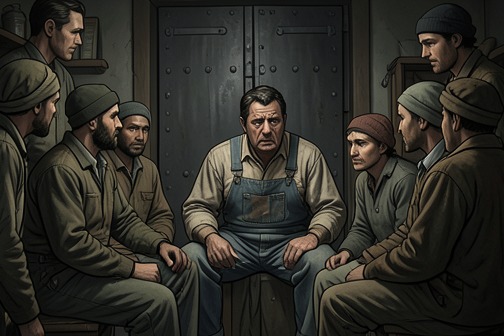
The [Inter-Services Intelligence](entity:organization-recall-organization-inter-services-i-01dba5d23083) raid on [Abdel Khader Khan](entity:character-recall-character-abdel-khader-khan-822d0cbbc88e)’s group in [Karachi](entity:location-recall-location-karachi-4b33ee0420d8) transforms a covert mission into an immediate flight from exposure. The raid is not narrated as an action scene: its force arrives through Khaled’s whispered warning that the political police have struck both [Lin](entity:character-recall-character-lin-428ebd96b429)’s hotel and Abdel Khader Khan’s house. In the aftermath, the group learns that it has been discovered, that an insider may have betrayed its location, and that its work for Afghan resistance fighters has placed it on the wrong side of [Pakistan](entity:location-recall-location-pakistan-041a2aec3e49)’s political calculations.
## The warning in Karachi
The news reaches Lin just after he has watched Khaled pray. When Khaled returns, visibly troubled, the men sit close together as he tells Lin that the police have been at the hotel. His clarification matters: these are not ordinary police officers but the Inter-Services Intelligence, Pakistan’s political intelligence service. Khaled says the authorities want Lin and the others, and that they have also hit Abdel Khader Khan’s house. The group’s presence is no longer concealed.
The raid has already forced the conspirators to measure what could identify them. Lin has kept his passports, money, and knife with him, but his clothes, toiletries, and a few books remain at the hotel. More dangerous than those belongings are the plane and train tickets in his carry bag: as Lin observes, they are the only items left there that he is fairly sure bear a name. The details make exposure concrete. The threat lies not only in the police reaching their rooms, but in the possibility that ordinary travel documents can connect a person to the operation.
## Escape and the suspected leak
[Nazeer](entity:character-recall-character-nazeer-70724b855ba6) gets Lin’s carry bag out of the hotel only a minute before the police rush in. He has time to take that one item, not to clear the room. The hotel manager, who is one of the group’s men, warns Nazeer in time; the warning creates a narrow interval in which a potentially identifying possession can be recovered, but it does not undo the raid or make the hotel safe. The group has escaped a more immediate loss, not the consequences of being found.
Khaled identifies the unanswered question as how the authorities learned where they were. He believes the information must have come from someone on Abdel Khader Khan’s side, someone close to the group. That suspicion turns the raid into an internal crisis as well as an external threat: the men must reckon not only with a powerful intelligence service but with the possibility that their own circle has been penetrated. The evidence establishes Khaled’s suspicion, not the informant’s identity; at this point, betrayal is a troubling inference rather than a solved mystery.
## Why the group has been targeted
Lin cannot initially reconcile the raid with Pakistan’s support for [Afghanistan](entity:location-recall-location-afghanistan-ea09a8d619a6) in the war. From his perspective, the group is smuggling supplies to Afghan fighters, so the Pakistani authorities ought to help them. Khaled’s answer replaces that broad picture with a factional one. Pakistan supports some Afghans, he explains, but not the fighters near [Kandahar](entity:location-recall-location-kandahar-06ce6574e7a2) to whom the group is delivering supplies: they are Massoud’s men.
The political division is sharpened by the dispute over Afghanistan’s future leadership. Khaled says that Massoud’s men will not accept Hekmatyar or other pro-Pakistan resistance leaders, while Pakistan and the Americans have selected Hekmatyar as their preferred future ruler after the war. The opposition is expressed in the fighters’ contempt for Hekmatyar’s name. In this account, support for the Afghan war does not mean support for every Afghan faction; the same supply mission that might appear useful to Pakistan in general becomes dangerous because of its recipients.
## Significance of the raid
The raid reveals how precarious the group’s position is in Karachi. Its members are not simply hidden from an enemy across the front line: they are vulnerable to surveillance and political choices within a country that is itself involved in the Afghan conflict. The hotel and Abdel Khader Khan’s house are struck in the same sweep, indicating that the authorities are pursuing the group rather than reacting to an isolated trace left by Lin.
The episode also changes the meaning of seemingly minor objects and relationships. Lin’s tickets make the bag a link to his identity; the manager’s warning and Nazeer’s quick retrieval make trusted connections essential to avoiding immediate capture. Yet the recovery is incomplete, and Khaled’s suspicion of someone close to the group leaves trust unsettled. The raid therefore marks a shift from covert movement to exposure: the men understand that their mission has attracted state attention, while the factional explanation shows why their Afghan allies have made them targets.
Event 62
Khader Khan’s blood feud and exile
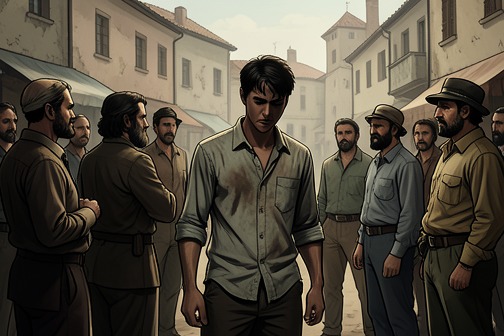
[Khader Khan](entity:character-recall-character-khader-khan-2bf2b74321b0) recounts the origins of his blood feud and exile to [Lin](entity:character-recall-character-lin-428ebd96b429) as a chain of choices that began with an attempt to protect a child and ended in separation from his family. The first killing set in motion years of reciprocal violence; when Khader finally left home and was declared dead, the feud subsided, but his departure became a lasting estrangement rather than a return to peace within his family.
## The First Killing
Khader places the beginning in [Quetta](entity:location-recall-location-quetta-6e45f4d11afe), where he had gone after receiving an education from [Mackenzie Esquire](entity:character-recall-character-mackenzie-esquire-2376064c836f). The day after his teacher left, Khader, then fifteen, killed a man in the bazaar outside his uncle’s warehouse. He describes the confrontation as having no substantial cause at its outset: the man was beating his own child, and Khader intervened because he could not bear to watch. His sense of authority as the son of a village leader and nephew of a prosperous merchant shaped how he acted; he ordered the man to stop, and the rebuke led to an argument and then a fight. Khader says the man tried to use his own dagger against him, and Khader killed him with it. Though the killing was treated as self-defense, it became the first act in a feud whose consequences extended far beyond the bazaar.
The dead man’s family refused the blood-money offered through Khader’s influential uncle. Instead, two men pursued Khader in [Kandahar](entity:location-recall-location-kandahar-06ce6574e7a2). Warned by his uncle, Khader struck first and shot both with his father’s old long rifle. The response turned a single fatal confrontation into a cycle of retaliation: Khader’s first killing had provoked pursuit, and his killing of the two pursuers gave the opposing family further grounds for revenge. In his account, the feud did not arise from a planned contest between families but grew from an intervention, an argument, and reprisals that each made harder to stop.
## The Feud and Exile
The killings grew into a blood feud that Khader described as consuming both families through successive acts of retaliation. The losses followed a grim arithmetic: first one person on Khader’s side and two on the other, then two on his side and one on theirs. His father repeatedly tried to find a way to end the violence, but each death drew the families further into a cycle that Khader likened to a force passing from one man to another and leaving each with a desire to kill. Khader believed his first killing had made him the cause of the feud, and he tried to leave home; his father would not allow it, and Khader felt unable to defy him. The years of violence took both his brothers and his father’s two brothers, Khader’s uncles.
The turning point came after an attack left Khader’s father badly wounded and no longer able to stop him. Khader arranged for his family to spread the rumor that he had been killed, then left the family home. The feud eventually ended, and peace returned between the two families, but Khader’s disappearance did not restore his place among his own. He had sworn to his mother that he would never return, making the choice that ended the violence also the source of a lasting separation from his family.
## The Disclosure to Lin
The account is framed as an unusual act of personal disclosure rather than one of Khader’s familiar discussions of religious or moral principles. In a room in the compound, with [Khaled Ansari](entity:character-recall-character-khaled-ansari-579dc41e3899) nearby, Khader tells Lin how the feud began and what it cost; his manner is calm, but his expression is sombre, and the usual brightness in his eyes is absent. Lin recognizes that Khader has rarely spoken so expansively about his own life and chooses not to interrupt with a question that might end the telling. That restraint makes Lin a witness to more than a sequence of killings: he hears how Khader connects his youthful intervention, the reprisals, and his departure to a single history of responsibility and loss. The recalled feud thus becomes a personal account entrusted to Lin, while its silence-filled setting underscores the distance between Khader’s public moral reasoning and the family history he has kept largely to himself.
## The Past in the Present
The setting places Khader Khan’s family history of violence beside the armed present: Khaled Ansari is in the adjoining room cleaning a Kalashnikov, while Khader pauses to pray before drinking water. The contrast does not make the old feud a closed chapter; it sets the account of its origins within a life still surrounded by weapons. Yet Khader’s measured telling and Lin’s decision not to interrupt create a moment of personal testimony amid that present reality. The disclosure gives the story of his exile a continuing weight: peace between the two families was possible, but it came at the cost of Khader’s permanent separation from his own.
Event 63
Asmatullah Achakzai Muslim’s peace talks with the Russians
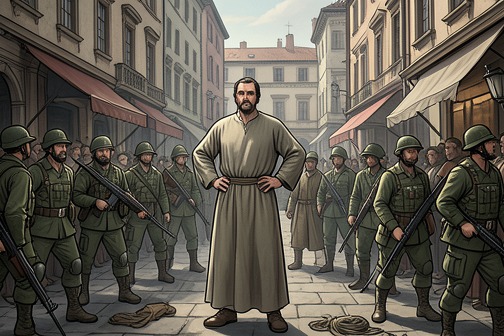
[Asmatullah Achakzai Muslim](entity:character-recall-character-asmatullah-achakzai-3e960453a3ce)’s secret peace talks with the Russians and the Afghan government in [Kabul](entity:location-recall-location-fa0d480263ce) disrupted the anti-Soviet resistance in the [Kandahar](entity:location-recall-location-kandahar-06ce6574e7a2) region at a moment when [Lin](entity:character-recall-character-lin-428ebd96b429) and his companions were waiting in [Quetta](entity:location-recall-location-quetta-6e45f4d11afe) to cross into [Afghanistan](entity:location-recall-location-afghanistan-ea09a8d619a6). Because so much depended on Asmatullah’s militia, its withdrawal from active service left other resistance units isolated and their supply routes exposed. The talks turned a military delay into a crisis over whether the regional struggle would continue at all.
## The Achakzai and Their Commander
The talks acquired their force from the Achakzai’s standing as a clan and a fighting force. Sheep and goat herders who had once belonged to the dominant Durrani clan, they were formally separated from it in 1750 by Ahmed Shah Abdali, founder of modern Afghanistan. Afghan custom allowed a sub-clan to become independent when it had grown sufficiently large or strong; the separation also acknowledged the Achakzai’s power and the need to appease them. Over the following two centuries, the clan increased its status and earned a reputation for fierce fighting and obedience to its leader.
During the early years of the war against the Russians, Asmatullah organized his men into a well-armed, highly disciplined militia. In their region, they became the spearhead of the independence struggle and its jihad against the Soviet invaders. His authority therefore carried consequences beyond his own force: when he changed course, the resistance around Kandahar could not simply continue as before.
## The Talks and the Withdrawal
Toward the end of 1985, as Lin’s group prepared in Quetta for the crossing into Afghanistan, Asmatullah began to vacillate in his commitment to the war. He pulled his men back from active service and began secret peace talks with the Russians and their Afghan puppet government in Kabul. The account establishes that the talks were under way, but does not disclose their terms or confirm a final decision by Asmatullah.
The immediate consequence was a collapse of the resistance in the Kandahar region. Other mujaheddin units outside Asmatullah’s command, including [Khader Khan](entity:character-recall-character-khader-khan-2bf2b74321b0)’s men in the mountains north of the city, remained in position, but were left isolated. Their supply routes became perilously vulnerable to Russian attack. The withdrawal thus weakened not only the militia’s direct contribution but also the security and viability of forces still fighting nearby.
## The Waiting in Quetta
Asmatullah’s uncertainty kept Lin and his companions waiting for a month in Quetta. The delay was marked by false starts: the group could not know whether he would resume the jihad or switch sides and support the Russians. Since the resistance in the region depended so heavily on his militia, his unresolved choice determined whether their intended crossing led into an active struggle or a newly compromised one.
The episode is narrated from Lin’s position among those waiting, with the military and political crisis conveyed through its practical effect: no one could predict which way Asmatullah would jump. The drawn-out pause makes the peace talks consequential before their outcome is known. Rather than presenting a settled agreement, the narrative leaves the group suspended between two possible futures, while the other units’ exposed supply lines show the cost of that uncertainty.
Event 64
Soviet–Afghan War
The [Soviet–Afghan War](entity:event-recall-event-soviet-afghan-war-d91b10b26ef1) shapes the Afghan mission that draws [Lin](entity:character-recall-character-lin-428ebd96b429), a fugitive working for [Abdel Khader Khan](entity:character-recall-character-abdel-khader-khan-822d0cbbc88e), into a conflict whose purposes are at once local, religious, geopolitical, and personal. Lin travels with supplies for resistance fighters, posing as an American whose supposed nationality may protect the group as it crosses territory held by rival clans. The mission’s course—from a month of waiting in [Quetta](entity:location-recall-location-quetta-6e45f4d11afe) to fighting in the mountains—shows how the war turns aid into a perilous bargain and how its human cost outlasts any promised victory.
## Origins and Competing Interests
The account describes the conflict as the outcome of overlapping ambitions rather than a single confrontation. In [Khaled Ansari](entity:character-recall-character-khaled-ansari-579dc41e3899)’s explanation, the Soviet Union first sought influence through aid and a government dependent on its support; the [United States](entity:location-recall-location-united-states-2f533bc8d0b9), acting within the [Cold War](entity:time-recall-time-700d9e46b459) rivalry, backed religious opponents of that government with money and weapons. Soviet invasion followed, turning political interference into open war. [Ahmed Zadeh](entity:character-recall-character-ahmed-zadeh-feee227ea4a6) adds [Pakistan](entity:location-recall-location-pakistan-041a2aec3e49)’s territorial ambitions and its military relationship with the United States to this account, and describes the training of religious fighters in Pakistani madrassahs as part of the conflict’s widening aftermath. The explanations belong to characters speaking from within the war, and the novel presents a struggle already shaped by foreign power before Lin arrives.
For Abdel Khader Khan and [Nazeer](entity:character-recall-character-nazeer-70724b855ba6), however, the war is also a fight over home. The fighters besieging [Kandahar](entity:location-recall-location-kandahar-06ce6574e7a2) are from their village and region; Abdel Khader Khan says that they need guns and that he is prepared to help with his own blood if necessary. His mission therefore carries a personal allegiance that sits alongside the practical business of moving contraband. The cargo includes guns, explosives, passports, money, gold, machine parts, and medicines. The plan is to carry it through areas where rival clans may demand plunder and deliver it to resistance fighters who have been besieging Kandahar for two years.
## The Mission and Its Delays
Lin’s role depends on passing as an American. Abdel Khader Khan explains that an American might be allowed through because the fighters oppose the Soviet invaders and receive American money and weapons; the nationality is cover, not proof that Lin can supply the weapons Afghans need. No American willing to take the risk could be found, so Abdel Khader Khan asks Lin instead. Lin accepts in the aftermath of prison and during heroin withdrawal, when he is physically unwell and emotionally exposed. Abdel Khader Khan postpones the immediate demands of the mission, telling him first to recover.
The group spends a month in Quetta waiting on [Asmatullah Achakzai Muslim](entity:character-recall-character-asmatullah-achakzai-3e960453a3ce), whose militia is central to the resistance around Kandahar. His Achakzai fighters are described as disciplined and well armed, and their withdrawal from active service, together with secret peace talks with the Soviet-backed Afghan government, threatens to collapse the regional resistance. Other units, including Abdel Khader Khan’s men in the mountains, remain in position but become isolated and vulnerable to attack along their supply routes. The delay is thus more than a logistical inconvenience: the mission’s prospects depend on whether a local commander continues fighting or changes sides.
While the decision hangs unresolved, Lin studies Farsi, Urdu, and Pashto, learns a few words of Tajik and Uzbek, rides horses, and reads books brought from Quetta’s central library. These routines mark a temporary interval of preparation inside a war that permits little certainty. The wider setting presses in: the Shar-i-Safa camp lies near Kandahar and the [Kabul](entity:location-recall-location-fa0d480263ce) highway, within reach of conflicts over the city, the highway, and the [Arghandab Dam](entity:location-recall-location-5438afa6ca67). Its cave position offers concealment rather than strategic safety, and winter brings prolonged cold and snow.
## Civilian Loss and the Meaning of Resistance
The war’s devastation becomes personal through [Habib Abdur Rahman](entity:character-recall-character-habib-abdur-rahman-4c7533b4f31c). Once a village schoolteacher with a wife and two sons, Habib joined the resistance after the invasion. On returning from a mission, he found that a nerve-gas attack had killed his family and the rest of his village, along with the animals. The account identifies the incident as an example of experimental weapons being used in the war, while noting that the Soviets denied the accusation. Habib’s loss is not a detached statistic: it helps explain why a search for him becomes so consuming for the soldiers pursuing him, and why the resistance itself can be driven by grief as well as political purpose.
The novel also places the current conflict beside an older history of invasion. From a mountain ridge, Abdel Khader Khan recalls the Second Anglo-Afghan War, including the British advance through the [Khyber Pass](entity:location-recall-location-684e2314fb89), the occupation of Kabul, and the violence of martial law. He describes the Battle of [Maiwand](entity:location-recall-location-ac1811a33ea0), where Afghan forces under Prince Ayub Khan defeated a British and Indian force before the Siege of Kandahar began. The historical parallel makes the landscape a record of repeated foreign campaigns, but it does not make the present war identical to the past: the narration uses the earlier conflict to illuminate memory, inheritance, and the persistence of Afghan resistance.
## The Battle, the Stingers, and the Cost of Victory
After Abdel Khader Khan’s column is attacked, the survivors reach the camp with news of his death. The group then faces further danger from Afghan government forces and the possibility of Russian support. Its eventual escape becomes entangled with a separate operation by [Ahmed Shah Massoud](entity:character-recall-character-ahmed-shah-massoud-4b7918de8057)’s forces. Lin and his companions initially mistake the explosions and incoming mortar fire for a coherent assault; later, they learn that Massoud’s fighters had misidentified them as enemies and that some of the mortar strikes were friendly fire. The clarification overturns the apparent meaning of the escape: what had seemed like a victorious advance was partly an accident that killed men on the same side.
The turning point in the larger war is the arrival of [Stinger missiles](entity:object-recall-object-5678ec0da6cf). Afghans had long argued that the weapons could challenge Soviet air power, including helicopters and MiG fighters. The novel reports that the missiles were introduced a few months after Abdel Khader Khan led the group into [Afghanistan](entity:location-recall-location-afghanistan-ea09a8d619a6), and that their arrival shifted the balance. In Lin’s account, the eventual weakening and collapse of the Soviet empire comes at an enormous price: a million Afghan lives, a third of the population displaced, three and a half million refugees moving through the Khyber Pass to [Peshawar](entity:location-recall-location-peshawar-4ec806638d35), another million exiled in [Iran](entity:location-recall-location-0f24c5ab412b), [India](entity:location-recall-location-india-39df7eae59c1), and the Soviet Union’s Muslim republics, and fifty thousand people who lost at least one limb to land mines. Lin recognizes that he had looked Afghans in the eye while impersonating an American and could not give them the weapons they believed might have changed the course of the war.
## Narrative and Ethical Significance
The war’s stated purposes—resistance, faith, political influence, and regional ambition—do not remain stable once fighting becomes a daily contest for survival. The novel’s reflection on combat shifts attention from slogans and strategy to the land and the loved ones that fighters try to defend. That perspective complicates a simple victory narrative: the resistance may gain the weapons that change the military balance, yet the human consequences include mass death, displacement, and the destruction of communities.
Lin’s position sharpens that tension. He is neither a neutral observer nor an ordinary combatant: he is a wanted criminal, serving a mafia leader, crossing borders under a false identity and taking part in the movement of weapons. His account exposes the gap between the promise of outside support and the limited agency of those who bear the war’s immediate costs. The friendly-fire episode further resists the language of glory. Courage and loyalty remain possible, but the battle’s outcome cannot reliably distinguish intended sacrifice from error. In this narrative, the war is not a backdrop to Lin’s transformation; it is the test that makes the cost of his chosen loyalties visible.
Event 65
Madame Zhou’s betrayal of Lin
[Madame Zhou’s betrayal of Lin](entity:event-recall-event-madame-zhou-s-betrayal-d7cfd414235d) is revealed through a letter from [Didier Levy](entity:character-recall-character-didier-levy-bc900419ef54) and becomes the personal motive behind [Lin](entity:character-recall-character-lin-428ebd96b429)’s decision to join [Abdel Khader Khan](entity:character-recall-character-abdel-khader-khan-822d0cbbc88e)’s war and return alive. The disclosure turns Lin’s imprisonment from an unexplained misfortune into an act of retaliation, and redirects his grief toward a specific enemy.
## The Letter and the Disclosure
Two hours after [Khaled Ansari](entity:character-recall-character-khaled-ansari-579dc41e3899) gave Lin a letter in a taxi, Lin read it during a gathering where the Blind Singers were performing. [Didier](entity:character-recall-character-didier-381547eab195)’s message said he had learned that [Madame Zhou](entity:character-recall-character-madame-zhou-d453e8a13327), the owner of the Palace, had betrayed Lin to the police, causing his imprisonment and beating. Didier reported that his sources were reliable, but that he had not discovered her reason. The letter therefore supplied the identity of the betrayer while leaving Lin to reconstruct the motive.
## Lin’s Reconstruction of the Motive
As he read, Lin recalled [Rajan](entity:character-recall-character-rajan-b88c52c5a766), Madame Zhou’s servant, watching him with hatred on the day Lin and others rescued [Karla](entity:character-recall-character-karla-3f7aa8a8ae5c) from the [Taj Mahal Hotel](entity:location-recall-location-taj-mahal-hotel-74a944e98e21) during the flood. Lin remembered Rajan observing him with Karla and then seeing him leave in a taxi. Later that night, police arrested Lin, and his prison ordeal began. Lin understood the sequence as evidence that Madame Zhou had punished him for defying her: challenging her authority, impersonating an American consular officer, taking [Lisa Carter](entity:character-recall-character-lisa-carter-130e7270024c) away from her, and perhaps loving Karla. The letter confirms her role in the betrayal; the personal motive is Lin’s conclusion from the remembered encounter and the events that followed.
## Revenge and the Decision to Return
Lin tore up the letter and put its pieces in his pocket. The discovery settled why he would go to war with Abdel Khader Khan and why he intended to return: he was drawn by the love he felt in Abdel Khader Khan’s gaze, which answered the absence of a father in his life, while his hatred of Madame Zhou gave him a purpose for surviving. Lin recognizes that going to war for love is foolish, but weighs it against surviving only for revenge. He resolves that if he makes it through the war, he will find Madame Zhou and kill her. The betrayal thus binds two motives—attachment and vengeance—to the same dangerous journey.
Event 66
The poison gas attack on Habib’s village
[The poison gas attack on Habib’s village](entity:event-recall-event-habib-3753cd5afbfa) is recalled as the event that erased his home and family and changed the course of his life. In [Abdel Khader Khan](entity:character-recall-character-abdel-khader-khan-822d0cbbc88e)’s account, it also exposes the civilian cost of a war in which new weapons were being tested.
## Background and Attack
Before the attack, [Habib Abdur Rahman](entity:character-recall-character-habib-abdur-rahman-4c7533b4f31c) had been a schoolteacher in a village on the far side of the mountains. Seven years after the Russians invaded, he was remembered as a happy man with a young wife and two sons. Like other young men in the region, he joined the resistance. Two years before the account, he returned from a mission to find that the Russians had attacked his village with what Abdel Khader Khan described as a nerve gas. [Ahmed Zadeh](entity:character-recall-character-ahmed-zadeh-feee227ea4a6) added that the Russians denied using the gas, while asserting that land mines, rockets, and other weapons in the war were experimental. He presented the attack as part of a conflict in which new weapons were being tested on a scale and in circumstances unlike earlier wars.
## Aftermath and Transformation
The attack left no one alive in the village: Habib’s relatives across generations, his wife and children, childhood friends, and neighbors were all lost, along with the village’s animals and other living creatures. He buried them alone, a task that took so long that its completion marked a dividing line in his life. He then returned to his Afghan resistance unit, but the loss had changed how he fought. He began seeking out Russian soldiers and Afghan soldiers fighting alongside them, capturing many and killing them in retaliation. The sharpened steel spike he used was made from the shovel he had used to bury his family; when Abdel Khader Khan recounts the story, it is still strapped to the top of Habib’s pack. The same object thus connects the labor of mourning to the violence that followed, making the attack’s consequences visible in Habib’s changed conduct.
## The Attack as an Explanation
Abdel Khader Khan recounts the attack to [Lin](entity:character-recall-character-lin-428ebd96b429) with an apology, setting Habib’s later actions against the destruction that preceded them. Ahmed Zadeh’s interruption broadens the account from one village’s fate to a claim about experimental weapons in the war, while the shovel turned into a weapon gives the story a stark material link between burial and retaliation. The explanation establishes the scale of Habib’s loss and the change it produced, without making his subsequent violence erase the attack’s civilian victims or its consequences.
## Testimony and Uncertainty
The account reaches Lin through Abdel Khader Khan’s explanation, interrupted by Ahmed Zadeh’s insistence that the Russians denied using gas. That disagreement keeps the reported attack within the characters’ testimony rather than presenting it as an impersonal report, while the details of Habib’s return and the village’s destruction give the claim human scale. The exchange also shifts the focus from the dispute over what the Russians admitted to the consequences Habib carried forward.
Event 67
Khader leads his group across the mountains into Afghanistan
[Khader Khan](entity:character-recall-character-khader-khan-2bf2b74321b0)’s crossing into [Afghanistan](entity:location-recall-location-afghanistan-ea09a8d619a6) is a month-long wartime passage in which distance is measured not by the road but by what the terrain, secrecy, and danger will allow. The caravan carries concealed supplies toward the [Shar-i-Safa Mountains](entity:location-recall-location-dc85f633a0ce), moving over more than a hundred mountain passes where horses must be dragged and guided as carefully as the people. Its arrival at a hidden camp marks the end of the crossing and a new risk: the men waiting there cannot yet be confirmed as allies.
## Route and purpose
The ordinary road from Chaman crossed a tributary of the Dhari River and continued toward Spin Baldak, Dabrai, and Melkaarez on the highway to [Kandahar](entity:location-recall-location-kandahar-06ce6574e7a2). The journey was less than two hundred kilometres and took only a few hours by car. Khader Khan’s group did not use that route. It had no cars, and its passage by horseback over more than a hundred mountain passes took more than a month. The contrast sets the scale of the undertaking: a short trip on a map became a prolonged crossing through terrain that offered concealment but little ease.
The cargo was being smuggled into Afghanistan. On the first day, the group camped beneath trees, while the goods and personal supplies were spread across a nearby pasture and covered with sheepskins and goatskins to resemble livestock when seen from the air. A few actual goats were tethered among the bundles. The disguise was practical, but it also governed the journey’s larger method: the caravan had to move without drawing notice from above, and Khader Khan enforced a blackout on the march, forbidding cigarettes, torches, and lamps.
## The caravan and the mountain crossing
At dusk, the riding horses arrived: twenty mounts and fifteen pack animals. The animals carried the concealed load, while ten men walked and twenty rode; a herd of ten goats accompanied them. [Ahmed Zadeh](entity:character-recall-character-ahmed-zadeh-feee227ea4a6) assigned a horse to [Lin](entity:character-recall-character-lin-428ebd96b429), and [Nazeer](entity:character-recall-character-nazeer-70724b855ba6) led another. Lin noticed that Nazeer, an accomplished horseman, was walking while he rode. He eventually persuaded Nazeer to take turns on his horse, though Nazeer accepted the arrangement reluctantly and seemed most content when their positions were reversed.
The caravan’s progress was not simply a matter of riding uphill. In the Chaman range, which divides southwestern Afghanistan from [Pakistan](entity:location-recall-location-pakistan-041a2aec3e49), horses and people had to be pushed, dragged, and at times helped over the mountain. What first appeared to be an impassable wall of bare rock resolved into ravines, tiered crevices, and narrow ledges. Some paths were broad and level enough to resemble roads; others were so jagged and constricted that each step demanded care. Much of the passage through this barrier took place in darkness. In narrow defiles, the rock walls blocked even the faint light of the quarter moon, leaving the column to inch forward with men, horses, and goats pressed against stone and against one another.
[Habib Abdur Rahman](entity:character-recall-character-habib-abdur-rahman-4c7533b4f31c) was expected to lead the group through the mountains. At first, Lin accepted this with uneasy humour, but as the weeks passed, the others watched Habib more anxiously. They gradually understood why other Afghan resistance fighters had expelled him from their units. The route nevertheless depended on his knowledge: the caravan traveled by night and sometimes by day, moving north along the mountainous border toward Pathaan Khel before turning northwest into deserted terrain threaded with cold-water streams. Habib’s route avoided the main arteries and kept the group at roughly equal distances from towns and larger villages. They crossed between named settlements and forded rivers rather than following the more exposed roads.
## Threats and hospitality on the way
The route did not keep the caravan clear of armed opposition. Local pirates stopped it three times, first appearing at high vantage points with guns trained on the travelers, then sending armed men from hiding to block the way forward and prevent retreat. Each time, Khader Khan raised a green-and-white mujaheddin flag bearing a Koranic phrase. The repeated stops show the group’s vulnerability even away from the main roads: secrecy reduced exposure, but it could not remove the danger of armed men controlling the terrain.
The journey also brought encounters with village leaders whose authority had to be negotiated rather than bypassed. Hajji Mohammed liked Lin’s answer to him and invited the group to celebrate the wedding of his youngest son. Khader Khan accepted, concerned that refusing the elderly leader might cause offence and genuinely moved by the invitation. The welcome did not make the encounter cost-free: after driving a hard bargain over tribute, Hajji Mohammed demanded and received Khader Khan’s own horse as an additional personal gift. Khader Khan, Nazeer, and Lin then accompanied him toward his khel, while the rest of the column camped in a well-watered valley.
The pause allowed the men to groom and rest the horses. With the cargo secured in a protected cave, the pack animals could roam, and the village contributed four roasting sheep, Indian rice, and green-leaf tea for the travelers. The village elders recognized the group as fighters in their cause and offered help. After twenty-three days of travel, the singing and laughter from the camp were the first signs of such lightness among the men. The welcome thus stands in contrast to the armed tolls: the same passage through Afghanistan required both forceful caution and negotiated hospitality.
## Arrival at Shar-i-Safa
Near the end of the journey, the caravan made a steep but short climb in thin air and cold that penetrated Lin’s clothes. When Lin fell behind, two Afghan fighters gave up the ground they had gained, came back to help him drag a horse up the slope, and then hurried onward to assist the men ahead. Their uncomplaining help made the group’s endurance visible not as an abstract quality but as an action repeatedly offered to others.
After five hours of climbing, the caravan reached its destination in the Shar-i-Safa Mountains. A great ledge sheltered the camp from the air; below it, excavated ground opened into a vast cave connected to other caves. Smaller camouflaged bunkers formed a surrounding ring that reached toward the edge of the rugged plateau. Habib, serving as scout, had alerted the camp to the group’s arrival, and the fighters there were waiting for the supplies.
The approach remained uncertain even at the destination. The men inside stayed behind cover, and Khader Khan did not know exactly who was in the camp. The attack at [Shahbad Pass](entity:location-recall-location-cc6ae3617050) had led him to suspect that Asmatullah Achakzai had changed sides again and joined the Russians. Although Habib reported that the camp was friendly, Khader Khan asked Lin to ride near the front, behind him, impersonating an American. The crossing therefore ends not with uncomplicated safety but with a final test of trust: the supplies have reached the camp, yet the identity of those waiting must still be judged.
Event 68
Habib kills Siddiqi
[Habib Abdur Rahman](entity:character-recall-character-habib-abdur-rahman-4c7533b4f31c)’s killing of Siddiqi shatters the exhausted relief of a mountain camp and turns suspicion of Habib’s instability into an immediate danger. Seen by [Lin and Khaled Ansari](entity:relation-recall-relation-lin-and-khaled-ansar-2a25784406a7), the murder is sudden; Habib vanishes before the others can seize him, leaving the group to confront both the death and the uncertainty of what he may do next.
## The Camp and the Discovery
[Lin](entity:character-recall-character-lin-428ebd96b429) has just reached the camp after a month-long journey on horseback, crossing more than a hundred mountains and ten rivers, much of it in darkness. He is exhausted and still laughing with [Khaled Ansari](entity:character-recall-character-khaled-ansari-579dc41e3899) at his undignified arrival, but the laughter fades when he looks across the camp. A camouflage-coloured canvas shelter has been set aside for the wounded, while men unload cargo from the horses and carry it into a cavern. Amid this work, Lin notices Habib Abdur Rahman dragging a long, heavy object away from the line of activity and farther into the dark.
The cargo has drawn attention away from the shelter and its wounded men. That distraction gives Habib Abdur Rahman space to move Siddiqi, who has been unconscious beneath the awning. Lin asks what Habib is doing; Khaled Ansari immediately understands that something is wrong, and the two run toward the edge of the flattened plateau. Their movement marks the abrupt turn in the scene: the camp’s practical bustle, and the joking that followed Lin’s arrival, give way to the recognition of an act that cannot be undone.
## The Killing and Habib’s Disappearance
Lin and Khaled Ansari reach Habib Abdur Rahman as he is kneeling over Siddiqi. [Habib kills Siddiqi](entity:event-recall-event-habib-siddiqi-6c25ae43d74c) with a long knife, then turns to face the witnesses. The killing is not hidden from them once discovered, but their arrival comes too late to prevent it. Habib’s grin, and the apparent madness in his expression, seem to Lin to intensify when he sees their horror and anger.
Habib Abdur Rahman then appears to laugh without making a sound. Lin reads the look in his eyes as a message: Habib believes the others want him dead, and presents their hostility as confirmation that he was right not to trust them. This is Lin’s perception of the silent exchange, not a spoken explanation from Habib. The distinction matters: the witnesses can establish what Habib has done, but they cannot know from this encounter exactly what he intends or whether he will return.
Footsteps announce the arrival of [Abdel Khader Khan](entity:character-recall-character-abdel-khader-khan-822d0cbbc88e), [Nazeer](entity:character-recall-character-nazeer-70724b855ba6), and [Ahmed Zadeh](entity:character-recall-character-ahmed-zadeh-feee227ea4a6). By the time Khaled Ansari and Lin turn back, Habib Abdur Rahman has disappeared. Khaled Ansari tells the others that Habib killed Siddiqi after dragging him away from the shelter, while Nazeer demands to know where Habib went. Khaled Ansari cannot say. The scene therefore ends its immediate pursuit without resolving Habib’s whereabouts or bringing him under control.
## Response and Immediate Consequences
Abdel Khader Khan kneels beside Siddiqi and prays with his palms held upward. The gesture places mourning beside the practical demands of the camp: there is little moonlight left for work, and much remains to be done. Ahmed Zadeh proposes looking for Habib the following day, while acknowledging that Habib may already have left. His response does not diminish the killing; it registers the difficult choice between pursuing a dangerous man in the darkness and continuing the work still facing the group.
Khaled Ansari instead orders a guard for the night, specifying that the watchers should be men who know Habib well, rather than local men. He wants Habib watched but asks that they avoid shooting him if possible, while warning them not to take unnecessary chances. He also orders a search of Habib’s horse and pack for weapons or explosives, recalling that Habib may have carried something beneath his jacket. These precautions show that the crisis is not treated as an isolated act of violence: the group must consider what Habib can do, what he may have taken with him, and how to find him without making the situation still more dangerous.
## Narrative Significance
The event reverses the scene’s emotional direction in a few moments. Lin’s arrival has prompted shared laughter with Khaled Ansari, but the sight of Habib Abdur Rahman moving an unknown burden away from the camp exposes how little that brief ease can protect. The distraction of unloading cargo and the shelter for the wounded become part of the circumstances in which Siddiqi is killed; the camp’s ordinary tasks continue even as a threat emerges among them.
The killing also changes what the group knows about Habib. The danger is no longer only a matter of suspicion or unsettling behaviour: Siddiqi is dead, the witnesses have seen Habib kill him, and Habib has fled before they can question or restrain him. Yet the cause of the killing and Habib’s precise intentions remain unresolved in this encounter. The guards, the search of his belongings, and Khaled Ansari’s caution about using force are immediate responses to that gap. The episode closes not with Habib’s capture, but with a dead man, an absent killer, and a camp forced to keep working while preparing for the possibility that he is still nearby.
Event 69
Lin breaks with Khader
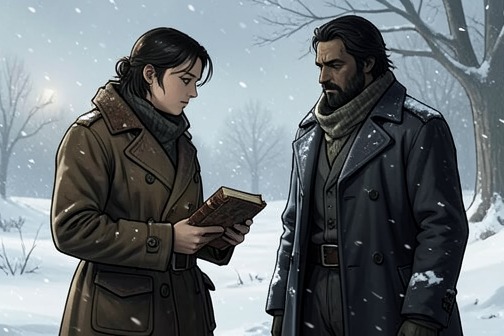
[Lin](entity:character-recall-character-lin-428ebd96b429) breaks with [Abdel Khader Khan](entity:character-recall-character-abdel-khader-khan-822d0cbbc88e) in a snowbound confrontation that turns a relationship of mentorship and affection into an acknowledged moral and personal rupture. The break follows a series of disclosures: Abdel Khader Khan confirms that [Karla](entity:character-recall-character-karla-3f7aa8a8ae5c) had worked within his organization, admits that medicine intended for the war was tested on people in Lin’s slum clinic, accepts responsibility for [Sapna](entity:character-recall-character-sapna-3597df1d97c4)’s killings, and tells Lin that he could have secured his release from prison much earlier but chose not to. Lin’s final declaration that his cause is freedom makes the scene both a reckoning with Abdel Khader Khan and a refusal to let their bond dictate his choices.
## Disclosures and the Burden of Secrecy
The confrontation opens around [Karla’s poem manuscript](entity:object-recall-object-36fccd051a84), which Lin has carried for years. The copy is creased, rubbed thin, and torn along its folds. Officers took the original page from him in [Arthur Road Prison](entity:location-recall-location-arthur-road-prison-50f3a84a4e65) and ripped it up; after [Vikram Patel](entity:character-recall-character-vikram-patel-70646435bc43) secured his release, Lin reconstructed it from memory and kept the replacement with him. He believes Abdel Khader Khan recognizes the poem because of Karla, whose connection with him Lin had not understood. Abdel Khader Khan corrects him: the poem was written by Sufi poet Sadiq Khan, whose work he knows by heart and whose favorite poet is also Karla. The recognition is not proof of a new intimacy formed during Lin’s rescue. It reveals a longstanding connection that Lin had not been told about.
Abdel Khader Khan then explains that Karla had worked for him for years, formally through [Abdul Ghani](entity:character-recall-character-abdul-ghani-d1a4aca9ef78), who worked for Abdel Khader Khan. Lin had assumed that she first met his mentor when [Nazeer](entity:character-recall-character-nazeer-70724b855ba6) accompanied her to Guptaji’s place to get him out. The revelation recasts that rescue: Karla was not simply an intermediary encountered through Lin’s crisis, but someone already connected to the organization. Lin remembers Karla describing a meeting with an Indian businessman that changed her life and wonders whether she meant Abdul Ghani. The scene leaves that interpretation as his question rather than confirming it. What is clear is the asymmetry between them: Abdel Khader Khan says he had spoken to Karla about Lin many times, while Lin did not know her work or the extent of her connection to his mentor.
## The Clinic and the Cause
The disclosures move from concealed relationships to the human cost of Abdel Khader Khan’s wartime decisions. Medicine brought to the Afghan camp, including antibiotics and penicillin, had been supplied by [Ranjit](entity:character-recall-character-ranjit-1b1f6a53c03c)’s lepers. Abdel Khader Khan says he needed to know whether the stock was safe before using it in the war. Lin’s clinic in his own slum offered an opportunity to test the supplies on its patients, people with no family or embassy connection to protect them. Abdel Khader Khan insists that the chance the medicines were impure was low and that they were almost completely sure they were safe when they gave them to Lin. His defense is framed as a calculation: risking twenty lives against the possibility of saving a thousand, and risking a thousand to save a million. The arithmetic does not erase who bore the immediate danger, or that Lin’s patients were made part of a decision they could not knowingly weigh.
Lin also asks whether Abdel Khader Khan was behind Sapna. Abdel Khader Khan denies being Sapna, but does not deny responsibility for Sapna’s killings. He says Sapna killed for his cause and acknowledges that Sapna’s existence, the fear Sapna produced, and Abdel Khader Khan’s declared effort to stop him helped politicians and police permit the movement of weapons through [Bombay](entity:location-recall-location-bombay-b9f73c3bdba6) to [Karachi](entity:location-recall-location-karachi-4b33ee0420d8), [Quetta](entity:location-recall-location-quetta-6e45f4d11afe), and the Afghan war. Sapna’s violence, in this account, served as cover and leverage for the arms operation. Abdel Khader Khan says he benefited from it and would use those killings again, even committing further killings himself if he believed they would advance the cause. His confession therefore unsettles the distinction between opposing violence and exploiting it: the man who claims to fight for a transformed world has deliberately made bloodshed useful to his plans.
## The Prison and the Betrayal
Lin’s question about his imprisonment brings the argument into their personal history. Abdel Khader Khan says he did not arrange Lin’s arrest, but acknowledges that he knew about it almost immediately and had the power to get him out after the first week. He chose not to act then. Others had taken beatings while trying to send him messages, and Lin had endured the prison’s punishment while hoping his mentor would intervene. In retrospect, Lin understands that the hope was empty: even if a message had reached Abdel Khader Khan, he would have left Lin there until he was ready to act.
Abdel Khader Khan explains that he had an arrangement with [Madame Zhou](entity:character-recall-character-madame-zhou-d453e8a13327), who was helping him reach politicians and secure favors from a Pakistani general. The general was Karla’s special client, and Karla had first introduced him to Madame Zhou. Because Madame Zhou was furious with Lin and wanted him killed in prison, Abdel Khader Khan allowed that danger to stand while the political work remained important. He says that once his work was done, he sent Vikram Patel for Lin at the earliest opportunity and insists that he never wanted to hurt him. The distinction between not wanting harm and knowingly withholding rescue offers Lin little comfort. Abdel Khader Khan’s eventual intervention saved him, but it came after prolonged suffering and after the hope of being rescued had itself become a source of injury.
## Refusal and Separation
Lin responds to the explanation by putting his hand on his holster and warning Abdel Khader Khan to leave. Nazeer steps between them, shielding Abdel Khader Khan, while [Khaled Ansari](entity:character-recall-character-khaled-ansari-579dc41e3899) and [Ahmed Zadeh](entity:character-recall-character-ahmed-zadeh-feee227ea4a6) also tense and raise their hands. Lin says he does not care whether he lives or dies if it means never again having to look at, speak to, or listen to his former mentor. The threat makes the rupture physical as well as emotional, but Lin does not fire.
Abdel Khader Khan’s final appeal is that his wrongs were committed for the right reasons and that he had always felt for Lin as a friend and beloved son. Lin answers that the lesson of Abdel Khader Khan’s wisdom is hatred, and rejects the cause that has justified testing patients, exploiting Sapna’s violence, and leaving him in prison. His only cause, he says, is his own freedom, which now requires freedom from Abdel Khader Khan. Snow gathers on them as Abdel Khader Khan turns and goes with the others. Lin draws and cocks the [Stechkin APS pistol](entity:object-recall-object-stechkin-aps-7d255d5d2a9f), but keeps it pointed at the ground; when the minutes pass, his frozen fingers will not release it. Alone in the storm, he lifts his arms, recalling the gesture he once made beneath the warm rain in [Prabaker Kharre](entity:character-recall-character-prabaker-kharre-ca699443f286)’s village. The scene ends not in reconciliation or violence, but in separation: Lin has rejected his mentor’s authority without pretending that the old affection has simply vanished.
Event 70
Khader’s group is ambushed and Khader is killed
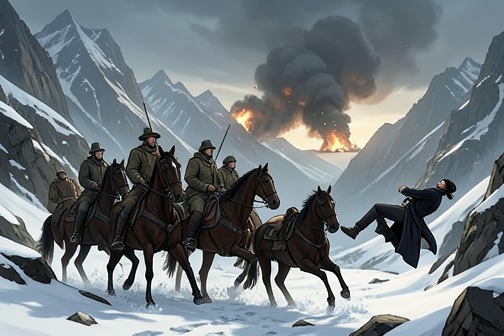
The ambush that killed [Abdel Khader Khan](entity:character-recall-character-abdel-khader-khan-822d0cbbc88e) turned a journey toward home into a disastrous encounter with forces hunting [Habib Abdur Rahman](entity:character-recall-character-habib-abdur-rahman-4c7533b4f31c). [Nazeer](entity:character-recall-character-nazeer-70724b855ba6)’s later account makes clear how Habib’s escalating campaign of terror had transformed the mountain corridor and set the conditions for the attack.
## Background and Ambush
After leaving the camp with twenty-six men and all the riding and pack horses, Abdel Khader Khan was travelling by what should have been a safe route to the village where he was born. On the second day, still a full day and night from the village, the group stopped for what its members believed was a routine exchange of tribute with a local clan leader. In fact, the meeting was a trap, arranged in a region already destabilized by Habib’s violence. During the preceding two months, Habib had attacked people he considered enemies or insufficiently committed to the cause, provoking fighters across the area to seek him out. The gathering placed Abdel Khader Khan among men hostile to Habib and his allies. Recognizing the danger, Abdel Khader Khan tried to leave peacefully, surrendering four horses as tribute before assembling his men and withdrawing. They were nearly clear of the hostile high ground when gunfire began in the canyon. The battle lasted half an hour. When it ended, Nazeer counted eighteen dead from the column, including men who had been wounded and then killed. Nazeer and [Ahmed Zadeh](entity:character-recall-character-ahmed-zadeh-feee227ea4a6) survived because they were trapped under a confusion of bodies and horses and appeared to be dead.
## Nazeer’s Return and the Confirmation of Khader’s Death
Three days after Abdel Khader Khan had left camp, sentries spotted figures struggling up the southern slope. Nazeer had made the final climb on foot, dragging Ahmed Zadeh and Abdel Khader Khan behind him. Ahmed was alive but gravely weakened; Abdel Khader Khan was dead. Nazeer was too exhausted to speak, and the men carried him into camp. [Lin](entity:character-recall-character-lin-428ebd96b429) and others brought Abdel Khader Khan’s body to the cave, while Ahmed was taken for care. He briefly opened his eyes as the men tended to him, but later died after telling them about his family and asking that they be informed he had died thinking of them.
Nazeer’s account filled in the journey back. After the attack, he had found one surviving horse, already seriously wounded, and secured Abdel Khader Khan’s body and the dying Ahmed to its back. The animal travelled through the snow for a day and a half before collapsing and dying nearly three kilometres from camp. Nazeer then continued on foot, dragging both men until he reached the camp. He did not know what had become of the five members of the column who were unaccounted for; they might have escaped or been captured.
The camp later examined Abdel Khader Khan’s body and established that a single bullet had killed him. The account identifies it as a hollow-tipped round fired by Russian AK-74 rifles, ammunition banned under international law. The fatal wound left a blue-black mark over his heart, a detail that gives the discovery its stark finality without changing its uncertainty: the men could identify how he had died, but not recover the life and leadership lost with him.
## Consequences for the Camp
The return of Abdel Khader Khan’s body did not end the danger created by the ambush. After the men wrapped him and placed him in a shallow trench near the cave entrance, mortar shells began striking the compound. [Suleiman Shahbadi](entity:character-recall-character-suleiman-shahbadi-e62ae720ba3a) and [Khaled Ansari](entity:character-recall-character-khaled-ansari-579dc41e3899) suspected that the attack was connected to the destruction of Abdel Khader Khan’s column: Afghan army forces might have regrouped and followed Nazeer’s trail, or learned the camp’s location by questioning prisoners. Nazeer had also reported seeing Afghan army uniforms and new Russian equipment among the enemy dead, giving the camp reason to fear that Russian forces might join a renewed assault.
Suleiman judged that a direct ground attack would be costly, but that Russian support could bring helicopter attacks once the weather cleared. With the camp’s position and men at risk, he decided to prepare two mortar counterattacks and began briefing [Jalalaad](entity:character-recall-character-jalalaad-3bac5877e9b8), a young Hazarbuz nomad, to scout enemy positions and numbers. The decision shows how the ambush widened into a new military crisis: the survivors had returned with the news of their leader’s death, only for the camp to face the prospect of being attacked in turn.
As the men discussed their limited options, Habib Abdur Rahman appeared at the cave entrance, having slipped past the sentries. His presence brought the campaign that had helped set the ambush in motion directly into the camp at the moment when its defenders were planning their response.
## Witness and Farewell
The return became a scene of personal loss as well as a report of military defeat. Nazeer was so exhausted and cold that he could not speak, and the men had to free his hands before carrying him into camp. Lin tried to revive Abdel Khader Khan, then remained beside him, cradling his head without remembering how he had moved there. The narration’s momentary break in Lin’s awareness makes grief register not as a speech but as an action he cannot recall choosing.
Ahmed Zadeh, meanwhile, briefly opened his eyes while the men cared for him. Before he died, he described his village and family and asked that they be told he had been thinking of them. His final words turned the column’s losses from a count of the dead into distinct absences: a son remembered by his family, and a man who had hoped to find a friend among strangers. Other men prepared Ahmed’s body according to Muslim burial rituals, while Nazeer slept through the first stage of his recovery.
The aftermath holds two kinds of witness together. Nazeer’s survival carried the account of how the column had been destroyed; Lin’s response to the body conveyed what that account could not settle. The men could mourn and prepare the dead, but the return of Abdel Khader Khan did not restore the leader or close the danger surrounding the camp.
Event 71
The battle at the Shar-i-Safa camp
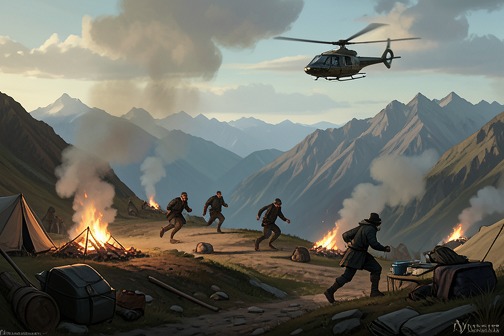
[The battle at the Shar-i-Safa camp](entity:event-recall-event-shar-i-safa-01009c7a6215) turns a risky attempt to seize the initiative into a devastating struggle for survival. After [Abdel Khader Khan](entity:character-recall-character-abdel-khader-khan-822d0cbbc88e)’s death, the men’s position on the mountain becomes exposed to Afghan army forces and Russian air power; a strike that kills eight Afghan soldiers is followed within an hour by a helicopter attack that costs the camp nine of its own men and drives the survivors to flee.
## Causes and strategic setting
The attack follows the destruction of Abdel Khader Khan’s returning column. [Suleiman Shahbadi](entity:character-recall-character-suleiman-shahbadi-e62ae720ba3a) and [Khaled Ansari](entity:character-recall-character-khaled-ansari-579dc41e3899) believe the Afghan army has regrouped after that battle and may have followed [Nazeer](entity:character-recall-character-nazeer-70724b855ba6)’s trail or obtained information from prisoners. Their explanation is a considered suspicion, not a confirmed account. They expect further attacks and fear that Russian support could bring helicopters once the weather clears. Remaining on the high ground, they conclude, could eventually mean losing the position and more men.
The immediate danger is set against a longer history of war that Abdel Khader Khan has related to [Lin](entity:character-recall-character-lin-428ebd96b429). In November 1878, the British forced their way through the [Khyber Pass](entity:location-recall-location-684e2314fb89), beginning the Second Anglo-Afghan War. Lord Frederick Roberts captured [Kabul](entity:location-recall-location-fa0d480263ce) and imposed martial law; Abdel Khader Khan recounts the execution of eighty-seven Afghan soldiers and the destruction and deaths that followed. He also describes Ayub Khan, his ancestor, raising an army against the British, and the Battle of [Maiwand](entity:location-recall-location-ac1811a33ea0), where the Afghans defeated a British and Indian force before the Siege of [Kandahar](entity:location-recall-location-kandahar-06ce6574e7a2) began. The history gives the current struggle a long perspective, without making its competing causes or costs disappear.
## The counterattack and its reversal
With few viable options, Suleiman Shahbadi decides on two mortar counterattacks. The fourteen-man strike force divides into two teams: Khaled Ansari and Habib lead one, while Suleiman Shahbadi leads the other. Lin remains at the camp with four sentries to care for the wounded. Following Habib’s directions, the teams position their mortars about a kilometre from the enemy camps, within effective range, and begin bombarding shortly after dawn. The firing continues for half an hour.
When the strike teams enter the ruined camps, they find eight Afghan soldiers, not all of them dead. Habib acts against the survivors. The others return to the camp sickened by what they have allowed him to do, hoping not to see him again. The episode makes the counterattack’s moral cost immediate: military success is measured in enemy casualties, but the men who carry it out cannot treat what follows as a clean victory.
Less than an hour after their return, a counter-bombardment strikes the compound. As the survivors emerge from cover, a Russian helicopter rises over the camp and fires rockets toward the caves. Lin is caught in the attack and shelters in a narrow cleft in the rocks. The aircraft makes further passes against the caves before opening fire on the exposed ground. The scene sharply changes the balance of the fight: the men who had just attacked enemy positions are now under assault from a force they cannot readily reach.
## Losses and the defense of the camp
Some of the defenders return fire with Russian PK machine guns. Another man launches rockets from an AK-74; the shots miss, but the combined fire hits the helicopter and helps persuade its pilot to withdraw. [Jalalaad](entity:character-recall-character-jalalaad-3bac5877e9b8), a young Hazarbuz nomad, leads the counterattack. After handing off the PK, he takes an AK-74 with a taped double magazine and leaves with two other young men to search for enemy soldiers who might have approached under cover of the aircraft. Their boldness contrasts with Lin’s initial instinct to hide, and converts the defense from passive endurance into a brief, dangerous challenge to the helicopter.
The camp’s losses are severe. Of the twenty men there at the start, eleven remain after the attack, including three wounded men. Nine have been lost—one more than the eight Afghan soldiers killed in the mortar strike. Lin tends the wounded, but the camp’s medical supplies and food have also been damaged or destroyed. The survivors can recover some medicines and basic supplies from the wreckage, and they still have ammunition and snow for water; food, however, becomes an urgent concern. The tally of men and resources makes clear that holding the position is no longer a realistic plan.
## Retreat and the battle’s continuing consequences
Suleiman Shahbadi and Khaled Ansari decide that the survivors must leave for a cave on another mountain, about twelve hours’ march to the east. They expect another Russian helicopter within hours and believe ground forces will soon follow. Khaled relays the orders: each man is to carry two canteens filled with snow inside his clothes, along with weapons, ammunition, medicines, blankets, a little fuel and wood, and the surviving goat. The men leave hungry and settle in the new cave for four weeks. They divide the goat into small daily portions and preserve the cooked meat in an improvised store in the snow. The retreat extends the battle beyond the moment of attack: survival now depends on conserving food, water, medicine, and strength.
The fighting also shapes Lin’s understanding of what the war demands. Earlier, while being tortured in [Arthur Road Prison](entity:location-recall-location-arthur-road-prison-50f3a84a4e65), he recalls reaching a choice between hatred and forgiveness and deciding that forgiveness was necessary to survive. That memory does not erase anger or make violence harmless; in the Afghan campaign, Lin continues to confront the costs of both action and survival. His experience at the camp gives concrete weight to the chapter’s reflection that men may begin wars for profit or principle, while the immediate struggle increasingly narrows to survival and the protection of home and loved ones. The battle ends not with security or resolution, but with a depleted group forced to move on. Later, during their descent from the mountain, the men hear enemy mortars finding their range, confirming that leaving the camp has not ended the danger.
Event 72
The Second Anglo-Afghan War
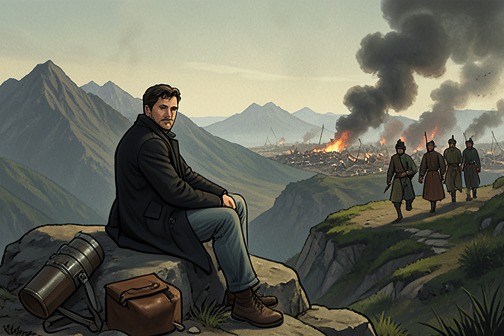
[The Second Anglo-Afghan War](entity:event-recall-event-4f2056c289d7) is recalled by [Abdel Khader Khan](entity:character-recall-character-abdel-khader-khan-822d0cbbc88e) as a conflict in which military victories and defeats could not be separated from the history of families, cities, and inherited loyalties. During a pause on a mountain overlooking [Kandahar](entity:location-recall-location-kandahar-06ce6574e7a2), he traces the British campaign from the [Khyber Pass](entity:location-recall-location-684e2314fb89) to the siege and relief of the city. His account turns military history into a personal inheritance, while making Kandahar the key to understanding the war around him.
## The British advance and Ayub Khan’s campaign
Khader dates the beginning of the war to November 1878, the same month his group began its mission. The British forced their way through the Khyber Pass, and Lord Frederick Roberts captured [Kabul](entity:location-recall-location-fa0d480263ce), where he imposed martial law. Khader describes the consequences as severe: eighty-seven Afghan soldiers were hanged in a public square, buildings and markets were destroyed, villages were burned, and hundreds of Afghans were killed. In his telling, the campaign’s violence reaches beyond the battlefield into the ordinary places where people lived and traded.
The account also places resistance within Khader’s family history. In June, Prince Ayub Khan announced a jihad to drive out the British and left Herat with ten thousand men. Khader identifies Ayub as an ancestor and says many of his kinsmen served in the army the prince raised. The war is therefore not distant background for him: its military events are bound to the losses and loyalties that shaped his own family. His description of the British as having forced their way into the country underscores the opposing perspectives contained in the story: what one side records as a campaign, the other remembers as an invasion.
## [Maiwand](entity:location-recall-location-ac1811a33ea0) and the siege of Kandahar
The decisive battle in Khader’s account takes place at Maiwand. The British officer responsible for Kandahar, Burrows, marched out with 1,500 British and Indian soldiers to meet Ayub Khan’s army. Khader describes both sides using cannons, with hundreds killed, and then fighting at close range. The British lost half their number; the Afghans lost 2,500. Despite those losses, the Afghans won, forcing the British back to Kandahar. Ayub then surrounded the city, beginning its siege.
Khader’s attention to the numbers and sequence makes the reversal plain: a British force had advanced into the country, but at Maiwand it was defeated and driven back to a city under threat. The battle’s meaning in his account is not limited to its casualty figures. Maiwand links Ayub’s campaign to the fate of Kandahar, where the war’s immediate stakes became a prolonged contest over whether the British garrison could be relieved.
## Roberts’s march and the city’s strategic meaning
Roberts later marched from Kabul with 10,000 men to relieve the siege. Two-thirds of his force were Indian soldiers, whom Khader explicitly recognizes as capable fighters. The march covered 300 miles in twenty-two days, crossing from freezing mountains to burning desert. Khader compares it with the journey he and [Lin](entity:character-recall-character-lin-428ebd96b429) had made from Chaman: their own passage had taken a month, even with good horses and help from villages. The comparison brings the historical campaign into the present conversation, measuring a famous military march against the hardships of the travelers’ own route.
After twenty days of marching, Roberts’s force fought Ayub Khan’s army and defeated it. Roberts saved the British in Kandahar and became known as Roberts of Kandahar. Yet Ayub escaped; his defeat in this campaign did not end his life. The British subsequently placed Abdul Rahman Khan, a close kinsman of Ayub and another of Khader’s ancestors, on the Afghan throne. Khader says Abdul Rahman ruled with enough wisdom that the British held no real power in [Afghanistan](entity:location-recall-location-afghanistan-ea09a8d619a6), leaving the country’s situation much as it had been before the war. In his account, military intervention produces a change of ruler without securing lasting British control.
## Family memory and the war in the present
Khader’s recollection is also shaped by [Mackenzie Esquire](entity:character-recall-character-mackenzie-esquire-2376064c836f), his first teacher and friend. Mackenzie taught him the saying [Bobs your uncle](entity:expression-recall-expression-bobs-your-uncle-d02e9c25359c), which Khader later learned was associated with Roberts. British soldiers had used the phrase because Roberts was kind to them; to Khader, the discovery gave the saying a painful double meaning, since Roberts had killed members of his people. Khader stopped using it. The connection deepened when he learned that Mackenzie’s grandfather had fought in Roberts’s army against Khader’s kinsmen. The two families had inherited opposing sides of the same war, yet Khader recalls Mackenzie as a friend and teacher while men who bore the scars of that conflict were still alive.
This history becomes the frame through which Khader reads the contemporary fighting near Kandahar. From the mountain, he sees the distant city and speaks of fires there as the result of a new war, in which men who had once lived as teachers and merchants were now attacking their own homes, shops, and schools. He argues that Kandahar is the key to Afghanistan: Kabul is its heart, but Kandahar is its soul, and whoever rules Kandahar rules the country. He therefore predicts that the Russians will lose the war only when they are forced to leave the city. The Second Anglo-Afghan War matters in this scene both as a remembered precedent and as a warning that the fate of Kandahar can outlast a single battle or campaign.
Event 73
The Battle of Maiwand
[The Battle of Maiwand](entity:event-recall-event-e279ddb974db) is presented as an Afghan victory whose consequences extended beyond the battlefield: the British force retreated to [Kandahar](entity:location-recall-location-kandahar-06ce6574e7a2), where Prince Ayub Khan’s army began a siege. In [Abdel Khader Khan](entity:character-recall-character-abdel-khader-khan-822d0cbbc88e)’s account, the battle is also family history, linking the conflict to his own Afghan ancestry.
## Background and Forces
Abdel Khader Khan places the battle within the British campaign in [Afghanistan](entity:location-recall-location-afghanistan-ea09a8d619a6). The British officer responsible for Kandahar, Burrows, marched out of the city with 1,500 British and Indian soldiers to meet Prince Ayub Khan at [Maiwand](entity:location-recall-location-ac1811a33ea0). Khader relates the event from a vantage point near the battlefield, describing Maiwand as visible from where he and [Lin](entity:character-recall-character-lin-428ebd96b429) are sitting when the weather permits.
## The Battle and Its Outcome
The two armies exchanged cannon fire before confronting each other at close range. The fighting caused hundreds of deaths. The British lost half their force; the Afghans lost 2,500 men. Despite those losses, the Afghans won, and the British survivors were forced to retreat to Kandahar.
## The Siege and Family Memory
Prince Ayub Khan immediately surrounded Kandahar, beginning the siege. Khader’s account gives the battle a personal dimension: he identifies Ayub as an ancestor and says that many of his kinsmen served in the army Ayub raised. The victory is therefore recalled both as a decisive military outcome and as part of the family history through which Khader understands Afghanistan’s past.
Event 74
The Siege of Kandahar
[The Siege of Kandahar](entity:event-recall-event-7ab1eaf395f4) was the crisis that followed Prince Ayub Khan’s victory over a British and Indian force at [Maiwand](entity:location-recall-location-ac1811a33ea0). As [Abdel Khader Khan](entity:character-recall-character-abdel-khader-khan-822d0cbbc88e) recounts it to [Lin](entity:character-recall-character-lin-428ebd96b429), the city’s relief became a decisive contest over who could command [Afghanistan](entity:location-recall-location-afghanistan-ea09a8d619a6): Roberts’s rapid march from [Kabul](entity:location-recall-location-fa0d480263ce) broke the siege, while the episode’s family histories and political aftermath give it meaning beyond a single military campaign.
## Causes and the Battle of Maiwand
In Khader’s account, the conflict begins with the British occupation of Kabul and the harsh rule imposed there by Lord Frederick Roberts. In June, Prince Ayub Khan left Herat with ten thousand men and announced a jihad to drive out the British. The British officer responsible for [Kandahar](entity:location-recall-location-kandahar-06ce6574e7a2), Burrows, marched out of the city with fifteen hundred British and Indian soldiers to meet him at Maiwand. Ayub’s victory forced the British back to Kandahar, which he then surrounded, beginning the siege.
The battle had exacted heavy losses on both sides: the British lost half their force, while the Afghans lost two thousand five hundred men. Khader presents the battle as both a military reversal and a family inheritance. Ayub was his ancestor, and many of Khader’s kinsmen served in the army he raised. He also links the conflict to his former teacher, [Mackenzie Esquire](entity:character-recall-character-mackenzie-esquire-2376064c836f), whose grandfather had fought in Lord Roberts’s army. The war had placed their forebears on opposing sides.
## Roberts’s Relief March
Roberts set out from Kabul with ten thousand men to relieve Kandahar. Two-thirds of his force were Indian soldiers, whom Khader recognizes as capable fighters. They covered the three hundred miles from Kabul to Kandahar in twenty-two days, crossing from cold mountain conditions to desert heat. After the march, Roberts’s army fought Ayub’s forces and defeated them, saving the British-held city.
Khader makes the speed and hardship of the march part of his comparison with his own journey alongside Lin from Chaman: that shorter journey had taken them a month, even with good horses and help from villages. The contrast underscores the scale of Roberts’s achievement without obscuring its purpose: the force’s arrival turned the siege into a British victory and made Kandahar the place by which Roberts would thereafter be known.
## Aftermath and Significance
Ayub escaped after his defeat. The British then put his close kinsman Abdul Rahman Khan, another of Khader’s ancestors, on the Afghan throne. Khader says Abdul Rahman ruled with enough political skill that the British had no real power in Afghanistan, presenting the outcome as a return to an earlier balance rather than a lasting British settlement.
Khader tells this history while he and Lin look toward the fires of Kandahar in the later war. He argues that Kabul is Afghanistan’s heart but Kandahar its soul: whoever rules Kandahar, he believes, rules Afghanistan. On that reading, the city’s fate is the strategic measure of the contemporary conflict too. Roberts’s relief of the nineteenth-century siege supplies Khader with a precedent for his prediction that the Russians will lose the war if forced out of Kandahar.
Event 75
Robert’s march from Kabul to Kandahar and the Battle of Kandahar
[Robert’s march from Kabul to Kandahar and the Battle of Kandahar](entity:event-recall-event-robert-0b7a7f460c62) are presented as a military victory whose consequences reached beyond the battlefield. In [Abdel Khader Khan](entity:character-recall-character-abdel-khader-khan-822d0cbbc88e)’s account, the campaign both relieved the British-held city and illustrates why control of [Kandahar](entity:location-recall-location-kandahar-06ce6574e7a2) matters to the fate of [Afghanistan](entity:location-recall-location-afghanistan-ea09a8d619a6).
## The March and Battle
Abdel Khader Khan recounts that Lord Roberts set out from [Kabul](entity:location-recall-location-fa0d480263ce) with ten thousand men to relieve the siege of Kandahar. Two-thirds of the force were Indian soldiers, whom he describes as capable fighters. Roberts covered the three hundred miles between the cities in twenty-two days—a faster journey than the month-long trip from Chaman that Abdel Khader Khan and [Lin](entity:character-recall-character-lin-428ebd96b429) had made with horses and help from villages along the way.
The march crossed freezing, snowbound mountains and then burning desert. Abdel Khader Khan says that after twenty days of this arduous journey, Roberts’s force fought the army of Prince Ayub Khan and defeated it. The victory relieved the British in Kandahar; Ayub was not killed, but escaped.
## Political Consequences
After the defeat, the British placed Ayub’s close kinsman, Abdul Rahman Khan, on the Afghan throne. Abdel Khader Khan portrays Abdul Rahman’s rule as wise and argues that, under him, the British had no real power in Afghanistan. In his telling, this outcome restored a political situation resembling the one before Roberts’s campaign.
## Kandahar’s Strategic Meaning
Abdel Khader Khan makes the battle part of an argument about the relationship between Kandahar and the country as a whole: Kabul is Afghanistan’s heart, he says, while Kandahar is its soul, and whoever rules Kandahar rules Afghanistan. He connects that claim to the war unfolding around them, predicting that the Russians will lose once they are forced to leave the city. This is his strategic judgment, voiced as he and Lin look toward his burning city, rather than a reported outcome of the earlier battle.
## The Recounting
The episode is embedded in Abdel Khader Khan’s conversation with Lin, not narrated as a present-day battle scene. His comparison between Roberts’s march and their own journey from Chaman gives the historical distance a personal measure, while the shift from the British victory to the burning city brings the story back to the war surrounding them. The account thus serves both as a compact history of the campaign and as Abdel Khader Khan’s explanation of why Kandahar remains pivotal.
Event 76
Stinger missiles are introduced into the Afghan War
The introduction of [Stinger missiles](entity:object-recall-object-5678ec0da6cf) into the Afghan War is presented as a turning point whose military significance cannot be separated from its human cost. Several months after [Abdel Khader Khan](entity:character-recall-character-abdel-khader-khan-822d0cbbc88e) leads his group into [Afghanistan](entity:location-recall-location-afghanistan-ea09a8d619a6), the missiles begin to alter the balance between the [Afghan mujaheddin](entity:organization-recall-organization-5fa8616071fe) and [Russian forces in Afghanistan](entity:organization-recall-organization-russian-forces-i-3c99012806bb). [Lin](entity:character-recall-character-lin-428ebd96b429) narrates this change from inside the conflict, where villagers ask him about weapons and where he has to face the gap between their expectations and what he can actually deliver. The new weapon may help tip the war, but victory does not undo the devastation already set in motion.
## The question behind the weapon
Before the missiles arrive, the question follows Lin through Afghanistan: when will the villagers receive Stingers? An Afghan leader, Hajji Mohammed, asks him directly. Lin has rehearsed a hopeful answer, promising that the weapons will come soon if Allah wills it. The answer satisfies Hajji Mohammed, but Lin recognizes that it is a lie rather than a reliable assurance. The villagers understand what the weapon could mean, and the question expresses more than curiosity about military supplies: it is a demand to know whether the resistance will be given a way to challenge the enemy’s control of the sky.
The missiles matter because Russian forces in Afghanistan possess an overwhelming advantage in the air. Lin explains that Russian helicopters can strike the resistance with deadly effectiveness, while MiG fighters are also formidable. A hand-launched Stinger could bring either kind of aircraft within reach. If the mujaheddin could deny their opponents that advantage, the conflict would be forced onto the ground, where Lin says the Russian forces and their [Afghan Government Army](entity:organization-recall-organization-c7f879b3d74f) proxies could not prevail against the resistance. The weapon therefore signifies a change in what the villagers can imagine doing: not merely enduring attacks from the air, but striking back.
## A disputed policy and a decisive arrival
Some Afghan cynics believe that the [United States](entity:location-recall-location-united-states-2f533bc8d0b9) withheld Stingers during the first seven years of the conflict deliberately. In their account, American policymakers wanted the Soviet Union to become overextended before supplying a weapon that could impose a costly defeat. This is reported as a suspicion held by the Afghans, not as a motive Lin establishes as fact. He distinguishes that uncertain explanation from the course of events as he understands it: when the missiles finally arrive, they do turn the tide, and the resistance weakens the Soviet Empire until it crumbles.
That retrospective account makes the delay part of the event’s meaning. The missile’s arrival is not described as a timely rescue that prevents the war’s losses; it comes after years in which the air advantage has already shaped the conflict. Lin’s earlier assurances to Afghan villagers also acquire a sharper edge in retrospect. Their question is answered eventually by events, but his promise could not make the weapons available, and he knew he was offering hope without the power to fulfill it.
## The cost of the turning point
Lin measures the consequences in lives and displacement. He says that the war costs a million Afghan lives and forces one-third of the population from its homeland. Three and a half million refugees move through the [Khyber Pass](entity:location-recall-location-684e2314fb89) to [Peshawar](entity:location-recall-location-peshawar-4ec806638d35); another million are exiled in [Iran](entity:location-recall-location-0f24c5ab412b), [India](entity:location-recall-location-india-39df7eae59c1), and the Muslim republics of the Soviet Union. Fifty thousand men, women, and children lose one or more limbs in land-mine explosions. These figures make the change in military fortunes impossible to treat as a clean victory. The Soviet Empire’s collapse is part of the outcome, but so are a country’s mass displacement and losses borne by civilians as well as fighters.
Lin’s account joins strategic result to human consequence rather than allowing the result to stand alone. The Stingers can make aircraft vulnerable and help the resistance prevail, yet the war’s price is measured across villages emptied, families uprooted, and bodies permanently marked by mines. The language of a turning tide describes what changes militarily; the scale of death and exile describes what that change does not repair. The weapon alters the course of the conflict, not its human ledger.
## Lin as witness and participant
Lin does not recount the event as a detached observer. He calls himself a wanted criminal working for a mafia leader, and admits that he impersonated an American while speaking to Afghan villagers. He looked them in the eye and lied about weapons he could not give them. His confession complicates his position in the mission: he is close enough to hear the villagers’ repeated demand and to understand the stakes, but he is not the official who can decide whether or when the missiles arrive. His rehearsed promise briefly reassures Hajji Mohammed, even as Lin knows that it cannot guarantee anything.
The event thus exposes a divide between military power and the people who bear the war. The villagers know what the Stingers could do; the decisions about supplying them lie elsewhere. Lin stands in the uncomfortable space between those facts, carrying a borrowed national identity and offering words in place of weapons. By placing his lie beside the eventual arrival and the immense losses, the narrative makes the turning point both a strategic reversal and an indictment of the distance between promises, policy, and the lives caught in war.
Event 77
Khader's mujaheddin unit's final escape and battle
[Khader's mujaheddin unit's final escape and battle](entity:event-recall-event-khader-s-mujaheddin-uni-14690e7054d3) is the attempt by [Lin](entity:character-recall-character-lin-428ebd96b429) and five companions to break out of a mountain compound, an escape that collides with a larger assault and turns into a friendly-fire disaster. The men reach safety only after deaths, serious wounds, and [Nazeer](entity:character-recall-character-nazeer-70724b855ba6)’s act of protecting Lin; the battle’s aftermath makes clear that what had seemed to Lin like glory was, in part, the senseless cost of a confused war.
## The escape plan
The immediate circumstances are those of exhaustion and hunger. Before dawn, the men force themselves to eat a soup prepared for them, then wait as their bodies recover. After prayers, they assemble near the compound’s south-eastern edge, at the steep slope [Habib Abdur Rahman](entity:character-recall-character-habib-abdur-rahman-4c7533b4f31c) had recommended as their best chance to fight their way to freedom. His advice seemed credible to them because he had planned to join the attack. Their trust in the route rests on the information they have, not on knowledge of the larger movements around the mountain.
There are six men in the group: Lin, [Suleiman Shahbadi](entity:character-recall-character-suleiman-shahbadi-e62ae720ba3a), [Mahmoud Melbaaf](entity:character-recall-character-mahmoud-melbaaf-8942c7d7faa1), Nazeer, [Jalalaad](entity:character-recall-character-jalalaad-3bac5877e9b8), and the young Ala-ud-Din. The moment of departure sharpens Lin’s awareness of how little he knows Jalalaad, despite having spent months alongside him. The men check their weapons, exchange embraces and handshakes, and look down the slope. That small gathering is both a practical preparation for flight and a farewell whose significance none can avoid.
Suleiman gives the order, and the group crosses the ridge into a clear dawn. The descent begins cautiously over snow, then quickens as the ground becomes less steep. Lin recalls having thought that the Afghan mountains, like prison, offered no true dawn or sunset; now the morning seems unusually beautiful. The contrast between the open landscape and the men’s confinement gives their escape its first promise of freedom, but the sound of mortar explosions soon replaces the quiet of the descent.
## The charge and the mistaken attack
At first, the distant explosions do not alarm Lin. As the mortar fire draws closer, however, he sees the other men running harder and struggles to make his numb legs keep pace. Shells burst near him, and the exchange of AK-74 fire shows that the opposing positions are close enough for both sides to inflict casualties. The escaping men cannot see clearly where the enemy is, so they press forward over rough ground while trying to find a path that offers some protection.
Jalalaad is killed by a mortar shell while running near Nazeer. Further ahead, Suleiman is struck and falls; the survivors have to continue over the rocky ground as the attack intensifies. Lin sees flashes from the enemy Kalashnikovs and a tracer round pass close by. At that point, the group appears badly outmatched: the enemy has time to aim at them, while the men are exposed in the open.
The firing then changes abruptly. Explosions hit the enemy positions, and Nazeer and Mahmoud Melbaaf fire as they run; Lin raises his own weapon and joins them. In the moment, Lin reads the blasts as the opposing force accidentally striking itself. The later account reveals a different, larger cause: [Ahmed Shah Massoud's forces](entity:organization-recall-organization-ahmed-shah-masso-099b75e614ae) had been preparing their own attack, and the sentries in the enemy camp, startled by the escape attempt, opened fire. Massoud’s men interpreted that shooting as a pre-emptive attack and began their assault. Their mortar strikes against the Russian positions were real, but other mortar rounds hit the escapees by mistake.
## Lin is wounded; Nazeer protects him
A mortar round bursts close enough to knock Lin down and leave him unconscious. He later learns that fragments wounded him in several places, while the blast damaged his left eardrum. The immediate experience is one of being overwhelmed by the explosion and losing consciousness, not a clear view of how the others fare. The violence of the battle is therefore initially registered through a gap in his memory, which the survivors’ later account must fill.
Nazeer, himself wounded in the legs and arm, drags Lin into a shallow depression for shelter. He then covers Lin with his own body while the bombardment continues. A piece of metal strikes Nazeer in the shoulder rather than Lin, and after the firing subsides he pulls Lin to safety. The rescue turns the attempted escape into an act of personal loyalty: Nazeer does not merely survive beside Lin but places himself between his unconscious companion and further danger.
## The aftermath and what the survivors learn
Nazeer and Lin remain on the battlefield through the cold day and into evening. The returning survivors find them there; Mahmoud Melbaaf and Ala-ud-Din bring back the bodies of Suleiman and Jalalaad. The group’s losses are thus made present in the aftermath of the escape, when the men who had set out together must account for those who will not continue with them. The surviving Ala-ud-Din is later remembered as having escaped unharmed, while Nazeer’s wounds leave him with a lasting limp.
Only gradually do the survivors piece together the military sequence. The Russian and Afghan force had been searching for Habib Abdur Rahman, whose atrocities had made the pursuit intensely personal for its soldiers. Many of those troops were occupied laying mines and traps on the far side of the mountain. The sentries left in the enemy camp fired wildly when the escapees appeared, and that gunfire precipitated Massoud’s planned attack. The mortars that seemed to Lin to be the enemy’s own shells exploding were, in fact, direct hits by Massoud’s forces; the rounds that tore into the escaping line were accidental friendly fire. After the survivors fell, Massoud’s men pursued the retreating enemy and destroyed the force sent to capture Habib.
Massoud’s forces and independent Achakzai fighters then secured the Chaman highway from the pass toward the Russian defensive perimeter around besieged [Kandahar](entity:location-recall-location-kandahar-06ce6574e7a2), less than fifty kilometres from the city. The evacuation toward Chaman and through [Chaman Pass](entity:location-recall-location-chaman-pass-2f5f0ecda918) into [Pakistan](entity:location-recall-location-pakistan-041a2aec3e49) was rapid. The survivors travelled by truck with their dead companions, covering in hours a route that had taken them a month to cross on Khader’s horses. In the weeks that followed, they moved repeatedly between tents, slum huts, and hidden rooms to avoid attracting the attention of Pakistan’s secret service. Nazeer’s successful recovery was incomplete: the wound in his right thigh impaired his leg, and he continued to walk with a limp.
## Courage without glory
During the charge, Lin experiences the men running together as a moment of fierce exaltation and calls it glorious in his mind. The explanation of the battle changes the meaning of that response. What he had perceived as a decisive moment of resistance was partly the result of friendly fire, and the deaths in his own group did not become less real because Massoud’s attack succeeded against the enemy. The later narration rejects glory as an adequate name for the event and concentrates instead on the courage, fear, and love that war destroys one life at a time.
That reversal also shapes the episode’s account of survival. The escape succeeds in the limited sense that Lin and the other survivors reach Pakistan, but it does not restore the group as it was: Suleiman Shahbadi and Jalalaad are dead, Lin is badly shaken and wounded, and Nazeer bears lasting consequences from saving him. The final movement is neither a clean victory nor a return to ordinary safety. It is a passage out of the mountains with the dead carried alongside the living, and with Lin’s understanding of the battle revised by the survivors’ knowledge of how it actually unfolded.
Event 78
The death of Khader Khan
[Khader Khan](entity:character-recall-character-khader-khan-2bf2b74321b0)’s death closes his Afghan campaign not with a settled account of its final moments, but with the consequences carried by the survivors: bodies recovered from the mountain, a hurried evacuation, and news that [Lin](entity:character-recall-character-lin-428ebd96b429) must eventually deliver to [Abdul Ghani](entity:character-recall-character-abdul-ghani-d1a4aca9ef78). Lin has held Khader’s body and still refuses to face what that means. When he finally speaks, the loss becomes both personal grief and a reckoning with the costly war Khader had pursued.
## The fatal return
Khader was killed by [Russian forces in Afghanistan](entity:organization-recall-organization-russian-forces-i-3c99012806bb) while trying to reach his village on the way back to Chaman. He was carrying horses to deliver there. The account gives this purpose and circumstance, but not a detailed description of the killing; its emphasis falls instead on the interrupted return and the fact that Khader did not make it home.
The journey back had been bound up with Khader’s horses and the mountain route taken by his group. After the fighting, the surviving mujaheddin and members of Lin’s unit returned to the battleground, where Mahmoud and Ala-ud-Din brought Suleiman and [Jalalaad](entity:character-recall-character-jalalaad-3bac5877e9b8) down from the mountain. Lin and [Nazeer](entity:character-recall-character-nazeer-70724b855ba6) had stayed there through the cold day and into evening. These recovered dead make the loss larger than Khader’s alone: his death belongs to a retreat in which companions were killed and survivors were left to gather what remained of their group.
## Survivors and the journey out
The group’s route out of the area changed sharply after the battle. Massoud’s men and independent Achakzai fighters had taken the Chaman highway from the pass toward the Russian defensive perimeter around besieged [Kandahar](entity:location-recall-location-kandahar-06ce6574e7a2). The evacuation through Chaman and the pass into [Pakistan](entity:location-recall-location-pakistan-041a2aec3e49) proceeded rapidly and without incident. Lin and the others travelled by truck with their dead friends, reaching the checkpoint in hours—a striking contrast with the month-long mountain journey they had made on Khader’s horses.
Survival did not mean that the living emerged untouched. Nazeer recovered from wounds to his arm and shoulder, but a deeper injury to his right thigh left the upper leg stiff and his walk altered. His recovery is one of the few concrete continuations offered after the battlefield: the company has escaped, but the damage of the campaign remains present in the bodies and movement of those who survived. Khader’s death is thus situated within both an immediate loss of life and a longer aftermath of injury, bereavement, and departure.
## Lin tells Abdul Ghani
Months later, Lin encounters Abdul Ghani and sees how the intervening nine months have aged him. Lin tells him at once that Khader is dead, explaining that he was killed by the Russians while trying to reach his village with the horses. Abdul Ghani breaks down, then asks who survived. Lin names Nazeer, Mahmoud, and Ala-ud-Din, and says that only four of them remain. Abdul Ghani asks specifically about Khaled; Lin can offer no resolution, only that Khaled went out into the snow on the last night and did not return, and that distant shooting was later heard. He cannot say whether Khaled was the target.
The exchange distinguishes confirmed death from unresolved disappearance. Khader’s fate is known, while Khaled’s remains uncertain, and Abdul Ghani’s immediate thought turns to Nazeer as the next person in the chain of loss. Lin watches Abdul Ghani grieve but does not join him openly. Since cradling Khader’s body on the snowy slope, Lin has resisted accepting the death. His anger at Khader has served as a shield against love, longing, and tears; it has also let him concentrate on the work he came to do, asking for information about [Krishna](entity:character-recall-character-krishna-41997d28ff51), [Villu](entity:character-recall-character-villu-c01b81125179), and the passport workshop. The report therefore arrives at a moment when Lin is still trying to keep grief at a distance.
## The cost of Khader’s death
Abdul Ghani describes Khader’s war as the consequence of what he calls Khader’s hero curse. Beyond the value of Khader’s life, he says, the conflict cost their organization millions and had required support over years. The financial burden does not explain the death or reduce it to an account of expenditure; it reveals another consequence of Khader’s campaign for the people and organization left behind. Abdul Ghani says he could not change Khader’s mind or save him, and laments that money meant nothing to a man who had no sense of its value.
The conversation gives the death two scales of consequence without resolving the tension between them. Khader is a singular loss to his old friend and to Lin, who has held his body and cannot yet mourn him freely. At the same time, his choices have left the organization with a costly war, a depleted group, and surviving members who must continue after the campaign. Lin’s narration places those facts beside one another rather than making one cancel the other: the financial reckoning cannot contain the human loss, while private sorrow does not erase what the war demanded. The delayed telling to Abdul Ghani becomes the point where the battlefield’s dead, Khaled’s unresolved fate, and Lin’s defended grief meet.
Event 79
Habib's death and Khaled's disappearance
[Habib Abdur Rahman](entity:character-recall-character-habib-abdur-rahman-4c7533b4f31c)’s death and [Khaled Ansari](entity:character-recall-character-khaled-ansari-579dc41e3899)’s disappearance form a single turning point: Habib is killed by the same man whose knife he uses, and Khaled soon leaves the camp alone, never to return. [Lin](entity:character-recall-character-lin-428ebd96b429) witnesses both events, but the killing brings neither certainty nor relief; it is followed by a departure whose meaning and outcome remain unknown.
## The killing and its immediate aftermath
The scene follows Khaled’s account of the experiences that brought him to [Abdel Khader Khan](entity:character-recall-character-abdel-khader-khan-822d0cbbc88e), whom he regarded as the one great man in his life. His words have brought him to tears, and Lin, still wanting to hear the parts of Khaled’s history that he has not been told, listens in the freezing mountain camp. A scream abruptly interrupts them. Lin and the others reach its source to find Khaled kneeling beside Habib’s body.
Habib has been killed with Khaled’s distinctive knife, driven into his throat. The resemblance to Habib’s earlier violence is deliberate and unmistakable: the same method had been used against their horses and against Siddiqi. The familiar carved horn handle identifies the weapon as Khaled’s, making the killing plain to the assembled men without any explanation from him.
[Nazeer](entity:character-recall-character-nazeer-70724b855ba6) and Suleiman help Khaled rise, but he soon kneels beside Habib again and removes two metal fragments from the dead man’s clothing. The pieces are souvenirs from the tank destroyed by [Jalalaad](entity:character-recall-character-jalalaad-3bac5877e9b8), Hanif, and Juma, which the friends had worn around their necks. Jalalaad takes them back. As Khaled walks away, Jalalaad attacks Habib’s body in rage; Lin, though glad that Habib is dead and once eager to kill him himself, finds himself grieving for him. He remembers that the dangerous man had once been a kindergarten teacher, a stark contrast that unsettles any simple distinction between monster and human being.
## Khaled's departure into the snow
Back at the cave, Khaled Ansari murmurs in Arabic, his expression fixed with an intensity that Lin reads as frightening resolve. He removes his canteen belt and cartridge belt, then empties his pockets until only his clothes remain. Around him lie the objects that had accompanied his life on the road: false passports, money, letters, a wallet, weapons, jewelry, and photographs of his long-dead family. When Lin asks what he is saying, [Mahmoud Melbaaf](entity:character-recall-character-mahmoud-melbaaf-8942c7d7faa1) identifies the words as passages from the Koran.
Khaled walks toward the edge of the camp, chanting as though absorbed by a vision. Lin tries to turn him back, first pushing him and then embracing him, but Khaled does not resist or respond. Lin calls for help; Nazeer, Mahmoud Melbaaf, and [Suleiman Shahbadi](entity:character-recall-character-suleiman-shahbadi-e62ae720ba3a) intervene not to hold Khaled, but to prise Lin away. Lin breaks free and tries again, shouting and striking at Khaled in an effort to rouse him, then clinging to him as the others restrain Lin. The scene reverses their expected roles: Khaled moves forward without resistance, while Lin is the one struggling against the men who keep him from following.
The others finally hold Lin back as Khaled walks out of the compound into the winter. Mahmoud Melbaaf asks afterward whether Lin saw Khaled’s face. Lin’s answer comes through his sobbing; he then returns to the cave, unable to explain or alter what he has witnessed. The departure remains unresolved in the immediate scene: Khaled has left the camp, but no one knows what the vision or his chanting means, or what awaits him beyond it.
## The uncertain aftermath
The later account preserves the departure as an unresolved loss rather than a confirmed death. In a retrospective roll call of the men gathered around Abdel Khader Khan, Lin identifies Khaled Ansari as the man who killed Habib and then walked into the snow, while naming Nazeer, Mahmoud Melbaaf, and Ala-ud-Din among those who survived. When asked where Khaled went, Lin says he never returned and that the men later heard shooting from far away; he cannot say whether Khaled was its target or what ultimately happened to him. The contrast between the definite killing of Habib and the uncertainty surrounding Khaled’s fate gives the episode its lasting force: the camp witnesses Khaled leave, but neither the men there nor the later account can turn that departure into a known ending.
## Narrative significance
The episode sets physical evidence against limits of knowledge. Khaled’s knife makes the cause of Habib’s death unmistakable, and the metal fragments connect the killing to the losses that preceded it; yet the objects Khaled leaves behind cannot explain the vision guiding him, and the distant gunfire cannot establish his fate. Lin is left as a witness to an ending he can describe but cannot resolve. The difference between what the scene proves and what it withholds turns Khaled’s departure into an enduring absence rather than a confirmed death.
Event 80
Sena Mob Burns Madame Zhou’s Palace
The Sena mob’s destruction of [Madame Zhou](entity:character-recall-character-madame-zhou-d453e8a13327)’s Palace abruptly ends the place’s role as a functioning seat of Madame Zhou’s power. Reported to [Lin](entity:character-recall-character-lin-428ebd96b429) as an attack from ten days earlier, the event leaves the building standing but ruined, its feared former owner alive and without the authority or resources she once possessed.
## The Attack
A mob of Sena people entered the Palace, destroyed everything inside, and then set the building on fire. The account Lin receives describes a sweeping assault rather than damage to a single room or part of the property: the interior is devastated, and the fire marks the destruction of the Palace as an operating establishment.
## The Ruined Palace
The building does not collapse completely. Its staircases and upstairs rooms remain, but the place is ruined and will never open again. Demolition is expected at some point soon, making the standing structure a temporary remnant rather than a recoverable base for Madame Zhou’s former life.
## Madame Zhou’s Defeat
When Lin asks whether Madame Zhou died in the attack, he learns that she survived and is reportedly still at the Palace. Her survival does not amount to a recovery: her power has been destroyed, and she is described as having nothing and being reduced to a beggar. Her servants search the streets for scraps of food to bring her while she waits for the building to be pulled down. The attack therefore strips away both the physical stronghold and the material security that had sustained her authority.
Event 81
Lin Confronts Madame Zhou in the Ruined Palace
[Lin Confronts Madame Zhou in the Ruined Palace](entity:event-recall-event-lin-madame-zhou-7c28911fab28) is the turning point at which [Lin](entity:character-recall-character-lin-428ebd96b429)’s pursuit of revenge gives way to pity and restraint. In the fire-scarred attic of [Madame Zhou](entity:character-recall-character-madame-zhou-d453e8a13327)’s palace, he finds not the formidable enemy he expected but a woman apparently lost inside her own past; seeing her forces him to recognize the danger his hatred poses to himself.
## Discovery in the Attic
Lin reaches the attic through a narrow, winding secret corridor, whose grilles look into the rooms below. The attic has been reached by the fire but not wholly destroyed: four stained-glass dormer windows still admit light, while burn-darkened walls and holes in the floor surround islands of intact carpet, furniture, and wall space. Madame Zhou sits in a throne-like chair among these remnants. The setting makes her seem both hidden away and exposed, a survivor enclosed by the ruins of her own palace.
Her appearance and stillness do not match the powerful, calculating figure Lin had expected to confront. Her elaborate makeup and wig sit over signs of age, while her vacant expression and slack posture suggest that she is no longer directing her attention toward the present. Lin cannot determine her age or nationality. He recalls that [Karla](entity:character-recall-character-karla-3f7aa8a8ae5c) had said she was once beautiful and that [Didier Levy](entity:character-recall-character-didier-levy-bc900419ef54) had described her as defeated and broken; what he sees makes both judgments feel true. Her former beauty, he reflects, depended on more than physical features, and now seems emptied of the goodness that might have sustained it.
The sight does not satisfy Lin’s desire for revenge. Instead, he feels ashamed that he had filled his heart with it, and recognizes that the impulse to destroy Madame Zhou would make him resemble her. His thoughts turn from her past betrayal to his own responsibility in [Khader Khan](entity:character-recall-character-khader-khan-2bf2b74321b0)’s death: Lin had been Khader’s American guarantee against warlords and pirates, and believes he should have been with him when Khader tried to take horses to his village. That guilt had accompanied him since seeing Khader’s body beneath the snow. In the attic, the blame and sorrow loosen the hold of vengeance, leaving Lin able to pity Madame Zhou and consider forgiving her.
## The Attack and [Didier](entity:character-recall-character-didier-381547eab195)’s Intervention
The moment of release is interrupted by [Rajan](entity:character-recall-character-rajan-b88c52c5a766), Madame Zhou’s servant, who rushes at Lin and drives him toward an attic window. Lin manages to pull them back inside, and the two struggle until Rajan is forced away. The fight is not a planned confrontation with Madame Zhou but a defense against men who have chosen to protect her. Lin is already exhausted from the war and injured in the struggle when another Rajan appears through a gap in the floor. The resemblance makes him think the first attacker has somehow returned, before he recognizes that Madame Zhou has twin servants. The second man carries a knife, and the brothers attack together; Lin realizes, for the first time, that he might lose.
Didier Levy arrives carrying a gun and takes in the scene: Lin and the two brothers are hurt, while Madame Zhou remains in her chair. When the armed twin turns on him, Didier shoots him in the hip. The other brother moves to shield Madame Zhou, and Didier aims at him in turn. His calm readiness to use the gun exposes the force beneath his shabby appearance: he is prepared to kill the men if Lin wants him to. Didier urges Lin to look at what they have done and asks whether he wants to shoot them. Lin refuses, even when Didier offers to do it himself.
Lin’s refusal clarifies what has changed since he entered the attic. He is grateful that Didier stopped the brothers from killing him, but more grateful that Didier’s arrival prevented him from killing them. Lin recognizes their attack as an attempt to protect Madame Zhou, not a personal campaign against him, and asks Didier to leave them alone. Asked what should happen to Madame Zhou, Lin accepts that she is already beyond the person he had come to punish. He apologizes for not having understood this sooner, then lowers Didier’s gun with his hand. The surviving brother’s fear gives way to relief as he goes to his twin. Lin leaves by the secret corridor with Didier; the encounter ends not in revenge, but in his decision to spare Madame Zhou’s protectors as well as her.
## Narrative Function
The confrontation separates the target of Lin’s revenge from the reason he has been carrying it. Madame Zhou’s ruined palace makes the past physically present, but her vacant state offers no meaningful contest in which vengeance could restore what Lin has lost. The scene then tests his recognition under pressure: Rajan and his twin renew the danger, and Didier’s armed intervention makes retaliation immediately possible. Lin’s refusal is therefore more than a change of feeling in the attic; it governs what he does when fear, injury, and anger might have pulled him back toward violence. By directing Didier to spare the brothers and leaving without punishing Madame Zhou, Lin turns a private insight into a consequential choice.
## Mercy Without Restoration
Lin’s decision does not undo Madame Zhou’s betrayal or restore what her actions helped destroy. Instead, it breaks the link he had made between justice and revenge: he can acknowledge the harm and his own grief without turning either into a reason to kill. The change is tested not in safety but amid an active threat, when Didier’s gun makes retaliation possible and Lin must choose whether his new understanding will govern his conduct. By asking Didier to spare the brothers and leaving Madame Zhou unpunished, Lin gives mercy a practical consequence without pretending that the past has been repaired.
Event 82
The Sapna Operation and Madjid’s Death
[The Sapna Operation and Madjid’s Death](entity:event-recall-event-sapna-madjid-62981f577498) was an attempt by [Abdul Ghani](entity:character-recall-character-abdul-ghani-d1a4aca9ef78) to turn public fear into political leverage—and, when the operation threatened to expose him, to conceal its connection to [Khader Khan’s council](entity:organization-recall-organization-khader-khan-s-co-4bdb9f304d04) by sacrificing one of its own. The account, conveyed from [Nazeer](entity:character-recall-character-nazeer-70724b855ba6)’s Urdu by [Sanjay Kumar](entity:character-recall-character-sanjay-kumar-98d8a08d1dd7), describes a plan that first manufactured a common enemy and then used Madjid’s death to misdirect the police. Its outcome was not the end of the violence: the authorities looked elsewhere, Ghani avoided blame, and his men returned to killing.
Event 83
The Gang War Between Khader’s and Ghani’s Factions
[The Gang War Between Khader’s and Ghani’s Factions](entity:event-recall-event-khader-ghani-ae642b667b46) is revealed as both a contest for control of the mafia council and the violent consequence of a betrayal in [Pakistan](entity:location-recall-location-pakistan-041a2aec3e49). The conflict ends with [Nazeer](entity:character-recall-character-nazeer-70724b855ba6) killing [Abdul Ghani](entity:character-recall-character-abdul-ghani-d1a4aca9ef78) and the council’s power returning to Nazeer and the Khader faction, but its two-week duration and six deaths make that outcome a costly restoration rather than a clean victory.
## Causes and Hidden Operation
The conflict’s immediate background is Ghani’s betrayal of [Abdel Khader Khan](entity:character-recall-character-abdel-khader-khan-822d0cbbc88e)’s group in Pakistan. The full explanation emerges afterward, during the first formal debriefing following Ghani’s death. [Sanjay Kumar](entity:character-recall-character-sanjay-kumar-98d8a08d1dd7) translates Nazeer’s account: Ghani had grown alarmed that Khader was devoting too much time to [Afghanistan](entity:location-recall-location-afghanistan-ea09a8d619a6) and its war, at the expense of the business and money that sustained the council. He also feared that Khader’s plans for missions in [Sri Lanka](entity:location-recall-location-9edb3dc68cb7) and Nigeria would further threaten the organization’s interests. Unable to persuade Khader to change course, Ghani turned to the [Sapna](entity:character-recall-character-sapna-3597df1d97c4) operation. [Sanjay](entity:character-recall-character-sanjay-d03f09b872a7)’s account makes clear that the scheme was Ghani’s from the start, rather than a plot that merely grew beyond his control. The gang war is thus rooted in competing priorities within the organization, as well as in the personal betrayal that followed from Ghani’s attempt to preserve its power.
The Afghan commitment at the heart of that disagreement was not a passing concern for Khader. During the mission, he placed it within a longer family and national history, recalling Prince Ayub Khan, an ancestor who had fought the British, and describing the Battle of [Maiwand](entity:location-recall-location-ac1811a33ea0) and the siege of [Kandahar](entity:location-recall-location-kandahar-06ce6574e7a2). That account belongs to the novel’s Afghan war narrative, not to the [Bombay](entity:location-recall-location-bombay-b9f73c3bdba6) gang war itself; its relevance here is that it clarifies what Ghani regarded as a dangerous diversion from council business. Khader’s attention was fixed on a cause larger than the organization, while Ghani measured the threat in terms of money, business, and political control.
## The Retaliatory Killing
The account of Ghani’s death unfolds alongside [Lin](entity:character-recall-character-lin-428ebd96b429)’s confrontation with [Madame Zhou](entity:character-recall-character-madame-zhou-d453e8a13327) in the ruined Palace. One hour after Lin leaves Ghani’s mansion, Nazeer and three trusted men enter the house next door and pass through the basement workshop connecting the two properties. Wearing knitted masks, they emerge through a trapdoor in Ghani’s kitchen. They detain the cook, yardman, two servants, and the Sri Lankan counterfeiters [Villu](entity:character-recall-character-villu-c01b81125179) and [Krishna](entity:character-recall-character-krishna-41997d28ff51), but keep them apart from the operation by locking them in a basement room. The distinction matters: the men later decide that these household workers and counterfeiters had no part in Ghani’s treachery and release them.
While Lin makes his way through the Palace, Nazeer finds Ghani alone in his study, seated in a chair and weeping. Two men hold Ghani’s arms while another keeps his head facing forward. Nazeer removes his mask, looks Ghani in the eyes, and kills him. The narration presents the killing as deliberate vengeance: Nazeer acts for himself and for Khader, whose group Ghani had betrayed in Pakistan. Ghani appears to have expected death, but the account does not turn that expectation into an escape or a change of heart; the act closes his role in the conflict.
## Retaliation and the War’s End
After killing Ghani, Nazeer’s men arrange his body in an echo of what Ghani had ordered the Sapna killers to do to Madjid. The parallel makes the retaliation an answer not only to the betrayal in Pakistan but also to the earlier violence against a loyal member of Khader’s circle. Nazeer’s party then releases Villu, Krishna, and the servants, whom it judges uninvolved, and leaves to pursue members of Ghani’s faction. Its declared course is to kill them all. The account therefore distinguishes between the killing of Ghani, presented as vengeance for betrayal, and the threatened continuation of violence against the faction associated with him.
The subsequent debriefing supplies the scale and result of the struggle: the gangster war lasted two weeks and cost six lives. By its end, power in the mafia council had returned to Nazeer and the Khader faction. Nazeer’s injury is also suggested in the scene: Sanjay’s friendly slap lands where Nazeer had been wounded, though Nazeer gives no sign of pain. The brief gesture places the aftermath back among the survivors, whose physical and political costs remain present even as the fighting has stopped.
## Betrayal, Revenge, and Narrative Perspective
The gang war intersects with Lin’s own passage into organized crime. After torture and release from [Arthur Road Prison](entity:location-recall-location-arthur-road-prison-50f3a84a4e65), he stays in Bombay because he wants to discover who had imprisoned him and why, and he wants revenge. Joining Khader’s branch of the mafia is, in his judgment, the safest and fastest route to that vengeance; Khader’s instruction and [Khaled Ansari](entity:character-recall-character-khaled-ansari-579dc41e3899)’s training in black-market money give Lin the means to become a professional criminal. The gang war’s revelations therefore concern more than a struggle among factions: they show the treacherous world Lin has chosen to enter and the revenge that first drew him there.
That choice sits uneasily beside Lin’s account of surviving prison. During the beating, he says, he recognized that he could hate his attackers or forgive them, and believed forgiveness had helped him survive. He also admits that anger remained. The contrast does not make his later involvement in criminal vengeance a simple reversal: the narrative places forgiveness and revenge side by side as responses to harm, with different consequences. In the gang war, Nazeer’s retaliation helps restore the Khader faction’s authority, but it also continues the cycle of killing. The episode’s structure reinforces that tension: while Lin confronts one broken enemy and finds pity replacing revenge, Nazeer kills another for betrayal. These parallel actions leave the conflict’s political result clear while refusing to make vengeance itself equivalent to peace.
Event 84
Karla Shoots an Abuser in the United States
[Karla](entity:character-recall-character-karla-3f7aa8a8ae5c)’s shooting of the man who had abused her is a concealed turning point in her past: it drove her out of the [United States](entity:location-recall-location-united-states-2f533bc8d0b9), remained unresolved, and became a truth [Lisa](entity:character-recall-character-lisa-f8f8fe21b70f) chose to tell [Lin](entity:character-recall-character-lin-428ebd96b429) when she hoped he might give Karla another chance. The event reaches the reader not through Karla herself, but through Lisa’s account, which makes the circumstances of the shooting inseparable from the question of why she is revealing it now.
## Disclosure and narrative frame
Lisa brings up Karla’s departure from the United States while speaking privately with Lin. Lin has not heard Karla explain why she left. He also chooses not to repeat what [Khaled Ansari](entity:character-recall-character-khaled-ansari-579dc41e3899) told him on the night Khaled walked into the snow, preserving the distinction between what he has heard and what Karla has chosen to tell him herself.
Lisa says Karla had refused to explain her past to Lin. Lisa had urged her to be frank, at first believing that the truth might put Lin off. Now she tells him because she wants him to have the chance to give Karla one more chance, if he wishes. The disclosure therefore changes the meaning of her earlier silence: what Lisa once regarded as a reason to deter Lin becomes information she offers in support of a possible renewal between them.
## The shooting
Lisa identifies the target as the father of a child Karla had babysat when Karla was herself still a child. She says that nobody did anything about what had happened and that it affected Karla deeply. The account links the shooting to a failure to respond to the original harm, without describing that harm in further detail.
According to Lisa, Karla obtained a gun, went to the man’s house when he was alone, and shot him six times. Lisa supplies those circumstances as the essential outline of the act: Karla went to the house herself, the man was alone, and the shooting was deliberate. She does not present the killing as a public confrontation or an act witnessed by others.
## Flight and uncertainty
Afterward, Karla left the country quickly. Lisa says Karla was unsure whether anyone had identified her: she believed she had left no fingerprints at the house, and nobody had seen her leave. She also disposed of the gun. Having never returned, Karla did not know whether there was a warrant or other record against her. The account thus establishes her flight, but not the legal outcome of the killing; whether investigators connected her to it remains unknown.
## Consequences of the revelation
Lin responds to Lisa’s disclosure with laughter that grows beyond his control, then pulls himself together and asks her to continue. Lisa does not laugh and makes clear that she regards the subject as serious. After hearing the account, Lin sits back and lets out a long breath while Lisa watches him closely. His reaction registers the weight of what he has learned, but the exchange does not specify what decision he makes about Karla.
The event’s significance in the conversation lies in its double exposure of Karla’s past and present. The shooting explains why she left the United States, while the unresolved question of discovery leaves that past without a settled ending. Lisa’s choice to tell Lin places this violent secret inside their present relationship: it gives him information Karla withheld, while leaving the decision about whether to offer her another chance with him.
Event 85
Crawford Market Shootout and Abdullah’s Rescue
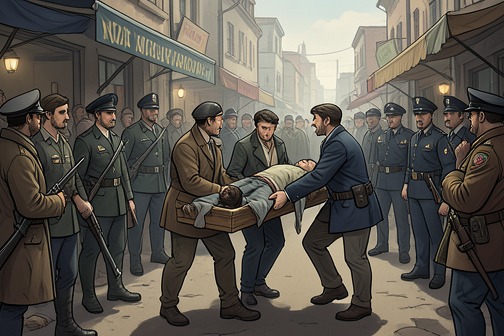
The [Crawford Market Shootout and Abdullah’s Rescue](entity:event-recall-event-crawford-market-abdulla-67973f9a23dd) is the concealed history behind Abdullah Taheri’s survival after he was shot near [Crawford Market](entity:location-recall-location-989f9f906516). Recounted to [Lin](entity:character-recall-character-lin-428ebd96b429) after the events, it turns a public police-station riot into the final stage of a planned trap, and discloses that [Farid](entity:character-recall-character-farid-f7c775352211) the Fixer—not [Khaled Ansari](entity:character-recall-character-khaled-ansari-579dc41e3899)—carried Abdullah out to safety. The account also shows how alliances between secret police, political informants, and criminal factions shaped the ambush and its aftermath.
## The earlier connection and the trap
Abdullah begins his explanation by reminding Lin of an earlier encounter on their motorcycles. They had come upon several men from [Iran](entity:location-recall-location-0f24c5ab412b); although Abdullah had told Lin to wait by the motorcycles, Lin followed him, and the two fought the men together. Abdullah now identifies them as his enemies and enemies of [Khader Khan](entity:character-recall-character-khader-khan-2bf2b74321b0). They were connected to Iran’s secret police, the new [SAVAK](entity:organization-recall-organization-savak-4a7457b9aa41). The recollection establishes that the Iranian men were not strangers drawn into the later shooting by chance: Abdullah had already encountered them, and Lin had fought alongside him.
The threat widened through a chain of intelligence and betrayal. [Pakistan](entity:location-recall-location-pakistan-041a2aec3e49)’s [Inter-Services Intelligence](entity:organization-recall-organization-inter-services-i-01dba5d23083) informed the Iranian secret police about [Abdul Ghani](entity:character-recall-character-abdul-ghani-d1a4aca9ef78)’s contact on [Khader Khan’s council](entity:organization-recall-organization-khader-khan-s-co-4bdb9f304d04). Abdullah says that six Iranian agents had already been killed and that their bodies could never be found; three men from Iran remained. Those three then worked with Abdul Ghani, who told them how to set a trap for Abdullah. The episode links the coming attack to a larger contest involving intelligence agencies and Khader Khan’s council, while showing Abdul Ghani as the intermediary who turned knowledge of the council into a plan against Abdullah.
At the time of the ambush, Abdullah says, neither he nor Khader Khan knew that [Sapna](entity:character-recall-character-sapna-3597df1d97c4) was working for Abdul Ghani and preparing to move against them. Abdullah’s account marks this as crucial information withheld from the people walking into the trap. He later imagines that, had he known of Sapna’s role, he would have killed Sapna’s men himself; in fact, he did not know. The trap therefore depends not only on the Iranian agents’ presence but on Khader Khan’s side being unaware of a wider alignment against it.
## The shooting and the crowd’s misunderstanding
The trap was sprung near Crawford Market. The Iranian men fired first from a position near Abdullah. The police mistook the gunfire as Abdullah shooting at them and returned fire. Abdullah understood that he was dying, and responded by firing at the police. His account describes a rapidly collapsing situation in which the agents’ first shots, the police’s mistaken attribution, and Abdullah’s response made him appear to be the source of the attack. The police station crowd later knew the outcome as a shooting so extensive that people said Abdullah’s face was unrecognizable.
Lin had been present in that crowd, outside Crawford Market police station, on the night Abdullah was shot. He remembers the scene as wild and says that everyone believed Abdullah had been shot many times. His testimony supplies a second perspective on the same event: Abdullah explains the sequence that led to the shooting, while Lin recalls the public confusion and the apparent severity of Abdullah’s condition. Their accounts meet at the police station, but Lin had not known who had arranged Abdullah’s removal from it.
## The rescue from the police station
Khader Khan’s men recognized Abdullah despite the circumstances. They started a riot, then fought their way step by step into the police station and carried him out. Khader Khan had arranged a truck nearby and a doctor, [Doctor Hamid](entity:character-recall-character-doctor-hamid-3435ac57c6e5), whom Lin also knew. Abdullah says they took him to the hospital and saved him. The rescue thus depended on preparation as well as force: a vehicle and medical help were waiting near the station, and the riot gave Khader Khan’s men a way to reach Abdullah and remove him.
Abdullah clarifies that Khaled Ansari was among the men who made the riot, but was not the person who carried him out. That task fell to Farid the Fixer. Lin is startled by the disclosure, because Farid had kept the rescue secret through the months he and Lin had worked closely together. The revelation revises Lin’s understanding of both men’s roles: Khaled helped create the diversion, while Farid physically brought Abdullah out of the station and into the rescue network’s care.
## The secret and the unresolved aftermath
Abdullah presents Farid’s silence as proof of his reliability, calling him his brother now that Khader Khan is gone and placing him among the best of Khader Khan’s men. He also tells Lin to entrust a secret to Farid. The praise gives the rescue a continuing consequence beyond Abdullah’s survival: it reveals the depth of Farid’s loyalty and explains why Abdullah regards him as a trusted successor in the circle of men around Khader Khan.
The account does not yet establish what happened to the three Iranian men after the shooting. Lin asks whether Khader Khan caught them, but the supplied scene ends before Abdullah answers. Their fate therefore remains unresolved here, even as the story clarifies the plot against Abdullah, the police station rescue, and the identities of the men who made his survival possible.
Event 86
Abdullah Returns to Bombay and Reunites with Lin
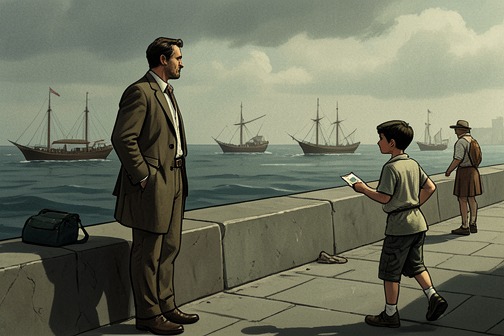
[Abdullah Returns to Bombay and Reunites with Lin](entity:event-recall-event-abdullah-lin-a06d6adbe987) is the moment when [Lin](entity:character-recall-character-lin-428ebd96b429)’s belief that his friend is dead gives way to the knowledge that Abdullah Taheri survived a police ambush and has come back to [Bombay](entity:location-recall-location-bombay-b9f73c3bdba6). Their reunion interrupts Lin at a moment of grief and temptation, then discloses the long recovery that kept Abdullah away and the dangerous purpose behind his return. The scene changes a presumed death into a return, but does not restore an uncomplicated peace: Abdullah has come back carrying unresolved violence and a fresh pursuit.
## Setting and Immediate Context
Lin is alone near the [Gateway Monument](entity:location-recall-location-gateway-monument-3bdb41b93271) after leaving a building and walking down to the sea wall. The passage first places him among the reflections in the building’s elevator, then outside among tourists returning by boat. His thoughts turn to the difference between their apparent freedom and the unseen burdens people carry. The setting matters as a threshold between private sorrow and public life: boats continue across the bay, passers-by move along the street, and Lin’s grief unfolds in the middle of ordinary activity.
At the sea wall, Lin sees Mukul, a street boy he knows, selling a small packet to a young tourist. Lin reads the customer as new to Bombay and recognizes the danger of the transaction. The encounter draws his attention to his own history with heroin: he feels an intense desire for the drug and remembers the brief relief and longer damage associated with it. Mukul notices Lin’s state and edges closer, presenting the possibility of buying. Lin does not accept the offer in the scene. Instead, he remains caught between craving and grief, unable to release the sorrow he has been holding back.
## The Apparition and Recognition
Mukul’s approach is interrupted when someone touches Lin’s shoulder. Mukul recoils, and Lin turns to see Abdullah. At first, Lin reads the sight through the assumption that Abdullah was killed in the police ambush and experiences him as a ghost. Abdullah’s changed appearance sharpens the shock: his hair is short, and he wears a white shirt and grey trousers rather than the long hair and black clothes Lin associates with him. Yet the strangeness of the encounter is set against a calm, matter-of-fact exchange and the familiar surroundings, leaving Lin unsure whether he is dreaming rather than seeing his friend alive.
Abdullah invites Lin to go inside for tea. Lin objects that Abdullah is dead, but Abdullah calmly denies it. The disagreement is not merely confusion about what Lin sees: it gives the scene its decisive turn. Lin has already spent months grieving a friend he believed lost, and the return first arrives in a form his mind cannot readily reconcile with that loss. When Abdullah explains that he was shot and survived, the apparent supernatural encounter becomes a delayed recognition of a living person.
## Survival and Reunion
Abdullah recounts what happened after the shooting. His body was taken from the [Crawford Market](entity:location-recall-location-989f9f906516) police station to Thana, where he spent the first two months, and then to a private hospital near [Delhi](entity:location-recall-location-7242cbb9d528). He remained there for a year, undergoing many operations; it took almost another year for him to become well. The sequence explains why he vanished from Lin’s life and why his return has been delayed. His survival was not immediate recovery: it involved an extended period in hospital followed by a further period of convalescence.
Lin reaches out to embrace him, and physical contact confirms what Lin has struggled to believe: Abdullah is warm and alive. Lin holds on tightly, still afraid that the encounter may be a dream, and the reunion releases some of the grief he has carried for Abdullah and for their shared losses. Abdullah responds gently and tries to reassure him. Lin’s relief does not erase his anger, however. He breaks away and demands to know what happened, where Abdullah has been, and why he did not send word. The exchange holds both affection and grievance: the embrace establishes their bond, while Lin’s questions register the cost of Abdullah’s unexplained absence.
## Return, Pursuit, and Significance
Abdullah has returned not only to see Lin. He says that after Abdel Khader killed [Sapna](entity:character-recall-character-sapna-3597df1d97c4) and his men, those associated with them fled to Delhi. One of the men escaped, and Abdullah later went looking for the four men and their associates. Once strong enough to fight, he found and killed one of them, an Iranian. He reports that three remain: two Iranian spies and one killer from [Abdul Ghani](entity:character-recall-character-abdul-ghani-d1a4aca9ef78)’s faction. He is certain they are now in Bombay, and identifies that knowledge as the reason he came back to the city.
The news gives the reunion a forward-moving consequence. Lin learns that Abdullah survived, but also that Abdullah has resumed a conflict whose remaining targets are in the same city. Abdullah says [Salman Mustaan](entity:character-recall-character-salman-mustaan-435568cafd2f) and the others are waiting upstairs at the hotel and want to celebrate; they had seen Lin leave earlier and doubted Abdullah would find him. Abdullah proposes that they return there together. The passage establishes the invitation and the waiting group, not what happens after they set off.
Structurally, the return reverses the scene’s apparent direction. Lin is on the edge of yielding to heroin and submerged in grief for a man he thinks dead; Abdullah’s arrival interrupts the drug transaction and makes the lost friend present again. The reversal does not make the pain disappear or settle the danger around them. Instead, it joins reunion to responsibility: Lin must absorb the truth of Abdullah’s survival and hear that a new encounter with the men Abdullah is pursuing may be imminent.
Event 87
Kano’s Escape and Disguise for Transfer
[Kano’s Escape and Disguise for Transfer](entity:event-recall-event-09f4cf882daa) turns a wildlife-protection policy into a rescue operation shaped by affection, ingenuity, and public spectacle. After [Kano](entity:character-recall-character-kano-72d93d20f33c) breaks out of the animal jail when his handlers are mistreated, the bear and the two men hide in [Lin](entity:character-recall-character-lin-428ebd96b429)’s former home in the slum. Lin helps devise an escape route: disguise Kano as Ganesha, roll him through the city on a vendor’s cart, and get him to a waiting truck at [Nariman Point](entity:location-recall-location-7e2be44c9822). The plan carries the group close to its destination, but the narrative stops before confirming that the transfer is completed.
## Causes and Stakes
The crisis begins with a policy introduced by the [Wildlife Protection Authority](entity:organization-recall-organization-wildlife-protect-a888e7a3dd53) to stop cruelty to dancing bears. Kano’s handlers, whom the account presents as deeply attached to him, are not understood by the officials as caregivers who would never harm the bear. Kano is taken to an animal jail, separated from them, and distressed; the handlers remain outside, also upset by the separation.
The conflict sharpens when two guards leave their post and mistreat the handlers. Seeing this, Kano breaks out of his cage. The handlers then resist the officials and escape with him. The account describes no killing: the immediate stakes are Kano’s freedom and the group’s effort to avoid recapture. The very rule intended to protect bears has produced a confrontation in which Kano’s bond with his handlers, rather than the policy’s stated aim, determines what happens next.
## Shelter and the Need for a Plan
The three fugitives take refuge in the same hut that had once been Lin’s home in the slum. Their shelter is only temporary. Authorities are searching for the handlers and the bear, and the group must move Kano out of the city without being caught. A truck and a driver willing to take Kano and his handlers away are waiting at Nariman Point, but getting a bear from the slum to the vehicle is the central practical problem.
Lin’s solution comes from looking for materials that could conceal Kano without making the cart impossible to move. He remembers passing Rakeshbaba’s workshop, where papier-mâché pieces from Ganesha sculptures were being made. The large hollow pieces are light enough to use as a covering; silk and flower garlands could help complete the disguise. The idea makes the route depend not on speed or secrecy alone, but on making the bear look like a familiar religious image moving through the city.
## Making Kano into Ganesha
The handlers agree that Kano can sit on a wheeled hawker’s cart. They say he can be steadied with ropes if the reason for the fastening is explained to him, an important detail in a plan that depends on his cooperation as well as his concealment. [Johnny Cigar](entity:character-recall-character-johnny-cigar-abaa784fef8e) develops Lin’s materials idea into the proposal to present Kano as Ganesha and move him on the cart as part of a devotional procession.
The recent [Ganesh Chaturthi](entity:time-recall-time-ganesh-chaturthi-5a49ec0ee023) festival has already ended. [Joseph](entity:character-recall-character-joseph-a6dc2a0eb175) points out that the city’s large festival images are normally carried to Chowpatty Beach and immersed in the sea, so the disguise may seem out of season. Lin counters that a Ganesha image on a trolley would not necessarily invite questions simply because the festival was over. The plan therefore draws on a public spectacle people recognize, while relying on the group’s hope that passersby will accept it without investigating.
At Rakeshbaba’s workshop, the finished construction is more complete than a covering alone. A huge elephant head sits above a pink, round-bellied body with attached arms. Light-blue silk surrounds the base where the figure rests on the cart, and flower garlands conceal the join between head and body. When Kano turns his head at [Jeetendra](entity:character-recall-character-jeetendra-81b0506b001d)’s voice, the assembled group startles: for a moment, the movement makes the sculpted Ganesha seem alive. The disguise’s effectiveness and its risk are joined in that response; the figure looks convincing, but the animal inside can still move.
## The Procession Through the City
As the cart advances toward [Back Bay](entity:location-recall-location-back-bay-ae1b2c272da2), wedding musicians rehearsing in a maidan fall in behind the group and play a devotional song. Children and adults leave the footpaths to join the procession, swelling it to more than a hundred people. The crowd that might draw attention also becomes cover: Kano’s passage now appears embedded in a public celebration rather than a small, secretive escape attempt.
The procession is not fully under the group’s control. The crowd grows, dogs bark, and Kano sways on the cart, turning his head toward the surrounding noise. Lin notices a group of policemen standing and watching as the procession passes. Near Nariman Point, he worries that the musicians will remain with them and expose the operation. He runs back, gives the bandmaster money, and directs the band to turn away along [Marine Drive](entity:location-recall-location-marine-drive-943f298beb77). The musicians go one way as the cart turns toward the sea, and many of the crowd follow them. The diversion separates the spectacle from the escape party at a moment when the truck is close.
## Handoff and Significance
The cart continues along the sea road toward the truck’s location. A car horn briefly alarms Lin, who fears it may be the police, but the people beside the car are Abdullah, Salman, [Sanjay](entity:character-recall-character-sanjay-d03f09b872a7), and [Farid](entity:character-recall-character-farid-f7c775352211). Lin checks that Johnny can take over; Johnny indicates that the truck is ahead and that the handlers can proceed. Lin then leaves the procession and joins the others. His departure marks a handoff in the operation, not a confirmed end to it: the scene does not show Kano reaching the truck or leaving the city.
The episode sets institutional protection against the particular relationships it fails to recognize. The officials’ stated purpose is to prevent cruelty, yet the account’s immediate cause of escape is their treatment of the handlers and Kano’s response to it. The disguise converts that conflict into a public image: a fugitive bear crosses the city as a sacred figure, carried not by official permission but by the care of his handlers and the improvisation of the slum community. Its success remains provisional, ending with the group close to the planned vehicle and the transfer still underway.
Event 88
Lin and Modena Reunite
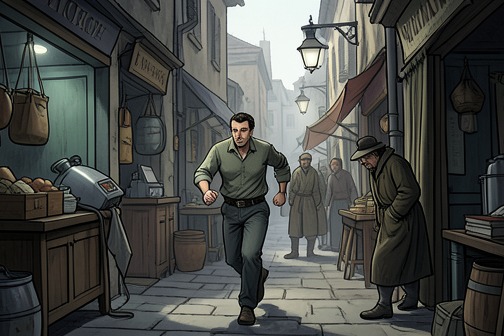
[Lin and Modena Reunite](entity:event-recall-event-649eb1ced395) is an unexpected meeting that brings [Modena](entity:character-recall-character-modena-687f7ee2847c) back into [Lin](entity:character-recall-character-lin-428ebd96b429)’s life and changes how Lin understands his own past. Modena has survived [Maurizio](entity:character-recall-character-maurizio-9cd3f527287c)’s attack, but the reunion is not a simple return to their former friendship: he lives with lasting disfigurement, waits for [Ulla](entity:character-recall-character-ulla-87a1fc56dfd8) to come back, and believes Lin avenged him by killing Maurizio. Lin leaves the encounter without correcting that belief. The decision, and the recognition of how Modena has borne his suffering, become the occasion for Lin to accept his own responsibility for a long-unresolved heartbreak.
## The sighting and pursuit
The reunion begins among the stalls of a busy market, where Abdullah quietly directs Lin’s attention to a stooped figure watching from the shadows behind a peanut shop. Abdullah explains that the man is there every day and has also watched Lin in other places. The sight of him is a surprise arranged by Abdullah, but Lin recognizes the figure before he can ask for an explanation: it is Modena.
Lin runs after him without looking back at Abdullah, [Vikram](entity:character-recall-character-vikram-9e00afad97ee), or the other companions, and without pausing to consider what he intends to do. The chase turns into a passage through the hidden routes of the city. Modena slips through doorways, gaps in walls, makeshift shops, and lines of drying saris, using a knowledge of the streets that few people could match. Lin can keep up because he, too, knows these passages from having lived among the city’s poorer residents.
Modena’s route ends in a narrow lane occupied by roughly a hundred people, including families crowded out of nearby apartments. They sleep in shifts in a loft built above the cobbled passage; below, the lane serves as their shared indoor space, with cooking stoves, bathing stalls, and card players. Modena tries to escape through the crowded room but turns into a dark cul-de-sac with high walls and only one way out. Lin knows the dead end from earlier visits to buy from dealers he did not fully trust. There, with Modena close by but unseen, the pursuit becomes a meeting.
## Recognition in the dark
Lin speaks softly, identifies himself, and assures Modena that he wants only to talk. Rather than rush into the darkness, he sets down his bag and offers to share beedies. He lights two matches and holds out one of the cigarettes. When the flame goes out, Modena takes it by touch. The small exchange lets them approach one another without forcing an immediate confrontation: Lin offers a familiar gesture, and Modena accepts it.
The next faint light makes Modena’s condition visible. Maurizio’s attack has left his face deeply scarred and altered. Lin’s involuntary shock is apparent to Modena, who responds with a knowing smile. The moment makes Lin confront not only what has been done to his friend but also the way other people may react to Modena’s appearance. Their reunion is therefore marked by an effort at recognition: Lin must see Modena as the person before him, rather than recoil from the signs of what he has endured.
Modena tells Lin that he watches him because he hopes to find Ulla. He no longer goes to the places where they used to spend time together; he expects that, if she returns and looks for him, she may come to Lin or one of their acquaintances. Modena is certain that Ulla will come back from Germany because she loves him. Lin knows that she left after the attack, but he does not press the contradiction at once. Modena’s confidence is presented alongside the circumstances that make it difficult for Lin to share, giving the reunion both tenderness and unease.
## Modena’s life and account of Maurizio
Despite what happened to him, Modena has established a working life. He says that he has a well-paid job with a friend named Ramesh, who cared for him after he was hurt. When a son is born in a wealthy household, the two men go there and Modena puts on a special costume. His emphasis on the word, and his fractured smile, unsettle Lin, but the account also shows that Modena has found a way to earn money and continue living after the attack. The work is a concrete counterpoint to Lin’s assumption that Modena would be defined only by his injuries or abandonment.
Modena speaks of Maurizio as his former best friend, indeed the only friend he had, and as the man who subjected him to the attack. He does not claim that Maurizio’s cruelty began there. He recalls a life governed by fear and describes fear and cruelty as the combination through which powerful men dominate others. Modena had loved Maurizio’s power, though he did not share that way of exercising it. He also believes that Maurizio’s violence frightened Ulla so badly that she fled. In Modena’s account, his hatred began not simply because he himself had been harmed, but because he believed Maurizio had driven Ulla away and would continue to harm others.
When Lin says that he did not kill Maurizio, Modena treats the denial as unnecessary. He believes Lin did kill him, calls the secret safe with him, and says he is grateful. In his view, Maurizio had passed beyond the last limit that might have restrained his evil, and the attack had cost him his soul. Modena’s approval is grounded in what he believes happened, not in the actual truth Lin is withholding. The difference between the facts and Modena’s understanding becomes the encounter’s central moral tension.
## Lin’s silence and change
Lin considers telling Modena what really happened, and recognizes that Modena has a right to know. Yet he cannot speak. The narration acknowledges that anger toward Ulla, or contempt for Modena’s faith in her, may contribute to his silence, while leaving the exact force of his hesitation uncertain. As Modena’s eyes fill with tears, Lin holds his gaze, nods, and says nothing. Modena appears to read the gesture as agreement or confirmation, but Lin admits that he cannot know exactly what either of them understood. Their silence is neither a clean confession nor a straightforward lie; it leaves the painful misunderstanding intact while allowing them a moment of closeness.
After Modena turns and limps away, Lin reflects on the different ways they have lived with heartbreak. Lin’s own marriage ended in betrayal and bitterness, after which he became addicted to drugs and hurt people as his life deteriorated. Modena, by contrast, has worked, saved, and waited for love to return. Lin does not present that waiting as proof that Ulla will come back. Instead, he recognizes that Modena has managed his pain by accepting his own part in causing it, whereas Lin had refused to accept his share of responsibility for his marriage’s failure and the sorrow that followed.
As Lin returns from the shadowed lane to the market’s bustle, he accepts that responsibility and feels fear, resentment, and self-doubt begin to lift. He rejoins Abdullah, Vikram, and the others smiling, answers their questions about Modena, and thanks Abdullah for arranging the surprise. He also says that he forgave Abdullah everything, though he cannot find words to explain the change in him. The reunion’s decisive consequence is thus not a resolution of Modena’s hope or the mistaken story of Maurizio’s death. It is Lin’s recognition that accepting responsibility can begin to loosen the hold of the past, and that the encounter with Modena has given him a new peace that can slowly grow.
Event 89
Battle at Chuha’s Residence
The [Battle at Chuha’s Residence](entity:event-recall-event-60892daaff8d) is the climactic assault in the conflict between [Salman Mustaan](entity:character-recall-character-salman-mustaan-435568cafd2f)’s group and [Chuha](entity:character-recall-character-chuha-4e4b16ac0388)’s faction within the [Walidlalla council](entity:organization-recall-organization-walidlalla-counc-b3ca69698c47). Launched before the opposing gang can strike, it destroys several hostile alliances and ends the border war, but the victory is inseparable from the deaths of Salman and Raj and the severe wounding of [Amir](entity:character-recall-character-amir-5df28d017561). [Lin](entity:character-recall-character-lin-428ebd96b429) experiences the operation not as a clean triumph but as a turning point after which the group’s old order and its own sense of purpose have changed.
## Causes and alliances
For days, reports and rumors had suggested that Chuha and his associates were preparing to attack Salman’s group. The conflict over new gang territory had sharpened the danger: Chuha was seeking both power and room to expand, and the possibility of an attack on Salman’s people made delay increasingly risky. The threat became more immediate when a [Sapna](entity:character-recall-character-sapna-3597df1d97c4) survivor and two relatives joined Chuha’s side. The alliance connected the local gang struggle to the survivors’ pursuit of revenge.
The [Sapna gang](entity:organization-recall-organization-sapna-gang-1ac5a2739183) had emerged from the survivors of [Abdul Ghani](entity:character-recall-character-abdul-ghani-d1a4aca9ef78)’s failed coup against [Khader Khan](entity:character-recall-character-khader-khan-2bf2b74321b0). They were acting without Abdul Ghani, while the Iranians who joined them had no official backing from [SAVAK](entity:organization-recall-organization-savak-4a7457b9aa41). Their motives converged in hostility: the Sapna survivors wanted vengeance for their dead companions, and the Iranian men brought their own enmity toward Abdullah. Chuha’s ambition gave these separate grievances a shared opportunity. The planned attack therefore threatened more than one group; it brought old betrayals, personal vendettas, and a territorial contest into the same impending confrontation.
## Intelligence and the decision to strike
Salman had anticipated that Chuha’s faction might move against him. He placed Little Tony, a [Goa](entity:location-recall-location-goa-4b350123a787)-born gangster unknown in [Bombay](entity:location-recall-location-bombay-b9f73c3bdba6), inside Chuha’s gang to collect information. Little Tony’s reports exposed the Sapna-[Iran](entity:location-recall-location-0f24c5ab412b) connection and indicated that the opponents were planning to bring in additional men from [Delhi](entity:location-recall-location-7242cbb9d528) and Calcutta for coordinated attacks at several locations. The intelligence gave Salman warning of the danger, but it did not remove the cost of acting: waiting could provide more fighters and weapons, while giving the enemy time to disperse or launch its attack.
The immediate signal came when Chuha’s associates, the Sapna men, and the Iranians assembled at Chuha’s house on Sardar Patel Road earlier than expected. Little Tony confirmed their presence after observing them enter; when he came out and lit a cigarette, the gesture signaled that the target group had gathered. Amir, who had personally seen the arrivals, estimated that there were eleven men inside, perhaps one or two more, and reported that Hussein was watching the house for further arrivals.
Salman framed the choice plainly to his men: they could wait for roughly thirty additional fighters and weapons, or act at once while the enemy was together. The delay already incurred made waiting seem liable to squander their advantage. He nevertheless left the choice to the men rather than ordering them into the house, and they answered one by one that they were ready to go now. After a prayer, Salman committed to the assault. His decision converted weeks of preparation and suspicion into a direct attack, with revenge, protection, and the seizure of Chuha’s territory all bound together.
## The assault
The group took its weapons and drove in two cars the short distance to Chuha’s home. Salman’s plan divided their roles: some men would enter with automatic weapons, while others would cover the street and prevent anyone from escaping or entering. The shotguns were assigned outside because the fighting inside was expected to bring the opposing men into close contact. Salman also planned an exit by the back, past Abdullah and Lin. The arrangement shows the speed and severity of the operation, but also its attempt to control the house’s entrances and the movement of people around it.
Lin and Abdullah approached through a narrow lane, climbed over a wooden fence, and entered the backyard. While they waited in the dark, Lin was suddenly seized by two men at a door; a third joined them, and they forced the knife from his hand. Abdullah was fighting nearby. Lin then saw a larger attacker pulling him away from the struggle and understood that Abdullah was in danger. Despite his pain and difficulty moving, Lin used his knife against the man to stop him advancing on Abdullah. Other members of the group reached Lin and pulled him toward the back exit. The encounter makes the operation personal for Lin: the assault’s wider strategic purpose narrows, in the moment, to keeping Abdullah alive and escaping capture.
## Losses and consequences
As the surviving men withdrew, Faisal and Hussein carried one injured man, [Farid](entity:character-recall-character-farid-f7c775352211) and Little Tony carried another, and [Sanjay](entity:character-recall-character-sanjay-d03f09b872a7) carried a body. Mahmoud told Lin that Salman and Raj had been lost and that Amir was badly hurt but alive. The news changes the meaning of the outcome. The attackers had defeated their opponents, yet the loss of Salman removed the last voice of reason in [Khader Khan’s council](entity:organization-recall-organization-khader-khan-s-co-4bdb9f304d04) and, in Lin’s account, ended the old council’s existence. The group’s victory had cost it the leader who had chosen the moment and taken responsibility for the decision.
Lin lists what the assault accomplished: the Sapna killers were gone, Khader Khan was avenged, Abdul Ghani’s betrayal had been defeated, Abdullah’s Iranian enemies had been eliminated, Chuha’s gang had been crushed, and the border war was over. The chain of revenge that began with Sapna’s name had reached its close, while Chuha’s territory and operations were taken out of the opposing faction’s hands. These victories did not restore the former order. Lin sees the wheel as having completed a full revolution, with nothing returning to its previous state.
The men had expected the outcome to bring satisfaction, but they wept. As the cars left the scene, Lin describes anger giving way to sorrow and the force of what they had done yielding to grief over what they had become. The ending refuses to treat victory as absolution: the operation achieves its stated aims, but the dead, the wounded, and the disappearance of Salman’s council make its cost impossible to separate from its success.
Event 90
Prayers in Remembrance of Salman Mustan
[Prayers in Remembrance of Salman Mustan](entity:event-recall-event-35aea19bb4c9) bring [Lin](entity:character-recall-character-lin-428ebd96b429) and the surviving members of his circle together at [Haji Ali Mosque](entity:location-recall-location-haji-ali-mosque-4407547f5171), the first time they have gathered as a group since Salman was killed in the battle at [Chuha](entity:character-recall-character-chuha-4e4b16ac0388)’s house. The memorial is both a communal act of grief and a portrait of the life the men resume afterward: they pray for their friend, then return to a criminal organization tolerated by the police in exchange for money and a measure of order. Lin’s silence during the prayers makes that contradiction personal; he cannot separate the religious act from the criminal world in which he and Salman lived.
## Setting and return
The gathering takes place at the mosque on its white marble island, reached by a flat stone path from shore that the incoming tide will submerge. As daylight fades, pilgrims and local residents leave the shrine, while flowers cast upon the receding water drift back toward the path. The setting places the gang’s private bereavement within a public space of prayer and pilgrimage, where grief and repentance are already part of the daily passage between island and shore.
The men have been apart for weeks after the fight at Chuha’s house, hiding and recovering from their wounds. The press has called the violence carnage and massacre and demanded justice and punishment. Yet the police do not arrest the group. No one is willing to testify; the battle has eliminated the [Sapna](entity:character-recall-character-sapna-3597df1d97c4) killers; Chuha’s gang had previously killed a policeman, a crime the police could not bring to court; and money taken from Chuha’s operations has been used to bribe officers. The memorial therefore follows not a public reckoning but the gang’s return to the city and its work.
The police privately warn [Sanjay](entity:character-recall-character-sanjay-d03f09b872a7), now leader of the [Khader Khan](entity:character-recall-character-khader-khan-2bf2b74321b0) council, that the gang has exhausted its chances: they expect peace and continued prosperity, and threaten that they will impose discipline if Sanjay cannot. They also tell him that Abdullah must not be seen in [Bombay](entity:location-recall-location-bombay-b9f73c3bdba6) again. This warning shadows the reunion with the knowledge that the same authorities who have allowed the gang to escape prosecution can still dictate who may remain in the city.
## The gathering and prayer
After weeks in hiding, the men return to their former jobs in Sanjay’s organization. Lin comes back from [Goa](entity:location-recall-location-goa-4b350123a787) and resumes work in the passport operation with [Villu](entity:character-recall-character-villu-c01b81125179) and [Krishna](entity:character-recall-character-krishna-41997d28ff51). When the call goes out to gather at Haji Ali, he rides his Enfield bike to the shrine and crosses the bay on foot with Abdullah and [Mahmoud Melbaaf](entity:character-recall-character-mahmoud-melbaaf-8942c7d7faa1). The memorial is thus not an isolated religious observance: it reunites people who have been dispersed by the violence and draws them back into the organization’s everyday operations.
Mahmoud leads the prayers from a small balcony reserved for the group. Facing Mecca, he speaks for those kneeling or standing behind him. The Muslim members of the council kneel; Sanjay, a Hindu, and [Andrew](entity:character-recall-character-andrew-531aa0f64cfb), a Christian, kneel beside them. Lin knows the words and the movements of the prayer and believes the others would welcome his joining them. He nevertheless remains standing, unable to divide his criminal life from his religious life as the others seem able to do. He offers Salman a quiet hope for peace, but feels that his own compromised state allows no more than this small prayer.
The prayer’s language of compassion and mercy also includes those who have incurred wrath and gone astray. Lin hears in it a fitting reflection of his diminished sense of honour and pride. Rather than resolving the conflict between faith and crime, the ritual makes his discomfort legible: the men can gather in devotion, but Lin cannot experience that devotion as separate from the violence and dishonesty around them.
## Mourning and its aftermath
At the end of the prayers, the men embrace according to custom and walk back toward shore. Their appearance complicates the solemnity of the occasion. They wear sunglasses and new clothes; most display the gold chains, watches, rings, and bracelets bought with a year or more of smuggler’s wages. Their confident, armed-gangster swagger makes the procession look menacing, so they have to work to persuade the professional beggars along the island path to accept the rupee notes they have brought as alms. The juxtaposition does not cancel the mourning: they have prayed in their own ways and cried for Salman. It instead holds charity, grief, display, and criminal power together in one return from the shrine.
Three cars wait by the sea wall, near the place where Lin once stood with Abdullah on the night he met Khaderbhai. Lin pauses there to say goodbye, and Sanjay invites him to share a meal with the group. The gathering therefore ends not with the dissolution of the council but with an offer of renewed fellowship. For Lin, however, the prayer has left the gap between the group’s religious observance and its criminal life unresolved. The men can mourn Salman together; Lin remains apart in the very moment when the others are closest in ritual.
Event 91
Lin Agrees to the Sri Lanka Mission
[Lin](entity:character-recall-character-lin-428ebd96b429)’s agreement to join the [Sri Lanka](entity:location-recall-location-9edb3dc68cb7) mission turns a conversation about a future journey into a renewed commitment to [Abdel Khader Khan](entity:character-recall-character-abdel-khader-khan-822d0cbbc88e)’s unfinished work. Abdullah Taheri explains that the plan is to help Tamil Muslims who have no armed group to defend them, and [Nazeer](entity:character-recall-character-nazeer-70724b855ba6) reveals that Khader had designed the operation for a team of three. Lin hears an inward warning against returning to violence, but accepts anyway: he offers his hand and agrees to finish the job. The decision is both a practical pledge and an attempt to make meaning from loss, debt, and the dangers he has already entered.
## Background: From Exile to Khader’s Student
Lin’s decision follows a history in which survival and criminality have become difficult to separate. After his imprisonment in [Arthur Road Prison](entity:location-recall-location-arthur-road-prison-50f3a84a4e65), he could have left [Bombay](entity:location-recall-location-bombay-b9f73c3bdba6) when he was released. Instead, he stayed because he wanted to discover who had put him in prison and why, and because he wanted revenge. He later recognized that joining Abdel Khader Khan’s mafia was the safest and fastest route to that vengeance.
Khader’s instruction changed how Lin understood his own actions. Before that apprenticeship, Lin considered himself a desperate exile who had committed serious crimes, but not yet a professional criminal. Under Khader, he learned organized crime as a system and was sent to [Khaled Ansari](entity:character-recall-character-khaled-ansari-579dc41e3899) to study black-market money trading. The work brought excitement and a sense of belonging to a close-knit group, even as it drew Lin across a line he had not previously intended to cross. The Sri Lanka proposal returns him to that world, now with Khader’s death and the consequences of their shared history behind it.
Lin’s relation to violence is not presented as simple appetite or simple refusal. During his torture in prison, he recalled reaching a point at which he understood that he could hate his tormentors or forgive them. He chose forgiveness because he believed hatred would prevent him from surviving. That choice did not erase his anger, and his later wish for revenge shows how survival and resentment can coexist. When Abdullah asks him to take on the mission, Lin again faces a choice shaped by violence, but this time the stated purpose is to protect people who have been left defenseless.
## Khader’s Message and the Proposed Mission
Abdullah tells Lin that he will leave for the airport at midnight and does not want Lin to accompany him, because Lin’s presence could draw police attention. He says they may meet in [Delhi](entity:location-recall-location-7242cbb9d528), then asks Lin to work with him on a job in Sri Lanka. When Lin raises the existence of a war there, Abdullah answers that conflict exists everywhere and that people can choose whom they fight for and against. His explanation makes the offer sound less like a promise of safety than a demand to take a position within an already violent world.
The connection to Khader emerges as Abdullah explains that Khader had asked him to do this work when a sign or message arrived from Sri Lanka. That message has now come. Abdullah describes a conflict between the Tamil Tigers and the [Sri Lankan Army](entity:organization-recall-organization-b09256ba9483), with Tamil Muslims caught between them: they have neither guns nor an army, are attacked by both sides, and have no one fighting on their behalf. The proposed assistance is specific: they need passports and money in gold. The evidence establishes the purpose and intended resources of the mission, but not how the group will obtain or deliver them.
Nazeer adds the plan’s deliberately small scale. There will be only three men: Abdullah, Nazeer, and Lin. He frames Lin’s place in the group as part of Khader’s design, not as an improvised request made by Abdullah alone. The mission is therefore both a response to a newly arrived message and the continuation of an obligation Khader had assigned before his death.
## Lin’s Choice and Its Personal Stakes
Lin does not treat the invitation as an uncomplicated chance to serve. He knows that Abdullah would not remind him of his debt or punish him for refusing, because they have already endured too much together. Yet Lin believes he owes Abdullah his life. He also reads Nazeer’s warm smile as an offer of more than a job: Nazeer blames himself for Khader’s death, while Lin remains guilty and ashamed that he was not there with Abdullah when Khader died. The mission offers Lin a way, however incomplete, to face that shared burden.
For a few heartbeats Lin hears an inner warning that he is a killer and should leave. He recognizes that the warning is right, but also that it does not take long for him to decide. When Abdullah says the journey will happen in a few months, with someone sent to bring Lin when the time comes, Lin repeats that interval, extends his hand, and accepts. His agreement is not the mission’s execution: it is a commitment made in advance, with the departure still months away.
Nazeer covers Lin’s hands with both of his, then embraces him abruptly and forcefully. The gesture gives their exchange a physical expression of affection that neither man turns into a declaration. Lin understands that naming or revisiting the moment would put their friendship at risk, so he leaves it unspoken. The mission thus binds three men through a plan inherited from Khader, but its immediate emotional force lies in the debt and trust between those who remain.
## Significance and Ending
The decision brings Lin back toward the kind of criminal work he had joined for revenge, while giving that work a stated humanitarian purpose: securing passports and money for a vulnerable community caught between armed forces. It does not resolve the contradiction between helping others and returning to violence. Instead, Lin accepts the contradiction as part of the choice before him, despite the warning that he is entering danger again.
The scene ends with a promise, not a completed rescue or a departure for Sri Lanka. Lin starts his motorcycle and heads toward Nana Chowk and [Colaba](entity:location-recall-location-colaba-2bd495476f0e) after agreeing to join Abdullah and Nazeer when the time comes. That modest ending keeps the future mission open while closing the conversation’s immediate question. Lin cannot undo his absence when Khader died, but he can accept the work Khader left behind and move toward the next obligation with the men who share it.
Event 92
Lin and Karla’s Final Conversation
[Lin and Karla’s Final Conversation](entity:event-recall-event-80f42c32c12d) is the last face-to-face reckoning between them, turning years of secrecy, complicity, love, and estrangement into a direct exchange of explanations and forgiveness. On a nearly deserted stretch of the [Back Bay](entity:location-recall-location-back-bay-ae1b2c272da2) shore, after [Lin](entity:character-recall-character-lin-428ebd96b429) has agreed to join a mission to [Sri Lanka](entity:location-recall-location-9edb3dc68cb7), [Karla](entity:character-recall-character-karla-3f7aa8a8ae5c) tells him what she did, what she could not feel, and why she kept her distance. Lin leaves with the truth he had sought, but the conversation’s decisive outcome is not their reunion: it is his release from the power their unfinished love once held over him.
## Setting and Approach
The conversation takes place at night on the road beside Back Bay, near [Nariman Point](entity:location-recall-location-7e2be44c9822). A festival in the [Sassoon Dock](entity:location-recall-location-sassoon-dock-ce0dd1ba977f) area has drawn people away from the beach huts and shelters, leaving the route where Lin walks unusually quiet. Karla is sitting on an old fishing boat partly buried in sand. The setting puts their meeting between the city’s public celebration and a private conversation about what each has withheld.
Lin has just ridden away from Abdullah and the others after agreeing to take part in their Sri Lanka mission. Abdullah calls out a slogan about truth and courage, but Lin cannot confidently answer it; he is unsure how much either quality has guided his decision. That uncertainty carries into his encounter with Karla. He tells her that her appeal to him has changed, then recognizes that the power she once exercised over him has shifted. Rather than accepting the reunion without explanation, he wants to know what happened and why.
Karla, for her part, says she had delayed contacting him because she expected him to ask questions. She had let people know she was nearby and asked after him, but had taken no direct step until then. Her account makes the conversation a deliberate disclosure, not simply a chance meeting that resolves their past by itself.
## The Fire and the [Sapna](entity:character-recall-character-sapna-3597df1d97c4) Scheme
Karla explains that [Abdul Ghani](entity:character-recall-character-abdul-ghani-d1a4aca9ef78) told her [Madame Zhou](entity:character-recall-character-madame-zhou-d453e8a13327) had arranged for [Rajan](entity:character-recall-character-rajan-b88c52c5a766) to follow Lin and used her influence with the police to have him arrested after learning that he and Karla had made love. Karla says this was the point at which she acted against Madame Zhou: she called in favors through Abdul Ghani, who arranged the riot, and admits that she helped set part of the fire. The revelation gives Lin a clearer account of Karla’s part in the destruction, while showing that her action was bound up with Madame Zhou’s interference in their relationship.
She also distinguishes her plan involving Sapna from the killings that later took place. The original idea was to invent a common enemy and use posters, graffiti, and harmless bomb hoaxes to create the appearance of a dangerous leader. The aim was to get people cooperating with them in moving goods through [Bombay](entity:location-recall-location-bombay-b9f73c3bdba6) when some were unwilling to help. Abdul Ghani, she says, turned the plan into a campaign of real killings because he thought the original approach would not frighten people enough. Karla denies originating or directing those murders; she describes the killings as Ghani’s escalation of her idea.
Karla says she first learned what Ghani had done during a lunch at the [Village in the Sky](entity:location-recall-location-b50ca370b746), when Lin’s friends discussed the killings. She was shaken, tried for a time to stop the violence, and found that her efforts failed. She recalls that she had liked Madjid, yet felt no grief when he was killed. Her account does not erase her involvement in the original scheme, but it clarifies the boundary she draws between that plan and Ghani’s lethal version.
## Why Karla Left
Karla says that emotional numbness, rather than a wish to earn forgiveness, was what made her leave. She had not felt sorrow over Madjid’s death or over Lin’s imprisonment and beating, even though she liked him more than anyone else. She had understood his suffering as something that had to happen and as bad luck, and recognized her lack of feeling as a reason to get away. Her explanation makes [Goa](entity:location-recall-location-goa-4b350123a787) part of a wider retreat from the life she had been living, not a simple attempt to repair her relationship with Lin.
She also explains what happened while Lin was imprisoned. [Abdel Khader Khan](entity:character-recall-character-abdel-khader-khan-822d0cbbc88e) told her that Lin had to remain in jail until Madame Zhou did what he wanted. Karla says she then used her connection with a young Pakistani general, a contact who liked her, to help Abdel Khader Khan obtain what he sought. Afterward, she quit. Her account links her work for Abdel Khader Khan to Lin’s imprisonment and exposes a further reason she could not speak freely: she owed him and did not know whether Lin could be trusted with what she knew.
Karla describes Lin’s visit to Goa as meaningful, but says he returned to Abdel Khader Khan rather than staying with her. She could not tell Lin what she knew about his patron, and when Lin left, she again felt nothing. At the shore, she says she is still emotionally cold, does not love others or herself, and does not regret what she has done, even as she wants forgiveness. She is preparing to go to [Khaled Ansari](entity:character-recall-character-khaled-ansari-579dc41e3899) and [Idriss](entity:character-recall-character-idriss-e5b39fb6d9a6). Her wish for forgiveness is therefore not presented as an admission of remorse; it coexists with her insistence that she feels no regret.
## Forgiveness and Farewell
Lin has expected that hearing the details would make him feel vindicated or released. Instead, he feels an emptiness that is neither acute distress nor heartbreak. He understands that emptiness as freedom: the truth has not restored their earlier love, but it has ended his need to remain under its former hold. His response is to forgive Karla and tell her that he will always love her. In the scene, forgiveness is an act Lin chooses even though Karla has not claimed to regret her actions.
They kiss, and the narration connects the moment to earlier parts of their shared history: [Leopold’s](entity:location-recall-location-leopold-s-1d82f936fa9e), the [Standing Babas](entity:character-recall-character-standing-babas-d0026063fa2f), the Village in the Sky, the cholera outbreak, the flood, and their time in Goa. The recollections gather the relationship’s different forms—companionship, danger, intimacy, and separation—without suggesting that the past can simply be resumed. Afterward, Lin walks Karla to a nearby taxi and gives her a final kiss goodbye. She leaves, and he watches the taxi’s lights disappear before heading back toward [Prabaker’s slum](entity:location-recall-location-prabaker-s-slum-46a1d59447a4) to retrieve his bike.
The farewell settles the conversation’s central change. Lin can love Karla without expecting her to become the person he once hoped she was, and can forgive her without turning forgiveness into a promise that they will stay together. The festival’s people begin returning to the road as he walks alone, placing their private ending back within the ordinary movement of Bombay. Karla’s account supplies the answers Lin sought; his decision to let her go is what makes those answers an ending.