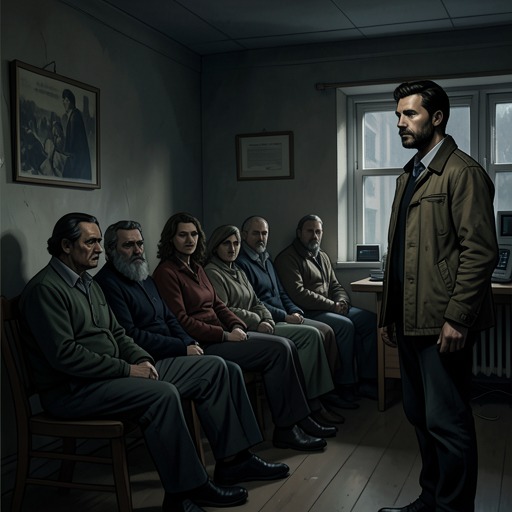
Lin’s imprisonment and near-fatal condition at Arthur Road Prison
ShantaramLin’s imprisonment and near-fatal condition at Arthur Road Prison reveal how confinement strips away bodily autonomy while leaving a prisoner dependent on the uncertain choices of those who control him. Leg-irons, a severe food shortage, untreated illness, and abuse by overseers steadily bring him close to death. His survival turns on an unexpected consequence of a staged attack: the beating that follows prompts the overseers to arrange a wash, an intervention Lin believes saves his life.
Confinement and adaptation
Leg-irons restrict Lin to tiny steps. A ring in the chain between his legs hangs from a strip of coarse cloth tied around his waist, keeping the chain from dragging on the ground. At first the device governs every movement; the two other chained men in his room become his practical teachers. By watching and imitating them, he learns the rolling, shuffling gait that the irons demand.
That adjustment is more than mechanical. Lin comes to see the men’s movements as an effort to put grace into an imposed indignity, to make the sliding steps their own. Their adaptation gives him a small instance of human artistry within the prison’s coercive routine. Yet learning to walk does not make the chains less humiliating. His reflection connects that shame to the injury done to a person’s capacity to love the world, and to the painful recognition that being degraded can make humanity itself feel like a source of shame.
Hunger and worsening illness
The daily ration is a palm-sized piece of chapatti and a saucer of watery soup. Lin estimates that he loses as much as fifteen kilograms in a month, and describes his body as weakening steadily. Other prisoners try to help by smuggling him food. They are beaten for it, so Lin eventually refuses their offers: the guilt of seeing others punished on his behalf adds to the danger he is already facing.
The wounds he sustained in an earlier beating remain untreated and become infected. Water from the prison is no remedy, while nightly bites from kadmal and the presence of body lice compound his suffering. Lin continues trying to wash and remove the lice, but these basic acts leave him exhausted. His condition is not a single collapse so much as an accumulating deprivation: hunger, infection, and the limits imposed by his chains reinforce one another.
The beatings lessen after Lin meets a prison official on a Sunday morning, but they do not end. Big Rahul and other overseers still strike him from time to time, though Lin understands these blows as habitual rather than delivered with full force. The reprieve from the worst beating therefore leaves the underlying conditions intact. He remains chained, underfed, and sick in a place where ordinary care is scarce.
A staged attack and an unintended reprieve
While Lin lies conserving what energy remains, a powerful man attacks him. Lin draws on the last of his strength and fights back; the overseers pull him away and chain him face down at the gate. They have arranged the attack, he learns during a pause in the beating, allowing the man into the room and approving his attempt at revenge. Their plan fails when Lin defeats him, and the overseers respond by beating Lin for hours, with breaks for food, cigarettes, and tea. They also display his bloodied body to selected visitors from other parts of the prison.
Afterward, the overseers recognize that Lin’s condition has become so severe that they cannot report what they have done to prison officials. They decide to keep the incident quiet and order one of their attendants to wash him with soap. The attendant initially objects, but after being struck, carries out the task. He remains unnamed to Lin. The assault and punishment thus produce a rare act of care indirectly: without the overseers’ fear of exposure, Lin believes he would not have received soap and warm water.
Lin considers that wash decisive because his wounds and sores are badly infected and he is feverish and too weak to move. The attendant’s careful washing brings relief, and afterward the fever subsides to a shiver. The treatment does not restore him or end the hunger, but it interrupts the worsening infection at a critical point. Lin credits the unknown attendant with helping save his life, even as the circumstances that made the wash possible remain rooted in prison violence.
The overseers’ table and Lin’s refusal
The contrast between Lin’s ration and the overseers’ meals makes the prison’s hierarchy visible. A dozen flunkies do domestic work for the overseers, from washing clothes and cleaning floors to preparing meals and giving massages. In return, they receive fewer beatings, a few beedie cigarettes, and scraps. The overseers eat rice, lentils, chutneys, fresh roti, fish, stews, chicken, and desserts, tossing bits toward the men who wait around them.
Big Rahul turns that inequality into a repeated humiliation. He displays a chicken drumstick to Lin and tries to entice him with food, sometimes throwing a piece or a sweet toward him while encouraging him to crawl for it. When Lin does not respond, the waiting flunkies scramble for the offering, and Big Rahul laughs. Lin knows the scraps could keep him alive, but cannot bring himself to accept food on those terms. His refusal is a choice made under extreme physical pressure, not a sign that he can ignore the cost: he grows weaker while continuing to watch the meals he cannot bring himself to approach.
Near death and removal from the dormitory
As the hunger deepens, even moving from one side to the other or sitting up requires careful consideration. Lin limps or crawls to the toilet, and fever makes those trips less frequent. He notices dark orange urine, a racing heartbeat even at rest, and short, strained breaths. He lies still for much of the day and night, trying to preserve energy for necessities that have become exhausting. The bodily detail makes his decline cumulative and measurable: the prison does not need one final blow when deprivation is already taking its toll.
In fevered, drifting thoughts, Lin remembers his family and friends from Australia, whom he believes he has lost forever. He also thinks of Abdel Khader Khan, Abdullah, Qasim Ali, Johnny Cigar, Vikram Patel, Lettie, Ulla, Kavita, and Didier Levy. His thoughts return to Prabaker, whose honesty, optimism, courage, and generosity Lin longs to tell him he loves, and to Karla, who recurs in his mind through the days and nights. The memory of these relationships contrasts with the prison’s attempt to reduce him to a weakened, chained body.
Lin imagines that Karla saves him. As he is thinking of her, strong arms lift him; the chains are removed from his wounded ankles, and guards escort him to the prison official’s office. The passage ends with this removal, not with an account of what follows. It marks a change from immobility and confinement in the dormitory, while leaving the outcome beyond the office unstated.