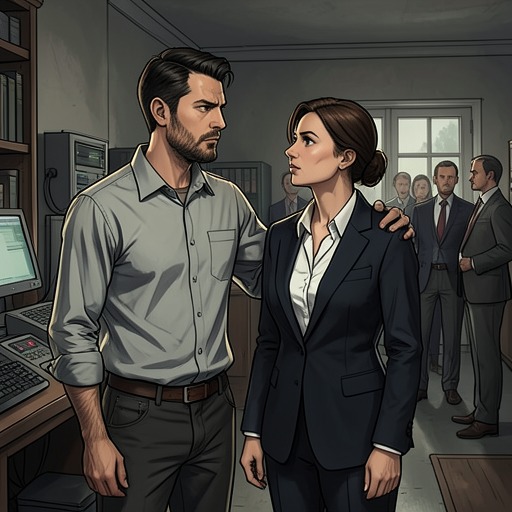
Dominick Corvaisis–Parker Faine relationship
StrangersThe relationship between Dominick Corvaisis and Parker Faine is a close friendship shaped by practical care, frank disagreement, and an uneven willingness to accept help. When Dominick’s sleepwalking makes living alone seem dangerous, Parker offers him a place to stay and proposes that they work through the problem together. Dominick refuses, fearing a retreat into the isolation he has struggled to leave behind. Their outings with two boys from Big Brothers of America offer a warmer counterpoint: Parker, initially reluctant to become a Big Brother, grows enthusiastic about the role, while continuing to notice when his friend is not all right.
Friendship Under Pressure
On the drive from Dr. Cobletz’s office in Newport back to Laguna Beach, Parker argues that Dominick should not keep living alone until the sleepwalking stops. At the wheel of his Volvo, he drives fast but not recklessly; although he seldom looks away from the Pacific Coast Highway, his attention seems fixed on Dominick. The scene makes his concern concrete. He is not merely discussing a symptom but questioning the arrangement that leaves his friend alone at night with a condition he cannot control.
Parker offers room at his home and promises to keep an eye on Dominick without hovering. He also imagines the arrangement as a chance for conversation: he wants them to examine how the sleepwalking might connect to the changes Dominick underwent during his trip to Mountainview College the summer before last. His offer combines companionship with a self-appointed therapeutic role. He jokes that, had he not become a painter, he would have become a psychiatrist, and insists that he has a knack for getting people to talk about themselves. The confidence is characteristic of Parker’s approach: he offers help directly, with humor, and on terms that would bring the two men into closer daily contact.
Dominick’s Refusal and Need for Independence
Dominick refuses the invitation. Staying at his own house, alone, feels preferable to retreating into the same “rabbit hole” in which he had hidden from life for years. The choice is not presented as indifference to Parker; it follows from Dominick’s fear that accepting shelter would undo a hard-won change. Since his trip to Mountainview, he has begun to like the person he has become and has seized a more active life at thirty-three. He is especially afraid of slipping back into his former dreary existence.
The friends therefore disagree over what care should look like. Parker sees company and close observation as prudent until the sleepwalking ends. Dominick sees remaining at home as a test of whether he can meet the problem without withdrawing from his new life. He suspects that the sleepwalking may be an excuse to escape the challenges and stress of that life, and decides to stay alone, take the medicines Dr. Cobletz prescribed, and endure the condition. By Saturday, December 7, the decision appears to have helped: after walking in his sleep every night before treatment, he has left his bed only twice in the previous five nights. This improvement gives his choice some support, but it does not settle the larger question of how much Parker’s help is needed.
Shared Care for the Boys
The friendship also takes shape through their work with Denny Ulmes and Nyugen Kao Tran, two boys assigned to them by the Orange County chapter of Big Brothers of America. Dominick had joined the program years earlier in Portland, Oregon, and it was his only community involvement. His investment has a personal history: raised in a series of foster homes, he had been lonely and increasingly withdrawn. He hopes to adopt children if he marries; meanwhile, spending time with the boys lets him help them and comfort the lonely child he remembers in himself.
Parker became a Big Brother because Dominick insisted, but his first response was comic resistance. He describes himself as a heavy drinker, a womanizer, a procrastinator, a dreamer, and a self-centered egomaniac, then questions whether a child should turn to him for advice. He even complains that he dislikes dogs, though children like them. The self-mockery marks a contrast with Dominick’s confidence in the program: Parker doubts his suitability, while Dominick sees enough in him to press the invitation.
During a Thursday afternoon at the beach, cold water rules out swimming. Parker responds by organizing volleyball and surfside races, then invents a complicated game using two frisbees, a beach ball, and an empty soda can. Under his direction, the group also builds a sandcastle with a menacing dragon. Later, at Hamburger Hamlet in Costa Mesa, Parker tells Dominick that becoming a Big Brother was one of his best ideas. The episode shows not simply that Parker has accepted the role, but that he has found pleasure in actively shaping the boys’ afternoon. His initial objections give way to participation and appreciation.
Attentiveness and Its Limits
At dinner, Parker notices that Dominick seems distracted and “a little out of it.” Dominick says the sleepwalking has pretty much stopped and that Dr. Cobletz knows what he is doing, then claims that his new book is going well. The narration makes clear that the last claim is a lie. Parker’s question shows that his attention has not ended with the improvement in Dominick’s nights; he is watching his friend’s broader state, including his work and demeanor. Dominick, however, does not fully confide in him. Their bond thus holds both an offer of frank, sustained involvement and a limit: Parker notices, asks, and makes room, while Dominick continues to manage part of his trouble privately.