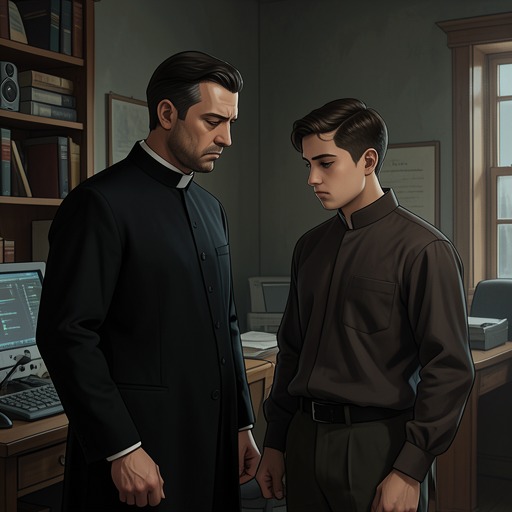
Stefan Wycazik–Brendan Cronin relationship
StrangersThe relationship between Stefan Wycazik and Brendan Cronin is a mentorship that moves beyond clerical instruction into practical care, shared service, and an unresolved struggle over what faith can explain. When Brendan’s crisis threatens both his belief and his future in the Church, Wycazik does not answer with another theological debate: he offers a trial of treatment and work, stays beside him through uncertainty, and later tries to understand the extraordinary events connected with him. The bond is tested by suffering that resists easy answers and, finally, by Wycazik’s death amid the effort to suppress the witnesses.
A Mentor Offers a Way Forward
Wycazik understands that Brendan’s crisis has institutional as well as spiritual consequences. He warns that scrutiny by the Prefect of Discipline could leave Brendan permanently suspect, restricting the prospects that Wycazik believes his younger colleague might otherwise have in the Church. His concern is not simply that Brendan regain composure; he wants to keep open the possibility that Brendan can serve the Church on a larger stage. Brendan, in turn, responds with respect for Wycazik’s example, treating a life like his mentor’s as honorable rather than as a diminished career.
Instead of continuing their discussions about good and evil, Wycazik proposes to apply his own theories about psychological disorders. He asks Brendan to give him until Christmas, promising that if the distress remains severe and they are no closer to an answer, he will arrange care with a Jesuit psychiatrist. The plan combines personal commitment with a limit: Wycazik will try to help, but he does not claim professional expertise or insist that his approach must succeed. Brendan agrees, accepting not a ready explanation but a period of guided effort.
Wycazik makes that effort concrete by directing Brendan to put away his ecclesiastical suits and report to St. Joseph's Children's Hospital. There, Brendan is to work as an orderly, not as a chaplain. Wycazik secures secrecy from Dr. Jim McMurtry and makes clear that Brendan must receive as much work, including unpleasant work, as any other member of the staff. The arrangement strips away the visible authority of the priesthood: at the hospital, Brendan is simply Brendan.
Service Among the Suffering
On his first day, Brendan empties bedpans, changes urine-soaked linens, helps with passive exercises, feeds a partially paralyzed eight-year-old, pushes wheelchairs, and cleans up after children made sick by chemotherapy. Faced with children suffering from rheumatoid arthritis, muscular dystrophy, burns, and abuse, he twice retreats to a locked restroom stall and weeps. The assignment brings him into contact with pain at close range, but it does not produce the restored faith Wycazik may hope for. Brendan cannot reconcile the suffering of innocent children with the merciful God he has been taught to believe in, and the standard theological argument that human choices account for evil seems inadequate before the children themselves.
The children complicate the lesson without resolving it. Many remain convinced that a caring Father watches over them; Emmy, despite crippled limbs, twisted hands, and pain, believes in God's goodness and in the rightness of creation. Wycazik’s implied challenge is that Brendan might learn something from their faith. Yet Brendan remains moved principally by their courage, not persuaded by their belief. The relationship therefore does not work as a simple transfer of conviction from mentor to pupil: Wycazik creates an encounter that deepens Brendan’s moral attention, while Brendan’s central question survives it.
A Wider Apprenticeship in Chicago
Wycazik’s guidance also takes Brendan outside the hospital. Through an arrangement with a local precinct captain, Brendan rides as an observer with Winton Tolk and Paul for five days. His cover is that of a lay consultant studying the need for Catholic charity outreach programs; wearing an ordinary suit, tie, and topcoat, he is not presented to the officers as a priest. The assignment places him in an impoverished, crime-ridden part of Chicago, where he develops a strong liking for the two men and sympathy for residents living amid decaying buildings and filthy streets. A sandwich-shop shootout becomes the worst incident of his police ride-along to that point.
This work extends the mentorship’s practical logic. At the hospital Brendan confronts suffering that asks what faith means; alongside the officers he sees vulnerable people exposed to violence and learns to regard the neighborhood through sympathy for its honest residents. Wycazik’s arrangements give him experiences rather than another abstract argument. They also place him near events that will later be interpreted as more than ordinary acts of service.
Miracles and Competing Explanations
When Winton is in danger, Wycazik tells surgeon Bennet Sonneford that he senses a force beyond human agency, a Presence more concerned with Brendan than with Winton himself. He connects this possibility to the healing of Emmy Halbourg, whose limbs had been crippled by disease. The claim reveals how Wycazik reads the events: Brendan is not merely a priest who happened to be present when a man was reached in a crisis, but someone linked to a pattern of apparent miracles. Even so, Wycazik does not call him a saint. When Winton asks whether Brendan is one, Wycazik answers that Brendan is a good man, not a saint; the distinction preserves Brendan’s moral character without pretending to explain the healing.
Later, Wycazik develops another interpretation. He believes Brendan’s crisis of faith may be connected to a buried memory of encountering a race vastly different from humanity and so superior that Brendan subconsciously felt it contradicted the Church’s teaching about humanity’s likeness to God. This is Wycazik’s hypothesis, not a confirmed account of what happened. He argues that likeness to God concerns minds and souls—the capacity for reason, compassion, love, and friendship—rather than physical appearance or technological advancement. His effort to reach Brendan thus adapts his earlier mentorship: rather than dismissing the unsettling possibility of an alien encounter, he tries to place it within a religious understanding centered on care.
Death and the Cost of Guidance
The relationship’s final turn comes at Thunder Hill Depository. After the witnesses and Parker Faine are brought there under armed guard, Leland Falkirk orders his men back to Shenkfield to bury Stefan Wycazik in an unmarked grave and await further orders. The order establishes that Wycazik has been killed and that even his burial is to be concealed. His concern for Brendan’s future, his hospital and police assignments, and his attempts to interpret Brendan’s connection to the healings now stand against the machinery being used to control or erase the witnesses.
Wycazik cannot provide Brendan with a final explanation or accompany him through the crisis to its resolution. What remains is the shape of his mentorship: he tried to protect Brendan’s vocation without shielding him from difficult work, treated doubt as something to meet with care rather than slogans, and continued to seek a language in which extraordinary events and compassion could coexist. His death makes that guidance both intimate and unfinished, while the proposed unmarked grave gives the relationship a stark final image of a teacher whom the authorities intend to remove from public memory.