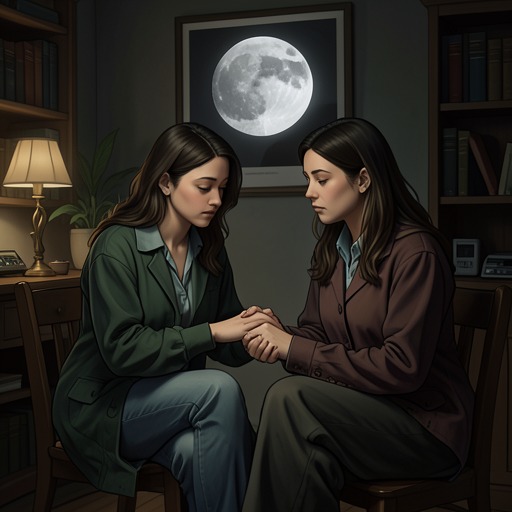
Jorja and Marcie — mother and daughter
StrangersJorja and Marcie — mother and daughter is a relationship tested by Marcie’s retreat into a confused, nearly unresponsive state and sustained by Jorja’s attentive care. As Marcie’s memories begin to surface, Jorja does more than comfort her: she helps her distinguish the remembered image of a falling moon from the spacecraft that actually came down, giving a shared name and history to what had remained frighteningly obscure.
Care Under Threat
In the truck carrying them through the windy night, Jorja holds Marcie with one arm and grips a strap with the other. Marcie clings fiercely to her. Her earlier semicatatonic limpness has given way to an intense need for touch and affection, but she is still not connected to reality. Jorja reads the change cautiously: the renewed desire to hug and be hugged seems hopeful because it may mark a way back from the darkness into which Marcie has retreated, not because recovery is already complete.
That care unfolds under coercion. Leland Falkirk has demanded to know where Ginger, Dom, and Jack have gone, and has threatened to cause Marcie pain to force the others to answer. Jorja’s attention is therefore divided between her daughter’s fragile condition and the danger surrounding them. Parker Faine’s account of Calvin Sharkle and of Brendan Cronin passing his power to Emmy Halbourg and Winton Tolk briefly displaces even that immediate anxiety; his suggestion that he, too, may have received the power, and his explanation that something came down from the sky, reshape what Jorja understands about the past. Yet the threat of remaining in Leland Falkirk’s custody prevents revelation from becoming simple relief.
The Moon as a Broken Memory
Marcie’s repeated word, spoken against Jorja’s neck, is “Moon.” Jorja silently imagines reassuring her that, now they understand what Marcie has forgotten, remembering will show her there is nothing to fear. She does not offer that promise aloud. She cannot know what Leland Falkirk intends to do with them, and she does not believe a happy ending is likely while they remain in his custody. The restraint is part of her care: she wants to soothe Marcie, but does not present hope as certainty when their circumstances give her no grounds to do so.
The word “moon” is not merely a description of what Marcie sees. At the recovered spacecraft, Jorja recalls standing on the shoulder of Interstate 80, afraid to approach and telling herself that her reluctance came from needing to keep Marcie safe. She watched Brendan Cronin, Dom, and Ginger move toward the golden craft; when they disappeared from view, those remaining on the highway moved east to keep them in sight. Jorja remembers seeing the round portal of blazing light on the ship’s side. These recollections place mother and daughter in the same encounter, although Marcie’s memory has not yet returned in an orderly account.
Recognition at the Ship
Later, with Marcie in her arms, Jorja stands beside Jack Twist before the spacecraft, now resting on trestles. The return of Jorja’s own memories has partly prepared her for the sight, but she is still overcome by awe. She reaches out and touches the hull, feeling fear, wonder, and delight together as her fingertips meet its scorched, abraded metal. Marcie reaches toward it too, whether following her mother’s example or acting on her own impulse. When her hand touches the hull, she says, “The moon. The moon.”
Jorja answers directly and gently: “Yes, honey. This is what you saw come down. Remember? It wasn’t the moon falling. It was this, glowing white like the moon, then red, then amber.” She corrects the image without dismissing it. The moon was the form in which Marcie had carried an experience she could not fully recall; the ship gives that image a concrete referent. Marcie’s small hand moves across the mottled hull as though trying to clear away both its aged surface and the clouding of her own memory. The gesture connects physical contact with the work of remembering, while leaving open how much of that work she can yet complete.
A Return That Remains Incomplete
Marcie turns and looks at Jorja with eyes no longer out of focus or turned inward, then asks, “Like Captain Kirk and Mr. Spock?” Jorja smiles and holds her tighter, answering, “Yes, honey, like Captain Kirk and Mr. Spock.” Jack Twist adds the familiar figures Luke Skywalker and Han Solo to the explanation. Their shared references let Jorja describe the spacecraft in terms Marcie recognizes, making an immense revelation briefly accessible through the language of stories and films.
The moment does not amount to a settled recovery. After hearing the explanation, Marcie’s eyes lose focus again and she returns to her private place to contemplate it. Jack reassures Jorja that Marcie will be all right, interpreting her moon obsession as a struggle to remember that can ease now that remembering has begun. Jorja is reassured by his presence, but answers with the condition that defines her situation: Marcie may recover if they can get out alive and with their memories intact. Their exchange holds affection and uncertainty together. Jorja can give Marcie a hand to hold, a touch on the ship, and words that distinguish the remembered moon from the vessel; she cannot yet guarantee safety, complete memory, or a happy ending.