Battle at the Nevada Test Site
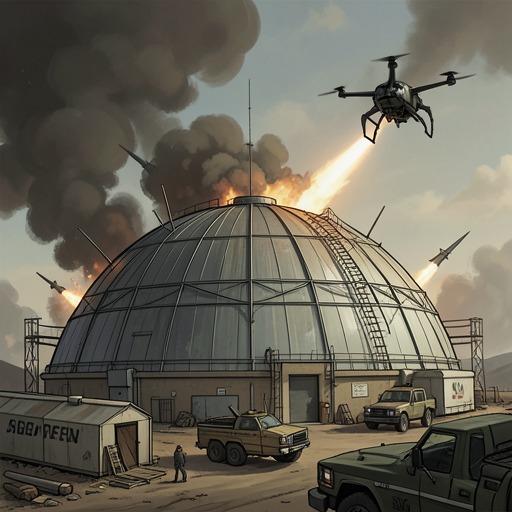
StrikeThe Battle at the Nevada Test Site is the assault on the Retro camp that brings Sounder resistance and SYLO forces into a coordinated fight against the Retro occupation. Its decisive turn comes when drones appear over the desert and Tori Sleeper signals that the air operation is underway. The battle is not simply a contest for the camp: control of the Bridge dome determines whether the Sounders can carry out their plan, while the approaching detonation deadline puts the same structure at the center of events in 2324.
Causes and Stakes
The battle grows out of a colonization project prepared over years by the future military and government. Its stated purpose is to replace the population of the twenty-first century with people from the twenty-fourth. The Retro camp is part of that undertaking, and its prisoners are treated as a controlled labor force. The contrast between the mission’s administrative presentation and its human consequences is visible in the camp’s numbering system: Tucker is told that he is Zero Three One One, and that his former life, including his mother and friends, no longer belongs to his history or future.
The military hierarchy also gives the conflict a personal face. Major Bova introduces himself to prisoners as their host, despite commanding the work camp. Elsewhere, a Retro lecturer describes assigning workers to maintain water-filtration plants and training them to operate without help from surviving local people. These details show how the invasion is meant to become a functioning society, not just a military occupation. The battle therefore threatens the machinery of a larger plan to displace the existing population and establish the future arrivals in its place.
The Sounders oppose the invasion from within the future’s military structure. Captain Kenny Sokol explains that public support for the mission and the limited size of the resistance make simple refusal inadequate; the Sounders have formed to oppose it. At the Nevada camp, members of that resistance are already positioned to act when the attack begins. Their knowledge of the coming assault allows them to prepare the dome’s entrance rather than react only after the Retro defense has organized.
The Air Operation and the Assault
The desert scene first signals the change through sound: faint musical notes precede the appearance of black drones in the distance. A second drone follows, and Captain Granger’s response makes clear that the sight is a warning that the operation has begun. Tori then gives the brief signal that the group is waiting for. Kent Berringer confirms that the message has reached him, and Granger orders the strike to start. SYLO personnel rise, vehicles start, and the stillness gives way to the movement of an advancing force. Tucker, Tori, and Kent remain momentarily frozen by the sudden transition from expectation to action.
Inside the camp, the Retro soldiers are caught between conflicting impressions: they have been attacked before, but this time their own aircraft appear to be turning against them. That confusion delays the response. Artillery crews lose time deciding whether to fire on the aircraft, and the drones attack the large guns. The camp guards, meanwhile, herd the prisoners into barracks and lock them inside, apparently adapting their response to an earlier escape during an air raid. The decision keeps guards occupied with the prisoners instead of sending them immediately to defend the dome, weakening the camp’s initial defense.
At the dome, the Sounders have placed armored vehicles across the large open entrance as a barricade and taken positions inside on either side of it. Their weapons give them an advantage over the Retro soldiers’ smaller Pulsers. The first Retro troops sent toward the entrance meet prepared resistance; even when the defenders face the greater numbers of the camp force, they hold the line. The attackers continue forward despite losses, and only a few reach the doorway before being stopped. The defense remains precarious, however: the narration explicitly leaves open how long a small group can withstand the growing assault.
SYLO Reinforcements and a Shifting Balance
The battle threatens to turn against the Sounders when Retro forces press toward the dome and other commandos have to divide their attention to protect the drone command center. If that center falls, the Retros could regain control of the drones and reverse the air operation’s advantage. The arrival of SYLO helicopters interrupts that danger. Dark-red-uniformed commandos descend by zip lines and move toward the dome, adding a new force to the fight just as the Sounder defense is under pressure.
The reinforcements change the shape of the fighting. Retro troops who had been advancing toward the dome must also defend themselves against attackers approaching from several directions. SYLO’s weapons are much older than Retro technology, but the account emphasizes their effectiveness in coordinated hands: the commandos move in compact groups, cover one another, and use short bursts of fire as they advance between buildings. The Sounders initially challenge a SYLO soldier who enters the dome, not knowing whether the newcomers are allies. The confusion ends when another commando recognizes that the young people have helped bring SYLO into the fight. The arrival that changes the battle’s balance also confirms that the alliance has become operational on the ground.
The air and ground actions thus depend on one another. The drones weaken the camp’s heavy guns and disrupt its response; the Sounders protect the dome and help keep the drone operation from being retaken; SYLO’s arrival prevents the Retro forces from concentrating solely on the entrance. None of these advantages makes the outcome immediate. The camp’s defenders still have numbers, and the dome remains under attack as the larger operation moves toward its next stage.
The Battle Across Two Times
The fight is intercut with events in 2324, where Olivia stands before the dome’s closed door. For the bomb to destroy the Bridge, that door must remain shut, leaving Olivia’s only route out through the Bridge into the past. This parallel action gives the battle a second front and makes the dome’s entrance more than a tactical position: the same threshold is tied to the Sounders’ defense in the past and to Olivia’s effort to keep the future-side structure sealed. The consequences of the assault therefore extend beyond who controls the camp at any given moment.
In the twenty-first-century fighting, Tucker’s group skirts the center of the battle to approach the dome from behind. The time pressure has become explicit: fifteen minutes remain before the expected detonation. On that approach, Tori tries to stop Colonel Feit, but her Pulser fails when she pulls the trigger. The misfire leaves Feit able to continue the confrontation and pushes the group into a more immediate personal danger amid the larger battle.
Moral Consequences and the Event’s Turning Point
The battle also tests the distinction the opposing sides claim between themselves. Earlier, Tori challenges Tucker over the willingness to let an individual die for the mission. She connects that choice to the deaths caused when the group sabotaged the Retro fleet, including people she had shot herself, and asks whether the resistance can condemn the Retros’ disregard for life while adopting the same logic. Her question becomes still more severe when she asks whether Tucker would press a button that stopped the invasion but erased the entire population of 2324. The military objective is therefore shadowed by the possibility that defeating the invaders could itself mean mass death.
Tucker’s own account of his change makes that tension concrete. He recalls that he once feared the handgun Tori kept in the car; in the war, he has become ready to shoot anyone he believes is an enemy. Revenge, as well as the search for truth and an end to suffering, has driven him. Yet the prospect of rebuilding after victory forces a further question: whether humanity would reproduce the failures that helped create the desperate future the Retros are trying to escape. When Tucker says the killing must stop somewhere, he acts on that recognition and runs toward Feit rather than treating the battle’s logic of retaliation as inevitable.
The available account ends with the conflict still in motion, not with a settled military result. The Sounders have held the dome through the first pressure of the assault, SYLO’s arrival has altered the balance, and Tucker’s decision carries the fight into a direct confrontation with Feit. The event’s central reversal is both tactical and ethical: an operation launched to stop a population-replacement campaign succeeds through cooperation between former opponents, while its participants must decide whether victory will interrupt the cycle of killing or simply give it new justification.