Retro Camp Bus Escape Attempt
StrikeThe Retro Camp Bus Escape Attempt is a prisoners’ coordinated bid for freedom, disguised as a protest over water and answered by the destruction of their getaway bus. The reversal exposes both the prisoners’ ability to organize under Major Bova’s rules and the Retros’ willingness to erase an escape attempt from the air. For Tucker, the night moves from a glimpse of collective resistance to apparent mass death—and then to the astonishing discovery that Tori Sleeper survived.
Conditions and the Diversion
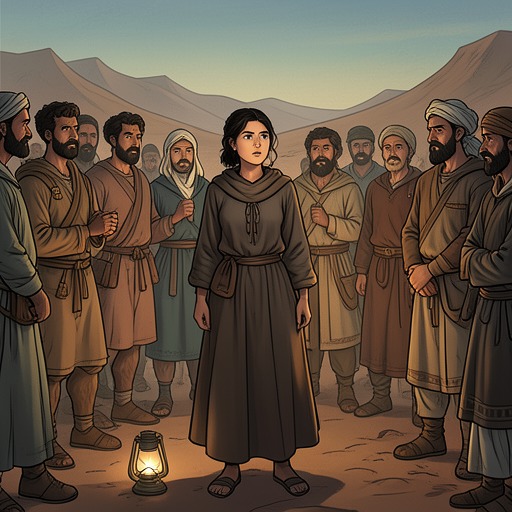
The demonstration grows from the prisoners’ daily conditions: backbreaking labor under the hot desert sun without enough water to stay hydrated. From the infirmary roof, Tucker sees smoke rising in separate clouds and several fires burning, but no buildings appear damaged. The explosions seem designed to draw attention rather than destroy the camp. At the edge of a clearing, a crowd of hundreds gathers, arms locked, and chants, “Water! Water! Water!”
Retro soldiers hold their baton weapons in both hands but do not yet aim them at the prisoners. The crowd grows louder, and the standoff carries the threat of violence: an attack on the guards could cost many prisoners their lives. Tucker initially reads the scene as a demonstration, not a breakout. He also doubts that protest will improve the prisoners’ treatment. The apparent stalemate is precisely what makes the diversion effective: the guards’ attention remains fixed on the crowd while a different group prepares to move.
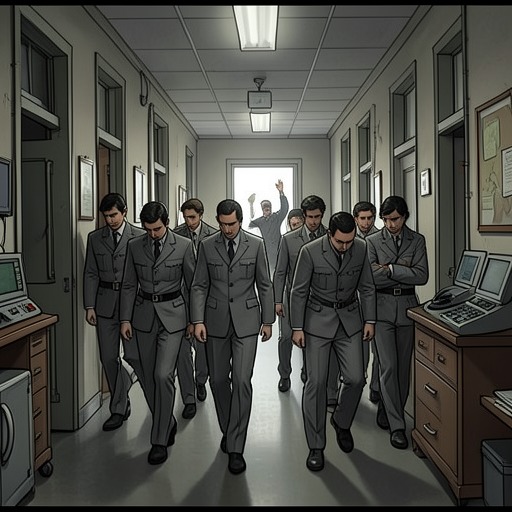
A dark-painted bus, similar to a school bus, approaches without headlights and stops beside a barracks near Tucker’s position. He fears it has brought reinforcements, but the vehicle is empty. Prisoners in orange emerge from the neighboring barracks and board quietly, without a word. Their speed and coordination reveal that the protest, the explosions, and the armed standoff are parts of a rehearsed plan. The crowd is not simply demanding water; it is creating a distraction so a handful of prisoners can escape.
Escape and Sacrifice
The demonstration’s true cost becomes clear to Tucker as he watches the two groups’ roles converge. The prisoners in the courtyard hold the guards’ attention while the bus fills. They are, in effect, sacrificing themselves to give the escapees a chance. Tucker recognizes that the camp’s rules have not extinguished communication or cooperation: even under forced labor and strict control, prisoners have found a way to coordinate resistance. The discovery gives him a rush of pride and hope, though he can do no more than watch from the roof and wish the escapees well.
Tucker understands that Major Bova may punish the prisoners who helped create the diversion. He believes they must have weighed that danger and chosen to proceed anyway. The breakout is therefore not only a plan to get a few people out; it is an act of solidarity in which those remaining accept the risk of retaliation for others’ freedom. Tori Sleeper is among the prisoners Tucker believes is escaping. His relief at seeing her alive is bound up with the bravery of the people who helped her reach the bus.
The Bus Is Intercepted
The brief hope breaks when Tucker hears music from the direction of the steel dome—the sound associated with the black fighter planes. Three aircraft on the ground come to life, their undersides lighting as they prepare for takeoff. The Retro guards’ restraint now looks ominous to Tucker: he fears the planes, rather than the soldiers in the courtyard, will bring the attack. The prisoners’ chanting is so loud that they cannot hear the aircraft.
The planes bank together and head for the bus. Tucker runs along the building, but the aircraft move away faster than he can follow. He has seen a similar ruthless attack kill Quinn Carr, and he recognizes what is coming. Each stingray-shaped plane projects a narrow, intensely bright beam; the beams join into a single, more powerful Three-aircraft coordinated vaporization beam and strike the bus. The vehicle glows as it continues forward for a moment, then vanishes. There is no wreckage, scorched ground, or visible body left behind.
The planes retract their beams and fly away, their attack complete. Tucker initially understands the disappearance as the deaths of the passengers, including Tori. He falls to his knees in shock, after passing within minutes from the relief of learning she was alive to believing he had witnessed her execution. He also wonders whether he has somehow drawn the Retros’ attention to the bus, but cannot know whether his actions contributed. The attack leaves him grieving and uncertain, while the lack of physical remains makes the scene’s destruction seem almost like an erasure.
Survival and Significance
Tori later appears alive and tells Tucker, “You saved me.” She explains that when she saw him, she could not leave without him; she got on the bus and ran straight for the front door. Her account overturns Tucker’s immediate belief that she was among the dead. The other escapees, however, are mourned as gone: Tori says they had taken her in because she had been part of their work unit that day. The rescue of one person does not undo the loss of the group that made the escape possible.
The event’s central reversal is also a measure of the prisoners’ resistance. What first looks like a futile protest becomes a carefully coordinated breakout, and what Tucker takes for Tori’s death becomes a survival he did not expect. The escape fails as a collective flight, but the diversion demonstrates that the prisoners remain capable of trust, planning, and self-sacrifice. Against the camp’s coercive order, their solidarity briefly creates a route to freedom—even as the aerial attack shows how quickly the Retros can close it.