United States Air Force
StrikeThe United States Air Force is the technologically superior military force at the center of the future war in the novel. Under Retro control, it turns its aircraft and weapons against SYLO and helps carry out a plan to replace the population of the twenty-first century with people from the twenty-fourth. Yet the Air Force is not simply a unified instrument of aggression: some of its own personnel oppose the invasion and organize as the Sounders. The contrast between the institution’s military power and the dissent within its ranks makes it a site of both the conflict’s violence and its internal resistance.
Identity and Military Advantage
The Air Force is one of the branches of the United States military, while SYLO is associated with the Navy. In the conflict presented to Tucker and his companions, however, the two sides are sharply unequal in technology. Retro forces fire powerful energy bursts that are invisible and silent, but destructive enough to serve the function of conventional missiles. SYLO’s helicopters have no weapons aboard, and Captain Granger explains that their defense depends on separate gunships. The aircraft crews have to evade the incoming attacks while trying to keep their helicopter under control; when SYLO gunships arrive, their machine guns and rockets provide a welcome counterattack, but they do not erase the broader technological disparity.
The gap is not limited to a single weapon or encounter. Tucker understands that the Air Force has capabilities that SYLO does not, and describes the civil war between them as an unfair fight. The Air Force’s advantage helps explain why SYLO’s operations are so dangerous: it must confront a force able to strike from the air with weapons that its opponents cannot readily match.
Air Power and the Continuing Campaign
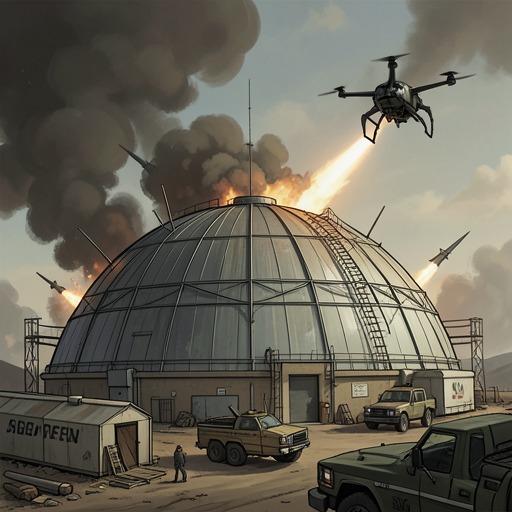
The Air Force’s threat persists even after SYLO’s success against its aircraft at Area 51. Tucker and his companions later encounter a black Retro attack plane rising vertically from the Mojave dome before accelerating away. The sight shows that the destruction of the fleet at Area 51 did not end Retro air power. Tucker realizes that additional aircraft are arriving, and fears that the force may rebuild its capacity to continue the campaign.
The dome is also a fortified military position. From above, the group sees the wreckage of hundreds of SYLO fighter jets scattered across the desert, aircraft that had been shot down by drones and antiaircraft guns while trying to destroy the structure. The dome remains beyond their reach, and the surviving Retro force retains the ability to operate from it. The episode shifts the meaning of the Area 51 victory: a major fleet has been destroyed, but the Air Force’s larger military presence has not been defeated.
On Pemberwick Island, the military situation is framed as a contest between SYLO’s attempt to protect the island and the Air Force controlled by the Retros. SYLO has established a base there to resist the opposing force, while the island itself has been overrun by SYLO soldiers and placed under quarantine on the pretext of a nonexistent virus. The conflict’s local consequences are therefore entangled with military control and deception, not only with aerial combat.
The Invasion and Its Political Purpose
Olivia explains that the future’s environmental and resource crises formed the background to the invasion. Climate change flooded low-lying regions, farmland and habitable space shrank as the population grew, and the government failed to bring about a transition to safer fuels or meaningful action on climate change. Decades of diplomacy between the governments of different eras also failed to change the course of events. In Olivia’s account, the future authorities concluded that changing the past would not save the billions of people already suffering in their own time.
The invasion consequently becomes more than a military response to immediate danger. With no colonies on other planets, the past offers the future society territory into which it can expand. Olivia describes the effort to persuade people in the past to change their behavior as part of a plan to make conquest and colonization easier, rather than a genuine attempt to avert the future crisis. The military and the United States government planned the undertaking for years. Its stated objective, as disclosed by Sokol, is to replace the twenty-first-century population with the population of the twenty-fourth century. The Air Force’s military power thus serves a political project of population replacement, not simply the defense of its own territory.
Complicity and Resistance Within the Ranks
Sokol’s account places the Air Force’s personnel inside the colonization project: those involved have been fulfilling duties in support of the mission and are aware of its different aspects. He describes Colonel Feit as an officer he knew from the Academy, and Major Bova as another leader of the undertaking. Sokol’s assessment is that Bova’s treatment of the native workers obstructs completion of the colonization camp. The description connects the military leadership’s conduct to the practical operation of the project, rather than leaving the invasion as an abstract policy.
At the same time, Sokol says that many service members want the operation to end. They believe that resignation or public refusal would not stop the institutional machinery, and that they are too few to change public opinion, which supports the invasion. The Sounders emerge from this minority opposition. Their existence makes the Air Force internally divided: personnel participate in the campaign, while others resist from within its military structure. The resistance does not undo the institution’s role in the invasion, but it complicates any account of the organization as morally or politically unanimous.
Consequences and Ethical Reckoning
The scale of the Air Force’s violence is described through its consequences: the Retro Air Force has killed three quarters of the world’s population. Its leaders and supporters justify their actions as protection against a still worse fate, but Tucker finds it difficult to accept that rationale alongside the mass killing. The survivors’ resistance is also morally unsettled. Tori reminds Tucker that opposing the invasion does not automatically make their side better: their actions have killed people too, and their willingness to accept those deaths when useful to their aims demands scrutiny.
That challenge becomes personal as Tucker recognizes how revenge has shaped his own participation in the war. He has moved from fearing a handgun to firing a pulser at perceived enemies, and has wanted not only to end the suffering but to make someone responsible suffer in turn. As the group approaches the final confrontation, he concludes that the killing has to stop somewhere and runs toward Feit rather than treating another death as an uncomplicated victory. The conclusion does not erase the Air Force’s responsibility for the invasion or its mass casualties. Instead, it makes the conflict’s ethical stakes extend beyond defeating a military force: the survivors must consider what kind of world their victory would rebuild, and whether they can break the cycle of violence the Air Force’s campaign has intensified.