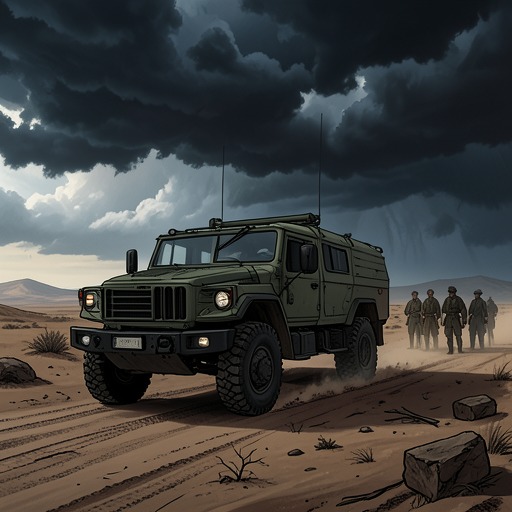
21st-century United States Government
StrikeThe 21st-century United States Government is the past-era government that learned of the Bridge and worked with its future counterpart while attempting, unsuccessfully, to avert the disaster revealed on the other side. It kept the discovery secret for more than seventy years, sealed the surrounding area, and eventually created SYLO to resist a possible invasion. Its history is defined by a stark contradiction: it had access to knowledge of the coming ecological catastrophe, yet that knowledge did not produce the changes needed to stop it.
Discovery, Secrecy, and Control
The government’s secret began with the Bridge, whose opening connected the military installation to a particular future. The phenomenon was not understood as a machine that could send people freely through time: the explanation offered to those who encountered it involved nuclear fission, particles accelerated beyond the speed of light, gravity, and the dome’s shape, while even the people briefed on the physics did not know why the Bridge connected to that specific time. The government therefore possessed access to the future without possessing a complete account of how the connection worked.
Secrecy made that access politically manageable. The site had been a secure military base since the 1940s, giving the government an existing means to restrict access and conceal the Bridge. The secret was maintained for more than seventy years and disclosed only to a select few. In the account of the discovery, this was not merely an attempt to hide an unusual military installation: the government feared that knowledge of future travel could unsettle basic beliefs and become an unprecedented source of power. Information about how people would die, or about events yet to come, could change choices in the present. The government kept that knowledge from the public, even as it struggled to decide what the discovery should mean for policy.
Foreknowledge Without Effective Prevention
The Bridge gave governments of two eras a glimpse of what lay ahead, but foreknowledge did not translate into successful prevention. The future shown to them was marked by environmental and material decline: melting polar ice caps flooded low-lying regions; Lower Manhattan and much of Los Angeles were underwater; New Orleans and other major cities had disappeared; and Pemberwick Island no longer existed. Population growth continued as livable land and farmland diminished. These details made the warning concrete, but did not ensure that the people who received it would act on it.
The future account describes repeated failures to change the conditions that produced that world. The governments’ efforts to avert the crisis included nearly seventy years of diplomacy between the United States Governments of the two eras. Those efforts failed. In the past, leaders did not secure the development of safe alternative fuels, in part because businesses saw insufficient profit, and they did not persuade enough people to confront climate change. Cars continued to consume fuel, coal continued to generate electricity for factories, and population grew while the food supply dwindled. The government’s knowledge thus carried a responsibility that its policies and negotiations did not fulfill: the warning was received, but the political and economic obstacles to acting on it remained in place.
The Creation of SYLO
The government also anticipated that the future-era military might threaten the past. It created SYLO as a force intended to hold that threat back. That decision shows that the government did not simply ignore every danger revealed by the Bridge. It recognized enough risk to establish a defensive organization, but it underestimated the scale of the military preparations on the other side. The Air Force in the future built a massive attack force over a period of years, and the past’s defenders had no adequate understanding of the firepower being assembled.
The resulting imbalance exposed the limits of the government’s response. SYLO was meant to protect the past, but the creation of a counterforce could not compensate for the government’s failure to prevent the larger crisis or to anticipate the full capacity of the future military. Its role is therefore neither that of an entirely passive victim nor that of a successful guardian: it perceived the possibility of attack and prepared for it, yet the preparation proved insufficient to keep the past from facing an invasion.
Responsibility and Historical Consequence
The future government’s justification for invading the past was shaped by a history of resentment. People in the future lived amid disease, hunger, dwindling resources, and crowded, government-controlled cities; they regarded the past as responsible because it had been shown the consequences of its choices and had failed to change course. The invasion was eventually presented publicly as a response to failed negotiations and resistance, but that explanation was also part of a plan to cultivate hatred toward the people of the past. The future leaders’ private strategic purpose was to conquer and colonize the past, not simply to persuade it to reform.
The government’s record consequently sits at the intersection of two failures with different causes and consequences. Its unsuccessful environmental and diplomatic efforts helped leave the future population facing catastrophe; its security response, through SYLO, was aimed at resisting the danger that followed. Neither fact makes the later invasion a neutral or inevitable act: the future’s decision to expand into the past was presented as a choice made under pressure, and its leaders concealed their colonial purpose behind public appeals to humanity and historical blame. The 21st-century United States Government is significant because its access to the warning makes the conflict more than a clash between strangers from different eras. The people of the future arrive with a grievance rooted in real neglect, while the past confronts an invasion it had tried, inadequately, to anticipate.