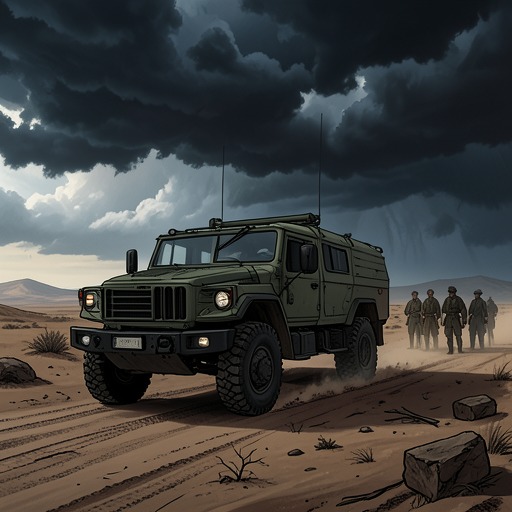
Future United States Air Force
StrikeThe Future United States Air Force is the armed institution that gives the future government’s invasion of the past its force and reach. Its campaign is not merely a military occupation: it is a planned effort to replace the population of the twenty-first century with people from the twenty-fourth. The Air Force’s overwhelming capacity makes that project appear difficult to stop, while the existence of the Sounders shows that resistance has taken root inside the system itself.
Institutional Purpose and the Invasion
The Air Force’s campaign follows decades of failed attempts to avert the future’s environmental and social collapse. In Olivia’s account, leaders from the past had seen what was coming but did not bring about the necessary changes; diplomacy between the governments of the two eras also failed. Against that background, the future government and military devised a plan to save their people and planet by invading the past. The stated emergency explains the policy’s political appeal, but it does not change its defining consequence: the past’s surviving population is to be displaced and eradicated so that the future’s population can take its place.
The Air Force is a principal instrument of this undertaking, which was prepared over years by the military and the United States government. The colonization mission joins force to administration. Future arrivals are organized for work needed to sustain settlements, including the maintenance of water-filtration plants and the repair of their systems. Training is designed to make the newcomers independent of local expertise, although the lecture on water management allows that surviving inhabitants might be pressed into service for what they know. The language of essential services therefore sits beside a plan that treats the people already living in the past as replaceable or exploitable.
Camp Administration and the Logic of Control
The labor camp presents the invasion’s institutional logic in miniature. Tucker is assigned a number and told that his former identity, family, and friends no longer count; work and obedience are declared to be his entire history and future. The camp’s rules restrict communication with Air Force personnel unless they initiate it, and restrict contact among workers to matters concerning their tasks. The system reduces prisoners to managed labor while attaching severe consequences to disobedience.
Major Bova makes that reduction explicit in the camp’s treatment of names. He announces that names are not used there, yet identifies himself as the prisoners’ host and supplies his full rank and name. The contrast is revealing: authority retains its identity and formal standing while those under it are classified as numbers. Bova’s courteous manner does not alter his role as commander of a work camp. His performance of hospitality gives the institution a civil surface, but the prisoners remain subject to a system built around compulsion and punishment.
The colonization program also reaches beyond immediate camp discipline. In a lecture to future settlers, a speaker describes water infrastructure as a critical duty and emphasizes learning to maintain it without native assistance. Other training is organized around the resources needed to support the new population. These plans turn occupation into a practical program of settlement: infrastructure, labor, and expertise are to be arranged for the incoming society, not for the continued autonomy of the people whose land and world are being taken.
Military Strength and the War with SYLO
The Air Force’s greatest strategic advantage is the scale of its resources. The Sounders explain that once their operation begins, the military will try to stop it, and that the Air Force has substantial forces in the colonization camp, including heavy artillery and drones. Control of the Bridge from one side would not be enough: forces based in the past could attack the other side and leave the Sounders exposed. The conflict is therefore fought across two fronts, and control of the connection between eras is inseparable from control of the forces stationed on each side.
The Sounders describe the wider war with SYLO as radically unequal. In their assessment, the Air Force can send waves of machines against the past, lose a hundred in an hour, and replace them with two hundred the next day. SYLO cannot match that capacity. Its nuclear arsenals have been rendered useless, and the loss of manufacturing capability prevents it from replacing even conventional weapons. The Air Force’s advantage is not simply a matter of battlefield strength: its ability to renew its forces makes resistance vulnerable to attrition.
The next planned offensive raises the stakes further. According to Kenny Sokol, the Air Force intends to abandon the relative restraint of the first wave and use a scorched-earth attack in which entire cities will disappear, followed by another wave against the remaining population. The Sounders present closing the Bridge as the only available means of preventing that escalation and giving survivors in the past a chance to rebuild. Their warning casts the Air Force not only as an occupying power but as a force preparing to destroy the society it intends to replace.
Resistance Within the Ranks
The Sounders emerge because opposition cannot be reduced to a conflict between two unified armies. Sokol explains that many within the future’s military establishment want the invasion to end, but that they are too few to change policy simply by refusing their assigned duties. Public support for the invasion further isolates them. Their resistance is thus organized from within a military and political order whose machinery continues to function even when some of its members reject its purpose.
The officers directing the colonization effort embody different forms of authority. Colonel Feit is described as treating the mission like a game, while Major Bova is characterized as taking pleasure in punishment. Sokol links Bova’s treatment of local workers to delays in completing the camp, suggesting that brutality can obstruct the project even on its own administrative terms. But the deeper indictment is institutional: the mission does not depend on one officer’s temperament. It is a large undertaking planned by government and military leaders, and replacing or opposing individual commanders would not by itself dismantle it.
The Dome and the Limits of Force
During the fight for the dome, the Air Force’s defenses are disrupted when its own aircraft appear to turn against its ground forces. The resulting confusion costs the artillery gunners valuable time; the drones then attack the heavy guns. At the camp, guards herd prisoners into barracks and lock them in rather than immediately joining the defense. That decision weakens the response at the dome, where only a small contingent initially confronts the Sounders’ commandos.
The defenders nevertheless face a renewed assault when the guards join the force and the Retro commanders urge their soldiers forward despite heavy losses. Some attackers reach the entrance but are stopped before they can get inside. The Sounders hold the defense for the moment, while Olivia watches the closed dome from the future, knowing that it must remain sealed if the bomb is to destroy the Bridge. The episode does not erase the Air Force’s numerical and material advantage; instead, it shows how disruption, divided loyalties, and the physical control of a single door can interrupt the operations of a much larger military.
The Air Force’s significance lies in this tension between institutional scale and human refusal. Its resources make conquest appear nearly inexhaustible, and its administrative systems translate that conquest into orders, numbers, labor assignments, and plans for settlement. Yet the Sounders’ existence means the institution is not morally or politically unanimous. The resistance exposes the gap between claiming to save a population and making another population expendable, while the battle at the dome turns that contradiction into a contest over whether the invasion can continue at all.