At 12:07 a.m. on the opening night
The Garden Discovery
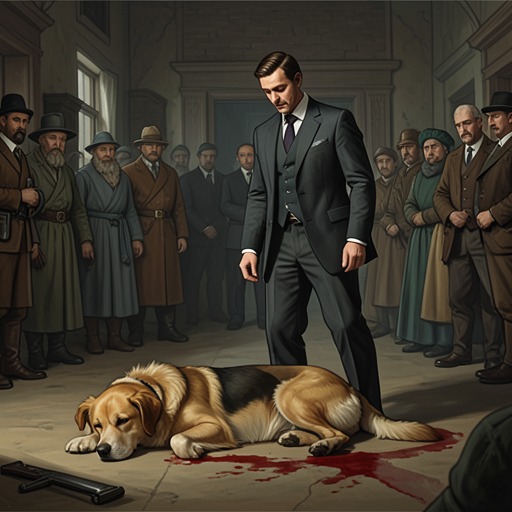
Christopher finds [Wellington](entity:character-recall-character-wellington-39434dc5b2d5) lying dead on the lawn outside [Mrs. Shears](entity:character-recall-character-mrs-shears-7a12d91c5db6)’s house, a [garden fork](entity:object-recall-object-ca53bd4f3869) driven through him into the ground. The dog is still warm, and Christopher studies the wounds before concluding that someone has probably killed him with the fork.
He strokes Wellington and wonders who could have done it and why. The discovery gives Christopher a concrete mystery to investigate, but it also begins a chain of events that will unsettle his home and his understanding of the people closest to him.
Minutes after Christopher finds Wellington
The First Police Encounter
[Mrs. Shears](entity:character-recall-character-mrs-shears-7a12d91c5db6) rushes outside, sees Christopher holding [Wellington](entity:character-recall-character-wellington-39434dc5b2d5), and screams at him. Overwhelmed by the shouting, he curls onto the wet grass with his hands over his ears. When police arrive, Christopher likes their clear uniforms and identifiable roles, but the officer’s quick questions pile up faster than he can process them.
When the policeman grabs his arm, Christopher strikes him to make him stop touching him. He is arrested for assault, an outcome that frightens him less than the confusion of the encounter: the familiar language of a police arrest gives him a brief sense of order.
Later that night
At the Police Station
At the station, Christopher empties his pockets and describes his family, his rat [Toby](entity:character-recall-character-toby-dc8e3140da29), and the objects he carries. He studies the cell as a nearly perfect cube and imagines how he might escape, turning an upsetting confinement into a practical problem.
His father arrives, and the two exchange their familiar hands-touching gesture instead of hugging. In an interview, Christopher admits he meant to hit the officer but did not intend to injure him; he insists he did not kill [Wellington](entity:character-recall-character-wellington-39434dc5b2d5) and does not know who did. The inspector gives him a police caution and releases him to his father.
The early hours after the arrest
A Promise to Investigate
On the drive home, Christopher apologizes for making his father come to the station, then says he will find [Wellington](entity:character-recall-character-wellington-39434dc5b2d5)’s killer. His father orders him to stay out of other people’s business, but Christopher regards a murder as a puzzle whose perpetrator must be identified and punished.
At home Christopher feeds [Toby](entity:character-recall-character-toby-dc8e3140da29) and plays Minesweeper. Later he finds his father crying over Wellington, but, understanding that sadness can call for solitude, he leaves him alone. The father’s grief makes the dog’s death personal, though Christopher does not yet understand why.
About two years before the opening
The Story of Mother’s Hospital Stay
Christopher recalls the day his mother did not come home. His father said she had gone into an ordinary hospital with a heart problem, would need rest, and could not receive visitors. He promised to bring her food and deliver Christopher’s get-well card.
Christopher accepted the explanation and made a card printed with nine red cars. His father later told him she had died unexpectedly of a heart attack. At the time, Christopher had no reason to question the story; the memory will become crucial when he discovers that the letters she sent him were hidden at home.
The morning after the dog’s death
The Good Day Decision
Four red cars in a row make the bus ride a [Good Day](entity:time-recall-time-good-day-ee2a2811ef97) by Christopher’s personal system. He explains that the colors and counts give him a reassuring order, even though they are not logical in the same way as mathematics. He also describes his ambition to become an astronaut and his belief that noticing details is different from using evidence to make a discovery.
Because it is a Good Day, he decides to investigate [Wellington](entity:character-recall-character-wellington-39434dc5b2d5)’s death. [Siobhan](entity:character-recall-character-siobhan-f4d21c07c592) encourages him to write about the investigation, and he begins the book that becomes the account of his search. Their teacher-student relationship gives his curiosity a form and a place to grow.
Two weeks after Christopher was told she entered hospital
Mother’s Death and the New Household
Christopher remembers being told that his mother had died of a heart attack. He tries to reason through possible medical causes, but his father cannot answer his questions. [Mrs. Shears](entity:character-recall-character-mrs-shears-7a12d91c5db6) comes over to make supper and comforts Christopher’s father, becoming a practical presence in the household.
Christopher does not attend the funeral. His account of his mother’s death appears settled, while his father and Mrs. Shears draw closer; the reader can later see that the household is being shaped by absences and secrets Christopher has not been told.
The Saturday after the investigation begins
The First Neighborhood Interviews
Christopher decides to question his neighbors, despite his fear of strangers. He makes a map of [Randolph Street](entity:location-recall-location-ec7f0d8f6f9e), carries his [Swiss Army knife](entity:object-recall-object-swiss-army-knife-4ccb0e3d8b0e), and asks several residents whether they witnessed [Wellington](entity:character-recall-character-wellington-39434dc5b2d5)’s killing or noticed anything suspicious. Most know little, misunderstand his questions, or advise him to stop investigating.
[Mrs. Alexander](entity:character-recall-character-mrs-alexander-85a5bd5907e7), an older neighbor with a dachshund, listens kindly and invites him for squash and cake. Christopher becomes nervous when she goes inside and leaves before she returns. On his way home, he reasons that the killer may have wanted to hurt [Mrs. Shears](entity:character-recall-character-mrs-shears-7a12d91c5db6) and names her estranged husband, Mr. Shears, as his prime suspect.
That evening
The Fork in the Shed
Christopher visits [Mrs. Shears](entity:character-recall-character-mrs-shears-7a12d91c5db6) and tells her he wants to find [Wellington](entity:character-recall-character-wellington-39434dc5b2d5)’s killer. She refuses to discuss it and sends him away. After pretending to leave, he climbs into her back garden and looks through the shed window, where he sees a clean fork matching the weapon.
He considers whether Mrs. Shears herself might have killed Wellington, then rejects the idea because she seemed genuinely shocked. The fork is evidence, but it could also be a red herring; Christopher leaves with more questions about who had access to the shed and why his father forbade the investigation.
After Christopher returns from the shed
The Order to Stop
Christopher’s father confronts him over his visit to [Mrs. Shears](entity:character-recall-character-mrs-shears-7a12d91c5db6)’s garden. Christopher says he suspects Mr. Shears, but his father reacts sharply and calls him evil, then insists that Christopher stop asking anyone about [Wellington](entity:character-recall-character-wellington-39434dc5b2d5) and stop trespassing.
The father makes Christopher promise to abandon the detective game. Christopher understands a promise as an absolute rule and says he will stop, even though he still wants the answer. The force of the prohibition suggests that the investigation touches a painful history his father cannot bear to discuss.
Several days later
Mrs. Alexander’s Revelation
On a [Super Good Day](entity:time-recall-time-super-good-day-3fd364087fa9), Christopher meets [Mrs. Alexander](entity:character-recall-character-mrs-alexander-85a5bd5907e7) outside a shop and resumes talking with her. He asks whether she knows Mr. Shears, and she cautiously says that his father’s anger may have a reason. Christopher wonders aloud whether Mr. Shears caused his mother’s death, but Mrs. Alexander says she did not know about the supposed hospital stay or death.
Away from the street, she tells Christopher that his mother and Mr. Shears had been very close—so close that they were having an affair. Christopher learns that this is why his father considers Mr. Shears evil and does not want him mentioned. He leaves frightened and confused, promising not to tell his father about the conversation.
During the investigation, before the hidden letters are found
The Monty Hall Problem
Christopher explains the Monty Hall problem, in which a contestant should switch doors after a game-show host reveals a goat. Although intuition suggests equal odds, calculation shows that switching wins two times out of three. He uses the puzzle to defend the value of logic against assumptions about how life works.
The digression reflects the way Christopher processes uncertainty: he wants rules that can be stated and checked. But the family secrets unfolding around him will not yield to a tidy calculation until he finds evidence his father has concealed.
Six days after the first letter is found
The Hidden Letters
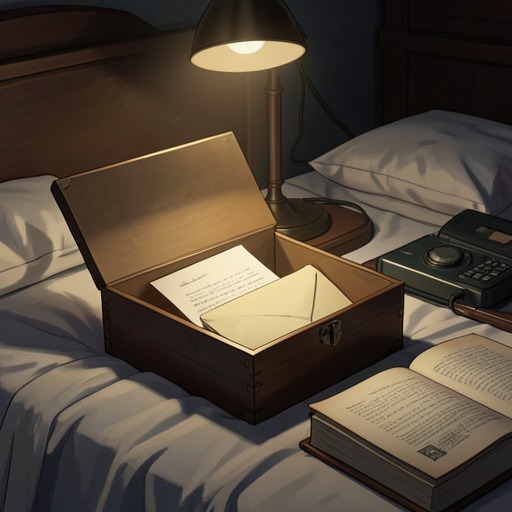
While his father is away handling an emergency, Christopher opens the remaining letters in the shirt box. They describe his mother’s life in [London](entity:location-recall-location-1bfd335cdd1b) and explain that she left after a prolonged period of conflict in the marriage. She had grown close to Roger, who was also lonely in his own relationship, and eventually moved with him.
The letters reveal that Christopher’s mother wrote to him regularly and wanted him to know she still loved him. His father’s concealment had prevented Christopher from receiving them and had made him believe she was dead. The letters also show the strain in the family before her departure, including the different ways Christopher’s parents coped with his needs and their own unhappiness.
That evening, after Christopher reads the letters
The Confession About Wellington
After Christopher is cleaned up, his father sits beside him and says he will tell the truth from then on. He admits that he killed [Wellington](entity:character-recall-character-wellington-39434dc5b2d5) during a furious argument with [Mrs. Shears](entity:character-recall-character-mrs-shears-7a12d91c5db6). He had hoped she might become part of his life after helping him through his wife’s departure; when she rejected that hope, he lost control and stabbed her dog.
Christopher understands that the confession is not a joke. Because his father has lied about his mother and killed Wellington, Christopher believes he may be in danger too. The revelation collapses the trust he had placed in the one person who had always cared for him, turning home into a place he must escape.
That night
Christopher Hides in the Garden
Christopher waits until his father falls asleep on the sofa, then takes his coats, food box, and [Toby](entity:character-recall-character-toby-dc8e3140da29)’s cage outside. He hides behind the garden shed, carrying his [Swiss Army knife](entity:object-recall-object-swiss-army-knife-4ccb0e3d8b0e) in case his father comes looking for him. The night sky and the stars give him a measure of calm, but he remains cold and frightened.
At dawn, his father searches the garden and leaves without finding him. Christopher decides he cannot return to the house. He first considers [Mrs. Shears](entity:character-recall-character-mrs-shears-7a12d91c5db6), then rejects other possible homes, and finally chooses to go to [London](entity:location-recall-location-1bfd335cdd1b) and live with his mother, whose address he has learned from the letters.
The morning after Christopher hides
Toby Left in Mrs. Alexander’s Care
Christopher asks [Mrs. Alexander](entity:character-recall-character-mrs-alexander-85a5bd5907e7) to look after [Toby](entity:character-recall-character-toby-dc8e3140da29) while he travels to [London](entity:location-recall-location-1bfd335cdd1b). He explains that his father killed [Wellington](entity:character-recall-character-wellington-39434dc5b2d5) and lied about his mother, and that he is afraid to live with him. Mrs. Alexander urges him to come inside and contact his father, but Christopher refuses, unwilling to give up control of his plan.
He returns to his house, breaks a kitchen window to get in, and packs food, clothes, books, and supplies. He takes his father’s bank card and remembers the PIN. With Toby in his coat pocket, he sets off toward school, hoping the familiar route will help him reach the station.
Later that morning
The Walk to the Station
Christopher walks toward school, using the thought of getting farther from his father to counter the fear of entering an unfamiliar place. He becomes sick when he sees his father’s van outside the school, then steadies himself with counted breaths and cubes. A woman directs him toward the railway station, and he follows a bus through the crowded town.
The noise and movement overwhelm him, so he navigates by a methodical spiral search rather than relying on a mental map. He eventually reaches [Swindon](entity:location-recall-location-swindon-3767f9af35e4) station, where the unfamiliar architecture and crowds make it difficult to think. His persistence carries him forward, but the station’s sensory pressure nearly stops him.
At Swindon station, around midday
The Ticket and the Train
Christopher sits in the station for hours, trying to quiet his mind with a mathematical puzzle. A policeman named [Nigel](entity:character-recall-character-nigel-9e824448bfe1) finds him and asks where he is going. Christopher says he intends to live with his mother in [London](entity:location-recall-location-1bfd335cdd1b) and admits that he has his father’s cashpoint card.
The officer helps him withdraw money and points him toward the ticket office, where Christopher buys a single ticket to London. He follows signs toward the platform, imagining a red line and repeating a steady rhythm to guide himself through the crowd. The trip is frightening, but he boards the train without turning back.
During the journey from Swindon toward London
The Search on the Train
[Nigel](entity:character-recall-character-nigel-9e824448bfe1) catches up with Christopher on the train and says his father is looking for him. Christopher insists he is going to his mother; when the officer tries to take him back, Christopher screams and pulls away. The train begins moving before Nigel can remove him, leaving the officer stuck aboard with him.
The crowded carriage and Christopher’s fear make the journey increasingly difficult. He hides in a luggage space near the toilet, avoiding Nigel when the policeman searches. At successive stops he remains concealed, uncertain where he is, while his bag disappears and [Toby](entity:character-recall-character-toby-dc8e3140da29) becomes separated from him.
Later that day
The London Underground
Christopher emerges at a major [London](entity:location-recall-location-1bfd335cdd1b) station and asks an attendant how to reach his mother’s address. She directs him to the Underground. He studies how passengers use the ticket machines and gates, buys a ticket, and chooses the Bakerloo Line for Willesden Junction.
The underground station is crowded and loud, and the arriving trains overwhelm him. He closes his eyes, counts, and waits through repeated surges of noise and people. The signs and system give him enough structure to continue, but the journey pushes him close to panic.
That evening on the Underground
Toby on the Tracks
After hours at the station, Christopher realizes [Toby](entity:character-recall-character-toby-dc8e3140da29) is missing. He searches near the tracks and spots the white rat below, then climbs down to retrieve him as a train approaches. A man in patterned socks pulls Christopher back onto the platform just before he is struck.
Toby bites Christopher’s thumb, but Christopher gets him safely into his pocket. The rescue is a dangerous turning point in the journey: Christopher’s attachment to his pet draws him into immediate physical danger, and a stranger’s intervention saves both of them.
That evening, after the railway rescue
The A-to-Z Route
At Willesden Junction, Christopher asks for directions to [451c Chapter Road](entity:location-recall-location-451c-chapter-road-17586f9a8a3e). A shopkeeper sells him a [London](entity:location-recall-location-1bfd335cdd1b) street atlas, and Christopher works through its grid and pages until he locates Chapter Road. The map turns the overwhelming city into connected squares and a route he can follow.
He walks to the address, reaching it after dark. No one answers the door, so he waits in the small front garden, cold and wet, hoping his mother will return. The map has brought him to the destination, but not yet to certainty about whether the person he seeks is there.
Late that night
The Reunion in Willesden
Christopher’s mother arrives with [Roger Shears](entity:character-recall-character-roger-shears-5c7c1be6a386), and Christopher stands up from his hiding place to tell her he has been waiting. She embraces him, but he pushes her away because he cannot tolerate being grabbed. He is cold, exhausted, and relieved to see her alive.
His mother takes him inside, warms him with a bath, gives [Toby](entity:character-recall-character-toby-dc8e3140da29) food and water, and makes him tomato soup. Christopher explains that his father said she was dead and that he found the letters. His mother reacts with shock and grief, while Roger makes clear that he does not welcome Christopher’s arrival.
Shortly after the reunion
The Police Decision
A policeman speaks to Christopher in the flat and asks whether he wants to return to [Swindon](entity:location-recall-location-swindon-3767f9af35e4) or stay with his mother. Christopher says he wants to stay. His mother confirms that he can, and the officer accepts the decision, leaving the family to resolve its own conflict.
Roger stacks boxes in the spare room for Christopher, but the arrangement is uneasy. Christopher is happy to be with his mother, yet he remains wary of Roger and frightened by the prospect of his father appearing. The reunion solves the immediate problem of where he will sleep, not the deeper ruptures between the adults.
That night, at about 2:31 a.m.
Father Arrives in London
Christopher wakes to shouting in the flat. His father has arrived and argues with his mother and Roger about Christopher’s disappearance, the lie about her death, and the past. Christopher hides in the spare room with his [Swiss Army knife](entity:object-recall-object-swiss-army-knife-4ccb0e3d8b0e) ready, frightened that his father may come in.
His father enters, apologizes for [Wellington](entity:character-recall-character-wellington-39434dc5b2d5) and the letters, and promises not to do anything like it again. Christopher does not accept the familiar hand-touching gesture. The police return after Roger calls them and take the father away, leaving Christopher with his mother but no restored trust.
The days after Christopher reaches London
Life with Mother and Roger
Christopher stays in the cramped flat while his mother takes compassionate leave and tries to arrange practical necessities. A trip to Brent Cross Shopping Centre overwhelms him, and she has to take him home before buying clothes and toiletries alone. He is also afraid of Roger and retreats to the spare room when Roger returns from work.
Christopher repeatedly insists that he must return to [Swindon](entity:location-recall-location-swindon-3767f9af35e4) for his scheduled mathematics A-level. His mother, already struggling with work, money, and conflict with Roger, asks to postpone it. The exam becomes a fixed point of order for Christopher and a growing source of strain in the household.
Several days after arriving in London
The Decision to Return
Christopher’s mother loses her temporary job and the arguments with Roger intensify. Christopher’s anxiety over the postponed exam, the lack of a garden, and the crowded flat becomes difficult to contain. When Roger drunkenly berates him, his mother intervenes, then decides the next morning to leave with Christopher.
She borrows Roger’s car and drives them back to [Swindon](entity:location-recall-location-swindon-3767f9af35e4). Christopher is relieved that the journey will take him toward the exam, but he does not want to see his father. His mother’s decision is an attempt to escape the [London](entity:location-recall-location-1bfd335cdd1b) household’s mounting conflict, even though returning means facing the unresolved family crisis at home.
The day they return to Swindon
Back at the House
Christopher and his mother entered the house when the father was not there. Christopher returned to his room to play Minesweeper, but after the father came home, the adults argued downstairs. Christopher covered the noise with drumming and moaning until his mother told him that the father had moved in with Rod
The Wednesday through Friday after the return
The A-Level Examination
At school, Siwon told Christopher that the exam could still be taken, and the school could make arrangements for him to take a make-up exam. Although exhausted, and considering that the exam committee might not accept the late arrangement, Christopher decided to take the exam. Pastor Peters supervised the first exam
After the examination
The Broken Household
Christopher's father came to visit him, asking about the exam results; Christopher gave a brief answer, and his father said he was proud of him. Soon after, the father told Christopher's mother that she had to leave the house, and she did not have enough money to rent another place. She
During the weeks after the move
Toby’s Death
[Toby](entity:character-recall-character-toby-dc8e3140da29) lived two years and seven months, which was already a long life for a mouse. Christopher wanted to bury Toby, but they didn't have a garden, so he put Toby in a large pot filled with soil. The mother could not agree to keep another mouse because their room was too small
Some time after Toby’s death
Father’s Five-Minute Project
Christopher's father asked him to talk for five minutes and set the kitchen timer so that Christopher would know how long the conversation would last. The father said that the silence between them made him uncomfortable and proposed a plan: Christopher would spend more time with him, and he would have to prove himself worthy of
Near the ending, after the examination results
A Future Reassembled
Christopher named the puppy [Sandy](entity:character-recall-character-sandy-457b75877fae) and began taking it for walks. When his mother caught the flu, Christopher stayed at his father's house for three days; Sandy slept on his bed, and Christopher also helped his father plant vegetables in the garden. These shared daily routines did not erase the betrayal, but they