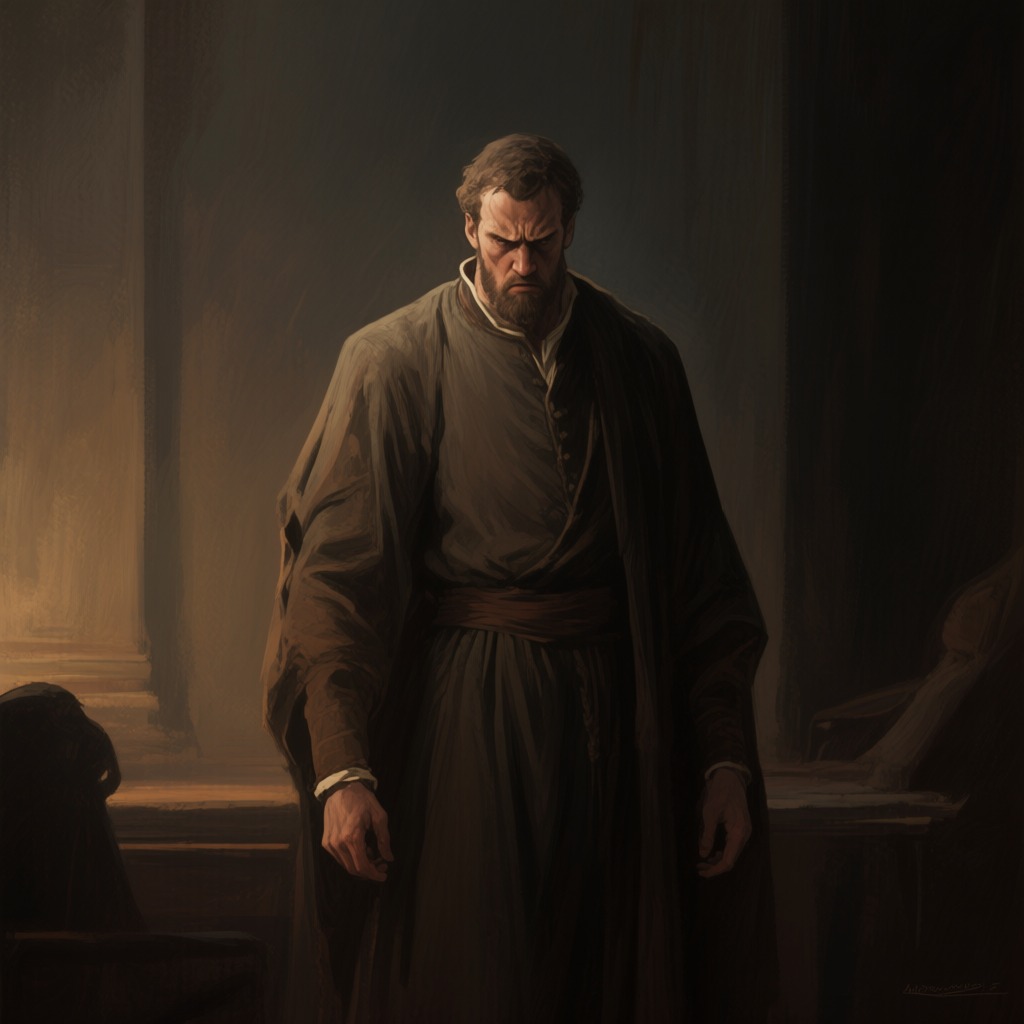
Rittmeister Schmidt
Rittmeister Schmidt, the Gestapo Kommandant in Amboise, is the primary antagonist of Isabelle Rossignol's final ordeal in the war. A methodical and sadistic interrogator, he embodies the Nazi regime's ruthless determination to crush the French Resistance, and his actions directly lead to the deaths of both Isabelle's father and, ultimately, Isabelle herself. He is a figure of pure, bureaucratic cruelty, whose pleasure in inflicting pain is matched only by his professional need to extract information.
Identity and Role
Schmidt is introduced as the Kommandant of the Gestapo in Amboise, a position that gives him authority over the interrogation and punishment of captured resistance fighters. He is a man who wields his power with theatrical precision, using a combination of psychological pressure and physical brutality. His first appearance in the narrative is marked by a casual, almost bored demeanor as he begins his interrogation of Isabelle, whom he knows only as Juliette Gervaise. He immediately establishes the binary choice he offers his victims: "Pain," he says simply. "Or no pain. The choice is yours." This is not a genuine offer but a sadistic game, as he strikes her hard the moment she attempts to answer. His methods are designed to break his subjects down, both physically and mentally, and he takes a visible, almost sensual pleasure in the process.
Interrogation and Torture of Isabelle
Schmidt's interrogation of Isabelle is a prolonged and horrific ordeal. He uses a variety of techniques, beginning with direct blows to the face with an iron ruler, which splits her skin and draws blood. When she refuses to give him the name of the Nightingale, he escalates the torture. He has her stripped naked and locked inside a refrigerator, a freezing, airless box designed to induce hypothermia and asphyxiation. The psychological terror is as potent as the physical: Isabelle awakens in the dark, bound to a chair, her eyelashes frozen, and realizes she is in a "refrigerator." Schmidt's goal is not merely to extract information but to annihilate his victim's will. He is present throughout, a constant, looming threat. Even when he offers her a dress, it is a calculated gesture, a moment of false mercy before the next wave of cruelty. His final act of psychological warfare is to bring in her father, Julien Rossignol, and force Isabelle to watch as the old man falsely confesses to being the Nightingale, a confession that leads directly to his execution by firing squad. Schmidt's laughter at the sight of Isabelle's horror reveals the depth of his depravity.
Role in the Execution of Julien Rossignol
Schmidt is the architect of Julien Rossignol's death. After failing to break Isabelle, he has her father brought into the interrogation room. Julien, seeing his daughter's broken state, immediately declares, "I am the Nightingale." Schmidt, who has clearly not tortured the old man, accepts this confession with a cynical smile. He orchestrates the execution, having Julien dragged into the square where a firing squad is waiting. Isabelle, watching from her cell window, sees her father stumble forward, stand tall, and mouth "I love you" before the shots ring out. Schmidt's role in this is not that of a soldier following orders but of a puppet master who has found a more effective way to break his target than through direct torture. He uses the love between a father and daughter as his final, most devastating weapon.
Narrative Significance and Thematic Weight
Schmidt represents the faceless, institutional evil of the Gestapo. He is not a complex character with a backstory or a redeeming feature; he is a function of the Nazi machine, efficient and cruel. His presence in the narrative serves to underscore the immense risk Isabelle and her network took, and the horrific price they paid. He is the embodiment of the warning that was constantly given to Isabelle: that capture would mean not just death, but a prolonged, agonizing ordeal designed to strip away her humanity. His success in breaking her father, and his indirect role in Isabelle's eventual death from the typhus and pneumonia she contracted in Ravensbrück, makes him a key agent of the tragedy that befalls the Rossignol family. He is the dark mirror to the courage of the Nightingale, a reminder that for every act of resistance, there was a corresponding act of brutal repression.