the wedding day, before the ceremony
The Wedding-Guest Is Stopped
An [Ancient Mariner](entity:character-recall-character-ancient-mariner-5d0da7efe4b9) stops one of three guests on his way to a wedding feast. The [Wedding-Guest](entity:character-recall-character-wedding-guest-93088432b2fa) protests that he is expected inside, but the Mariner’s glittering eye holds him fast, and he sits to hear the tale.
The encounter establishes the story’s frame: the Mariner’s burden is not only what happened at sea, but a compulsion to find listeners and tell it. The Wedding-Guest’s ordinary celebration is suspended as the remembered voyage begins.
at the beginning of the voyage
The Ship Leaves Harbor
The Mariner recalls how his ship was cheered out of harbor and sailed past the church, hill, and lighthouse. The Sun rose on the left, crossed overhead, and set on the right as the vessel traveled onward.
The departure begins a voyage that will carry the crew far from familiar human life. The [Wedding-Guest](entity:character-recall-character-wedding-guest-93088432b2fa) hears the story even as music from the wedding calls to him, unable to break away from the Mariner.
early in the voyage
The Storm Drives South
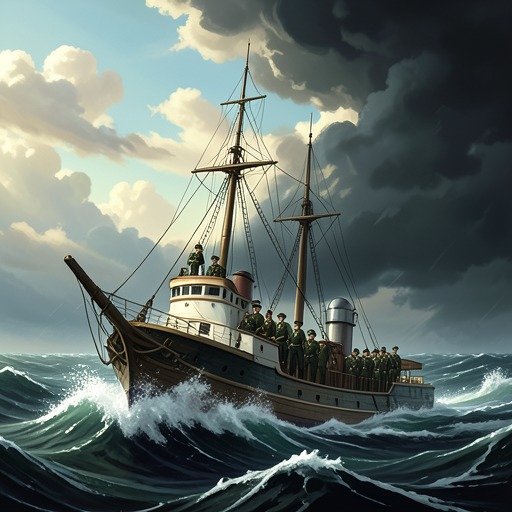
A powerful Storm-Blast drives the ship southward. The vessel races ahead with sloping masts and dipping prow, as if fleeing a pursuing force.
The wind’s violence takes the crew away from their intended course and toward an unfamiliar region. The storm begins the passage from ordinary travel into a supernatural ordeal.
after the storm drives the ship south
The Ship Enters the Ice
Mist and snow descend, the cold intensifies, and immense green ice drifts around the ship. The crew can see no shapes of people or beasts through the frozen expanse; the ice cracks, growls, and roars around them.
The ship is trapped in a world stripped of familiar bearings. The voyage’s isolation becomes starkly physical as ice closes off every direction.
while the ship is surrounded by polar ice
The Albatross Appears
An Albatross crosses through the fog, and the sailors hail it as though it were a Christian soul. It accepts food from them and circles the vessel; the ice splits with a thunderous report, allowing the helmsman to steer the ship through.
The bird’s arrival is treated as a welcome sign amid the frozen desolation. Its presence is associated with the breaking of the ice and the crew’s renewed chance to escape.
after the ship breaks through the ice
The Albatross Follows the Ship
A favorable south wind rises behind the ship, and the Albatross follows the sailors day after day, coming when they call for food or play. It perches on the mast and rigging during the foggy nights as the Moon shines through the mist.
The bird becomes a companion to the crew during their passage away from the ice. Its welcome presence makes the Mariner’s sudden violence against it all the more consequential.
after the Albatross has followed the ship for several days
The Mariner Shoots the Albatross
The [Wedding-Guest](entity:character-recall-character-wedding-guest-93088432b2fa) interrupts the tale to ask why the Mariner looks so distressed. The Mariner answers that he shot the Albatross with his [Crossbow](entity:object-recall-object-crossbow-aa745a832d15).
The unexplained killing breaks the apparent bond between the sailors and the bird that had accompanied them through danger. It becomes the central act for which the Mariner and crew will suffer, and the Wedding-Guest recognizes that the tale is an account of grave wrongdoing.
immediately after the Albatross is shot
The Crew Condemns the Killing
At first, the sailors say the Mariner has done a hellish thing, blaming him for killing the bird that brought the favorable wind. When the Sun rises through the mist, however, they decide that the Albatross had brought the fog and snow and declare that killing it was right.
Their changing judgment reveals the crew’s readiness to excuse the act when it seems convenient. They have not yet escaped responsibility for approving it, and their apparent absolution will soon give way to blame.
after the crew reverses its judgment
The Ship Reaches the Silent Sea
The breeze continues, carrying the ship into a silent sea where the sailors believe they are the first to travel. Then the wind falls away and the sails droop; the ship stops moving, and the crew can speak only to break the oppressive quiet.
The sudden stillness turns their apparent progress into captivity. The Mariner’s act is now followed by a punishing change in the conditions of the voyage.
during the becalming
The Crew Suffers Thirst
Under a hot copper-colored sky, the Sun hangs overhead while the ship lies motionless. Water surrounds the sailors, but none is drinkable; their mouths dry out, the ship’s boards shrink, and the sea appears to rot as slimy creatures crawl across it.
The crew’s thirst makes the surrounding abundance cruelly useless. Their distress gives memorable form to the punishment of a ship trapped without wind or fresh water.
during the days of stillness
The Deadly Sea Glows
At night, death-like lights dance around the water, which burns in strange green, blue, and white colors. Some sailors dream of a spirit following the ship from the [Land of Mist and Snow](entity:location-recall-location-land-of-mist-and-sno-f7ba23e92fcd), while drought leaves every tongue withered and the crew unable to speak.
The uncanny sea deepens the sense that unseen forces have taken hold of the voyage. The sailors’ silence and fear make the Mariner’s guilt a shared, immediate affliction.
after the crew blames the Mariner for the becalming
The Albatross Is Hung Around His Neck
The crew turns against the Mariner, accusing him of killing the bird that had brought the breeze. They hang the Albatross around his neck in place of a cross.
The bird’s body becomes a visible burden of guilt, while the substitution for a sacred sign gives the punishment a spiritual force. The Mariner is marked as responsible even as the whole crew remains trapped in the consequences of the voyage.
after a long period of thirst
A Ship Appears
After a weary interval, the Mariner sees something in the western sky. It shifts from a speck into a mist and then a distinct shape, moving in an erratic course across the water.
The sight of another vessel offers the parched crew the possibility of rescue. Yet it approaches without a breeze or tide, and its uncanny movement makes the hope of help uneasy from the start.
as the strange vessel draws nearer
The Mariner Calls the Sail
Unable to laugh or cry, the sailors stand with cracked lips and dry throats as the Mariner bites his arm and sucks blood to make his voice carry. He cries that a sail is approaching, and the crew grins and draws breath in relief.
His desperate call briefly revives the sailors’ hope. The vessel’s steady approach, despite the absence of wind or tide, soon reveals that it is no ordinary rescue ship.
near sunset on the day the vessel appears
The Spectre-Bark Crosses the Sun
The strange vessel drives between the crew and the setting Sun, which seems to peer through its ribs like a face behind dungeon bars. The Mariner sees fragile-looking sails and recognizes that the vessel carries only a woman and another figure.
Its uncanny outline replaces the promise of rescue with dread. The ship appears to bring an encounter with forces that will decide the sailors’ fates rather than save them.
at sunset as the strange vessel comes alongside
Death and Life-in-Death Appear
The Mariner sees a deathly woman, [Life-in-Death](entity:character-recall-character-life-in-death-5c575e8f6073), with pale skin, red lips, and golden hair, and asks whether [Death](entity:character-recall-character-death-b8f38d089c7f) is her companion. The naked hull draws alongside the [Mariner’s ship](entity:object-recall-object-mariner-s-ship-a4866ad2f755) as the two figures cast dice.
Their arrival gives supernatural form to the choice and judgment hanging over the crew. Life-in-Death’s presence signals a fate that may be worse than an ordinary death.
as the Sun sets
Life-in-Death Wins the Mariner
[Life-in-Death](entity:character-recall-character-life-in-death-5c575e8f6073) cries that she has won, and the [Spectre-bark](entity:object-recall-object-spectre-bark-bb83000804a2) shoots away as darkness falls. The Moon rises while the sailors turn one by one to fix the Mariner with a ghastly look and die without groaning.
The Mariner alone survives the crew’s sudden deaths. Their silent accusation becomes a lasting torment, while the dice game’s outcome condemns him to endure the aftermath in isolation.
immediately after the Spectre-bark departs
The Crew Dies
All the sailors fall dead one after another, and their souls depart toward bliss or woe. The Mariner hears each soul pass him like the whizz of his [Crossbow](entity:object-recall-object-crossbow-aa745a832d15).
The death of the crew leaves him alone among the bodies, with no companion to share his suffering or absolve him. The echo of his weapon links the deaths to the violent act that began the disaster.
after the crew’s death
The Mariner Is Left Alone
The [Wedding-Guest](entity:character-recall-character-wedding-guest-93088432b2fa) recoils from the Mariner’s appearance, but the Mariner assures him that his own body did not fall. He remains alone on the broad sea, with no saint taking pity on his soul, while the dead sailors lie around him and slimy creatures live on.
His survival becomes a punishment rather than a reprieve. The contrast between the dead crew and the life persisting around him intensifies his sense of abandonment.
during his solitary ordeal after the crew’s death
The Mariner Cannot Pray
The Mariner looks at the rotting sea and the bodies on deck, then tries to pray toward Heaven. A wicked whisper dries his heart like dust before a prayer can form, and he keeps his eyes closed against the sea, sky, and dead men.
His inability to pray marks the depth of his spiritual desolation. The dead sailors’ unchanging looks keep their accusation present even when he tries to escape it.
over the next seven days and seven nights
The Dead Men’s Curse Endures
The crew’s bodies do not rot, and the expression with which they died never leaves their faces. The Mariner feels the curse in the dead men’s eyes and cannot die, enduring their gaze for seven days and seven nights.
The ordeal makes the cost of his survival unmistakable: he must remain conscious under the silent judgment of those who died because of his act. The curse is part of a penance he has not yet learned how to bear.
during the seven-day ordeal
The Moonlit Sea Burns Red
The Moon moves steadily across the sky, and its beams spread like frost over the hot sea. Beneath the ship’s shadow, however, the water remains a still, terrible red.
The contrast between the Moon’s quiet beauty and the ship’s uncanny surroundings sustains the Mariner’s isolation. The sea reflects a world in which ordinary natural calm cannot undo the horror aboard the vessel.
after seven days and nights of the dead men’s curse
The Mariner Watches the Water-Snakes
Beyond the ship’s shadow, the Mariner watches water-snakes move in tracks of shining white, their raised bodies shedding elfish light. Within the shadow, he sees their blue, green, and black forms coil and swim in flashes of gold.
For the first time since the killing, he recognizes beauty in living creatures without calculation or resentment. His spontaneous delight opens the way back to prayer and changes the course of his penance.
at the moment he watches the water-snakes
The Mariner Blesses the Water-Snakes
A spring of love rises in the Mariner’s heart, and he blesses the water-snakes without intending to. In that same moment he can pray again, and the Albatross slips from his neck and sinks into the sea.
His release does not erase the killing or end his penance, but it marks a moral turning point: compassion for living creatures makes prayer possible again. The visible burden of the bird is gone, though the consequences of his act remain.
after the Albatross sinks
The Mariner Sleeps and Rain Falls
The Mariner praises sleep as a gentle gift and believes the Virgin Mary has sent it from Heaven. He dreams that the ship’s unused buckets have filled with dew; when he wakes, rain is falling, wetting his lips, throat, and clothes.
After the long drought, the rain restores his body and accompanies the change in his spiritual condition. His exhaustion gives way to a strange lightness, as if he might have died in sleep and become a blessed ghost.
after the Mariner wakes to the rain
The Air Comes Alive
A roaring wind shakes the thin, dry sails, though it does not seem to reach the ship directly. Lights move through the upper air among the stars, rain pours from a black cloud, and lightning streams down beside the Moon.
The sky’s uncanny activity signals that unseen forces have resumed control of the voyage. The ship begins moving without an ordinary breeze, and the dead crew groan as the supernatural disturbance takes hold.
during the storm and lightning
The Dead Crew Rise
The dead sailors groan and rise, working the ropes and steering the ship without speaking or moving their eyes. The Mariner’s dead nephew stands beside him at the same rope, but says nothing.
The crew’s return to labor does not restore ordinary life or companionship. Their bodies move as instruments under supernatural direction, making the vessel’s progress more disturbing than reassuring.
at dawn after the dead sailors rise
Blessed Spirits Animate the Crew
The Mariner explains that the souls returning to the corpses are not those that fled in pain, but a troop of blessed spirits. At dawn, the dead sailors drop their arms and gather around the mast as sweet sounds rise from their bodies and fly toward the Sun.
The music fills the sea and air with changing harmonies, from birdsong to instruments and an angel’s song. The spirits’ presence distinguishes this supernatural service from the crew’s earlier curse and gives the ship a brief, solemn grace.
from dawn until noon
The Spirit Drives the Ship
The ship continues smoothly through the morning without a breeze. A spirit that dwells beneath the keel, nine fathoms deep and from the [Land of Mist and Snow](entity:location-recall-location-land-of-mist-and-sno-f7ba23e92fcd), moves the vessel onward.
The invisible power carries the Mariner closer to home, but its purpose is not simply mercy. The motion depends on forces beyond the crew’s control and ends when the ship reaches a new stage of the Mariner’s penance.
at noon during the spirit-driven voyage
The Ship Lurches
At noon the sails fall silent and the ship stops beneath the Sun. It begins to rock backward and forward, then bounds like a released horse, flinging the Mariner down into a faint.
The abrupt motion breaks the supernatural passage and leaves the Mariner unconscious. Before he recovers, voices in the air explain the spiritual conflict shaping his fate.
while the Mariner lies unconscious
The Spirits Discuss His Penance
One voice recalls that the ancient sailor used cruel bow to kill the harmless albatross. The speaker explains that the who lives alone in the land of fog and ice deeply loves the bird that once deeply loved the man who shot it. Another more gentle voice says that the ancient sailor has already at
after the Mariner wakes from his faint
The Curse Remains in the Crew’s Eyes
The Mariner wakes to find the dead crew standing together on deck, their stony eyes glittering in the Moon. The pang and curse with which they died have not passed away, and he cannot turn his gaze toward prayer.
Although the ship has moved onward, the dead sailors’ silent judgment remains. The Mariner’s return toward familiar waters does not free him from the moral weight of their deaths.
after the Mariner looks again on the ocean
A Wind Blows Only on Him
The Mariner turns from the dead men and sees the ocean again, though he fears looking back, as if a fiend were following him. Then a wind touches his hair and cheek without making a ripple or shadow on the sea.
The breeze blows on the Mariner alone, and the ship sails swiftly but softly toward familiar shores. Its gentle character offers a moment of welcome amid the fear that still governs the voyage.
near the end of the supernatural voyage
The Mariner Sees His Homeland
The Mariner recognizes the lighthouse, hill, church, and his own country, and prays that the sight is real. The ship drifts over the harbor bar while he sobs, overwhelmed by the return to land.
The familiar coast promises an end to his isolation at sea, but his arrival remains bound to supernatural consequences. His homecoming is relief mixed with dread rather than a simple restoration of ordinary life.
as the ship enters the harbor bay
Seraphs Stand on the Corpses
Moonlight lies across the clear harbor, and crimson shadows rise from the water near the ship’s prow. The Mariner looks back and sees a shining seraph standing on each corpse, waving silently toward land.
The heavenly figures make the dead crew look like signals guiding the vessel home. Their silence settles like music in the Mariner’s heart, offering a sacred contrast to the curse that had fixed the sailors’ eyes on him.
as the ship reaches the harbor
The Pilot’s Boat Approaches
The Mariner hears oars and the Pilot’s cheer, then sees a boat carrying the Pilot, his boy, and the [Hermit](entity:character-recall-character-hermit-eb4f996cf447). He welcomes the sight of them with joy and imagines that the Hermit may absolve him and wash away the Albatross’s blood.
Their approach brings human help within reach after the long ordeal. The Mariner’s hope of confession and spiritual relief gathers around the Hermit, whose presence connects his return with the need to answer for his actions.
just before the rescuers reach the vessel
The Hermit Questions the Ship
The [Hermit](entity:character-recall-character-hermit-eb4f996cf447) and the others wonder where the many lights have gone and remark on the ship’s warped planks and thin, dry sails. The Pilot says the vessel looks fiendish and admits his fear, while the Hermit urges the boat onward.
The rescuers recognize that the ship is not ordinary, even before it sinks. Their unease foreshadows the sudden destruction that will separate the Mariner from the vessel carrying him home.
as the rescuers draw alongside
The Ship Sinks
As the boat comes close beneath the ship, a dreadful rumble rises underwater, reaches the vessel, and splits the bay. The ship sinks like lead, leaving the Mariner stunned and afloat as the Pilot’s boat spins over the whirlpool.
The Mariner’s vessel is destroyed at the threshold of home, completing the supernatural journey in a final rupture. He survives in the rescuers’ boat, but the Pilot collapses and the Pilot’s boy laughs wildly, suggesting that the encounter has overwhelmed them.
immediately after the ship sinks
The Mariner Reaches Land
The [Hermit](entity:character-recall-character-hermit-eb4f996cf447) prays, the Pilot lies in a fit, and the Pilot’s boy laughs that the Devil knows how to row. The Mariner takes the oars, and the rescuers’ boat carries him to firm land in his own country.
Though physically returned to safety, the Mariner is not released from the spiritual burden of his voyage. His first act on shore is to seek the Hermit’s help, and the agony that follows forces his story into speech.
on reaching shore
The Mariner Is Forced to Confess
The Mariner begs the [Hermit](entity:character-recall-character-hermit-eb4f996cf447) to shrive him. When the Hermit demands to know what kind of man he is, the Mariner is seized by a terrible agony that compels him to begin his tale; once he has told it, the pain leaves him.
The confession establishes the pattern that governs his life afterward. At uncertain hours, the agony returns until he finds the person who must hear the story, turning narration itself into an ongoing penance.
later, at the Wedding-Guest’s celebration
The Mariner Tells His Tale Again
The Mariner tells the [Wedding-Guest](entity:character-recall-character-wedding-guest-93088432b2fa) that he passes from place to place with a strange power of speech, recognizing the person who must hear him. The wedding continues nearby, while the bride and her companions sing and a vesper bell calls the Mariner to prayer.
His encounter with the Wedding-Guest is another fulfillment of the compulsion born from his agony. The tale turns the wedding’s celebration into a setting for instruction about isolation, prayer, and care for living things.
at the end of the tale
The Mariner Teaches Love
The Mariner tells the [Wedding-Guest](entity:character-recall-character-wedding-guest-93088432b2fa) that it is sweeter to walk and pray with a community than to endure loneliness at sea. He concludes that the one who prays well loves people, birds, and beasts, and that the best prayer belongs to one who loves all creatures made and loved by God.
The lesson gives the voyage’s suffering a moral meaning without erasing the Mariner’s continuing penance. His blessing of the water-snakes and his final counsel join compassion for every living thing to the possibility of prayer.
the morning after the wedding
The Wedding-Guest Leaves Changed
The Mariner departs, and the [Wedding-Guest](entity:character-recall-character-wedding-guest-93088432b2fa) turns away from the bridegroom’s door rather than joining the feast. He leaves stunned and without his former ease, but wiser for having heard the account.
The tale’s final consequence falls on its listener: the Wedding-Guest’s ordinary expectations have been altered by the Mariner’s account of guilt, isolation, and love. His changed departure closes the frame while the Mariner’s own compelled journey continues.