Event 1
Gerry Wade's Alarm-Clock Prank

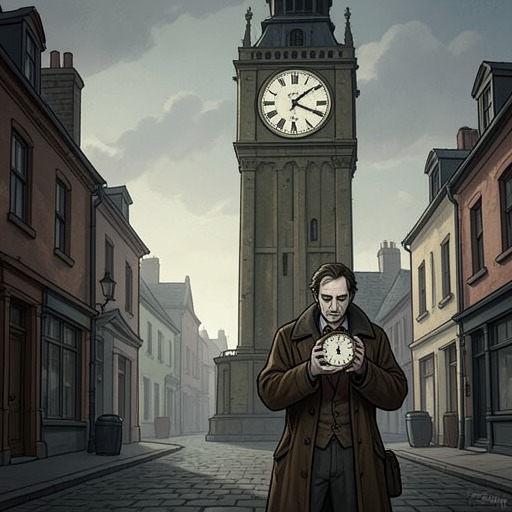
[Gerry Wade's Alarm-Clock Prank](entity:event-recall-event-gerry-wade-s-alarm-cloc-238f0e297eab) begins as a practical joke on a famously heavy sleeper and ends with the discovery that [Gerald Wade](entity:character-recall-character-gerald-wade-69d500281dbe) has died. Eight clocks ring through the morning without waking him, turning the guests’ intended lesson in rising early into an ominous measure of how completely he remains silent.
## Planning the Joke
After dinner, while [Sir Oswald Coote](entity:character-recall-character-sir-oswald-coote-4b934c4e3e94), [Rupert Bateman](entity:character-recall-character-rupert-bateman-98772080c092), [Lady Coote](entity:character-recall-character-lady-coote-5ed3f038230b), and Gerald Wade play bridge, the other guests are supposedly dancing to the wireless in the ballroom. In reality, they gather outside Gerald’s bedroom, where their subdued giggles mingle with the ticking of the clocks. That split between the respectable social scene and the conspirators’ backstage amusement gives the prank its playful, almost clandestine character.
The group debates how best to defeat Gerald’s sleep. One side argues that a champion sleeper will need all eight alarm clocks ringing together; the other favors a steady, sustained assault. The second plan prevails: the clocks are set to ring one after another, beginning at 6:30 a.m. [Bill Eversleigh](entity:character-recall-character-bill-eversleigh-7f14a2933184) presents the arrangement as a lesson for Gerald, while the careful debate over timing shows how seriously the group takes the mechanics of its joke.
## The Clocks Go Off
Pongo carries the two largest clocks into the dark bedroom, returns for two more, and repeats the process until all eight are inside. The others wait and listen. Gerald’s breathing continues rhythmically, but the clocks’ insistent ticking seems to smother it. The contrast is at once comic and unsettling: the sleepers’ ordinary breathing is set against an artificial, increasingly forceful rhythm that nobody in the room can ignore.
When the alarms begin, the prank reaches at least one unintended audience first. Ronny Devereux leaps out of bed with the confused impression that the Day of Judgment has arrived, then goes into the passage and listens at Gerald’s door. He expects to hear profanity or some other protest. Instead, he hears the clocks ticking loudly, followed by another alarm’s deafening ring. The clocks have performed as promised; Gerald has not reacted.
## A Joke That Fails
By twelve o’clock, the group’s verdict is that the joke has gone badly. The clocks have rung with formidable energy, yet Gerald has apparently slept through them. The guests’ despondency and [Jimmy Thesiger](entity:character-recall-character-jimmy-thesiger-86b9cc12120c)’s complaint that Gerald is not human preserve the scene’s comic register, but the laughter now rests on a troubling absence: there has been no response from the man the clocks were meant to disturb.
That failure acquires sharper meaning because Gerald has already been presented as unusually vacant beside Jimmy’s cherubic appearance. The prankers expect an easy target, someone whose sleep can be broken by an excessive noise. Instead, the mechanical racket produces no answer from him. The repeated alarms turn a familiar joke about oversleeping into suspense: the question is no longer simply whether Gerald will wake, but why he has not.
## The Discovery
The change from comedy to crisis comes through the household staff. Tredwell explains that Gerald has not yet come downstairs and that he sent Williams up to the bedroom. Williams has just rushed back down in a state of agitation; Tredwell reports that the young man appears to have died in his sleep. The announcement makes the morning’s silence legible in a wholly different way. What had seemed like an extraordinary triumph of sleep over eight alarms is now a death discovered after the prank.
Jimmy and Ronny stare at Tredwell. Ronny rejects the report as impossible, falters over Gerald’s name, and runs upstairs to see for himself, hoping Williams has made a mistake. The prank’s immediate consequence is therefore not merely embarrassment for its organizers: it places them at the threshold of a death investigation. Its narrative force comes from that reversal, as a staged disturbance fails to wake Gerald and instead delays the recognition that something is seriously wrong.
## Significance
The clocks make time audible in the scene. Their staggered schedule is designed to prolong the joke, and their ticking first supplies a comic soundtrack to the guests’ conspiracy. Once Gerald remains unresponsive and Tredwell brings news from Williams, that same mechanical persistence changes character. The alarms have kept their appointment; Gerald cannot answer them. The episode’s central irony lies in the gap between the group’s confident plan to teach a heavy sleeper a lesson and the fatal reality that their noise cannot undo.
Event 2
Gerry Wade's death
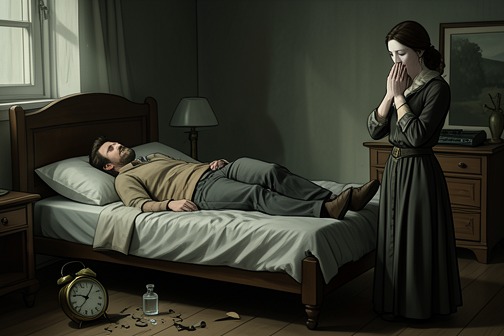
[Gerald Wade](entity:character-recall-character-gerald-wade-69d500281dbe)’s death begins as an apparently straightforward tragedy: he is found dead in his room, with chloral, a bottle, and a glass beside the bed. That explanation is gradually undermined by his friends’ reactions, an unexplained clock thrown out of the window, and a letter warning [Loraine Wade](entity:character-recall-character-loraine-wade-0c5105753f0f) away from [Seven Dials](entity:location-recall-location-seven-dials-0a3205031444). The later revelation that [Jimmy Thesiger](entity:character-recall-character-jimmy-thesiger-86b9cc12120c) murdered Wade turns the supposed overdose into the first concealment in a larger conspiracy.
## Discovery and First Reactions
When Wade has not come downstairs, Tredwell sends Williams to his room. Williams returns in agitation, and Tredwell reports that the young man seems to have died in his sleep. [Jimmy Thesiger and Ronald Devereux](entity:relation-recall-relation-jimmy-thesiger-and-r-3b13a2ba647a) stare at him; Ronald rejects the news as impossible and hurries upstairs, hoping Williams has made a mistake. The shock is sharpened by Jimmy’s sense that Wade’s recent manner had been unlike his usual self, though he struggles to explain what troubled him.
The initial announcement gives no visible sign of violence. Its force comes instead from the contrast between the lively young man his friends knew and the sudden, quiet finality of a death apparently occurring during sleep. Ronald identifies himself as Wade’s greatest friend, making his response more than a formal expression of grief: he insists that the death does not fit the person he knew.
## The Medical Explanation and Its Limits
The doctor considers the case apparently simple. Wade had looked healthy, and the chloral found beside his bed, together with a bottle and glass, suggests an overdose. The doctor asks whether Wade habitually took anything to help him sleep. Ronald is astonished by the question and says Wade slept very well and had never complained of sleeplessness. That answer sits awkwardly beside the apparent presence of a sleeping draught, even as the doctor treats the physical evidence as a sufficient explanation for now.
Jimmy asks whether foul play is possible, voicing the suspicion Ronald cannot bring himself to put into words. Ronald answers firmly that there is no cause to suspect it and rejects suicide as well. The doctor is less completely convinced. His assessment remains provisional enough to require an inquest, but the early account encourages the household to understand the death as an overdose rather than an attack. In retrospect, the confidence with which the simplest explanation takes hold is part of the concealment: Wade’s death was murder, carried out by Jimmy and disguised as an overdose.
## The Clocks and the Unfinished Letter
That evening, [Bundle Brent](entity:character-recall-character-bundle-brent-498187f5c44e) reconsiders the death. She finds suicide implausible for someone who had seemed so full of life, and initially settles on an accidental overdose instead. Her reasoning does not resolve the evidence; it makes the room’s peculiar details more conspicuous. [Seven clocks](entity:expression-recall-expression-8641310c1616) had stood neatly on the mantelpiece, while the remaining clock was found on the lawn, apparently thrown from the window. Bundle can imagine a servant tidying the clocks, but not why anyone would throw one outside. The displaced clock is a small, concrete disturbance in an otherwise convenient account of an uneventful death.
The unfinished letter Wade wrote to Loraine adds a more serious unease. He says he feels fit and is looking forward to seeing her on Wednesday, then tells her to forget what he said about Seven Dials: what he had thought was a joke, he now says, is not a joke at all, and she should not be mixed up in it. He apologizes, begins to introduce something else, and breaks off because he is too sleepy to continue. The unfinished sentence about Lurcher leaves the letter incomplete, while its warning makes clear that Wade had discovered a danger he did not want Loraine to share.
## Significance and Later Reversal
Wade’s death is therefore made legible in two competing ways. At first, the chloral and the bedside glass invite a domestic explanation; the doctor’s judgment and Ronald’s emphatic denial of foul play leave that account largely undisturbed. Bundle’s attention to the clock outside and the contents of the letter reopens the question, linking an apparently private death to Seven Dials. Later, a secret meeting treats Wade’s letter as a matter of concern and asks who found it, confirming that its warning touched the organization’s interests.
The eventual identification of Jimmy Thesiger as Wade’s murderer changes the meaning of the earlier clues without making the initial scene any less carefully misleading. The evidence presented at the death first supports an overdose; the friends’ memories, the unexplained clock, and the unfinished warning show why that account should not be accepted as the whole story. Wade’s death establishes the central pattern of the case: a plausible surface explanation conceals violence, while seemingly incidental details preserve the route toward the truth.
Event 3
Discovery of Gerry Wade's unfinished letter

The discovery of [Gerald Wade](entity:character-recall-character-gerald-wade-69d500281dbe)’s unfinished letter gives Bundle a piece of evidence that unsettles the apparent explanation of his death. Hidden in a jammed writing desk, the sheet is dated the evening before Gerald was found dead and records his warning to [Loraine Wade](entity:character-recall-character-loraine-wade-0c5105753f0f) about [Seven Dials](entity:location-recall-location-seven-dials-0a3205031444). Its account of his condition does not sit easily beside the belief that he took enough chloral that night to fall into a coma and never wake again. The letter does not resolve the mystery; it makes the known sequence of events harder to accept at face value.
## Finding the Letter
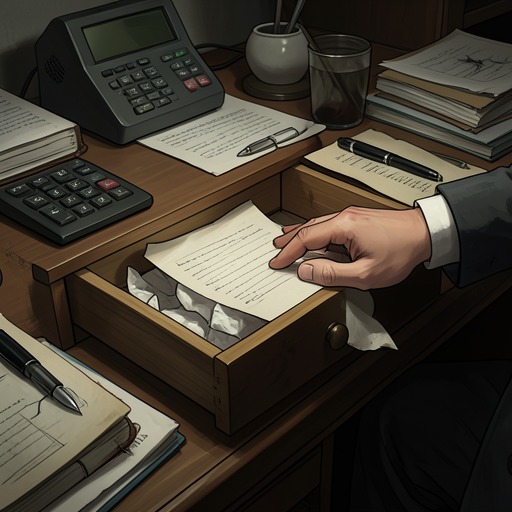
Bundle is already thinking about the clocks and about [Bill Eversleigh](entity:character-recall-character-bill-eversleigh-7f14a2933184), who had been present. Rather than remain in speculation, she turns to a writing desk: an inlaid piece with a lid that rolls back. She sits down to write to Bill, then reaches for the lower part of the desk, which has stuck halfway, as she remembers it often doing. Her recollection supplies a practical explanation for the obstruction: on an earlier occasion, an envelope had been pushed back with the drawer and jammed it.
Bundle works a thin paperknife into the narrow crack. A corner of white paper appears; she catches it and draws out the crumpled first sheet of a letter. The find depends on an ordinary fault in the furniture, but the paper’s date immediately gives that small recovery larger consequences. In the middle of beginning one inquiry, Bundle has uncovered a document from the night at the center of another.
## Date and Circumstance
The date is written large and flourishing: September 21st. Bundle recognizes its importance because Gerald was found dead on the 22nd. She identifies the page as something he must have been writing on the evening of the tragedy. The letter is not a later recollection or an account composed after the fact; its proximity to the death makes it evidence of what Gerald was trying to communicate at the time.
That closeness gives the unfinished page its particular tension. It ends before Gerald completes what he wanted to say, so Bundle can read his words but cannot ask him to explain them. The document offers immediacy without completeness: it preserves a voice from the eve of his death while withholding the information that might have made its implications certain. Its date narrows the interval between writing and death, but the missing conclusion keeps the circumstances open.
## The Warning to Loraine
Addressed to “My Darling Loraine,” the letter says Gerald expects to be down on Wednesday and is looking forward to seeing her. He describes himself as feeling “awfully fit,” then tells her to forget what he had said about Seven Dials. What he had initially thought might be more or less a joke, he now insists, is anything but. He apologizes for having brought it up and says it is not the kind of business that someone like her should be mixed up in.
The warning changes the significance of Seven Dials in Bundle’s investigation. Before the letter, Bundle cannot immediately place the words, though she thinks of a rather poor district of [London](entity:location-recall-location-1bfd335cdd1b) and senses that the name recalls something else. Gerald’s message makes the subject personal and serious: he had discussed it with Loraine, reconsidered the danger, and tried to withdraw her from involvement. The page therefore links the name to Gerald’s private concern as well as to Bundle’s emerging puzzle. It does not explain what the business involves, but it makes clear that Gerald no longer regarded it as a harmless joke.
## The Unfinished Contradiction
Gerald breaks off after saying he is too sleepy to keep his eyes open. He begins another thought—“Oh, about Lurcher; I think”—and the letter stops there. The unfinished reference cannot be completed from the surviving page, and Bundle has no answer to what Gerald meant to tell Loraine. Instead, she is arrested by the contrast between his statement that he feels fit and his claim that he can scarcely stay awake.
That contrast matters because Bundle knows that Gerald took a heavy dose of chloral on the same night and never woke again. If his written description of himself is true, she reasons, why should he have taken it? The letter does not prove who administered the drug or establish what happened in the room; it introduces a discrepancy between Gerald’s recorded state and the apparent explanation for his death. Bundle’s certainty that something does not fit replaces the simple acceptance of an overdose with renewed suspicion.
The scene ends not with a solution but with the weight of the place where the clue is found. Bundle looks around the room, remembers that Gerald died there, and imagines the possibility of being watched. She sits very still as the silence is marked only by the unusually loud ticking of her little gold clock. The clock recalls the earlier mystery of the alarms, while the letter turns the date, the warning, and Gerald’s last unfinished words into fresh questions. Its discovery advances the investigation precisely by refusing to settle it: the evidence brings Bundle closer to Gerald’s final night and makes that night less intelligible.
Event 4
Ronny Devereux's death by shooting
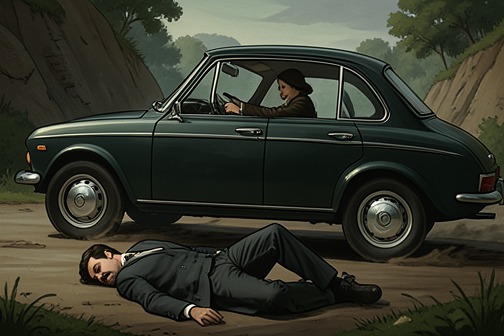
[Ronald Devereux](entity:character-recall-character-ronald-devereux-e72048b36bdc)’s shooting turns [Bundle Brent](entity:character-recall-character-bundle-brent-498187f5c44e)’s apparent road accident into the second death linked to [Seven Dials](entity:location-recall-location-seven-dials-0a3205031444). As Devereux lies dying, he asks her to carry a message to [Jimmy Thesiger](entity:character-recall-character-jimmy-thesiger-86b9cc12120c), joining the name of the secretive organization to the friend he specifically wants told. The immediate investigation accepts an accidental explanation, but the message and Bundle’s recollection of [Gerald Wade](entity:character-recall-character-gerald-wade-69d500281dbe)’s death give the event a more sinister meaning. The later identification of Jimmy as Devereux’s murderer exposes the gap between the inquest’s verdict and what happened.
## The roadside encounter
Bundle Brent is driving along a quiet stretch of road when a man suddenly reels out of a hedge in front of her Hispano. She swerves hard to avoid him, nearly putting the car into a ditch. Looking back, she sees him lying face down and still. Although she has not run over him, she fears that the car struck him as it passed. The man’s apparent drunkenness and the abruptness of the incident leave her initially convinced that she has caused his death.
Bundle returns to him and turns him over. He is young, well dressed, and wears a small toothbrush moustache. She can see no external injury, but he seems either dead or close to it. His eyelids flicker; his brown eyes open partway, and he struggles to speak. Bundle bends down to hear him. He first manages the fragment “Seven Dials... tell...” and, after she asks whom she should tell, forces out the name Jimmy Thesiger. His head falls back and his body goes limp. Bundle is shaken and still believes that she has killed him, yet she immediately tries to act: she considers getting him into the car and taking him to a doctor because he might still be alive.
## From apparent accident to shooting
The first explanations do not resolve the contradiction between Bundle’s fear and the man’s condition. Doctor Cassell tells her that the car never touched Devereux: he was shot. The physician also reports that Devereux had muttered that he wanted something told to a friend and had mentioned Seven Dials. He considers the name an unlikely one for a man of Devereux’s class and suggests that his assailant might have come from there, while leaving the matter to the police.
At the police station, Devereux is identified through a card-case as Ronald Devereux, with an address in the Albany. Bundle recognizes the name as Ronny Devereux, a friend of [Bill Eversleigh](entity:character-recall-character-bill-eversleigh-7f14a2933184) at the Foreign Office and one of the men associated in her memory with Bill and Gerald Wade. That recognition changes the meaning of the encounter. Gerald Wade has already died, and Bundle can still imagine that his death resulted from carelessness or natural causes; Devereux’s shooting, however, makes the possibility of a connected crime harder to dismiss.
The message also has a precise earlier echo. Gerald Wade had mentioned Seven Dials in the unfinished letter he wrote to his sister on the night before his death. Bundle had found the name familiar when Devereux spoke it, but only afterward understands the connection. His final instruction adds Jimmy Thesiger to this chain: Devereux does not merely name Seven Dials but insists that Jimmy be told. The fragment is not a complete explanation of the organization or the shooting, yet it gives Bundle a concrete link between the dying man, the earlier letter, and the people around the two deaths.
## Investigation and public verdict
The doctor takes Bundle to the police, where an inspector records her statement carefully. The local police sergeant offers a casual theory: boys practising with firearms may have fired at birds without considering who was beyond the hedge. That suggestion treats the shooting as a stray accident, rather than as an attack deliberately aimed at Devereux. It also sits uneasily beside the victim’s dying effort to pass on a message naming both Seven Dials and Jimmy Thesiger.
At the inquest, Bundle gives evidence, as does the doctor; evidence is also heard about rifle practice in the neighbourhood. The proceedings produce a verdict of death by misadventure. The ruling supplies an official conclusion, but it does not resolve the personal clue Devereux managed to leave behind. The difference matters: the formal account makes the fatal shot an accident, whereas the larger investigation eventually establishes that Devereux was murdered.
## Meaning within the mystery
Devereux’s death is staged for the reader first as a possible collision, then clarified as a shooting, and finally entangled with the Seven Dials investigation through his last words. Each change revises Bundle’s understanding: she moves from believing herself responsible, to learning that an unknown assailant shot him, to recognizing that the victim was connected to Gerald Wade and had deliberately named Jimmy Thesiger. The scene’s roadside urgency gives the clue its force; Devereux has little strength left, and the name he struggles to deliver becomes the event’s surviving evidence.
The public verdict of misadventure temporarily places the death in the category of an accident, but the eventual revelation identifies Jimmy Thesiger as the murderer, who killed Devereux to silence him. Devereux’s message therefore functions both as a lead and as an accusation whose significance is not immediately understood. His death binds the investigation’s separate threads: Gerald Wade’s suspicious end, the secret activity surrounding Seven Dials, and Jimmy’s concealed criminal identity. The contrast between an apparently ordinary country-road mishap and a deliberate killing makes the failure of the first explanation central to the event’s role in the mystery.
Event 5
Bundle's infiltration of Seven Dials Club and witnessing of a secret meeting
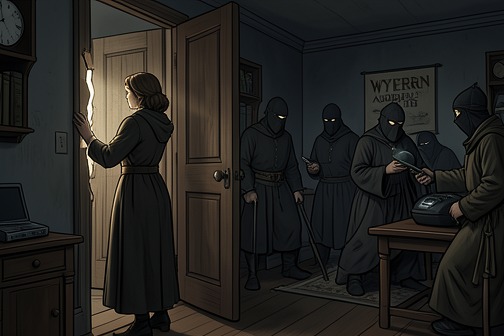
[Bundle Brent](entity:character-recall-character-bundle-brent-498187f5c44e)’s infiltration of the [Seven Dials Club](entity:location-recall-location-seven-dials-club-d5a24a2d7847) gives her first direct view of the secret meeting behind the name that has become a clue in the investigation. She enters hoping to question [Alfred](entity:character-recall-character-alfred-8593662aff34), the former footman from [Chimneys](entity:location-recall-location-chimneys-a9208b7c89b9), but a search of the premises leads her to a concealed room and then to hours of cramped concealment. From there she hears masked members discuss [Wyvern Abbey](entity:location-recall-location-wyvern-abbey-85e7c67646f7), Eberhard’s invention, and the danger of their activities becoming known. The scene presents the organization as a real threat while leaving its full place in the larger investigation to be clarified later.
## The Approach and Alfred
After ending a telephone call, Bundle dresses in nondescript clothes belonging to her maid and sets out on foot for the Seven Dials Club. She reaches 14 Hunstanton Street at about six in the evening, when she judges the premises to be quiet. Her immediate objective is not to attend a meeting but to get hold of Alfred. She believes that speaking to him will make the rest of her inquiry easy, and intends to keep her presence from as many people at the club as possible.
The opportunity arrives without an elaborate plan: the door opens and Alfred himself comes out. Bundle greets him, startling him, and begins questioning him about why he left Chimneys. She presses him directly on how much he was paid. Alfred admits that [Mr. Mosgorovsky](entity:character-recall-character-mr-mosgorovsky-d01b2b7af0e4) visited Chimneys with a party on a day when the house was being shown to visitors. Because Mr. Tredwell was indisposed, Alfred conducted the tour; afterward, Mosgorovsky stayed behind, gave him a substantial payment, and began a conversation. Alfred’s account gives Bundle a concrete connection between the club’s organizer and the household she is investigating.
Alfred also admits that the club has been raided twice, but says that nothing compromising was found because of the neatness of Mosgorovsky’s arrangements. Bundle makes clear that gambling is not the only matter she suspects. She tells Alfred that she has heard curious things at [Scotland Yard](entity:location-recall-location-scotland-yard-a9f32f21c1df) and asks for his help, offering to put in a good word for him if trouble follows. Her manner is both reassuring and authoritative: rather than wait for Alfred to volunteer information, she asks to inspect the whole building from top to bottom.
## The Hidden Room
Alfred accompanies Bundle on a thorough tour. Most of the premises yields nothing that catches her attention until she reaches the gaming room and notices an inconspicuous locked door in a corner. She determines that its ordinary lock may yield to a key from another door. Alfred fetches likely keys; the fourth fits. Beyond it, Bundle finds a small, dingy room with a long table in the centre, chairs around it, no other furniture, and two cupboards built into either side of the fireplace.
Alfred indicates one cupboard, but its lock is not an ordinary one: it is a patent lock that will open only with its own key. The distinction makes this door a more deliberate obstacle than the one Bundle has just opened. Her attention shifts from the visible club rooms to what the hidden chamber is for. She eventually remains concealed in the cupboard, though she has no certainty that anyone will come to use the room. The wait is physically punishing. She has guessed that a meeting, if one is planned, will happen while the club is busy, probably between midnight and two in the morning. As the hours pass, she worries that her interpretation of the room’s cleaning that morning may be wrong and that she will have endured the cramped hiding place for nothing.
## The Masked Meeting
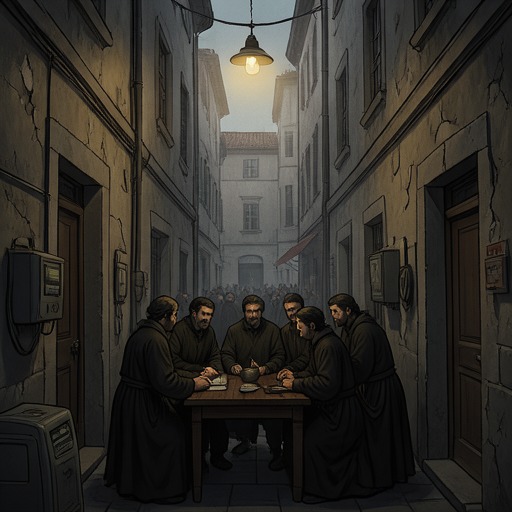
The chapter allows the four hours of waiting to pass quickly in narration, then makes the arrival of the meeting audible: Bundle hears a door being unlocked. One man checks his watch and moves briefly out of her line of sight. When he reappears, his face is covered not by a fitted disguise but by a round piece of material hanging like a curtain, with slits for the eyes and a clock face whose hands point to six. Bundle recognizes the sign of the [Seven Dials](entity:location-recall-location-seven-dials-0a3205031444). Seven muffled taps follow, and Mosgorovsky crosses toward the other cupboard door. A sharp click and greetings in a foreign language mark the beginning of the gathering.
Mosgorovsky presides over the meeting. The members first turn toward an empty chair for their absent comrade, No. 2, whom he says he wishes were present because difficulties have arisen. The ritual gives absence a formal place in the room: the group acknowledges the vacant chair together before moving to business. Mosgorovsky then says that too much is becoming known about the organization and its premises, that several people suspect them, and that those people must be silenced. Hidden nearby, Bundle understands that discovery could put her in danger.
The conversation turns to Chimneys and then to plans for Wyvern Abbey. No. 3 has brought plans, and Mosgorovsky reads out a list of names, including [Sir Stanley Digby](entity:character-recall-character-sir-stanley-digby-6e2011baff50), Terence O’Rourke, [Sir Oswald Coote](entity:character-recall-character-sir-oswald-coote-4b934c4e3e94) and [Lady Coote](entity:character-recall-character-lady-coote-5ed3f038230b), [Rupert Bateman](entity:character-recall-character-rupert-bateman-98772080c092), [Countess Anna Radzky](entity:character-recall-character-countess-anna-radzk-0be8de4f7107), and [Jimmy Thesiger](entity:character-recall-character-jimmy-thesiger-86b9cc12120c). When Mosgorovsky asks who Jimmy Thesiger is, the exchange shows that the names are being assessed rather than simply recited. The meeting also considers whether Eberhard’s invention is valuable: one member answers that there is no doubt, while No. 5, speaking as an aviator, says the device is feasible and that Eberhard’s genius has brought a long-discussed possibility to fruition.
## Intelligence, Exposure, and Aftermath
Mosgorovsky says that the original scheme cannot be improved and raises a letter by [Gerald Wade](entity:character-recall-character-gerald-wade-69d500281dbe) that mentions the organization. He learns that [Lady Eileen Brent](entity:character-recall-character-lady-eileen-brent-90981fd0aec1) found it and that it was written to Gerald’s sister. He calls the discovery unfortunate, then turns to the impending inquest on [Ronald Devereux](entity:character-recall-character-ronald-devereux-e72048b36bdc). The American member reports that stories about local boys practising with rifles have been spread; Mosgorovsky accepts this as sufficient preparation for the inquest. The discussion links the meeting’s plans not only to the invention but also to the management of suspicion and the shaping of what others may believe.
Before the group disperses, Mosgorovsky wishes their one o’clock luck in the part she is to play. She acknowledges the toast with a foreign gesture, rises, and the others follow. Bundle catches a glimpse of No. 3 as he puts Anna’s cloak around her: he is tall and heavily built. The party leaves through the secret door, which Mosgorovsky secures. After extinguishing the electric light, he passes through the other door as well. Alfred does not release Bundle until two hours later. She is so stiff that she nearly falls into his arms, and he has to hold her up.
The event’s revelations are deliberately partial. Bundle hears enough to connect the club with the plans for Wyvern Abbey, Eberhard’s invention, the Gerald Wade letter, and the arrangements surrounding Ronald Devereux’s inquest; she also learns that the members fear exposure and are willing to threaten those who may uncover them. Later, [Superintendent Battle](entity:character-recall-character-superintendent-batt-089d162e4e78) supplies a wider account of the amateur secret-service effort: Gerald Wade first approached him about forming a band of amateur workers, despite Battle’s warning that such work could be dangerous. Battle explains that they wanted to catch a particularly dangerous thief operating in the world of secret inventions, after professional investigators had failed. That later explanation reframes the investigative story around the amateurs’ purpose, without erasing the menace Bundle heard in the hidden room.
Event 6
Ronald Devereux's murder
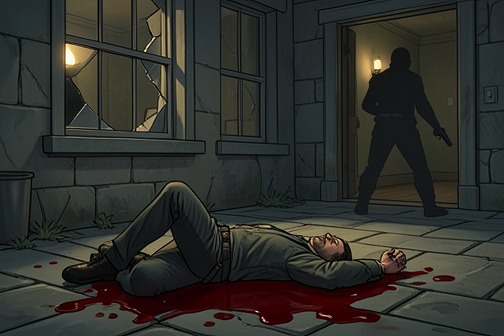
[Ronald Devereux](entity:character-recall-character-ronald-devereux-e72048b36bdc)’s murder is first obscured by a misleading fragment of evidence and an official verdict of misadventure. [Superintendent Battle](entity:character-recall-character-superintendent-batt-089d162e4e78) later reconstructs the crime as the silencing of a man who had independently reached the conclusion that [Jimmy Thesiger](entity:character-recall-character-jimmy-thesiger-86b9cc12120c) was responsible for [Gerald Wade](entity:character-recall-character-gerald-wade-69d500281dbe)’s death and the thefts surrounding Eberhard’s invention. Devereux’s attempted warning to [Seven Dials](entity:location-recall-location-seven-dials-0a3205031444), initially easy to misread, becomes the clue that turns suspicion toward his former friend.
## Background and Discovery
After Gerald Wade’s death at [Chimneys](entity:location-recall-location-chimneys-a9208b7c89b9), Devereux did not accept the apparent explanation that Wade had died from an overdose of a sleeping draught. Battle says Devereux believed Wade had been deliberately put out of the way and that the criminal was someone inside the house. Wade had been excited by a discovery and had told Devereux he was close to confirming his suspicions, though he had not confided what he had found. Devereux followed the same line of inquiry and, Battle concludes, reached the same answer: Thesiger was the culprit.
The evidence does not establish exactly what happened between that discovery and Devereux’s death. Battle notes that few people saw Devereux after Wade’s death, and presents the suggestion that he was betrayed in much the same way Wade had been. [Loraine Wade](entity:character-recall-character-loraine-wade-0c5105753f0f) had learned more from Gerald than she should have, according to Battle, and was devoted to Thesiger; Battle believes she passed information to him. Devereux, who was attracted to Loraine, may also have warned her about Thesiger. In Battle’s reconstruction, that disclosure gave Thesiger reason to silence Devereux.
## The Misleading Message
Devereux’s final communication did not identify its meaning plainly. He wanted something conveyed to a friend and mentioned Seven Dials. At first, the words seemed to mean that Seven Dials had killed him and that he was trying to alert Thesiger. Battle later reverses that reading: Devereux wanted Seven Dials to be told something about Thesiger. His message was therefore not an accusation against the organization but an attempt to direct it toward his murderer.
The first response to the clue narrowed rather than clarified its meaning. A doctor suggested that Devereux’s assailant might have come from Seven Dials, then asked [Bundle Brent](entity:character-recall-character-bundle-brent-498187f5c44e) to leave her name and address and accompany him to the police station. The inspector recorded her statement carefully but treated the shooting as likely to have been caused by young people practising with firearms. That casual explanation supplied a plausible public account while leaving the central implication of Devereux’s last words unexplored.
## Inquest and Official Conclusion
At the inquest, Bundle gave evidence, the doctor gave his, and evidence was heard that rifle practice had taken place in the neighbourhood. The proceeding ended with a verdict of death by misadventure. The formal conclusion settled the public account without establishing the truth later set out by Battle: Devereux had not simply been the victim of an accidental shot, but had died while trying to communicate the identity of the man who had killed him.
The gap between the verdict and the later reconstruction is central to the event’s place in the mystery. The inquest’s evidence could support an accidental explanation, while the message about Seven Dials remained ambiguous until read alongside the thefts, Wade’s investigation, and Devereux’s relationship with Thesiger. The verdict records what the inquiry accepted at the time, not what the subsequent investigation reveals.
## Battle’s Reconstruction
Battle says he did not suspect Thesiger for a long time. Devereux’s apparent closeness to him made the implication seem incredible, but the pattern of the thefts suggested an offender with access to information circulating in the Foreign Office. Battle also wondered how Thesiger could afford an expensive way of life on the small income left by his father. Devereux’s message eventually connected those suspicions to the earlier crimes.
In Battle’s account, the friendship between Devereux and Thesiger makes the murder both a betrayal and an obstacle removed. Devereux had come close to confiding in Thesiger before he suspected him, but something held him back; after discovering the truth, he tried to warn Seven Dials instead. His death prevented that warning from being understood in time. Once Battle interprets the message correctly, Devereux’s last words cease to be a confused reference to the organization and become the belated clue that exposes his killer.
Event 7
Formation of the Seven Dials Society
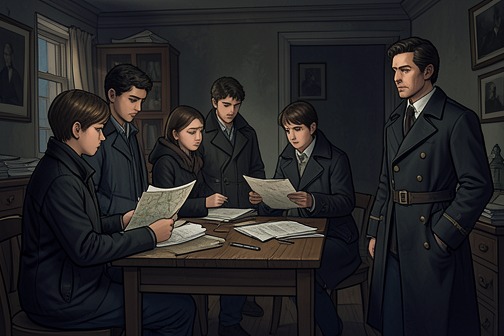
The [Formation of the Seven Dials Society](entity:event-recall-event-formation-of-the-seven-d0690c947f75) was the start of an amateur intelligence network working alongside [Superintendent Battle](entity:character-recall-character-superintendent-batt-089d162e4e78)’s department. [Gerald Wade](entity:character-recall-character-gerald-wade-69d500281dbe) proposed the group, and Battle made its risks plain before Wade’s friends joined. What began as a youthful appetite for excitement became a dangerous hunt for a criminal operating on an international scale, one in which the amateurs succeeded where professional investigators had not.
## Origins and Terms
The group began with young people seeking excitement. Gerald Wade was the first to approach Superintendent Battle with the idea of forming a band of amateur workers to perform secret-service work. Battle warned Wade that the work could be dangerous and insisted that anyone joining must understand that risk. The warning did not dissuade Wade’s friends; as Battle later explained, they were determined to take part.
The arrangement joined informal enthusiasm to official expertise. Battle represented the professional department, while the recruits entered the work as amateurs, accepting danger without the knowledge or skill of trained investigators. The contrast was explicit: when Battle urged Bundle to leave matters to the professionals, she answered that she could work in the dark. The group’s founding thus established a boundary-crossing kind of service, neither ordinary police work nor merely private adventure.
## Purpose and Mission
The amateurs were recruited to find a particular criminal whom Battle described as no ordinary thief: he operated in Gerald Wade’s world and pursued large-scale, international targets. Valuable secret inventions had already been stolen twice, and the thefts pointed to someone with inside knowledge. The professional investigators had tried and failed; the amateurs took up the pursuit and ultimately succeeded.
The work carried both practical and patriotic meanings. Battle later described the members as willing to face serious danger out of love of danger itself and an honest wish to serve their country. Their methods and trappings could seem melodramatic, but the service was not simply make-believe: the target was dangerous, the stolen inventions were valuable, and the investigation had a real cost in lives.
## Members and Risks
At the eventual introduction of the group, Battle identifies [Mr. Mosgorovsky](entity:character-recall-character-mr-mosgorovsky-d01b2b7af0e4) as a central figure who ran the club and other operations, and as a valuable secret anti-Bolshevist agent in England. No. 5 was Count Andras of the Hungarian Embassy, a close friend of the late Gerald Wade; No. 4 was the American journalist Hayward Phelps, whose British sympathies and instinct for news suited the work. No. 3 was [Bill Eversleigh](entity:character-recall-character-bill-eversleigh-7f14a2933184), whose contribution proved decisive in bringing the criminal to justice. The roll call makes clear that the band drew on different occupations and connections rather than a single professional corps.
The secret work exposed its members to retaliation. At a meeting, Mr. Mosgorovsky warned that too much was becoming known about the organization and its location, and that people who suspected them would have to be silenced. Gerald Wade’s unfinished letter, which mentioned the organization, had been found by [Lady Eileen Brent](entity:character-recall-character-lady-eileen-brent-90981fd0aec1); the group recognized the discovery as a security failure. The planned inquest into [Ronald Devereux](entity:character-recall-character-ronald-devereux-e72048b36bdc)’s death was also discussed alongside a cover story about local youths practising with rifles, showing how the members’ clandestine activity intersected with the management of public appearances and official scrutiny.
## Outcome and Significance
The group’s success did not mean that its members escaped harm. Battle says that the dangerous criminal claimed two lives and got away for a time, even as the [Seven Dials](entity:location-recall-location-seven-dials-0a3205031444) persisted in the pursuit. The eventual capture came through Bill Eversleigh, who helped bring the man to justice red-handed. The founding therefore leads not to a harmless club but to a network whose amateur status coexists with consequential intelligence work, personal loss, and real danger.
Battle’s account also reframes the society’s theatrical identity. The members may have adopted melodramatic trappings, but their work served the department in a way the professionals had been unable to achieve alone. The Seven Dials began in a desire for excitement; its lasting significance lies in the conversion of that appetite into risky, coordinated service.
Event 8
Bundle Brent's discovery of the Seven Dials meeting
[Bundle Brent](entity:character-recall-character-bundle-brent-498187f5c44e)’s discovery of the secret meeting at the [Seven Dials Club](entity:location-recall-location-seven-dials-club-d5a24a2d7847) converts her investigation into an immediate personal danger and reveals that the group is actively managing the risks of exposure. What she overhears includes plans, concern about a letter found by Bundle, and preparations surrounding [Ronald Devereux](entity:character-recall-character-ronald-devereux-e72048b36bdc)’s inquest; her later account to [Superintendent Battle](entity:character-recall-character-superintendent-batt-089d162e4e78) also exposes how the meeting and her presence at the Abbey have become entangled with the larger operation.
## The meeting and its stakes
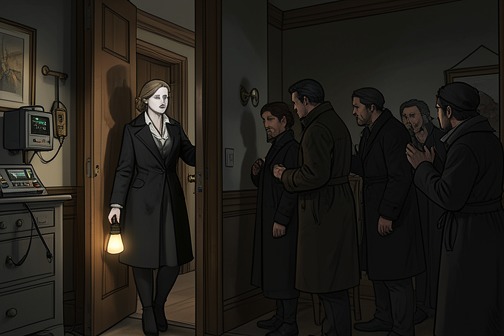
Inside the meeting, the Russian warns that too much is becoming known about the group and its location, and says that people who suspect them must be silenced. Bundle feels a shiver at the implication: discovery might make her a target too. The threat gives the gathering a sharper meaning than a secret society’s mere concealment. Its members regard knowledge itself as dangerous, and treat violence as a way to contain it.
The discussion also turns to the plans the members have seen and to whether their original scheme can be improved. One participant, speaking as an aviator, considers the proposed undertaking feasible and credits [Herr Eberhard](entity:character-recall-character-herr-eberhard-2c0e7b8666c4)’s genius with bringing it to fruition. The meeting thus links the society’s secrecy to a practical plan, though the account of Bundle’s discovery does not spell out every detail of the scheme.
## [Gerald Wade](entity:character-recall-character-gerald-wade-69d500281dbe)’s letter and the inquest
The members know that Gerald Wade’s letter has been found and that it mentions their organization. They learn that Bundle found it and believe it was addressed to Wade’s sister. Their discussion makes the letter more than a private remnant: it is evidence that can connect the dead man to the group. They also criticize Bauer for failing to get ahead of its discovery, treating that failure as a lapse in the organization’s precautions.
The next day’s inquest into Ronald Devereux’s death is another immediate concern. A member reports that stories about local boys practising with rifles have been spread widely, and the gathering treats this as a suitable arrangement. The detail shows the group shaping what others may believe about the death before the inquest takes place. At the meeting’s close, the members wish their one o’clock luck in the part she has to play, reinforcing the sense of numbered roles and coordinated action.
## Bundle reports what she saw
When Bundle later tells Superintendent Battle about her introduction to the club and her subsequent adventures there, he is visibly astonished. She reminds him that he had pointed her toward [Bill Eversleigh](entity:character-recall-character-bill-eversleigh-7f14a2933184), but continues with the revelation that the woman she saw at the meeting was No. 1. Bundle says she recognized the woman by a mole; Battle’s hesitation signals that her identification has complicated what he can tell her at that point.
The report also reveals how precariously Bundle’s proximity to [Jimmy Thesiger](entity:character-recall-character-jimmy-thesiger-86b9cc12120c) has been used. At the Abbey, she and Jimmy appeared to be acting together, and her insistence on being brought there had already embarrassed Bill. Once Bundle had overheard a meeting, Bill could not disclose the secret society to her without also exposing it to Jimmy. Yet the very circumstances that kept Bundle uninformed gave Jimmy a legitimate reason to be invited to the Abbey, making his access easier. Her discovery therefore carries consequences beyond what she heard: her apparent alliance with Jimmy affects the operation’s security and helps facilitate his movements.
## The later explanation
Superintendent Battle’s later account reframes the meeting and the organization behind it. The group began when Gerald Wade, concerned about a dangerous thief operating in the world of secret inventions, proposed a band of amateur workers for secret-service work. Battle had warned that the work could be dangerous, but Wade’s friends joined regardless; professional investigators had already failed to catch their target. This explanation complicates Bundle’s first impression of the gathering: the meeting belongs to an amateur operation with a serious purpose, even as its members discuss secrecy, deception, and silencing suspected informants.
Battle also explains the Abbey’s place in the sequence. The [Seven Dials](entity:location-recall-location-seven-dials-0a3205031444) had sent [George Lomax](entity:character-recall-character-george-lomax-51e5881f309a) a warning letter so that Lomax would seek Battle’s assistance, allowing Battle to be present naturally. Against that background, Bundle’s presence at the meeting is both a breach of the organization’s secrecy and a surprise to the people who thought they controlled the information. The discovery advances the mystery by turning overheard conversation into evidence, while the later explanation reveals that the meeting’s apparent criminal secrecy conceals a more complicated operation—and that Jimmy has been able to exploit it.
Event 9
The staged theft of the formula at Wyvern Abbey
[The staged theft of the formula at Wyvern Abbey](entity:event-recall-event-the-staged-theft-of-the-c5b93b34267b) is a manufactured crime scene: the apparent struggle and gunfire disguise the planned removal of Eberhard’s papers and misdirect those investigating it. Its force lies in the reversal between what witnesses seem to see and what the physical evidence eventually establishes.
## Causes and Background
The operation takes place against the [Seven Dials Society](entity:organization-recall-organization-9fe58db7bd76)’s secret efforts to obtain Eberhard’s invention. At a meeting, the members discuss plans for an aviation-related application of the invention and agree that their original scheme remains sound. Their concern is not merely the formula itself: [Gerald Wade](entity:character-recall-character-gerald-wade-69d500281dbe)’s discovered letter names the organization, and its leader, [Mr. Mosgorovsky](entity:character-recall-character-mr-mosgorovsky-d01b2b7af0e4), worries that too much has become known about the group and its premises. He identifies [Lady Eileen Brent](entity:character-recall-character-lady-eileen-brent-90981fd0aec1) as the person who found the letter and notes that Bauer should have prevented it from coming to light.
The approaching inquest into [Ronald Devereux](entity:character-recall-character-ronald-devereux-e72048b36bdc)’s death adds another risk. The conspirators discuss reports that local young men have been practising with rifles, accepting this as a way to make the inquest’s outcome appear plausible. In this atmosphere of surveillance, exposure, and deliberate misdirection, the attempted acquisition of the formula at [Wyvern Abbey](entity:location-recall-location-wyvern-abbey-85e7c67646f7) is not an isolated burglary: it is part of a wider covert contest in which information and appearances are both weapons.
The deeper history of that contest is later explained by [Superintendent Battle](entity:character-recall-character-superintendent-batt-089d162e4e78). Gerald Wade had proposed forming a group of amateur secret-service workers, despite Battle’s warning that such work could be dangerous. Their purpose was to catch a criminal operating in Wade’s world, a figure with inside knowledge who had already been responsible for the theft of valuable secret inventions. The professionals had failed; the amateurs took up the pursuit. The Wyvern Abbey incident brings that pursuit to its decisive test, as Battle must distinguish a genuine attack from a performance designed to look like one.
## The Apparent Attack and Its Reconstruction
Just after the clock struck two, [Loraine Wade](entity:character-recall-character-loraine-wade-0c5105753f0f) reached the terrace at Wyvern Abbey. She had entered the grounds by climbing through the fence, while Superintendent Battle’s men, under orders to stop people leaving rather than arriving, let her pass. A brown-paper parcel fell from an open window at her feet. As she picked it up, a man began climbing down the ivy; Loraine ran, still holding the parcel. Behind her came the noise of a struggle, then two revolver shots. She rounded the terrace and ran directly into Superintendent Battle, urging him to hurry because the men were killing each other. The scene seemed to offer a straightforward account: an intruder had descended from the house, a fight had followed, and Loraine had stumbled upon the attack.
Battle’s later reconstruction overturned that account. There was no second man. Loraine and [Jimmy Thesiger](entity:character-recall-character-jimmy-thesiger-86b9cc12120c) were working together, and her arrival at the exact moment the papers were dropped was part of their plan. Thesiger had left the room by the window, climbed the ivy to Mr. O’Rourke’s room, and taken the papers. He threw them down for Loraine to collect, then staged the struggle below. He knocked over tables, staggered about, and used his own voice and a hoarse whisper to make the confrontation sound like an exchange between two men.
The gunfire supplied the performance’s final proof of violence. Thesiger fired his Colt automatic at an imaginary attacker, grazing the window sash; with his left, gloved hand, he then used the small Mauser pistol to shoot through the fleshy part of his own right arm. He threw the Mauser through the window, tore off the glove with his teeth, and cast it into the fire before lying on the floor as if unconscious. Loraine, meanwhile, could have left the grounds with the papers while everyone rushed toward the apparent fight. When she ran into Battle, the plan changed from escape to defence: she gave an account that was true in its visible details, but concealed her part in arranging them.
The objects left behind made the performance vulnerable to reconstruction. The Colt’s larger bullet had grazed the sash and lodged in a cedar tree; the smaller Mauser bullet had passed through Thesiger’s arm and embedded itself in an armchair. Battle also examined the footprints and a dent in the grass. Only one set of footprints crossed the lawn where the pistol was supposed to have been dropped by a fleeing attacker: [Sir Oswald Coote](entity:character-recall-character-sir-oswald-coote-4b934c4e3e94)’s. The pistol’s position and the evidence of how it had been thrown did not fit the simple story of an assailant losing it while running away. The parcel, the two bullets, the glove, and the marks outdoors thus exposed a single staged sequence beneath the apparent attack.
## Evidence, Reversal, and Consequences
The parcel changed the apparent outcome of the scene. After [George Lomax](entity:character-recall-character-george-lomax-51e5881f309a) assumed the document had been lost, Superintendent Battle pointed out that it was safe and took the brown-paper parcel from Loraine Wade, who had continued to clutch it mechanically. What had looked like an escape with stolen papers had instead placed the evidence directly in the hands of the investigators, even as Loraine’s presence at the terrace initially concealed her role in the plan.
Battle did not understand the performance at once. He later traced the shift in his thinking to the burnt glove, which he found in the fireplace with teeth marks on it. To test how the pistol had reached the lawn, he had Sir Oswald Coote throw it through the window. It landed farther away than Battle expected: a right-handed person could not have thrown it that distance with the left hand. The experiment did not prove the whole reconstruction, but it gave physical meaning to a detail that the staged account had left unexplained.
The intended recipient of the papers supplied another turn in the investigation. Battle reasoned that they had plainly been dropped for someone to collect. For those unaware of the plan, Babe St. Maur seemed an easy answer; Battle, however, knew she was not involved. That left the person who had actually arrived at the precise moment the parcel fell: Loraine. Her apparently accidental discovery of the papers became, in retrospect, the strongest indication that the timing had been arranged. When Bundle suspected the countess, Battle deliberately said enough to divert her, protecting the investigation while he worked through his own still-tentative theory.
The staged attack therefore failed not because its visible details were wholly false, but because its traces could not all support the same account. Battle had initially been deceived along with the others; the glove, the pistol’s trajectory, and the suspicious timing gradually made the supposed second attacker unnecessary. The recovered parcel and the reconstruction together recast the incident as an attempted theft by [Jimmy Thesiger and Loraine Wade](entity:relation-recall-relation-jimmy-thesiger-and-l-fd8e5c23f17b), not a struggle that had interrupted an ordinary burglary. The formula had not disappeared, and the apparent violence had served as cover for the transfer rather than as evidence of a genuine fight.
## Aftermath and Narrative Significance
The episode turns on a calculated gap between watching and intervening. Battle’s men had been told to stop people leaving, not entering, so Loraine could reach the terrace; that restraint gave the planned handoff room to begin, but also kept the investigators in position to observe what followed. The brown-paper parcel ultimately remained with the authorities, while its passage through the scene exposed the intended coordination between Loraine and Thesiger. In this sense, the operation’s concealment becomes its weakness: the conspirators rely on witnesses to interpret the apparent fight as an interruption, yet the exact timing and surviving traces permit Battle to read it as a diversion. The staged attack is therefore both a failed theft and a revelation of how the criminal plot uses the language of violence to disguise the movement of secret papers.
Event 10
Exposure and arrest of Jimmy Thesiger
The exposure and arrest of [Jimmy Thesiger](entity:character-recall-character-jimmy-thesiger-86b9cc12120c) transform the [Seven Dials](entity:location-recall-location-seven-dials-0a3205031444) mystery by revealing that the masked society [Bundle Brent](entity:character-recall-character-bundle-brent-498187f5c44e) has feared is not a criminal organisation ruled by a hidden mastermind, but an amateur intelligence group working with [Superintendent Battle](entity:character-recall-character-superintendent-batt-089d162e4e78). The final unmasking makes the reversal literal: [No. 7](entity:character-recall-character-no-7-e4223d17e23d) removes his mask, and Bundle recognises Battle. His explanation identifies Thesiger as the criminal responsible for two deaths and shows how [Bill Eversleigh](entity:character-recall-character-bill-eversleigh-7f14a2933184)’s apparent helplessness helped bring him within reach of the authorities.
## The Masked Society Revealed
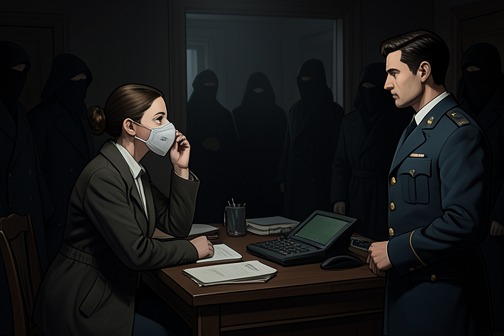
At the gathering, the removal of No. 7’s mask supplies the decisive visual turn. Bundle had expected the concealed leader of the [Seven Dials Society](entity:organization-recall-organization-9fe58db7bd76) to be a stranger; instead, she finds Battle, whose familiar, unassuming manner has hidden his place at the centre of the operation. Battle explains that [Mr. Mosgorovsky](entity:character-recall-character-mr-mosgorovsky-d01b2b7af0e4) has served as his lieutenant and that most of those around the table have followed Mosgorovsky’s instructions without knowing the full arrangement. The society’s elaborate appearance had encouraged the very interpretation Battle now corrects: that it must be a criminal group controlled by an unseen super-criminal.
Battle presents the members not as professional gangsters but as amateurs who accepted real danger in order to serve their country and satisfy a taste for adventure. Mosgorovsky, who runs the club, is described as a valuable anti-Bolshevist agent in England. No. 5 is Count Andras of the Hungarian Embassy, a close friend of the late [Gerald Wade](entity:character-recall-character-gerald-wade-69d500281dbe); No. 4 is the American journalist Hayward Phelps, whose British sympathies and instinct for news have made him useful. Bill Eversleigh is among the society’s members. The roll call also gives absence its own force: No. 2’s place belongs to [Ronald Devereux](entity:character-recall-character-ronald-devereux-e72048b36bdc), and No. 1’s to Gerald Wade, both remembered by Battle as men who died serving their country. Gerald’s place had subsequently been taken by a woman whose work, Battle says, proved her fitness for it.
## From Amateur Investigation to a Criminal’s Exposure
Battle traces the group’s origin to Gerald Wade, who approached him with the proposal for a band of amateur secret-service workers. Battle warned that the work could be dangerous and made clear that anyone joining had to understand the risk. Wade’s friends nevertheless came forward, and the organisation began. Its purpose was to find a criminal operating in Wade’s world: a thief of unusually ambitious and dangerous designs, linked to the theft of valuable secret inventions on two previous occasions. Professional investigators had failed to catch him; the amateurs eventually succeeded.
That success came at a severe cost. Battle tells Bundle that two lives fell victim to the criminal, yet the Seven Dials members persisted. The murderer’s identity is not left as an abstract solution to the puzzle: Battle names Jimmy Thesiger, someone Bundle knows well, and states that he was arrested that afternoon. He also credits Eversleigh with the capture. Thesiger had been unsettled by the Seven Dials investigation and did not know where its danger lay; the group’s pressure helped keep him off balance, while Eversleigh’s deliberate risk-taking gave Battle’s side the opportunity it needed.
## Reconstructing the Deception
The arrest’s explanation depends on the contrast between Thesiger’s apparent vulnerability and the evidence of deliberate staging. Battle lays out two bullets: a .455 fired from Thesiger’s Colt automatic, which grazed the window sash and lodged in a cedar tree, and a Mauser .25 bullet that passed through Thesiger’s arm before embedding itself in an armchair. Thesiger’s wound, the gunshot damage, and the pistol’s position had offered a convincing surface story, but Battle reconstructs the scene against the physical traces. [Sir Oswald Coote](entity:character-recall-character-sir-oswald-coote-4b934c4e3e94)’s footprints led up from the bottom of the garden; a place where he had stopped and stooped, together with a dent in the grass, gave Battle grounds to question the suggestion that a pistol had simply been dropped by a fleeing man. Only one set of footprints crossed the lawn at the relevant spot: Coote’s.
Battle’s fuller account explains how Thesiger manufactured the appearance of an attack and a faint. After going to the window, he had in fact left the room, climbed the ivy to Mr. O’Rourke’s room, and taken the papers there. He then returned by the ivy and staged a struggle inside. He overturned tables, moved about as if in a fight, and altered his voice to suggest more than one phase of the encounter. He fired his Colt at an imaginary assailant, then used his left, gloved hand to shoot himself through the fleshy part of his right arm with the small Mauser. He threw the pistol through the window, pulled off the glove with his teeth, and cast it into the fire before lying on the floor as if unconscious. The sequence makes the apparently self-confirming signs of an assault part of the suspect’s own construction.
## Eversleigh’s Risk and the Cost of the Capture
The trap that brought Thesiger within reach also required Eversleigh to act as bait. He went to Thesiger’s rooms with a fabricated story that papers belonging to Devereux had come into his possession and might implicate Thesiger. Playing the part of the honest friend, Eversleigh gave Thesiger the chance to respond. When his host left the room, Eversleigh poured away the drugged whisky and soda, then pretended that its effects were taking hold. The plan depended on Thesiger believing the deception: Battle’s team expected him to try to eliminate Eversleigh, and Eversleigh had to behave as though he could not resist.
When Thesiger appeared to leave to fetch a doctor, he had only slammed the door and hidden upstairs. Eversleigh remained on the sofa, continuing to feign incapacitation, while [Loraine Wade](entity:character-recall-character-loraine-wade-0c5105753f0f) later sent Bundle upstairs on an excuse. Eversleigh heard Thesiger return and heard Loraine report that the plan had gone well; the pair then carried him upstairs while he remained limp, intending to place him with Bundle as a surprise for No. 7. They locked the room and left. Eversleigh opened his eyes and found Bundle, believing her dead. Battle acknowledges that the Department had failed to protect her adequately. Her hat and the reduced strength in Thesiger’s wounded arm had helped spare her, but the escape from immediate death does not erase the danger into which the operation had allowed her to fall.
The arrest thus resolves the mystery through two reversals at once: the supposed criminal society is exposed as a patriotic amateur network, while the apparently foolish Thesiger is revealed as its dangerous enemy. The group’s romance and masks were not evidence of a hidden criminal sovereign; they were the dramatic trappings of covert work. Yet the deaths of Wade and Devereux, and the danger faced by Bundle and Eversleigh, prevent the revelation from becoming a harmless game. Thesiger is caught, but the capture confirms the real price of the society’s amateur service.
Event 11
Bill Eversleigh and Bundle Brent's engagement
[Bill Eversleigh](entity:character-recall-character-bill-eversleigh-7f14a2933184) and [Bundle Brent](entity:character-recall-character-bundle-brent-498187f5c44e)’s engagement turns a moment of apparent loss into a marriage decision, bringing Bill’s long-concealed love into the open and allowing Bundle to answer it in her characteristic teasing manner. What begins with Bill believing Bundle has died ends with her agreeing to marry him, and the decision is confirmed later when she tells [Lord Caterham](entity:character-recall-character-lord-caterham-8a72e79e5fce) she will marry Bill.
## The Crisis and Bill’s Confession
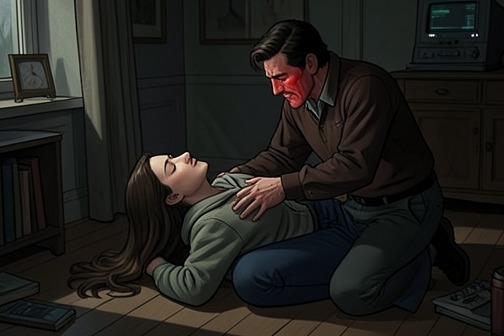
The proposal follows a moment of physical danger for Bundle. She is conscious again, though she keeps her eyes shut and lies still in Bill’s arms. From that position she hears him repeatedly address her as his darling and lament that she is dead. His grief culminates in the belief that he has killed her. The immediate circumstances matter: Bill’s declaration is not introduced as a prepared speech or a carefully staged courtship, but as an emotional outpouring made while he thinks he has lost her.
Bundle remains quiet long enough to hear the words he would not ordinarily dare to say. When she reveals that she has been listening, Bill turns dark brick-red. His embarrassment sharply changes the scene’s charge: the terror and grief of his imagined loss give way to the awkwardness of having his feelings exposed. Bundle remarks that he will never say those things as well again because he will become too self-conscious. The joke acknowledges both the intensity of what she heard and the vulnerability of the man who said it.
Bill then makes the feeling explicit. He tells Bundle that he loves her and has done so for a long time, but had never dared to tell her. The confession supplies the history of his silence without suggesting that Bundle had previously known its reason. When she calls him a silly juggins and asks why, Bill explains that he thought she would laugh at him and that she would marry some important man. His hesitation rests on a perceived difference between them: he sees Bundle as clever and imagines that she will choose someone distinguished and worthy of her.
## The Proposal and Bundle’s Answer
Bill does not leave the conversation at confession. He asks whether Bundle could ever bring herself to marry him, describing himself as thick-headed and offering to be her dog, slave, or anything she wanted. The proposal is earnest, but its self-deprecation keeps it within the pair’s teasing exchange. Bill presents devotion as service, while Bundle answers by turning his chosen image into a playful assessment of his character.
She tells him that he is very like a dog, then names the qualities she likes in dogs: friendliness, faithfulness, and warmth of heart. On those grounds, she says, she might just bring herself to marry him, though it would take a great effort. The comic qualification leaves Bill uncertain whether she means what she says. He lets go of her and recoils, staring at her in amazement before asking if she really means it. His physical withdrawal briefly reverses the closeness that has framed the scene: he had held her while believing her dead, but now the prospect of her living answer startles him into pulling away.
Bundle’s response is teasing rather than solemn, but the later confirmation establishes that it is a real acceptance. The scene does not present a prolonged negotiation or a separate grand gesture. Instead, Bill’s sudden candor, his direct question, and Bundle’s affectionate joke carry the proposal from fear of loss to a decision about marriage. Her warmth toward him is expressed through the same lightness with which she tests his seriousness; his amazement shows how little he had expected the answer to be yes.
## Confirmation and Significance
Later, Lord Caterham asks Bundle whom she is marrying. Bundle replies that she is going to marry Bill Eversleigh. Her answer makes the engagement explicit beyond the private exchange between the couple. Lord Caterham considers the news and nods with satisfaction, then observes that Bill is scratch and that the two of them can play together in the foursomes at the [Autumn](entity:time-recall-time-autumn-94f803f25564) Meeting. His practical response shifts the scene from romance to familiar social arrangements: the marriage is treated not only as Bundle’s choice but as news that can be fitted into Lord Caterham’s plans for golf.
Together, the two moments give the engagement both an emotional origin and a public confirmation. Bill’s love first emerges when he believes there is no opportunity left to confess it; Bundle hears him before he knows she is listening, then answers with humor rather than a formal declaration of her own. Later, her straightforward statement to Lord Caterham removes any doubt about the outcome. The movement from Bill’s anguished certainty that Bundle is dead to their agreed future makes the proposal a reversal of apparent loss, while the final mention of the Autumn Meeting keeps the resolution in the lightly comic register of their world.