2015
Trespasses2015 serves as the novel’s framing time, placing Cushla Lavery’s encounters with the past at its opening and close. At an exhibition, she studies Michael Agnew’s sculpture and is approached by a man who asks whether she remembers him. In the final 2015 scene, Davy McGeown stands before her as a middle-aged man, and years of searching become a face-to-face reunion. The frame thus gives memory two different forms: an image that preserves the dead, and a living person whose return makes absence newly present.
The Exhibition and the First Encounter
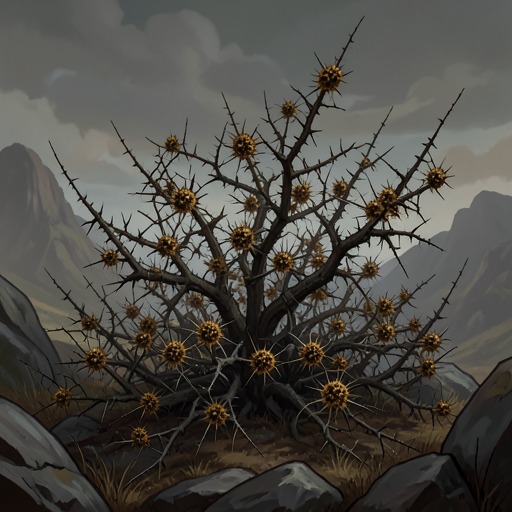
The opening scene situates Cushla among visitors following a guide through an exhibition. The guide is a pale, thin young woman whose moss-green linen dress and spiky tattoo catch Cushla’s attention. At first Cushla reads the tattoo as barbed wire; close up, its pattern resolves into gorse, with thorny stems and golden flowers. She likes that the guide has chosen the shrub that chokes the local hills rather than a conventionally decorative image. The detail gives the opening encounter an uneasy beauty, but the scene’s central image is not the tattoo: it is a white figure on a plinth.
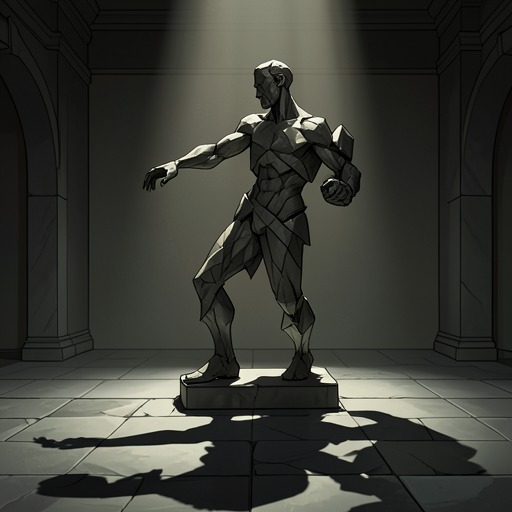
Made from resin, fabric, and glass fibre, the figure has a shrouded, almost sarcophagal appearance. It is recognizably male, though its body seems oddly sexless; its upper half appears peaceful, while its limbs lie awkwardly, as though no one has arranged them. Cushla lingers after the other visitors move on toward another work, a structure made from six doors taken from Armagh Prison. She looks closely at the sculpture and recognizes not an Everyman but an intimate, particular body. Its small details—the rounded stomach, raised right shoulder, and softened jaw—make the likeness difficult to mistake. She fears that the face might show fear or pain, but it looks as it did when its subject was sleeping.
The encounter turns when someone touches Cushla’s arm. The man has small glasses, steel-grey hair brushed back, and a soft wool jacket; he addresses her as Miss Lavery and asks whether she remembers him. The opening does not immediately explain the history behind his question. Instead, the exhibition brings together an image of a dead man, Cushla’s act of recognition, and a stranger’s claim on her memory. The withheld identification makes the past a present-tense problem before the novel has supplied its full history.
The Return of Davy McGeown
At the other end of the narrative, the 2015 frame resolves around Davy. Cushla has imagined the reunion many times, picturing herself bending toward the small boy she remembers. The person actually standing before her is a middle-aged man in glasses. His eyes are a vivid blue, distinct from Tommy’s violet shade and resembling the icy colour of his mother’s. His carefully chosen clothes include a navy pea coat, denim shirt, and maroon sweater, whose colour recalls the day Cushla soaked him. She thinks his former skittishness has disappeared, until he takes her hand and swings it. That small gesture makes the adult stranger physically continuous with the child she had carried in memory.
Cushla tells him she looked for him, and the reunion releases the scale and persistence of that search. She had looked in the street and in every classroom. She asked Gerry Devlin to check each new edition of the telephone directory for the family name. She also taped Tommy McGeown’s funeral and repeatedly replayed it, hoping to find Davy among the mourners. In the confusion of police and news crews, as shots were fired over the coffin, she could not locate him. These searches do not guarantee that Davy will return; they show instead that Cushla kept trying to make his absence answerable to ordinary means—streets, classrooms, a directory, and a recording.
Photographs, Memory, and the Frame’s Meaning
The closing scene sets the reunion against a sequence of photographs. Cushla’s pictures from the park are overexposed, making it difficult to distinguish the people in them. Davy’s photographs, by contrast, preserve movement and shared company: Cushla and Gerry on a blanket beneath a shaft of light, and children playing with energy. Other pictures record Fidel with vodka and bitter lemon, Leslie and Minty posing with him, and the three with Jimmy, whose pocket shows the outline of an egg. The images hold incidental particulars that make the past more than a general recollection, even when a photograph fails to render its subjects clearly.
The last photograph shows Michael at a counter, smiling, though his stooped posture still bears the quarrel between him and Cushla. Her hands enter the frame as she slips a beer mat beneath his whiskey; their outstretched fingers nearly touch. Looking toward the doorway, Cushla momentarily sees Michael’s broad body turning away, then he is gone. The photograph does not undo his death or settle the quarrel. It makes a brief, unfinished gesture available to memory, just as the sculpture at the opening preserves a body in a different medium.
Placed around the intervening history, the two 2015 scenes make recognition both the frame’s action and its uncertainty. Cushla can identify the exactness of a sculpted body, yet a person from her past first approaches as someone she may or may not remember. At the close, Davy’s hand and familiar details of appearance make the return unmistakable, while the photographs bring back other presences that cannot return. The year therefore holds no simple recovery of what was lost: it brings Cushla into contact with a living survivor and with images that preserve, imperfectly, the people and gestures time has taken from her.