St Dallan’s School
TrespassesSt Dallan’s School is the setting of Cushla Lavery’s work as a primary teacher and a place where religious practice, classroom discipline, and the violence beyond the school gates meet. Built on land shared with the church and parochial house, it is closely bound to parish life; its children’s lessons and routines unfold amid the conflict they are already learning to recognize.
Setting and Parish Connections
The school stands on parish land shared with the church and parochial house. That arrangement gives Father Slattery, the parish priest, ready access to the school: he roams its playground and corridors and enters classrooms without warning to deliver catechism. Cushla has told Bradley, the headmaster, that these visits unsettle her, but Bradley treats Slattery’s status as priest as sufficient explanation for his presence.
The school’s parish setting also shapes its calendar and classroom life. The children practise for their First Holy Communion and recite the Hail Mary together. Religious observance is not separate from the school’s everyday routine; it is part of how the children are gathered and taught.
Cushla’s Classroom
Cushla teaches P3, whose pupils are seven or eight years old. She recalls teaching P1 during her first two years, when much of her time went to taking the youngest children to and from the toilet. Her account locates her work in the practical rhythms of early primary teaching as well as in lessons and formal school rituals.
Unlike some teachers, who expect pupils to stand when they enter, Cushla slips into the room and listens to the children’s chatter. Davy McGeown sits in the front row, close to her, not because he is badly behaved but because the other children torment him. She empties her basket and hangs her coat on her chair; the pupils then settle into the posture they have practised for Communion, and she leads them in prayer.
Before lessons, the children have a session called The News. Cushla dislikes conducting it, while Bradley insists that it teaches pupils to attend to the world around them. She feels they already know too much about that world. Davy is consistently the first to volunteer, and one morning he reports that there has been a bomb in Belfast. The brief announcement brings the violence outside directly into the classroom’s routine.
Authority and Conflict
The school’s shared parish setting brings religious and educational authority into the same rooms. Slattery’s unannounced visits are one source of unease for Cushla; her dislike of him is also connected to his visit to her father in hospital, when he prayed with him and then persuaded him to write a cheque for a colour television. These circumstances give her objection a personal history as well as a professional one.
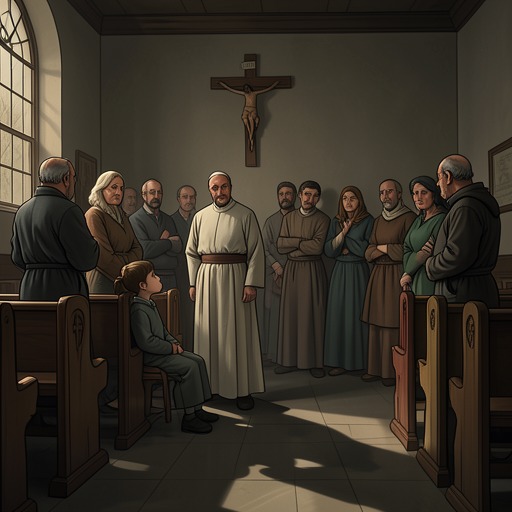
Discipline is another point at which the school’s authorities converge. After Davy hits Jonathan, Cushla asks him to apologize and sends the two boys to opposite corners of the room. They are still there when Bradley enters with Slattery. Slattery calls them bad boys, while Jonathan watches Bradley’s leather strap and Davy looks to Cushla for help. Cushla turns toward Bradley in appeal, but he is already backing out of the doorway. The episode shows how the school’s ordinary disciplinary procedures can become entangled with the priest’s presence and the threat of harsher punishment.
Narrative Significance
St Dallan’s School is not presented as a refuge from Belfast’s unrest. Its prayer and Communion preparations continue, but the children’s knowledge of events beyond the parish grounds enters the classroom through The News, and Davy is the one who voices the report of a bomb. The contrast between familiar school routines and the children’s awareness of violence gives the setting its particular weight.
The school also brings together the pressures shaping Cushla’s work: care for pupils, the headmaster’s expectations, and Slattery’s informal authority within parish property. Her attention to Davy’s vulnerability and her response to the boys’ altercation show her trying to protect children within a structure where she does not control every decision. The school is therefore both a place of instruction and a small-scale meeting point for the religious, social, and political forces surrounding its pupils.