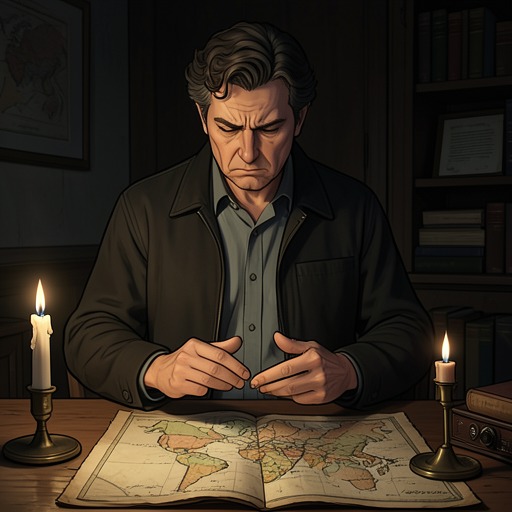
One man with courage makes a majority
TrumanOne man with courage makes a majority is the Jacksonian maxim that frames a recurring tension in Harry S. Truman’s political life: the power of an individual’s resolve, and the institutions and advisers that can constrain or amplify it. The phrase begins as an ideal associated with Andrew Jackson and the settlers of Jackson County, Missouri, then finds an echo in Truman’s investigative work and presidential conduct. It describes a political disposition rather than a claim that he acted alone or always prevailed.
Origins in a political ideal
The maxim belonged to the world of the early settlers of Jackson County, Missouri. Predominantly Scotch-Irish, Baptist, and Democratic, they identified with farmers and laborers, saw themselves as the true Americans, and revered Andrew Jackson, whom they regarded as one of their own. Their admiration centered on a leader whose courage, in the saying attached to him, could outweigh numbers. The county itself was named for Jackson.
The portrait is not uncomplicated. The settlers are described as independent and loyal to their own, but also as tough, blunt, touchy, narrow-minded, intolerant, quarrelsome, and obstinate. Their old prayer asks for the grace to be right while admitting how hard it is to turn them. In this setting, courage is inseparable from stubbornness: the maxim celebrates resistance, while the surrounding account suggests that conviction can harden into inflexibility.
The investigator who dared to challenge power
The phrase’s later resonance with Truman rests partly on his work in the Senate. His special committee won the administration’s respect, and Truman wrote to Bess that he hoped to avoid serious errors and make the war effort more efficient, thereby reducing American deaths and improving the prospects for an honorable settlement. His concern was practical as well as moral: scrutiny was meant to expose failures and improve the conduct of the war.
That work changed his standing. Claude Pepper recalled that Truman had dared to demand proof from the powerful military-industrial complex and had caught people in the act. Truman, previously regarded by some liberals as pleasant and conscientious but bland, acquired a new stature. The contrast with the Jacksonian maxim is telling: courage here was not simply defiance for its own sake, but the willingness to investigate institutions whose authority made them difficult to challenge.
A majority made through persistence
As president, Truman repeatedly faced resistance from the United States Congress. When lawmakers balked at his proposals, he continued to press them rather than abandon his course. He sought national compulsory health insurance, funded through payroll deductions, that would provide medical and hospital care regardless of ability to pay. He also advocated one year of universal military training for young men aged eighteen to twenty, arguing that peace required preparedness as well as goodwill. The proposals differed in purpose, but both show a president continuing to make his case despite poor prospects for passage.
His methods could also involve persuasion rather than a dramatic show of force. During the emerging crisis over aid to Greece and Turkey, George C. Marshall and Dean Acheson urged immediate action; the proposed aid for Greece alone amounted to a quarter of a billion dollars for the remainder of 1947. Truman then summoned congressional leaders to a crucial meeting. Marshall presented the danger of Soviet expansion, and Truman emphatically agreed that the choice was to act or lose by default. The episode links resolve to coalition-building: the president’s position acquired force through the arguments of senior officials and the prospect of congressional support, not through solitary will alone.
Courage under constraint
The book also shows Truman operating within an inherited administration. At a landmark meeting about Poland, the officials in the Oval Office were Franklin D. Roosevelt’s people; Truman had brought no new foreign-policy adviser or Missouri associate. He nonetheless challenged the implication that agreements with the Soviet Union were being honored only one way. The scene presents a president asserting his own judgment inside a room and a policy structure he had not assembled.
In another confrontation, George C. Marshall strongly opposed a course Truman was considering. Truman showed no visible reaction, acknowledged the difficulties and political risks, and suggested that everyone sleep on the matter. The pause matters: courage in this account does not always mean immediate action. His response combined a willingness to face disagreement with restraint about deciding under pressure.
The same caution appears in his handling of Douglas MacArthur’s public defiance. Although Truman later described the commander’s statement as a challenge to presidential authority, he did not immediately dismiss him. After consulting Dean Acheson and Robert A. Lovett, he chose a restrained reprimand reminding MacArthur of the order against public statements not cleared with Washington. The choice came amid MacArthur’s immense prestige, public frustration with the war, and Truman’s own low standing. Here the maxim meets its limit: courage could mean defending civilian authority, but presidential responsibility also required attention to consequences and timing.
Meaning and limits
One man with courage makes a majority gives a name to Truman’s willingness to expose wrongdoing, continue advocating policies after rejection, and accept the burdens of high office. Yet the episodes resist a simple lone-hero reading. The Senate committee’s work depended on an institution; the Greece and Turkey policy emerged through urgent consultation with officials and congressional leaders; and the disputes with Marshall and MacArthur required Truman to weigh advice, authority, and political risk.
The phrase therefore works best as an ideal of personal initiative within collective government, not as proof that numbers or institutions do not matter. Truman’s courage could challenge entrenched power, but its political effect depended on evidence, persuasion, allies, and judgment about when to press and when to wait. The old Jacksonian admiration for obstinacy remains in the background, as both a source of resolve and a warning about the difficulty of turning a determined man.