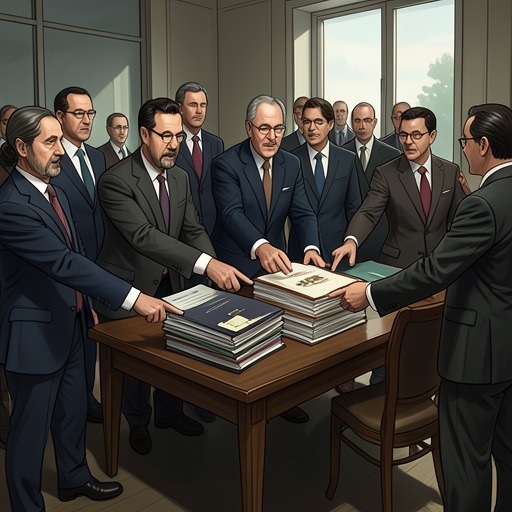
There is no substitute for facts
TrumanThere is no substitute for facts is Harry S. Truman’s clearest statement of the standard he wanted applied to public investigation. Spoken as guidance to his committee staff, the phrase rejects both sensational accusation and protective evasion: the work is to establish what happened, and neither rank nor pressure should decide the answer. The book’s later scenes echo that discipline in Truman’s approach to congressional resistance, international crises, and military insubordination, though they do not repeat the maxim itself.
The Committee’s Standard
Truman told his committee staff there would be no whitewash, no witch-hunt, no grandstanding for headlines, and no effort to obstruct the defense effort. Investigators were not to be intimidated by rank or political pressure; their primary task was to get the facts. He urged them to give the work everything they had, and warned them not to tell people under investigation that they were doing a good job: if later findings contradicted such praise, the committee’s own words could be used to imply that it had approved the work.
The rule also imposed a limit on the investigators themselves. Their time was to be spent on clear and present problems, not on searching for trouble without a known basis. During a closed session, Alexander Wiley, a senator from Wisconsin who was sitting in, asked what the committee was fishing for. Truman rejected the premise directly: the committee did not go on fishing expeditions. The maxim thus meant more than a demand for diligence; it required evidence-led scrutiny without manufacturing a case in advance.
Facts in Public and at Home in Congress
Truman’s first major test before Congress as president came with his address on April 16. He entered to a standing ovation, opened a large black looseleaf notebook, and began before Speaker Sam Rayburn had formally introduced him. Rayburn interrupted to make the introduction; the brief mistake became an amusing and poignant moment. Truman’s speech lasted fifteen minutes and drew applause seventeen times. The scene presents a public performance rather than an investigation, but its concrete details distinguish what occurred from the surrounding acclaim: the welcome was powerful, and the speech’s reception was immediate.
Later, when Congress balked at his requests, Truman asked for more rather than changing tactics. He proposed national compulsory health insurance, funded through payroll deductions, that would provide medical and hospital care regardless of ability to pay. He also sought universal military training: one year for young men aged eighteen to twenty, as civilians forming a trained reserve rather than serving in the armed forces. Truman argued that peace required both power and goodwill, and that the country could not assume it would have time to prepare after an emergency began. These proposals show him continuing to press policies he believed necessary despite the likelihood of congressional rejection; they do not amount to a repetition of the committee slogan, but place his public arguments in a political setting where conviction met resistance.
Crisis, Persuasion, and Political Judgment
In a meeting with congressional leaders about aid to Greece, Truman first heard George C. Marshall describe the danger that Soviet influence might extend across Europe, the Middle East, and Asia. Marshall framed the choice as acting with energy or losing by default. Dean Acheson then argued more urgently for action, and Arthur Vandenberg indicated, in Acheson’s later account, that congressional support depended on Truman presenting the case with comparable force. Truman’s own later account emphasized Marshall’s formulation and his agreement with it. The differing accounts make the meeting a revealing instance of how a crisis was presented and remembered, as well as a test of the persuasion required to secure action.
A later confrontation with Marshall over a proposed course of action brought a different test. Marshall’s rebuke stunned the room, but Truman showed no visible change in expression. He said he understood the difficulties, dangers, and political risks, and was inclined to agree with Marshall, while proposing that everyone sleep on the matter. After Marshall left, Truman told Clark Clifford that the exchange had been rough and reassured him not to feel badly. The scene shows the distinction between hearing forceful counsel and making an immediate decision: Truman acknowledged the risks without pretending that the meeting had settled them.
Restraint in the MacArthur Crisis
After Douglas MacArthur issued a statement in defiance of directives and Truman’s orders, Truman later wrote that he knew what he must do. Yet the next day he did not dismiss MacArthur or announce that he had decided to do so. In a meeting with Acheson, Robert A. Lovett, and Dean Rusk, he was described as combining disbelief with controlled fury. His advisers feared that challenging MacArthur would provoke public anger, since the general was promising victory while the country had grown tired of the war.
Truman chose instead to send a restrained reprimand, which he dictated himself and which reminded MacArthur of the December 6 order requiring public statements to be cleared with Washington. The choice did not erase the constitutional conflict: MacArthur’s action had challenged presidential authority and disregarded United Nations policy. But Truman proceeded cautiously rather than allowing anger or the prestige of either man to settle the matter at once. In that sense, the committee maxim resonates beyond investigations: judgment depends on separating established circumstances from pressure, even when delay carries political risk.