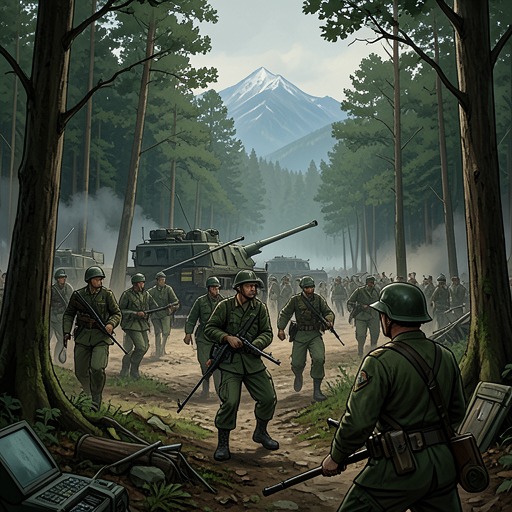
Police action
TrumanPolice action was a deliberately chosen public description of the United States’ intervention in Korea. Harry S. Truman accepted a reporter’s formulation that the action was being conducted under the United Nations, making the phrase a concise statement of how he wanted the conflict understood. Its significance lies in the contrast between the label’s restrained wording and the military emergency it described.
Definition and Scope
The expression entered the book’s account not as an abstract definition but as a question put directly to Truman: was it correct to call the fighting a police action under the United Nations? Truman answered, “Yes,” and added, “That is exactly what it amounts to.” His preceding declaration, “We are not at war,” made the distinction explicit. The exchange presented the intervention as a United Nations action rather than naming it a war; the evidence establishes this as Truman’s chosen public framing, not as a separate legal definition of the phrase.
The two parts of the description worked together. “Police action” characterized the undertaking as limited in scope, while “under the United Nations” located it within an international framework. The wording did not suggest that no fighting was taking place. Instead, it supplied a compact public category for military action that Truman insisted should not be described simply as a state of war.
Truman’s Press Conference
The exchange occurred on Thursday, June 29, at Truman’s first press conference since the Korean crisis began. He answered the question emphatically, and when a reporter asked whether the president could be quoted as saying, “We are not at war,” Truman confirmed it. The exchange thus gave the phrase unusual clarity: it was not an incidental description attributed to his administration, but language he personally endorsed before reporters.
The press conference came as the military situation was worsening. In the early hours of June 30, a report from General MacArthur argued that air and sea power alone could not stop the North Korean advance and called for United States combat forces in the battle area. By then, the contrast between Truman’s public label and the demands of the fighting was becoming increasingly stark. The phrase did not remove the urgency or danger of the intervention; it framed the action as Truman and his administration were confronting the prospect of a larger commitment.
A Deliberate Public Frame
Later, the press-conference answer would be remembered as another of Truman’s supposed verbal blunders, as if he had allowed a reporter to put words in his mouth. The account rejects that interpretation: the answer was no mistake. A “police action under the United Nations” was precisely how Truman wished the intervention to be viewed, and at the time no one saw reason to fault him for saying so.
That distinction matters to the phrase’s role in the narrative. Its significance is not merely that Truman used a label that sounded less sweeping than “war.” The wording made his intended framing audible in a public exchange, while the ensuing military reports exposed the severe conditions beneath it. The phrase therefore records both a description of the intervention and an effort to define its character for the American public.
From Police Action to Limited War
The language returned in a different form during the Senate hearings on General MacArthur. Asked how he would characterize the “Korean business,” and whether it was a police action or a large or small war, George C. Marshall replied, “I would characterize it as a limited war which I hope will remain limited.” His answer did not simply repeat Truman’s exact classification. It placed the conflict on a scale of war and stressed the importance of keeping it bounded.
Together, the exchanges trace a consistent concern with limits. Truman accepted “police action” as the public description of the United Nations intervention; Marshall later called the fighting a limited war and voiced the hope that it would stay so. The phrase’s historical and narrative force comes from that tension: a restrained label had to describe real combat, while officials continued to emphasize that the conflict should not expand into a broader war.