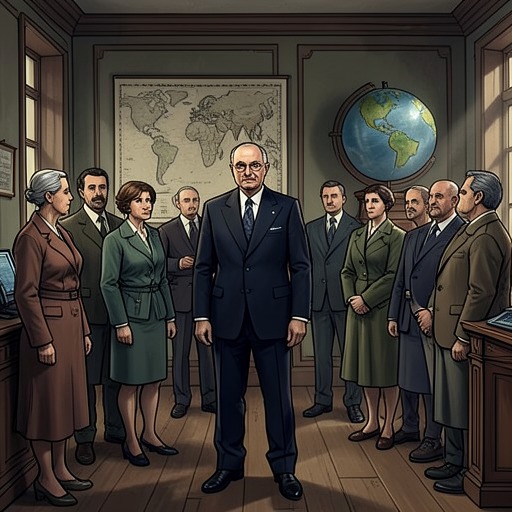
Truman Doctrine speech
TrumanThe Truman Doctrine speech was Harry S. Truman’s March 12, 1947, appeal to a joint session of Congress for aid to Greece and Turkey. Its decisive move was to present assistance not simply as relief for two vulnerable countries but as a commitment to support free peoples resisting coercion. Delivered amid urgent warnings about the reach of Soviet influence, the speech gave that commitment a clear public rationale and made the stakes of congressional action explicit.
The Crisis Behind the Appeal
The case for action took shape in a hurried meeting with congressional leaders before the address. Marshall warned that the United States faced the first in a series of crises that might extend Soviet domination across Europe, the Middle East, and Asia. The choice, he told them, was “acting with energy or losing by default.” Acheson pressed the argument more urgently, describing Greece as a danger that could spread through the region. In Acheson’s later account, Vandenberg offered Truman bipartisan support if he would make the case to Congress forcefully. Truman’s own later account emphasized Marshall’s warning and did not mention Acheson’s contribution or Vandenberg’s response, leaving a difference between the two recollections of how the argument was shaped.
The immediate request concerned Greece, which urgently needed substantial assistance, and Turkey, which had escaped the destruction of the war but also needed American support. Truman presented both as part of a wider problem: the future of political independence in a world where pressure from armed minorities or outside powers could deny a people the freedom to choose its own course. The address thus joined a specific funding decision to a larger claim about the consequences of inaction.
The Argument and Its Delivery
Speaking in the House Chamber before a joint session on Wednesday, March 12, Truman began a few minutes after one o’clock. He read slowly and forcefully from an open notebook. The speech lasted eighteen minutes. Its central distinction was between political systems based on majority rule, representative government, elections, individual liberty, and freedom of speech and religion, and systems in which a minority imposed its will through terror, oppression, controlled media, fixed elections, and suppression of personal freedoms.
Truman argued that the United States should support free peoples resisting subjugation and help them determine their own futures. The primary means, he said, should be economic and financial assistance capable of supporting economic stability and orderly political processes. The speech linked the requested aid to a principle: assistance was meant to strengthen the conditions in which people could govern themselves, rather than to dictate a way of life to them.
The delivery gave the argument a grave, deliberate character. The audience listened in silence as Truman read. John Snyder sat with his head bowed; Acheson sat rigidly with his hands folded; Senator Taft handled his glasses, rubbed his face, and yawned. Behind Truman, Speaker Martin and Vandenberg followed along in printed copies. At the end, Truman warned that the United States was embarking on a serious course, but that failing to lead could endanger world peace and the welfare of the country.
Congressional Stakes and Political Method
The address asked Congress to act on a proposal for $400 million in aid to Greece and Turkey. Truman described the choice as immediate and consequential: failure to assist them, he argued, would have effects reaching beyond the region. The request came against a backdrop of American prosperity—production and incomes were rising, consumer goods had returned to stores, and millions of veterans were attending college under the GI Bill. That contrast made the crisis less a response to domestic collapse than a warning that prosperity did not insulate the country from developments abroad.
The speech also shows Truman working through persuasion rather than relying on presidential authority alone. Before addressing Congress, he gathered its leaders, listened to their arguments, and secured support across party lines in the account Acheson later gave. In the address itself, he set out a choice in terms that lawmakers and the public could understand: aid to countries resisting coercion, or the risk of allowing their position to deteriorate. His later approach to Congress could be stubborn—when lawmakers rejected requests, he asked again rather than changing tactics—but here the appeal rested on a carefully stated argument about both the immediate need and the wider danger.
Significance
The Truman Doctrine speech gave the aid request a broader political meaning. Greece’s emergency and Turkey’s need became examples in an argument about competing forms of government and the right of peoples to shape their own destinies. By describing assistance as primarily economic and financial, Truman presented support not only as a response to danger but as a way to sustain political stability and free institutions.
The speech’s force lay in its passage from regional crisis to national responsibility. It asked Congress to approve a concrete sum, but also asked the country to accept that events beyond its borders could test its leadership and affect the conditions of peace. Truman ended without minimizing the risk: he would not recommend such a serious course, he said, if the alternative were not more serious still.