Atomic bomb under civilian control
TrumanThe Atomic bomb under civilian control became a defining test of Harry S. Truman’s presidency: a weapon developed in extraordinary secrecy, used against Japan, and then kept outside the military’s independent custody. Truman’s position joined constitutional authority to a moral distinction. The bomb might be available as a weapon, he maintained, but its power to destroy cities and kill civilians made its use a decision for civilian leadership—not a matter of routine military control.
A secret project and an uninformed senator
The bomb began as a crash effort to prevent Germany from obtaining a weapon that might decide the war. In a briefing about a vast construction project, Truman said he had heard that it was intended to produce a secret weapon capable of a tremendous explosion, and expressed hope that it would work. Yet that fragment of information did not give him knowledge of the program’s actual scale or costs. When officials explained to three legislators that manufacturing the weapon required an additional $1.6 billion—and requested funds without a traceable account because of the overriding need for secrecy—Truman was not among those informed. The senator who would later oversee investigations of wartime spending was himself excluded from this account.
The project, known as S-1, was the largest scientific-industrial undertaking of its time and among the war’s most closely guarded secrets. The Army Corps of Engineers held overall responsibility, with General Groves in charge. In less than three years, the United States spent $2 billion, while roughly 200,000 people were involved; only a small number understood more than vaguely what the work concerned. Security was so effective that Truman, despite his attention to defense spending, knew little about it, as did senior commanders including MacArthur and Chester W. Nimitz. The contrast was striking: a project involving an immense national mobilization had been designed to keep even prominent officials outside its circle of knowledge.
Truman’s exclusion took place amid an emerging argument about the proper relationship between military authority and civilian government. In 1942, he worried that generals and admirals were gaining influence over industry and agriculture as military contracts expanded. He regarded civilian control of the war effort as a fundamental principle, warning that the issue could shape the country’s political and economic structure after the war. The bomb made that concern immediate and consequential: the authority to command forces and the authority to decide whether to unleash a weapon of city-destroying power could not simply be assumed to belong to the same institutions.
From presidential briefing to recommendation
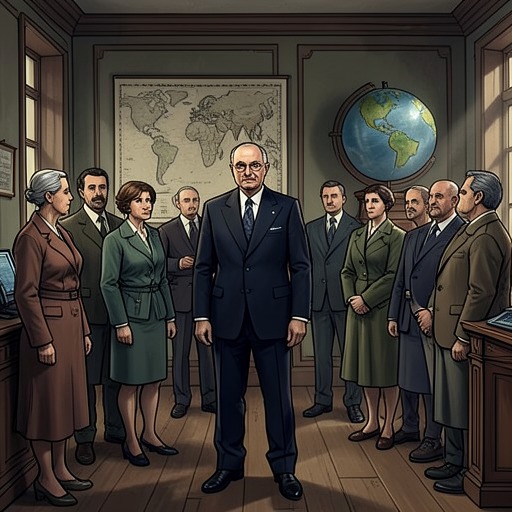
After becoming president, Truman encountered the project not as a senator overseeing its expenditures but as the leader responsible for decisions its completion would make urgent. At an April 23 meeting in the Oval Office, the assembled officials were largely the people Franklin Roosevelt would have called together. Truman had brought no new foreign-policy adviser or Russian expert of his own, and no former Senate associate was present. The meeting’s inherited composition underscored how much of the government he had taken over along with the presidency.
The scale of the prospective weapon was put plainly before him: within four months, the government expected to have completed a bomb capable of destroying an entire city. General Groves then presented a report of about twenty-five pages on the Manhattan Project, which Truman was asked to read. The material moved him from a belated awareness of a secret program to direct responsibility for its consequences, but it did not make the decision simple. Stimson stressed that the committee considering the question could advise; responsibility for recommending action to the president remained his alone.
The advisory process began on May 9, 1945, in Stimson’s office at the Pentagon, with further meetings on May 14 and 18. At a crucial two-day session beginning May 31, four physicists joined the committee: Enrico Fermi, Arthur H. Compton, Ernest O. Lawrence, and J. Robert Oppenheimer, head of the Los Alamos Laboratory where the bomb was being assembled. The committee recommended using the weapon against Japan as soon as possible, without warning, and against war plants surrounded by workers’ homes or other buildings in order to produce a profound psychological impression. These were not merely technical conclusions about a new weapon. They made the expected effect on inhabitants part of the proposed method of employment. The recommendation was advisory; the burden of judgment remained with the president.
Truman’s handwritten order to Stimson authorized use of the bomb against Japan. On August 14, 1945, at 7:00 p.m., he announced Japan’s surrender from his desk in the Oval Office. The two records—the pencilled order and the announcement—mark the weapon’s passage from a secret project into the president’s exercise of wartime authority, and then into the public conclusion of the war with Japan.
Custody, civilian authority, and moral distinction
The question of who would possess the bomb did not end with its wartime use. At a July 21 meeting arranged by Forrestal, an official read a formal request that custody be transferred to the Joint Chiefs. The argument was that those ultimately responsible for using the weapon should possess it, gaining familiarity with it and unifying command. Truman interrupted the reading curtly, saying he could read. Lilienthal answered that the question concerned broad policy: because the president was both Commander in Chief and Chief Magistrate, the bomb should remain the president’s responsibility. Civilian control, in this view, was not an administrative detail but a constitutional boundary.
Truman then stated a position more searching than his earlier descriptions of the bomb as a military weapon like any other. He said it should not be used unless absolutely necessary and characterized it as a means of destroying women, children, and other unarmed people, not simply a weapon for military purposes. His pause and reflective look, as Lilienthal recorded them, accompanied a distinction that changed the terms of the discussion: the bomb could not be treated as equivalent to rifles, cannon, or ordinary weapons. Truman insisted that there were other considerations to weigh and opposed casually moving it among military authorities. Two days later, he told Forrestal that the bomb would remain in civilian custody.
That decision connected an institutional rule to an ethical judgment. The president’s authority did not make the weapon harmless, nor did civilian custody resolve the question of whether using it was justified. Instead, it located responsibility at the highest civilian level and acknowledged that the destructive consequences made ordinary assumptions about military equipment inadequate. The weapon’s physical power sharpened the meaning of oversight: those charged with fighting battles could advise on needs and operations, but they would not independently acquire custody of the instrument capable of destroying a city.
The Korean War and the limit on use
During the Korean War, the distinction between availability and authorization remained visible. Asked at a press conference whether he was considering use of the bomb in Korea, Truman said no, while making clear that he would remain in Washington and at work. In a later exchange, when asked whether consideration of use included the atomic bomb, he acknowledged that its use had always been actively considered. He also said he did not want it used against innocent men, women, and children who had nothing to do with the military aggression. At the same time, he insisted that it was one of the country’s weapons. His position was neither that the option did not exist nor that its existence made use inevitable.
MacArthur urged recognition of a state of war with China and called for thirty to fifty atomic bombs against Manchuria and cities on the Chinese mainland. The Joint Chiefs likewise told Truman that mass destruction of Chinese cities with nuclear weapons was the only way to affect the military situation. The account emphasizes, however, that this course was never seriously adopted. Truman refused to pursue it. A separate discussion concerned a large dam on the Yalu River: after a conventional bomb made only a small mark on the dam, Air Force chief of staff Hoyt Vandenberg reportedly concluded that nuclear weapons would be required to destroy it. Truman refused that option as well.
The dispute over the bomb belonged to a larger conflict about the limits of military command. MacArthur’s public challenge to administration policy disregarded directives and, in Truman’s view, defied presidential orders and United Nations policy. Truman initially chose a restrained reprimand rather than immediately dismissing him, despite anger and concern about public reaction. The confrontation demonstrates why civilian control was not merely a declared principle: it required the president to distinguish military advice from authority to set policy. The bomb made the stakes of that distinction unusually stark, but the same contest over orders and independent military judgment extended beyond nuclear weapons.
Significance
The bomb’s history in Truman’s presidency traces a change in knowledge and responsibility. As a senator, he received only a hint of the secret project and was excluded when legislators were asked to approve concealed funding. As president, he had to absorb reports on a program that had enlisted hundreds of thousands of people and spent billions, then decide how its unprecedented weapon could be governed. The movement from secrecy to presidential decision did not eliminate uncertainty; it concentrated accountability.
Truman’s approach held two claims together: the atomic bomb remained among the nation’s weapons, but its use was not a routine military choice, and its custody should remain civilian. His refusal to authorize nuclear attacks proposed for the Korean conflict gave that distinction practical force after the wartime use against Japan. In this account, the bomb is therefore more than a technical achievement or a symbol of destructive power. It is the object around which questions of constitutional authority, military expertise, civilian vulnerability, and presidential responsibility converge.