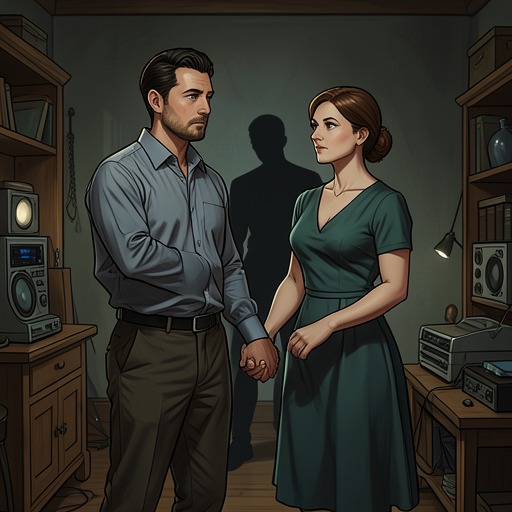
Cam and Lilith
UnforgivenCam and Lilith’s relationship is a love story fractured by Cam’s betrayal and reopened through a supernatural second chance. Their bond reaches back to an ancient engagement, but Cam’s decision to abandon their marriage leaves Lilith with a grief whose consequences Lucifer turns into repeated Hells. In the present, Cam tries to win her love without initially understanding that she does not know why she hates him. Their eventual reunion depends not on erasing the past but on naming his responsibility and choosing one another despite its cost.
An Ancient Love and a Broken Promise
Lilith’s memories recover an earlier life in which she and Cam were engaged. A song brings her a vision of the two of them seated beside a great river, far from the small stream at Rattlesnake Creek. In that remembered scene, Lilith has written a song for Cam; his pleasure in it and the kiss that follows belong to a relationship without resentment or fear. She understands that they had been practicing for a wedding. The vision makes their present connection more than an inexplicable attraction: they had loved one another before, and their shared music reaches across that lost history.
The remembered intimacy is set against Cam’s later account of what went wrong. He admits that he let Lilith go in Canaan, calling it his greatest mistake and ranking it above even joining Lucifer’s ranks. In the marriage preparations, Lilith notices that the parchment places their wedding beside the river, where they first fell in love. She wants to marry in the temple instead, explaining that although she likes the couple’s unconventional approach, she respects the long tradition of marriage. Cam anticipates what she is about to say with dread. The difference between their wishes gives the preparations a tension that the beautiful parchment and its painted scenes of their embraces cannot resolve on their own.
Separation, Grief, and the Hell-Cycle
The separation becomes catastrophic for Lilith. After Cam refuses her, she takes her own life because she loves him. When her memories return in the present, she recognizes that the rumor at Trumbull about the girl Cam had driven to suicide was true: that girl was Lilith. She recalls begging him and laying bare her feelings, only to be rejected. The revelation changes the meaning of her hostility. Her hatred is not an unexplained obstacle to Cam’s courtship; it is bound to a real history of love, rejection, and death.
Lucifer has made that history the organizing principle of Lilith’s torment. Snow globes in Hell represent different Hells he has fashioned for her, and each one plays music associated with her broken heart. When Lilith dies in one of these lives, she returns to the food court and is made to remember Cam’s betrayal before Lucifer sends her into another bespoke Hell. Her current life as a gloomy teenager at school is one more installment in that cycle. Cam recognizes that the globes represent the Hells Lucifer has trapped her in, and that Lilith’s anger is continually renewed by being forced back to the memory of his betrayal.
The Wager and a Second Search
Cam asks Lucifer what it would take to release Lilith and says he will do anything. Lucifer sets a fifteen-day deadline: Cam must cleanse Lilith’s hatred of him and make her truly fall in love with him again. If he succeeds, Lucifer will end the bespoke Hells made for her. The terms make their relationship the wager’s stake, but Lilith does not know the reason for Cam’s effort or the history behind her own anger. Cam must try to repair their bond while she experiences him through the injury he caused, not through the memories he wants her to regain.
Lilith, in another part of her history, is offered a dangerous journey to find Cam. Lucifer warns that he will not pass back that way, making the choice a possible permanent separation from her people. Lilith imagines leaving behind the harvest, well water, and her sisters’ laughter, then accepts the journey. She wants to confront the man she believes has made a mistake and convince him that he will never find a love like hers again. Her willingness to leave what she knows underscores that the bond persists even after abandonment; finding Cam is worth a journey whose return is not promised.
Recognition and Accountability
The relationship’s buried history surfaces during the performance at the Colosseum. As the Four Horsemen finish their song, Lilith sees herself and Cam beside a river in another time, remembers writing for him and sharing a kiss, and recognizes that they had been engaged. The vision soon becomes more painful than romantic: she connects her recovered past to the suicide rumor and confronts Cam with the fact that she died after loving him and being refused. She also identifies Lucifer as the one with whom she made a deal. Recognition joins what had been separated: her present distress, the story Cam has been trying to repair, and the bargain that placed her in Lucifer’s power.
Cam eventually explains his part without shifting the blame onto Lilith. He acknowledges that her wish mattered to her, that he dismissed it so he would not have to tell her what he was, and that he made it seem like her fault. He says he was the one who backed out of their marriage. He had run because he thought she could never forgive him; returning to her in this second chance was an attempt to redeem himself. Most importantly, he recognizes that his love for her is greater than his fear. His confession changes the terms of their reunion: it is no longer only a campaign to win the wager, but an admission of the choice that broke their relationship.
Sacrifice, Mutual Choice, and Redemption
As Hell collapses around them, Cam offers Lucifer a new deal: he will remain in exile and take Lilith’s place as Lucifer’s subject if Lilith is freed. The offer puts his freedom and their continued separation on the line. Lilith resists the exchange, asking why he would sacrifice himself for her; Cam says he would do anything for her. She recognizes that he has changed and that he has given her much during the preceding two weeks. When Cam reaches for her through the smoke, she says she will not let him take her place and that she wants to be wherever he is. She then tells him that she loves him, and he returns the declaration as the stage and the new Colosseum disintegrate around them.
Their reconciliation does not depend on Cam recovering his former appearance. He names letting Lilith go in Canaan as his greatest mistake and losing her love as his deepest regret. Lilith answers that finding his love is her redemption and tells him that his appearance does not determine his beauty to her. Their reunion makes love reciprocal again: Cam accepts the cost of his earlier choices, while Lilith chooses closeness rather than allowing his sacrifice to become another abandonment.
The change also appears in Cam’s wings. Their leathery, charred pieces fall away as new filaments grow, revealing white wings that spread and are restored to their original brilliance. Earlier, angelic wings had come to express the choices and allegiances of fallen angels: Lucifer’s followers bore gold, while those who had returned to Heaven carried silver. Cam’s restored white wings mark a different return, tied here to the end of his betrayal and to Lilith’s acceptance of him. Their relationship thus joins memory and consequence: the old love explains the force of their bond, but the second chance becomes meaningful only when Cam acknowledges the harm he caused and both choose a future together.