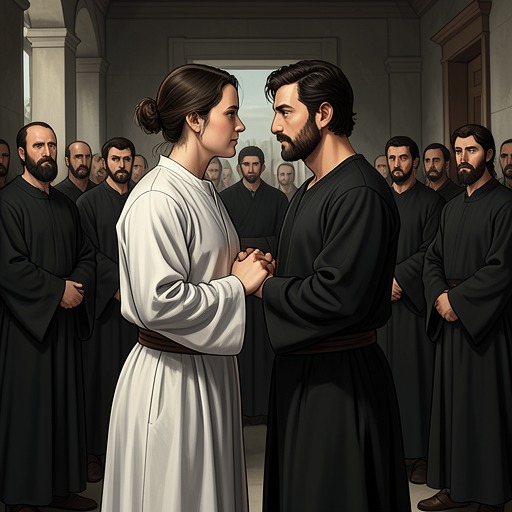
Cam and Lilith rebuild trust and love
UnforgivenCam and Lilith rebuild trust and love across lives, but their reunion is not a simple return to an earlier romance. Their history includes a swift courtship in ancient Canaan, a marriage broken by Cam’s concealed identity, and a later relationship in Crossroads where Lilith cannot remember the past that makes her hate him. Lucifer exploits that imbalance, turning their shared history into a repeating punishment. Cam’s efforts to approach Lilith again therefore require more than declarations: he must confront the harm behind her anger, while she gradually discovers feelings whose origins she cannot yet explain.
An ancient love and its concealed obstacle
Around 1000 BCE, Cam and Lilith were already in love in Canaan. Their courtship had been swift and passionate, and Lilith looked forward to marrying him after the harvest. At a village gathering, she picked up her lyre while Roland played flute for the assembled young people. The concert had been her idea, a demonstration of her love; iris blossoms decorated the canopy she and her sisters had woven that afternoon. Their shared music and the community’s expectation of their future make the later rupture more than a private disagreement: the wedding they imagine is the culmination of a life together.
Their plans falter over where to marry. Cam proposes a ceremony beside the river, the place where they fell in love, but Lilith wants a temple wedding because she respects the tradition it represents. Cam cannot enter consecrated ground: he is a fallen angel, and he has not told her. The sanctuary rule gives his secrecy an immediate practical consequence, yet the deeper obstacle is his fear that Lilith will think less of him if she knows what he is. Rather than trust her with the truth, he tries to steer her away from the temple without explaining why. When she asks what secret he bears, he still cannot answer.
Cam ends the wedding and the relationship instead. Though he loves Lilith, he decides they must separate, and the narration makes clear that he hears the angry words he needs in order to carry out his decision, not simply the words she says. Lilith tells him that he is breaking her heart. This moment becomes the betrayal that defines their later separation: Cam’s silence and departure leave Lilith with the injury, while his inability to speak honestly hardens into the history Lucifer will repeatedly use against him.
A reunion inside Lucifer’s cycle
In Lilith’s current Hell, she lives as a teenager in Crossroads without knowing why Cam matters to her. Lucifer explains that each time she dies in one of the Hells he has designed, she returns to a food court where she is reminded of Cam’s betrayal, then is sent into another bespoke torment. Her anger is made to endure even as the setting changes. The arrangement makes their relationship radically unequal at first: Cam remembers their love and the cause of its destruction, while Lilith experiences him through the resentment Lucifer has kept alive.
Lucifer offers Cam a wager with fifteen days remaining before Lilith’s current Hell expires. If Cam can remove her hatred and make her truly fall in love with him again, Lucifer will stop creating Hells for her. Cam accepts a challenge that asks him to repair a relationship under deliberately hostile conditions. Lucifer’s wager also makes the stakes explicit: Cam is not merely pursuing affection, but trying to end the cycle in which Lilith repeatedly suffers for his betrayal.
Cam’s gestures in Crossroads are tender but uncertain. He leaves Lilith a note on an antique desk he has taken from Chloe King’s family attic, along with irises he knows were her old favorite. From above, he watches her touch the paper, smell the flowers, and begin writing a song in her notebook. Her return to music is the response he hoped for, but Cam understands that a peaceful moment is not trust restored. Lucifer keeps intervening to make Lilith despise him, and the progress Cam gains can be undone. Even when band practice goes well, he expects the cycle of provocation to begin again.
His care is also measured by restraint. Cam tears up an early draft asking Lilith to prom because she backs away when he comes on too strongly. He decides to ask her in person and worries that even the word love in his note may have frightened her. This caution contrasts with the intensity of their ancient courtship: the Cam who once expected marriage must now learn to give Lilith room to choose whether she wants him near.
Recognition before memory
Lilith’s attraction develops before she can explain it. After Cam supports her songwriting, she considers the conflicting parts of his character: he can be forward and push her buttons, and he has done things he should not have done, but he also surprises her, makes her laugh, and cares about her brother. His presence unsettles her physically, yet the feeling is welcome. At the celebration of her songwriting success, she realizes that she is falling in love with him. The shift matters because it is her own recognition, not a recovered memory or a bargain imposed by Lucifer.
A later private prom gives that attraction space to become mutual intimacy. Cam tells Lilith that he respects her choice not to need a date for the Battle of the Bands, then explains that he has brought the prom to her instead. He also addresses the rumor that he and Lucifer had discussed her: the conversation, he says, was about how much he liked her and his wish to have a chance with her. Lilith finds that the truth of wanting to kiss him matters more than the rumors. As they dance, Cam leads carefully, and their movements feel instinctive to both of them. The physical ease evokes their earlier dance in Canaan, though Lilith does not yet have that history available to her.
Their first kiss in this renewed courtship is a decisive crossing from possibility into shared action. Cam kisses Lilith, and she kisses him back; the narration emphasizes that she has never kissed anyone this way before. Later, dancing together again, Cam tells her that he loves her, but the music obscures his words. He pulls her back into his arms and changes what he was about to say to praise for her dancing. The almost-confession reveals how much of their renewed closeness still depends on timing: Cam is carrying a history Lilith cannot yet hear, and he is unwilling to force its meaning on her.
Shared song, recovered history, and sacrifice
Music finally makes the buried past perceptible. During a performance, Lilith wonders why it feels as though she and Cam have sung the song together before. A vision places them beside a great river in another time: she has written a song for him, wants him to like it, and remembers their kiss without strain, resentment, or fear. She understands that they had been preparing for a wedding. The scene joins the present couple to the Canaan pair not through explanation alone but through repeated acts—songwriting, performance, and a kiss—that let emotional recognition arrive before a complete account of the past.
The vision sharpens into painful memory. Lilith sees herself in a different gown and speaks words in a language she has not learned in her current life but somehow understands. She recalls having traveled a long way to find Cam and still loving him, and asks him to come back to her. His refusal reconnects the remembered plea to the original abandonment. The returning past does not erase the injury; it reveals why the current attraction and anger have both carried a force Lilith could not account for.
When Lucifer’s stage shakes and the crater’s edge approaches, Cam offers a new bargain: he will remain in exile and take Lilith’s place as Lucifer’s subject if Lilith is set free. Lilith grabs his jacket and asks why he would sacrifice himself for her. Cam answers that he would do anything for her, and she does not pull away when he reaches for her hand. His proposal reverses the old pattern of concealment and departure. At the river, he had ended their future rather than tell her the truth; now he makes himself the one who would bear the cost of her freedom.
Cam’s wings then begin to change: charred, leathery pieces fall away as new filaments grow, revealing white wings beneath and restoring their original brightness. The transformation recalls the significance of angelic wings, which express an angel’s choices and allegiance, and gives the relationship’s ending a visible counterpart in Cam’s change. Their bond has moved from love damaged by secrecy, through a courtship conducted under Lucifer’s interference, to a reunion grounded in remembered history and Cam’s willingness to accept suffering in Lilith’s place.