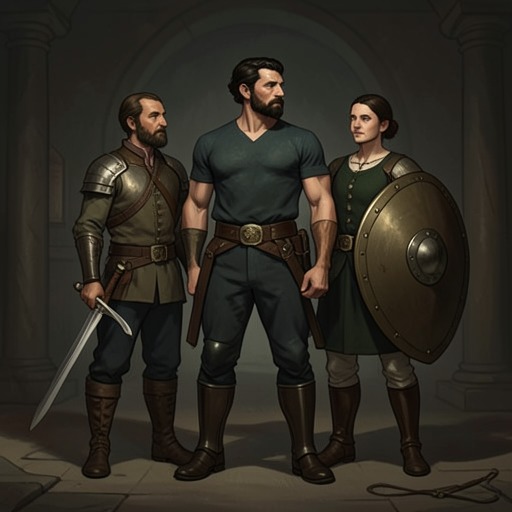
Cam—Roland
UnforgivenCam and Roland’s friendship is grounded in easy physical affection and a shared conversation about whether those marked by past mistakes can still hope for happiness. When they meet in a desanctified chapel, Roland embraces Cam; later, he argues that love and the possibility of another chance are not reserved for Lucinda and Daniel. Cam’s refusal to believe that happiness is possible for him sets their outlooks in opposition without undoing their evident closeness.
Reunion in the Chapel
The friendship comes into view when Cam drops through the chapel’s broken window and lands behind Roland and Arriane. The chapel has been desanctified, so fallen angels can enter without triggering the destruction that would follow their crossing into a sanctuary of God. The setting therefore makes their gathering possible, while the broken window gives Cam’s arrival a sudden, physical quality.
Roland greets Cam with an embrace. Cam tells him to take it easy, but does not pull away: the small exchange conveys familiarity and affection without turning the reunion into a formal declaration. Roland then remarks on the coincidence of finding Cam there. The moment leaves open whether Cam’s presence is truly unexpected, but establishes that Roland is attentive to his friend’s arrival.
An Argument About Hope
Their friendship also makes room for disagreement. In the chapel, Roland speaks for the possibility that people can learn from their mistakes and still deserve happiness. He extends that hope beyond Lucinda and Daniel, insisting that love is not theirs alone and that others may experience it again. His optimism is collective: he includes himself, Cam, and Arriane among those who have loved before and might do so again.
Cam answers with withdrawal rather than argument, looking through the shattered window and saying that perhaps he is not the kind of person who can find that happiness. When Roland’s confidence strikes a dissonant chord, Cam is more definite: not him. The contrast reveals a limit in their companionship—not a rupture, but a difference in what each can believe about the future. Roland offers Cam a generous interpretation of their shared past; Cam cannot yet accept it for himself.
Mistakes, Love, and Cam’s Later Choices
The exchange matters against the later course of Cam’s story. Cam’s betrayal of Lilith is the wound around which Lucifer has built her recurring Hells, returning her after each death to the place where she must remember that betrayal. Lucifer then proposes a fifteen-day wager: if Cam can overcome Lilith’s hatred and make her fall in love with him again, Lucifer will end the bespoke Hells. The wager makes the question raised in the chapel painfully specific: whether a person responsible for harm can do more than live with the mistake.
Near the end, Cam offers a new bargain, proposing to remain in exile and take Lilith’s place in Hell if Lucifer will free her. This choice does not establish that Roland’s words caused Cam’s change, nor does the story show Roland present for the offer. It does, however, give dramatic force to the hope Roland voiced: Cam’s actions move beyond his earlier insistence that happiness is not for him, toward accepting responsibility through sacrifice. His wings later recover their original white appearance, another visible change in Cam’s story, though not a direct sign of what Roland thinks or does.
Significance and Limits
Roland’s role in the relationship is clearest as a friend who meets Cam with affection and refuses to treat past errors as proof that happiness is impossible. Cam’s resistance keeps the scene from resolving their difference too neatly: Roland can offer hope, but he cannot make Cam believe it. Their exchange supplies a human scale for the story’s larger themes of love, culpability, and redemption, while the later consequences of Cam’s choices deepen—without erasing—the disagreement first voiced in the chapel.