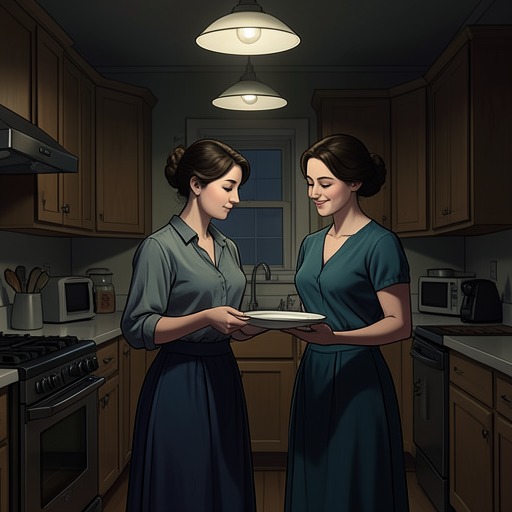
Lilith and Mrs. Foscor’s improving mother-daughter bond
UnforgivenLilith and Mrs. Foscor’s improving mother-daughter bond is shown through concrete gestures rather than a single reconciliation: groceries that prompt an unprecedented hug, money entrusted to Lilith for an outing with Bruce, and a mother who ultimately agrees to join her daughter at prom. Their connection remains shaped by things left unsaid, but by the performance night Mrs. Foscor is not only praising Lilith; she is preparing to enter a part of Lilith’s life from which she might once have felt excluded.
Material care and guarded trust
When Mrs. Foscor discovers the groceries Lilith has stocked in the family fridge, she questions her daughter about where they came from. Lilith hides the story of Cam and explains that she has been giving guitar lessons to a schoolchild for extra money. The account is a lie, but it also marks a real change in Lilith’s role at home: she has brought food into the household, and her mother responds with genuine surprise before hugging her. The embrace is unprecedented enough that Lilith, startled, lets it linger.
That moment does not immediately produce a full disclosure between them. Lilith keeps Cam’s part in the groceries secret, and later conceals a white gown in her closet when her mother knocks at her bedroom door. The difference between what Lilith shares and what she withholds gives the relationship its particular tension: care is becoming visible, while parts of her private life remain protected. The hug matters not because it resolves that distance, but because it interrupts it with physical affection.
A couple of days after finding the groceries, Mrs. Foscor offers Lilith a twenty-dollar bill. She explains that she has a little extra that week because Lilith took care of the groceries, calls the money an allowance, and tells her daughter that her generosity mattered. The payment is modest, but it answers Lilith’s unasked-for contribution with recognition rather than suspicion alone. It also turns the groceries into more than a secret act of household support: Mrs. Foscor acknowledges what Lilith has done and gives something back.
Money, Bruce, and a shared outing
The practical meaning of that recognition becomes clear when Lilith travels with Bruce. Before leading him away from the bus, she checks that she still has the cash her mother gave her. Lilith is nervous because she wants the outing to be special and wants Bruce to remember the surprise; she has even covered his eyes so he will not peek. Mrs. Foscor’s money therefore enters the scene not as an abstract sign of approval but as support for time Lilith is arranging with her younger brother.
The sequence connects household care to sibling care. Lilith had supplied groceries, and her mother had responded by giving her money and explicitly encouraging her to take Bruce and have fun. The surviving account does not establish what the surprise is or how the outing ends, but it does show Mrs. Foscor making room for Lilith to use the money for someone else. Her response treats Lilith as capable of generosity and gives that generosity a small, practical means of expression.
Introducing Cam to the family
Later, Lilith asks Cam if she can properly introduce him to her mother. She explains that Mrs. Foscor is old-fashioned and that the introduction would mean a lot to her. The request makes the family relationship consequential to Lilith’s romance: she does not want Cam to remain only a concealed part of her life. Cam agrees, although his easy claim that mothers love him is a lie; he knows mothers of teenage girls can recognize the bad boy in him, but says he would do anything for Lilith.
When Mrs. Foscor appears in a worn pink robe, Cam greets her formally and identifies himself as the boy she once encountered while taking Bruce to the hospital. He thanks her for raising a remarkable daughter. The reminder of the hospital links their meeting to a previous moment of family vulnerability, while his praise places Lilith’s worth plainly before her mother. Mrs. Foscor laughs and says that whatever Cam likes in Lilith is probably her rebelling against her; then she adds that Lilith does look beautiful. The teasing qualification and the compliment arrive together, making the praise affectionate without pretending that mother and daughter are alike or free of friction.
Cam answers that Lilith is the stuff of love songs. When he looks at her, he sees that her eyes are damp and understands how rare praise from her mother must have been. Lilith then embraces Mrs. Foscor, followed by Bruce. The sequence gives the compliment a bodily consequence: rather than answering only with words, Lilith closes the distance between them. Her tears register the weight of the moment as Cam perceives it, while the embrace makes her response unmistakable.
From private approval to public support
The exchange continues when Cam asks Mrs. Foscor whether she wants to see Lilith perform. Mrs. Foscor first assumes that she and Bruce would only embarrass Lilith. Lilith contradicts that assumption and asks her mother to come. Her hesitation shifts to a practical question about whether nonstudents can attend prom, but the important change is already clear: Lilith wants her family present for the performance, not kept outside it.
Mrs. Foscor accepts the invitation. She says she will get dressed and tells Bruce to do the same. Her agreement turns earlier private gestures—the hug, the allowance, the invitation to take Bruce out—into participation in a public occasion important to Lilith. The account does not suggest that every secret has been confessed or every difficulty settled. Instead, the bond is represented as a series of increasingly direct acts: Lilith provides for the family, her mother recognizes her, and, when asked to enter her daughter’s world, Mrs. Foscor chooses to go.