Emma's manuscript, PAAZ
UpEmma’s manuscript, PAAZ, turns her psychiatric admission into a work of recollection and self-examination, but its creation does not follow a simple path from suffering to recovery. The manuscript waits in a laptop hidden in a cupboard, becomes difficult to continue in the room where Emma is living, and is eventually named during a conversation with Dokter Visser. Its emergence gives form to memories and feelings without suggesting that either the illness or the life being written about has reached a tidy conclusion.
Form and Materials
For a time, the manuscript exists as a black, rectangular laptop at the bottom of Emma’s cupboard. When she takes it out and sets it on her desk, she recognizes the same object but notices that it is colder and dustier. Those small signs register how long the writing has been set aside: the work has not disappeared, but it has been left untouched along with the machine that contains it.
Emma opens the document and sees sentences made from thoughts that recall events and try to explore the feelings attached to them. The description presents the manuscript as more than a record of what happened during her admission. Remembering and interpreting are joined in the act of writing: events return, while their emotional meaning remains something to be investigated. The document therefore holds both a sequence of past experiences and Emma’s continuing effort to understand them.
That effort matters in a narrative where mental states can be difficult to explain from the outside. Emma struggles to convey to a psychiatrist the sudden lifting of an internal fog and the sense that the world has become newly visible. Elsewhere, depression appears as an engulfing memory and as a condition that erases the sense of time. These passages do not establish that each experience is written into the manuscript; they show the kind of difficult-to-communicate inner life that the book’s stated purpose—recalling events and exploring their associated feelings—must make room for.
Subject and Scope
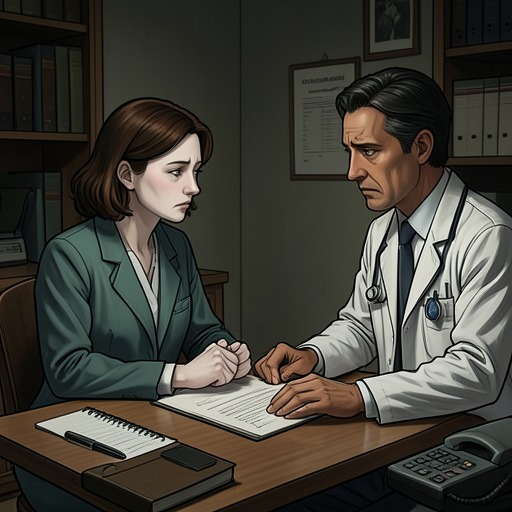
The manuscript concerns Emma’s admission to PAAZ. In a later conversation, Dokter Visser reveals that Lars has written in Emma’s file that she is working on an account of her hospitalization. Emma has not previously discussed the project with Dokter Visser. The information arrives through a clinical record, an institutional document that makes the private project visible to the psychiatrist before Emma has chosen to tell her about it herself.
Emma’s first response is guarded. She recognizes that writing about her first admission also means writing about Dokter Visser, whose position as doctor has made closeness and distance difficult to negotiate. The manuscript’s subject is thus not only a period spent in a psychiatric unit. It touches the relationship between patient and psychiatrist, and the unequal roles through which they have tried to approach one another. The book brings that relationship into view without erasing the boundary that shaped it.
At the same time, the scope Emma gives the project is concrete: it concerns five months spent in a faded, forgotten building, during which she searched for a way out that would not lead inward. That description makes escape itself complicated. The building is the immediate setting of the remembered admission, but the search is also entangled with Emma’s own mind and with what she is trying to face. The manuscript takes its material from a real period and place in her life, while its account of that period reaches beyond a simple story of leaving a building.
Returning to the Document
When Emma finds the laptop again, she feels the impulse to write—to make something, to set something down. She recognizes that she is permitted to do it, able to do it, and wants to do it. The sequence is emphatic, but wanting does not immediately produce a page. Her fingers remain tense on the keyboard, as if caught in an inner struggle she cannot identify.
The obstacle becomes clearer as Emma looks around the small, shabby room that has been her home for five weeks. She wants to write, but not there, and admits that she already knew it. The stalled attempt is therefore not evidence that the project has lost its importance: Emma has recovered the desire to work, yet the immediate surroundings do not allow that desire to become action. The room’s closeness contrasts with the expansive work she is trying to undertake—revisiting an admission and giving shape to the feelings attached to it.
After acknowledging this, Emma turns to her mobile phone and finds Sergei’s number with reassuring ease. The scene does not say that Sergei solves the writing problem or that the manuscript is completed through his intervention. Instead, it places the failed attempt beside a familiar act of reaching out. The document remains unfinished in that moment, but Emma is no longer merely avoiding it: she has opened it, scrolled to its end, and discovered both the wish to continue and the conditions that are holding her back.
Naming the Book
In a later exchange, Dokter Visser asks Emma how the book is going. Emma says that it is nearly finished. When asked whether it has a title, she is surprised by the question and begins to laugh. Until then, the work has been a document on her computer, associated with memories of a hospital stay. A title would make it something more definite: in Emma’s words, it would make the project real.
She looks through the window toward the outline of the new PAAZ and considers that perhaps she is ready for this. The view connects the remembered, faded building with a new one visible from where she is now. Emma also speaks of going home and returning to the real world, while wondering whether things are ready to become real in a fuller sense. Her decision to call the manuscript PAAZ is made in this unsettled passage between recollection and departure, not as a declaration that the past has been resolved.
The choice is plain and encompassing. Rather than offering a separate explanatory title, Emma uses the name of the institution that frames the experience she is trying to write. The title turns the setting into the book’s identifying word, while the conversation makes clear that the manuscript also concerns the people and inner life bound up with that place. Emma’s work is almost complete, but the act of naming it marks a further step: the private file is becoming an acknowledged account that can be discussed with Dokter Visser.
Narrative Significance
The manuscript gives the novel a second movement of memory within Emma’s life: she is not only living through psychiatric treatment but also trying to make a record of an earlier admission. Its progress is uneven. The laptop can be hidden, recovered, opened, and left at the keyboard without a word being added; later, the near-finished book can still lack a title. These are not interchangeable stages of a smooth recovery. Each makes a different part of the work visible—its material survival, Emma’s renewed desire, the practical difficulty of writing, and the decision to let the project take a name.
The book’s importance also lies in the distinction between being understood and being able to tell. Emma’s descriptions of mental experience resist easy explanation, while the manuscript offers a way to revisit events and explore their associated feelings. Yet writing does not promise to settle every feeling or remove the possibility that things will worsen again. Emma’s request that Sergei let her go, and her recognition that her life includes being a patient as well as a person responsible for herself, place the writing within a continuing struggle over how her experience is seen. PAAZ is consequently both a work about admission and an act of authorship: Emma takes the material of a period organized by illness and care and attempts to shape it in her own words.