Emma's unfinished manuscript
UpEmma's unfinished manuscript becomes a test of whether she can keep working and claim authority over her own experience while her mental state is unsettled. The book appears not as a completed account with a known subject or outcome, but through brief scenes of attempted work: a computer left unused, text on a screen, a question about the writer's legitimacy, and finally a laptop shut in frustration. Its unfinished state matters because Emma's ability to write is bound up with her changing sense of what is real, what can be told, and who gets to describe her life.
Identity and emergence
The manuscript first enters the story indirectly, when Sandra asks Emma where her computer is and recalls that she had been working on a text. Emma says she does not know and that she cannot manage it for the moment. Instead, she turns toward the mood forms she still has to complete for Rajid. The contrast is concrete: the creative work has stalled, while the clinical paperwork remains in front of her as an immediate obligation.
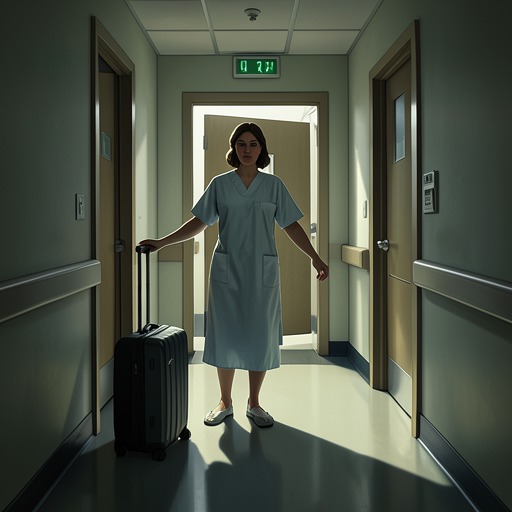
This interruption occurs on a Saturday, when the PAAZ is nearly empty because the other patients have weekend leave. Emma remains there because Rajid considers it safer to monitor her heart rate and blood pressure while the side effects diminish. The setting makes the computer's absence more than a matter of not getting to work: Emma is under observation, physically unwell, and asked to record her state in forms even as the text she had been writing becomes inaccessible. The evidence does not disclose the manuscript's full subject or form, so its importance lies in these scenes of attempted continuation and withdrawal rather than in any known finished content.
Work and the patient identity
Later, a visitor preparing a child for an appointment with the psychiatrist notices Emma's computer and asks what she is doing. She starts to say that she is working, then cannot sustain the answer. The exchange recalls the way other patients have described her: while they are ill, she keeps working. Emma herself now questions whether continuing to work was such a good idea. What had been visible to others as persistence no longer feels like secure evidence of competence or recovery.
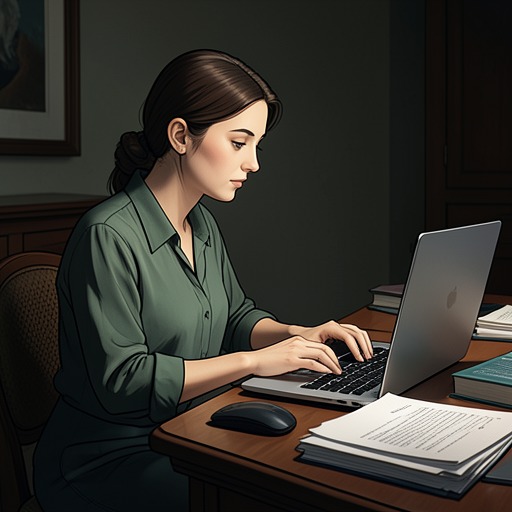
After the visitors leave, Emma breaks down at the keyboard. She thinks of the strain on her family and Sergei, recognizes that she can no longer work, and feels that everything is falling away. Yet she also reaches for the identity the PAAZ offers: if she cannot work and no longer knows what she is doing, then she can simply be a patient. The manuscript is caught inside this shift. It is a task she has tried to keep doing, but her return to the role of patient supplies a different way to understand her inability to continue.
The question of truth
As the group enters the lounge, Emma sees the final sentence she has written on the screen. It takes the form of a question about who she is to write the book. The thought expands beyond artistic confidence. Back on the PAAZ, she feels lost in the world and in herself; she doubts her ability to describe truth when she cannot distinguish delusion from reality and when she believes that even therapists no longer believe her. Her uncertainty about writing is therefore inseparable from uncertainty about being believed.
The scenes around this crisis give that doubt a wider context without resolving it. Earlier, Emma tries to convey to a psychiatrist how the lifting of an apparently endless mental fog changes what the world seems to be, but she offers a simple report of feeling well and clear. Elsewhere, a depressive memory returns despite her effort not to remember, and she describes herself as reduced to fragments held in a downward pull. These moments do not establish what the manuscript contains; they show the difficulty of making an account when experience can feel vivid, fragmented, or impossible to communicate. The written question exposes that difficulty rather than answering it.
Interruption and significance
Emma's work is also set against her changing experience of time. She reflects that mania fixes attention on an all-consuming present, while depression lets the past swallow the future until time itself seems to disappear. Read beside the stalled manuscript, this contrast clarifies why sustained writing may become difficult: the act of shaping experience into a continuing account meets states in which continuity and perspective are themselves under pressure. This is an interpretive connection, not a claim about the manuscript's undisclosed contents.
After the question appears, Emma stares at the screen, murmurs that the book is dead, and closes the laptop with a bang. The gesture gives the manuscript its clearest ending in the available scenes, but not a resolution: the book is declared dead in a moment of acute doubt, and no completed work follows here. Its significance lies in that unresolved collision between writing and illness. Emma wants to describe experience, yet fears that instability disqualifies her from telling the truth; the closed computer makes that fear visible without settling whether she can return to the work.